
Backlinks in 2026: Quality, Relevance, and Nothing Else
For two decades, the conversation about backlinks has been a conversation about counting. How many links does the page have? How many referring domains? How big is the gap between us and the competitor on the next result? Whole industries grew up around manufacturing those numbers, and whole budgets were spent making them go up. In 2026, that conversation is mostly over. The number of links pointing at a page tells you very little about whether it will rank. Two things tell you almost everything: are the links genuinely high quality, and are they genuinely relevant. Everything else is noise dressed up as a metric.
This is not a softening of the rules. It is the rules finally being enforced. Search engines spent years getting better at ignoring links they decided were manipulative, low quality, or off-topic, and they have now got good enough at it that the old volume game produces almost nothing. A page with four hundred links can sit below a page with twelve, because the twelve are relevant and trusted and the four hundred are not. If you are still building a link strategy around totals, you are optimising a metric that the search engine has stopped reading. This article is a practical guide to the strategy that replaces it.
What a backlink actually is — and what it signals
Strip away the jargon and a backlink is one thing: another website's editorial decision to point its readers at your page. That is the whole mechanism. When a site links to you, it is spending a small amount of its own credibility to say "this page is worth your attention." Search engines treat that as a vote, because in its honest form it is one — a human being who runs a website looked at your content and judged it good enough to send their audience to.
Understanding that the link is fundamentally a vote of confidence from a real publisher explains everything that follows. It explains why a link from a respected industry site matters more than a link from a directory nobody reads: one vote comes from a voter with standing, the other from a voter with none. It explains why a relevant link matters more than an irrelevant one: a vote from someone who actually works in your field carries weight that a vote from a random unrelated site does not. And it explains why bought and manufactured links are worthless or worse: a vote that was paid for is not a vote of confidence at all, and search engines have become very good at spotting the difference.
So when we say backlinks in 2026 come down to quality and relevance, we are not inventing two arbitrary tests. We are describing the two questions that determine whether a link is a real vote or a fake one. Quality asks: does the voter have standing? Relevance asks: does the voter's opinion apply to your subject? A link that passes both is a real endorsement. A link that fails either is, at best, ignored.
Quality: what makes one link worth more than another
Quality is the harder of the two ideas to pin down, because there is no single public number for it. But it is not mysterious. A high-quality backlink tends to have several recognisable characteristics, and you can assess them without any tool at all.
The first is that the linking site is itself trusted. It has a real audience, a track record, and an editorial standard. People in your field have heard of it. It does not link to everyone — its links are selective, which is exactly what makes them valuable. The second characteristic is that the link is editorial, meaning a human chose to place it inside real content because it genuinely helped the reader, not because money or a reciprocal favour changed hands. The third is placement and context: a link inside the body of a relevant article, surrounded by text that explains why it is there, is worth far more than a link buried in a footer, a sidebar, or a list of two hundred outbound links.
There is a simple test that captures most of this. Ask: would this link still be valuable to me if search engines did not exist? If a respected industry publication mentions your research in an article their audience actually reads, that link sends you real visitors and real credibility regardless of any ranking effect. It would be worth having in a world with no Google. A link from a spammy directory fails that test instantly — nobody reads it, it sends no one, it exists only to game a ranking. The links that pass the no-search-engine test are, almost without exception, the same links search engines reward. That alignment is not a coincidence. It is the whole design.
Relevance: the test most link builders still skip
Relevance is the easier idea and, strangely, the more neglected one. A relevant backlink comes from a site whose subject genuinely overlaps with yours. If you sell project management software, a link from a site about productivity, software, business operations, or team management is relevant. A link from a site about garden furniture is not — even if that garden furniture site is large and trusted.
For years, link builders treated relevance as a nice-to-have and quality as the real prize, chasing links from any large site they could reach regardless of topic. That ordering is now backwards. A search engine reads the topic of a linking site as part of the signal: a link from a site about your subject says "an expert in this exact field endorses this page," and a link from an unrelated site says, at best, "someone endorsed this page" with no expertise attached. The first is a strong, specific vote. The second is weak and easy to discount.
Relevance also operates at the page level, not just the site level. A link from a single on-topic article on an otherwise unrelated site still carries meaning, because the immediate context — the surrounding paragraphs, the article's subject — is relevant even if the wider site is not. The practical rule is to think about relevance every single time you consider a link, and to weight it at least as heavily as quality. A relevant link from a medium-sized trusted site usually does more for you than a higher-profile link from a site with no topical connection to what you do.
The two-axis map: where every link falls
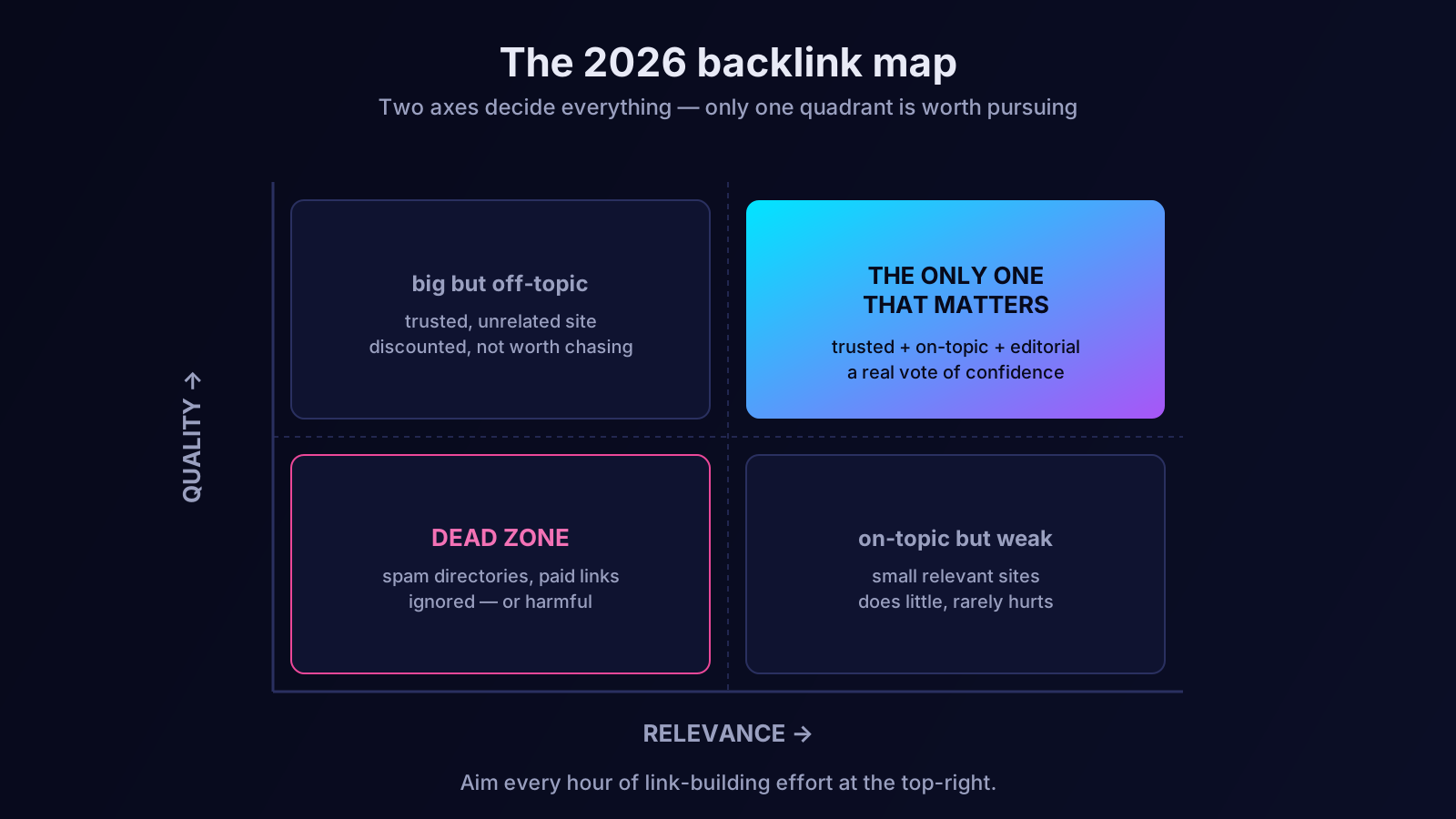
Put quality on one axis and relevance on the other and every backlink you could ever earn lands in one of four quadrants. This map is the most useful mental model for link strategy in 2026, because it tells you instantly which links to pursue and which to forget.
High quality, high relevance. This is the only quadrant that matters. A trusted, well-known site in your field links to your page from inside real content. This link is a strong, specific vote of confidence, it sends you real referral traffic, and it lifts your rankings. Every hour of link-building effort should be aimed here.
High quality, low relevance. A large, trusted site with no topical connection to your subject links to you. This is not harmful, but it does far less than its size suggests, because the search engine discounts the endorsement of a site that has no expertise in your field. Pleasant if it happens; not worth chasing.
Low quality, high relevance. A small, on-topic site links to you. The relevance is real but the site has little standing of its own to lend. These links do little, though they rarely hurt. They accumulate naturally as a by-product of doing good work; you do not build a strategy around them.
Low quality, low relevance. Spammy directories, link farms, paid placements, irrelevant sites with no audience. This quadrant ranges from useless to actively dangerous. Links here are at best ignored and at worst flagged as part of a manipulative pattern. The correct strategy for this quadrant is to never enter it.
The map clarifies the whole discipline. Most of what was sold as "link building" for two decades produced links in the bottom quadrants — high volume, low quality, low relevance. The strategy for 2026 is to pursue the top-right quadrant exclusively and to accept that this means fewer links, earned more slowly, with more effort each. That is not a downgrade. It is the only version of link building that still works.
How to earn links that pass both tests
If the only links worth having are trusted and relevant, and if those links are by definition editorial — placed because a publisher chose to — then link building stops being an outreach numbers game and becomes a question of giving publishers something genuinely worth linking to. There are a handful of reliable ways to do that.
The first is original research and data. When you publish a study, a survey, a benchmark, or an analysis that contains information available nowhere else, you create something other writers in your field need to cite. A writer covering your topic who wants to reference a real figure has to link to the source — and you are the source. This is the single most dependable way to earn high-quality, relevant links, because it makes linking to you the path of least resistance for other people doing their jobs.
The second is genuine expertise made visible. Definitive guides, frameworks, explanations that are clearer and more complete than anything else on the subject — these become reference points. Other writers link to the best available explanation of a concept so they do not have to write it themselves. If your page is that explanation, you collect links over years without further effort.
The third is real relationships and real participation in your field — contributing genuine expertise to other publications, being a source journalists can quote, taking part in the industry conversation as a knowledgeable participant rather than a link beggar. The fourth is simply being notable: building a product, a body of work, or a point of view that people in your field have reason to mention. Our guide to earning links through digital PR goes deeper on the outreach side of this, and the principle running through all of it is the same — you do not extract links, you create reasons for links to exist.
What no longer works — and why
It is worth being blunt about the tactics that the quality-and-relevance standard has retired, because some of them are still sold and still bought.
Buying links does not work, and the cost is not just wasted money — it is risk, because manufactured paid-link patterns are exactly what search engines have trained themselves to detect. Mass directory submissions do not work; those directories have no quality and no relevance, so their links sit in the dead quadrant. Low-quality guest posting at volume — the same thin article placed on dozens of unrelated sites that exist mainly to host paid posts — does not work, because neither quality nor relevance is present. Link exchanges at scale do not work, because reciprocal patterns are easy to spot and the underlying links are not editorial votes. Comment and forum spam does not work and never really did.
The common thread is that all of these tactics try to manufacture the appearance of a vote of confidence without the substance of one. They were built for an era when search engines counted links and could not yet judge them well. That era is over. A tactic that produces links failing the quality test, the relevance test, or the no-search-engine test is a tactic producing links the search engine will ignore — and you cannot build a result on links that are not being read.
How to audit the links you already have
Strategy is not only about the links you earn next; it is also about understanding the links you already carry. An honest audit sorts your existing backlink profile into the same four quadrants. Most sites with any history find that the large majority of their links are low quality, low relevance, or both — the residue of old tactics, automatic directory listings, scraper sites, and link schemes a previous agency may have run. That is normal and usually not a crisis.
The judgement call is whether any of those links form a pattern severe enough to be a liability. A scattering of junk links accumulated naturally is something search engines expect and discount on their own; you do not need to act on it. A concentrated pattern of obviously paid or schemed links is a different matter, and in clear cases the disavow tool exists to formally tell the search engine to ignore them. But disavow is a precision instrument, not a routine cleanup, and over-using it can remove links that were doing you good. The more useful output of an audit is strategic clarity: it shows you how many genuinely top-quadrant links you actually have, which is almost always fewer than you assumed, and that honest count tells you how much real work the strategy ahead requires.
Backlinks are one signal, not the whole game
A final piece of perspective. Backlinks remain a meaningful ranking signal in 2026, but they are one input among several, and their weight is easy to overstate. A page with excellent links and weak content, a poor match to search intent, or a bad reading experience will not rank on links alone. Links amplify a page that already deserves to rank; they do not rescue one that does not.
This is why link strategy should never be a separate department from content strategy. The same work that earns links — original research, genuine expertise, definitive explanations — is the work that makes a page worth ranking in the first place. A strong internal linking system then distributes the authority those external links bring across the rest of your site. External links, internal links, and content quality are three parts of one system, not three competing priorities.
Where an AI agent fits
The 2026 backlink standard is demanding in a specific way. It does not ask for more outreach; it asks for more judgement — assessing whether a linking site is genuinely trusted, whether it is genuinely relevant, whether your existing profile contains a risky pattern, and whether the assets you publish are strong enough to earn editorial links at all. That is steady, analytical work, and it is the kind of work that gets postponed because it never feels urgent.
This is where an SEO AI agent earns its place. Orova can audit your existing backlink profile and sort it by quality and relevance so you know where you actually stand, monitor your link growth for the patterns that signal trouble, identify the relevant, trusted sites in your field most likely to be worth a relationship, and — just as importantly — analyse your own content to flag where a piece is not yet strong enough to earn the links you want. It does not buy links or run schemes, because those do not work. It does the judgement-heavy analysis that makes a quality-and-relevance link strategy executable instead of merely aspirational.
The era of counting links is finished. The era of earning the right ones — trusted, relevant, genuinely editorial — is the only one left. Build for those two tests, ignore everything that fails them, and your backlink profile becomes what it was always supposed to be: a record of real publishers, in your real field, choosing to vouch for your work.
Let an AI Agent handle your SEO
Orova plans, writes, optimizes, and tracks rankings on its own — you just read the results.
Try it free