
"Build It and They Will Link" Is Half True
There is a comforting idea that circulates in content marketing, usually offered as a counterweight to aggressive link-building tactics. It goes: "build it and they will link." Make something genuinely great, the thinking runs, and the links will arrive on their own. No outreach, no begging, no schemes — just quality, rewarded naturally.
It is a borrowed line, of course. The original — "if you build it, he will come" — belongs to a film about a man who builds a baseball field in a cornfield on faith alone. And that origin is the clue to what is wrong with the SEO version. The film is a fantasy. In the real world, building something and waiting for the world to notice is not a strategy. It is a hope. "Build it and they will link" is half true, and the half that is false is the half that quietly sinks most content programmes. This article is about both halves.
The half that is true
Begin with the true half, because it is genuinely true and worth taking seriously.
You cannot earn links to something that does not deserve them. This is the hard floor under all honest link building, and the "build it" instinct is right to insist on it. No amount of outreach, promotion, or relationship-building will get respectable sites to link to thin, derivative, or unremarkable content. Editors are not stupid. A writer deciding whether to cite a source is spending a sliver of their own credibility, and they will not spend it on something mediocre. Quality is the entry ticket. Without it, you are not in the game at all.
So the "build it" half correctly identifies the necessary condition. If your content is excellent — genuinely original research, the clearest explanation of a concept anywhere, a tool people actually need — then it is linkable. It has the property that makes a link possible. Skip this and every other tactic is wasted effort, like running a sophisticated promotion campaign for a product nobody would want. The people who repeat "build it and they will link" are right to push back against schemes and shortcuts, and right to insist that the work starts with the work.
The half that is false
Here is where the saying betrays the people who believe it. "Linkable" and "linked" are not the same thing — and the gap between them is enormous.
The "build it and they will link" philosophy quietly assumes that the world is watching, that quality is self-announcing, that a great piece of content radiates a signal which the right people automatically receive. It does not. The internet is not a meritocracy with a notification system. It is an ocean, and a great piece of content dropped into it without promotion is a great piece of content that almost nobody sees.
Consider what actually has to happen for a link to exist. Someone in your field has to be writing something relevant. They have to need exactly the kind of source your content provides. They have to find your content among the millions of competing pages. They have to judge it the best available option. And then they have to decide to link. The "build it" philosophy assumes that chain completes itself. In reality, it usually breaks at the third step: they never find it. Your content can be the best resource on its subject in the world, and if the writer who needs it does not know it exists, the link does not happen. Linkable, forever. Linked, never.
This is why the saying is dangerous rather than merely incomplete. It tells teams that promotion is optional — that doing the creative work is the whole job. So they pour their effort into building, publish, and wait. And waiting, it turns out, is not the second half of the strategy. It is the absence of one.
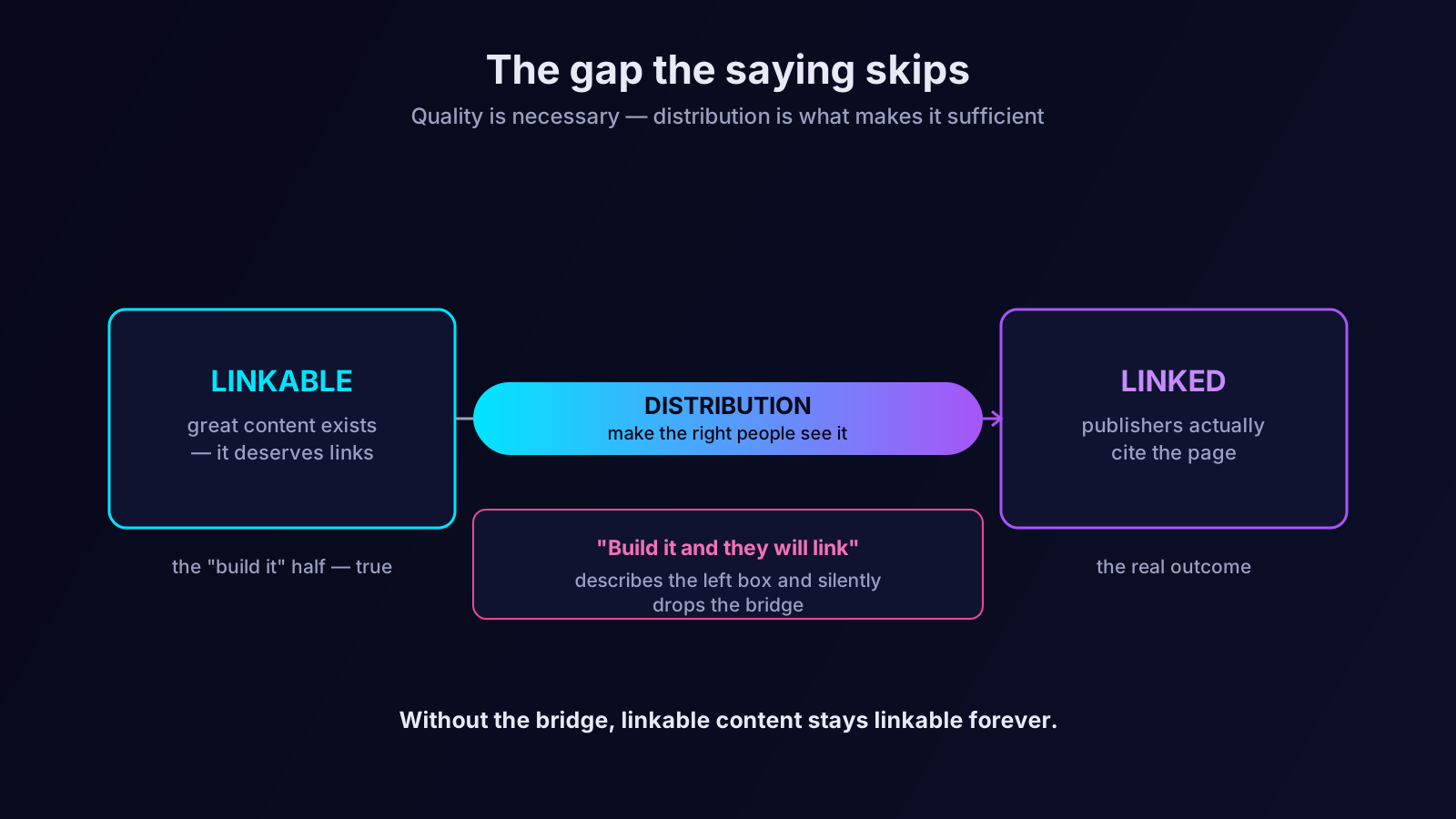
"Build it" is the necessary condition. Distribution is the sufficient one
The cleanest way to hold this is in the language of conditions. Quality is a necessary condition for earning links — without it, no links. But it is not a sufficient condition — having it does not, on its own, produce links. The sufficient condition is quality plus distribution: the content has to be worth linking to and the people who could link to it have to encounter it.
"Build it and they will link" is the error of mistaking a necessary condition for a sufficient one. It is the same error as "if I have a great product, customers will come" — true that you need the great product, false that the product sells itself. Every experienced founder learns that lesson about products. The content version of the lesson is exactly the same, and it is learned the same way: by building something good, watching it reach nobody, and slowly understanding that the building was only ever half the job.
So the corrected saying — less catchy, more honest — is: "build it, then make sure the right people see it, and then they might link." The "might" matters too. Even with quality and distribution, a link is something a publisher chooses, not something you can force. But quality plus distribution moves you from "essentially zero chance" to "real chance," and that move is the entire difference between a content programme that earns links and one that does not.
What the missing half actually involves
If distribution is the half the saying drops, what does that half consist of? It is not spammy outreach, and it is not begging — the "build it" crowd is right to reject those. It is the legitimate work of making sure your genuinely good content reaches the genuinely relevant people who might cite it.
It means knowing who, in your field, writes about your subject — the journalists, the bloggers, the publications, the analysts — and making sure they know your content exists, through honest, relevant, individual contact rather than mass email. It means being present where your field's conversation happens, so your work circulates naturally. It means giving your best content real internal support — featuring it, linking to it from your other pages, putting it where your own audience will find and share it. It means, over time, building the relationships and the reputation that mean your work gets noticed faster because of who published it. Our guide to earning links through digital PR covers this distribution half in depth — and the consistent theme is that distribution is not the opposite of quality. It is the act of giving quality a chance to be seen.
None of this is manipulation. You are not buying anything, scheming anything, or pretending your content is something it is not. You are doing the unglamorous logistical work of closing the gap between "exists" and "discovered." The "build it" philosophy treats that work as beneath the real creative effort, or as unnecessary. It is neither. It is simply the other half of the same job.
The cost of believing only the true half
It is worth being concrete about what happens to a team that fully believes "build it and they will link." Because the failure is not loud. It is quiet, and that is what makes it expensive.
The team does genuinely good work. They research, they write, they polish — they build it. They publish, and they wait, confident that quality will be rewarded. A few links trickle in, mostly by luck, mostly from people who stumbled across the page. The team interprets the trickle as the system working slowly, and keeps building. Months pass. The library of excellent, linkable, unlinked content grows. Eventually someone asks why all this quality is not translating into authority, and there is no good answer — because the team did everything the saying told them to do, and the saying was only half a strategy.
The tragedy is that this team is closer to success than a team running schemes, not further from it. They have the hard half — the genuine quality that cannot be faked. They are missing only the half that can be added: the deliberate work of distribution. But because the saying told them quality was sufficient, they never built the muscle for the other half, and a library of unseen excellence is the result. The most heartbreaking failures in content marketing are not the lazy ones. They are the diligent teams who believed a half-truth.
Why the half-truth is so persistent
If the saying is so clearly incomplete, why does it keep circulating? It is worth understanding, because the reasons it survives are the reasons it keeps catching out good teams.
The first reason is that it flatters the part of the work people most enjoy. Building — researching, writing, designing, polishing — is the creative, satisfying half of content marketing. Distribution is the logistical, repetitive, slightly uncomfortable half. "Build it and they will link" tells you that the enjoyable half is the whole job and the uncomfortable half is optional. That is a very easy message to want to believe, and people tend to adopt the beliefs that excuse them from the work they would rather skip.
The second reason is that the saying is occasionally, visibly true — and the exceptions are loud. Now and then a genuinely exceptional piece of content does take off on its own, gets discovered, gets shared, and earns links without deliberate distribution. Those cases are real, and they are memorable, and they get talked about. What does not get talked about is the vast quiet majority of excellent content that was published with the same faith and reached nobody. The visible exceptions keep the rule alive; the invisible failures cannot argue against it.
The third reason is that the failure is slow and ambiguous. A team that believes the half-truth does not get a clear error message. They get a slow trickle of links, which is just enough to feel like the system is working at a modest pace rather than failing. By the time the gap between effort and results becomes undeniable, months have passed and the cause is hard to isolate. A loud, fast failure teaches; a slow, ambiguous one just accumulates. The half-truth survives because the cost of believing it never announces itself.
What distribution is not
It is worth drawing a clear boundary, because some teams resist the distribution half for a reason that does them credit: they associate "promotion" with the spammy outreach and link begging they have rightly rejected. So it is worth stating plainly what distribution is not.
Distribution is not mass, untargeted outreach — the identical email sent to five hundred addresses scraped from a list. That has a near-zero response rate and, when it does land a link, often lands an irrelevant one. Distribution is not pretending your content is more important than it is, pestering people who have shown no interest, or treating writers as link vending machines. Those tactics fail for the same reason bought links fail: they try to extract a link rather than earn one.
Distribution, done properly, is the honest logistical work of connecting genuinely good content with the genuinely relevant people who would want it. It is closer to a librarian making sure the right book is on the right shelf than to a salesperson working a cold list. If your content is genuinely excellent and genuinely useful to a particular writer, telling that specific writer it exists is not an imposition — it is a favour. The discomfort some teams feel about distribution usually comes from imagining the spammy version. The legitimate version is something a person doing good work can do without embarrassment.
Holding both halves at once
The mature position is to refuse to choose between the two halves. The schemers are wrong: you cannot skip quality and promote your way to links, because relevant, trusted sites will not link to content that does not deserve it. But the "build it and they will link" believers are also wrong: you cannot skip distribution and quality your way to links, because content nobody discovers cannot be cited.
Earning links requires both, in sequence and without shortcuts. First the genuine, hard, creative work that makes content worth linking to. Then the deliberate, honest work of distribution that gives that content a chance to be seen by the people who might link. Drop the first and you have nothing worth promoting. Drop the second and you have something worth promoting that no one will ever encounter. Hold both, and links become not a guarantee — never a guarantee — but a realistic, recurring outcome of doing the whole job. As one corrected version of the aphorism puts it: build it well, then carry it to the people who were waiting for exactly this.
Where an AI agent fits
For most teams, the reason the second half goes undone is not laziness or disbelief. It is capacity. The creative work of building genuinely consumes the team, and the distribution work — identifying relevant writers and publications, knowing which of your pages are strong enough to deserve a push, tracking what is being noticed and what is not, keeping internal links pointed at your best assets — is steady, unglamorous, and easy to defer indefinitely. The half-truth survives partly because the other half is genuinely a lot of ongoing work.
This is where an SEO AI agent helps close the gap. Orova can analyse your content library to identify which pages are genuinely linkable — strong enough that distribution is worth investing in — surface the relevant, trusted sites and writers in your field who would be the right audience for a given piece, keep your internal linking pointed at your best assets so they get the support they deserve, and monitor which content is actually being noticed and cited so you learn what distribution is working. It does not replace the building, and it does not replace honest human outreach. It makes the missing half visible and manageable, so a library of linkable content does not quietly become a library of unlinked content.
"Build it and they will link" is half true, and the true half is the more important one — quality really is non-negotiable. But a half-truth believed whole is a quiet way to fail. Build it well. Then do the other half.
Let an AI Agent handle your SEO
Orova plans, writes, optimizes, and tracks rankings on its own — you just read the results.
Try it free