
How to Turn a Keyword List Into a Real Content Roadmap
A keyword list is not a plan. It is raw material. Yet a remarkable number of content teams treat the spreadsheet that comes out of keyword research as if it were the finished product — they sort it by search volume, slice off the top fifty rows, and call that the content roadmap for the next two quarters. Then they wonder why the resulting articles feel disconnected, why they keep accidentally overlapping, and why the topic never quite builds momentum.
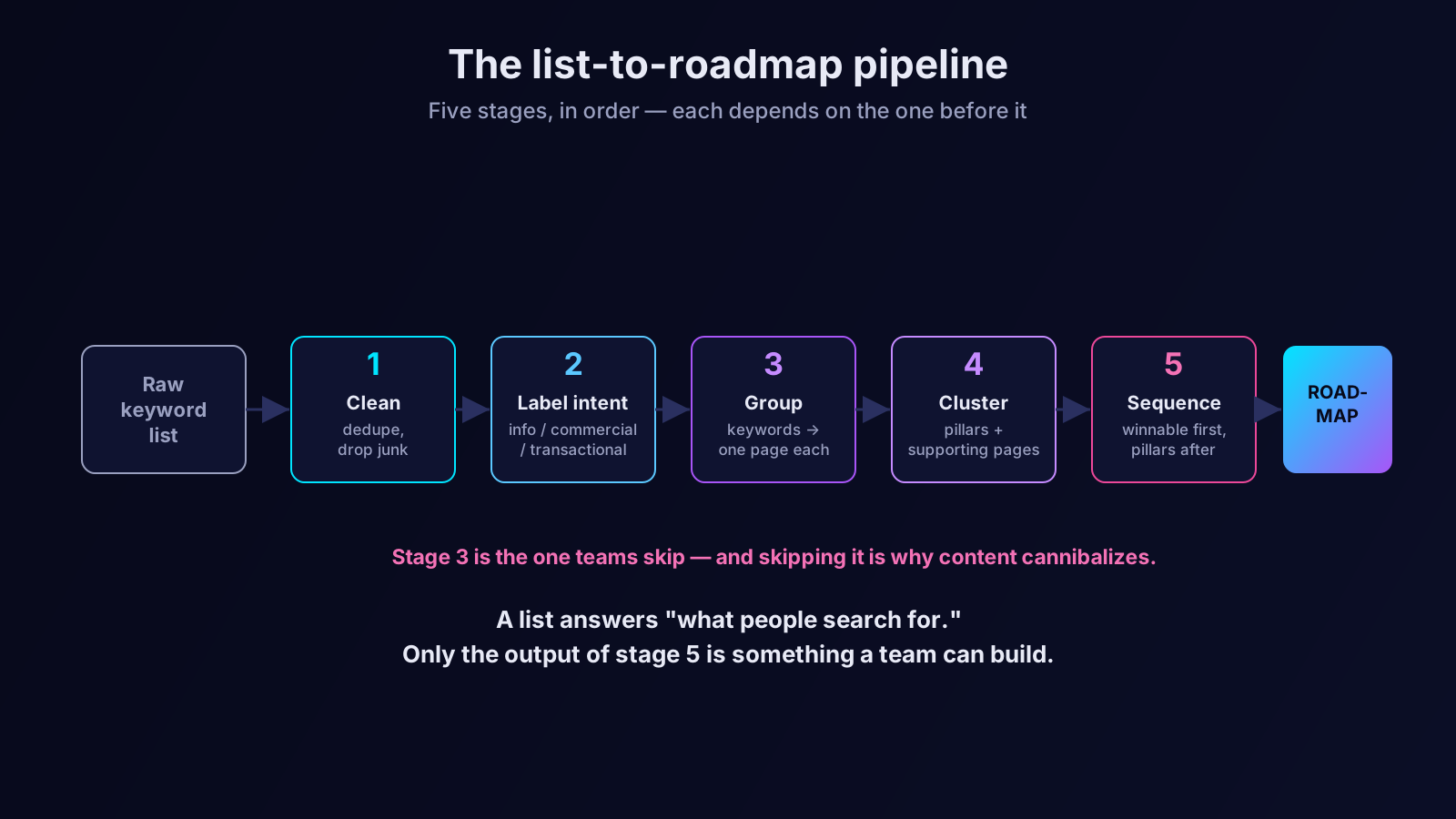
The gap between a keyword list and a content roadmap is real work, and it is the work most teams skip. This article is an analytical breakdown of that work: the specific transformations a list has to go through before it becomes a roadmap a team can actually execute against. We will move through it stage by stage, because the order matters — each stage depends on the one before it.
The difference between a list and a roadmap
Start with a clear definition of the destination, because you cannot transform a list into a roadmap without knowing what a roadmap is.
A keyword list is a flat, unordered collection of phrases, usually with a volume number and maybe a difficulty score attached. It answers exactly one question: "what do people search for?" That is useful, but it is the smallest part of planning.
A content roadmap answers four more questions the list cannot. What pages will we build? — keywords grouped into pages, because a page is the unit you publish, not a keyword. What is each page for? — the intent and the format of each page. How do the pages relate? — the cluster structure, which pages are pillars and which are supporting. And in what order do we build them? — the sequence, so the team knows what to do first. A list has none of this. A roadmap has all of it. The stages below are how you get from one to the other.
Stage one: clean and deduplicate the list
Before any sophisticated work, the list needs hygiene. Raw keyword exports are messy. They contain the same phrase in slightly different forms, plurals next to singulars, near-identical phrasings, branded terms you do not want to target, and queries that are simply irrelevant to your business that crept in from a broad seed.
The cleaning stage removes the junk and collapses the trivial duplicates — "email marketing tool" and "email marketing tools" are not two keywords, they are one. This is unglamorous and it is tempting to skip, but a roadmap built on a dirty list inherits every piece of that mess. Clean first. The output of stage one is a list where every row is a distinct, relevant query worth considering.
Stage two: label intent on every keyword
With a clean list, the first real analysis is intent labelling. Every keyword gets tagged with what the searcher actually wants: informational (they want to learn), commercial (they want to compare options before buying), transactional (they are ready to act), or navigational (they want a specific destination).
Intent is the most important label on the list, because it determines everything downstream — what kind of page each keyword needs, how that page should be written, and where in the buyer's journey it sits. A keyword without an intent label is not yet plannable. Two keywords with the same words but different intent need different pages. This is the analytical heart of the transformation: you stop treating the list as a flat set of strings and start treating each entry as a request with a purpose. Our walkthrough of the full method, from keywords to a content plan, goes deeper on labelling intent reliably.
Stage three: group keywords into pages
This is the stage most teams skip entirely, and skipping it is the single biggest reason their content overlaps and cannibalizes.
You do not publish keywords. You publish pages. So before anything else, the keywords have to be grouped — every keyword that shares a single intent collapsed into one group, and each group becomes exactly one planned page. "How to reduce churn," "ways to lower churn rate," and "decrease customer churn" are not three articles. They are one page, with one primary keyword and two secondary ones, because a searcher typing any of the three wants the identical thing.
Get this grouping right and you have built the foundation of a roadmap that cannot cannibalize itself. Skip it, and you carry a list of five hundred keywords straight into production as five hundred article ideas — guaranteeing dozens of pages that compete with each other for the same query. The grouping stage is what converts "what people search for" into "what we will actually build." It is the pivot point of the entire transformation.
Stage four: arrange the pages into clusters
After stage three you have a set of planned pages, each with a primary keyword and an intent. They are still, however, a flat set — a list of pages instead of a list of keywords. The fourth stage gives them structure.
You arrange the pages into topic clusters. Within each cluster sits one broad pillar page covering a subject comprehensively, surrounded by narrower supporting pages each targeting a specific question within that subject. The supporting pages link up to the pillar; the pillar links down to them. The flat set of pages becomes a connected architecture.
This stage is what makes the roadmap compound rather than merely accumulate. A flat set of thirty unconnected pages is thirty isolated bets. The same thirty pages organised into four clusters tell a search engine your site covers each of those subjects with genuine depth — and that demonstrated depth is what lets the whole group rank better than its parts ever would alone. The cluster structure is not decoration added at the end. It is the mechanism by which the roadmap produces results greater than the sum of its articles. Our guide to topic clusters and how to structure content for SEO covers the architecture in full.
Stage five: sequence the build
You now have structured, clustered pages — but you cannot build them all at once, so the roadmap needs an order. Stage five assigns a sequence.
A sound sequence follows a few analytical principles rather than gut feeling. Lead with winnable, commercially relevant pages — the specific, lower-competition pieces that can rank reasonably soon and prove to the wider business that the program works. Build clusters with enough internal coherence that each one starts signalling depth before you scatter effort across all of them. And hold the broad pillar pages until their supporting cluster pages exist, because a pillar published into an empty cluster has nothing holding it up.
The output of stage five is the actual roadmap: an ordered list of pages, each with a primary keyword, an intent, a format, a cluster assignment, and a position in the queue. A team can pick up row one on Monday and work straight down. Every page has a reason to exist and a defined relationship to the pages around it. That ordered, structured, reasoned artefact — not the keyword spreadsheet you started with — is the content roadmap.
Why each stage depends on the last
The five stages are a sequence, not a menu, and the dependency runs in one direction. You cannot label intent meaningfully on a dirty list full of duplicates and irrelevant terms — so cleaning comes first. You cannot group keywords into pages until you have labelled their intent, because intent is the property you group on. You cannot arrange pages into clusters until the pages exist as the output of grouping. And you cannot sequence a build until you know the cluster structure, because the sequencing rules — coherent clusters first, pillars after their support — operate on the cluster layer.
Skip a stage and every stage after it is built on sand. The most common skip, as noted, is stage three: teams clean and label, then jump straight to "let's write these," treating labelled keywords as articles. The result is a roadmap that looks structured but cannibalizes from day one, because the keyword-to-page collapse never happened. Respect the dependency order and the transformation holds together.
What patterns emerge from doing this well
Teams that run the full pipeline consistently report a recognisable set of qualitative patterns — not precise numbers, but reliable directional outcomes.
The first pattern is fewer pages than expected. A list of five hundred keywords does not become five hundred articles. After grouping, it commonly collapses to a much smaller set of planned pages, because so many keywords were variants of one intent. Teams are often surprised — and relieved — at how much smaller the real workload is than the raw list implied.
The second pattern is no cannibalization. When grouping is done properly, two pages chasing one intent simply cannot occur, because the grouping stage would have merged them. The roadmap is structurally clean.
The third pattern is momentum. Because the roadmap is sequenced — winnable pages first, coherent clusters built deliberately — results tend to appear in a recognisable order rather than randomly. Early wins arrive from the lower-competition pages, then clusters start to lift as their internal structure fills in. The progress feels legible, which keeps the program funded and the team motivated. A flat list, by contrast, produces results that feel scattered and unpredictable, because nothing was sequenced.
The cost of skipping the transformation
It is worth being explicit about what the shortcut costs, because the shortcut is so tempting. Carrying a raw keyword list straight into production — sort by volume, take the top rows, start writing — feels fast. It skips days of unglamorous analytical work.
But the cost arrives later and compounds. You get pages that overlap and cannibalize, because grouping never happened. You get a scatter of unconnected articles with no cluster structure, so nothing compounds. You get an arbitrary build order, so results appear unpredictably and the program is hard to defend to the people funding it. You spend the same writing effort and get a fraction of the return. The transformation is not bureaucratic overhead. It is the difference between effort that compounds and effort that merely accumulates.
What a finished roadmap row should contain
It helps to be concrete about the artefact the pipeline produces, because "roadmap" can mean almost anything. A finished roadmap is a table, and every row is one planned page. Each row should carry a specific set of fields, and if any field is missing, that row is not yet ready to be handed to a writer.
The primary keyword is the single clearest phrase the page targets — the representative of its intent group. The secondary keywords are the other variants from the same group that the page will naturally also rank for; listing them tells the writer the full range the page must satisfy. The intent label records whether the page is informational, commercial, transactional, or navigational, which in turn dictates tone and depth. The format names what kind of page it is — definition, how-to, comparison, checklist, listicle — turning a vague title into a brief. The cluster assignment records which topic cluster the page belongs to and whether it is the pillar or a supporting page. And the sequence position records where in the build queue it sits.
A row with all six fields is a brief. A writer can pick it up and start without asking a single clarifying question, because every decision that shapes the page has already been made and recorded. A row missing the intent label, or the cluster assignment, sends the writer back to guess — and guessing is exactly how overlap and inconsistency creep back in. The discipline of the pipeline is only as good as the completeness of the rows it produces.
How to keep the roadmap alive after launch
A roadmap is not a document you build once and then merely execute. The moment you publish the first few pages, reality starts sending feedback, and a good roadmap absorbs it.
Search Console becomes a second source of keyword data within weeks of publishing. It will show you queries your pages are getting impressions for that you never put in the original list — real demand you did not anticipate. Each of those is a candidate for the roadmap: check its intent, and either fold it into an existing page as a secondary keyword or, if the intent is genuinely new, add a row. The roadmap grows from evidence, not just from the original research.
Rankings also tell you whether your sequencing assumptions held. If the pages you labelled "winnable" are indeed ranking quickly, the sequence is sound and you continue. If they are not, that is a signal to re-examine — perhaps the competition was underestimated, perhaps the intent was misread. Either way, the roadmap should be revised rather than blindly followed off a cliff. The five-stage pipeline is how you build the roadmap; light, regular maintenance against real data is how you keep it accurate. A roadmap that is never revisited slowly drifts out of sync with the market it was built for. Treat it as a living document and it stays a guide rather than becoming a relic.
Where an SEO AI agent fits
Every stage of this pipeline is doable by hand, and none of it is intellectually difficult. What it is, is laborious — cleaning hundreds of rows, labelling intent on each, grouping variants into pages, arranging pages into clusters, sequencing the build. It is exactly the kind of structured, repetitive analytical work that teams start with energy and abandon around stage three.
This is where an SEO AI agent earns its keep. Orova can run the full transformation: take a raw keyword list, clean and deduplicate it, label the intent on every entry, group variants into planned pages so nothing cannibalizes, arrange those pages into topic clusters, and propose a build sequence. What you receive is not a spreadsheet of keywords but a draft roadmap — ordered, structured, with every page labelled — that you review and refine rather than build from scratch. The five-stage method in this article does not change. The agent simply removes the labour that stops most teams from completing it, so the list you researched actually becomes the roadmap you build.
Let an AI Agent handle your SEO
Orova plans, writes, optimizes, and tracks rankings on its own — you just read the results.
Try it free