
One Keyword, One Page: The Rule That Saves Your Rankings
There is a rule in SEO so simple it sounds like it cannot possibly matter: one keyword, one page. Each search intent you want to win gets exactly one page dedicated to winning it. No second page targeting the same query "just in case." No third article that quietly overlaps. One intent, one URL, one place on your site where Google can send that searcher.
It sounds trivial. It is not. Teams that ignore this rule do not fail loudly — they fail slowly, watching their own pages compete against each other for the same term, splitting the signals that would have ranked a single strong page, and wondering why a topic they have written about five times still sits on page two. This article is a practical how-to for applying the rule: what it actually means, how to assign keywords to pages without overlap, how to spot violations you already have, and how to fix them.
What the rule actually means
The rule is "one keyword, one page," but the more accurate version is "one search intent, one page." That distinction matters, because keywords are not the unit Google cares about — intent is.
Consider three queries: "how to reduce email bounce rate," "ways to lower email bounce rate," and "fix high email bounce rate." Three different keyword strings. One single intent. A person typing any of the three wants the same thing — a practical guide to bringing their bounce rate down. They should all land on the same page. Writing three separate articles, one per phrase, does not give you three chances to rank. It gives you three weak pages dividing the authority that one page should have concentrated.
So the rule does not mean every keyword variant needs its own URL. It means every distinct intent needs its own URL — and every URL should own exactly one intent. Two queries with the same intent share a page. Two queries with different intents must never share a page. Get that mapping right and you have applied the rule correctly. Get it wrong in either direction and you create problems.
Why violating the rule quietly destroys rankings
When two of your pages target the same intent, you have not doubled your coverage of that topic. You have created a competition your own site cannot win cleanly.
Google has to pick one of your two pages to rank for the query — it will rarely show both. The signals that should accumulate on a single page — internal links, external links, engagement, relevance — are now split across two. Each page is weaker than the combined page would have been. Worse, Google may not pick consistently: it can swap which of your pages it shows from week to week, so neither builds stable authority. You see a topic you have invested heavily in stuck below competitors who simply pointed all their effort at one page.
This is keyword cannibalization, and it is one of the most common self-inflicted SEO wounds. We cover its mechanics and symptoms in depth in our piece on keyword cannibalization, the silent traffic killer. The "one keyword, one page" rule is, at its heart, the discipline that prevents cannibalization before it ever starts. Follow the rule and you cannot cannibalize. Ignore it and you eventually will.
How to assign a keyword to exactly one page
Applying the rule starts at planning time, before a single article is written. Every keyword in your research needs to be assigned to one page — and the assignment needs to be deliberate, not accidental.
The mechanism is a keyword map: a simple document, usually a spreadsheet, with one row per target page. Each row records the page's primary keyword, the secondary keywords and variants that share its intent, the intent type, and the URL. The map is the single source of truth for what each page is allowed to target.
To build it, group your keyword list by intent first. Cluster together every phrase that means the same thing — every variant a searcher might type to express one underlying need. Each cluster becomes one row, one page. The primary keyword is the clearest, most representative phrase in the cluster; the rest are secondary keywords the same page will naturally also rank for. When a new keyword appears later, you do not write a new article reflexively — you check the map. If the keyword's intent matches an existing row, it joins that row as a secondary keyword. Only if its intent is genuinely new does it earn a new row and a new page.
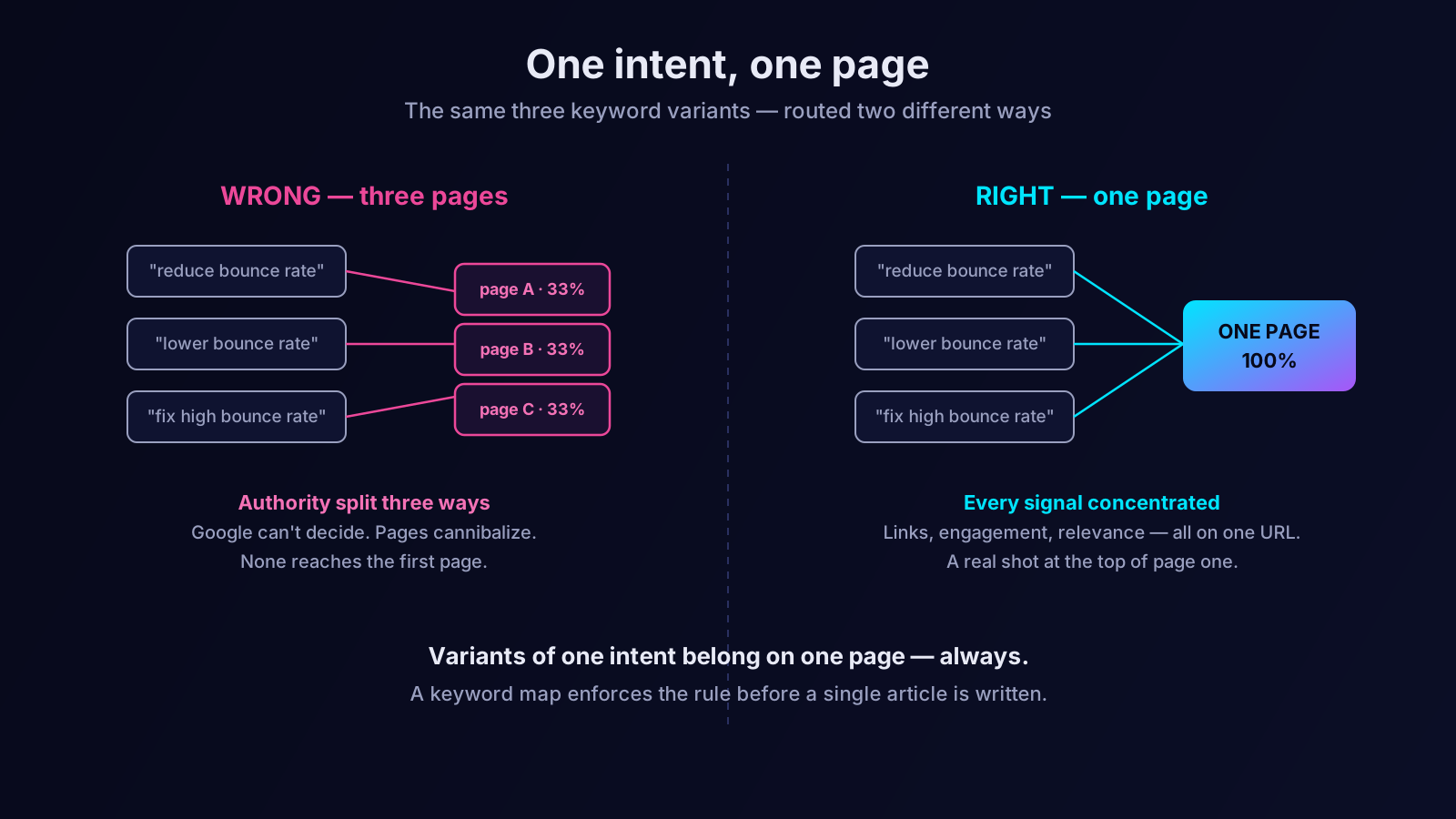
The keyword map is what turns "one keyword, one page" from a slogan into an operational discipline. Without it, the rule depends on every writer remembering every page that already exists — which fails the moment your site passes a few dozen articles. With it, the rule is checkable: before anything new is commissioned, you look at the map and confirm no existing page already owns that intent.
The grey area: closely related intents
The hardest part of applying the rule is the judgement call on intents that are close but not identical. "Email marketing software" and "best email marketing software" — same page or two? "What is churn rate" and "how to reduce churn rate" — one page or two?
Use this test: would a searcher be fully satisfied by the same page? "What is churn rate" wants a definition and explanation. "How to reduce churn rate" wants tactics and steps. A reader of one would not be served by the other — different intent, two pages. By contrast, "email marketing software" and "best email marketing software" both want the same thing: a comparison that helps them choose a tool. Same intent, one page.
When genuinely unsure, lean toward fewer pages. A single comprehensive page that fully covers a slightly broad intent will almost always outperform two thinner pages that split it. You can always expand a section into its own page later if search demand clearly justifies it. Splitting prematurely creates a cannibalization problem; consolidating is the safer default.
How to find rule violations you already have
Most sites with any history have violated the rule already — usually unintentionally, as different people wrote about the same topic over the years. Finding those violations is straightforward if you know where to look.
The fastest method is a site-restricted search. In Google, search site:yourdomain.com followed by a target keyword. If several of your own pages come back all clearly aimed at that one query, you have found a violation. Do this for your most important keywords and a pattern usually emerges quickly.
Search Console gives you the more rigorous version. Open the Performance report, filter to a specific query, and look at the Pages tab. If Google is showing two or more of your URLs for that single query — especially if it alternates between them across the date range — those pages are competing. The query-level view in Search Console is the clearest evidence of cannibalization you can get, because it shows Google's own confusion about which page to rank.
A third signal: titles. Scan your content inventory for pages with near-duplicate titles. "How to reduce churn" and "Reducing customer churn: a guide" are a violation waiting to be confirmed. Title similarity is a fast proxy for intent overlap.
How to fix a violation once you find it
Finding two pages targeting one intent is the easy part. Fixing it requires a decision, and there are three honest options.
Consolidate. Usually the best choice. Merge the two pages into one. Take the strongest URL — typically the one with more links and better existing rankings — and fold the best material from the weaker page into it, making the survivor genuinely more complete. Then redirect the weaker URL to the survivor with a permanent redirect, so any authority it earned flows into the page you kept. One strong page replaces two weak ones, and every signal now points to a single target.
Differentiate. Sometimes, on inspection, the two pages were not truly the same intent — they were just written carelessly so they overlapped. In that case, do not merge: re-focus. Rewrite each page so it owns a distinct intent cleanly, adjust the titles and headings to make the difference unmistakable, and fix the internal links so each points to the right page. You end with two pages that no longer compete because they genuinely target different things.
Remove. Occasionally the weaker page has no value worth saving and no meaningful links. Then redirect it to the survivor and move on. Do not delete it to a dead end — always redirect, so you keep whatever equity it had.
Whichever route you choose, the goal is the same: after the fix, exactly one page targets that intent. Update the keyword map to reflect the new reality, so the violation does not silently reappear the next time someone plans content.
The rule and your internal linking
"One keyword, one page" also makes your internal linking dramatically easier — and your internal linking, in turn, reinforces the rule.
When exactly one page owns each intent, there is never any doubt about where an internal link should point. Mention churn reduction in an article? Link to the one churn-reduction page. There is no second candidate, no guessing. Your anchor text becomes consistent because there is a single correct destination every time. That consistency is itself a ranking signal: it tells Google, unambiguously, which page is the authority on that intent.
The reverse is also true. When two pages target one intent, your internal links scatter — some point to one, some to the other — and the split link equity makes the cannibalization worse. So the rule and good internal linking are mutually reinforcing. A clean keyword map produces clean internal links; clean internal links concentrate authority on the right pages. For the broader system, our guide to internal linking strategy for SEO shows how to build it deliberately.
The rule at scale
On a ten-page site, you can hold the whole keyword map in your head. On a three-hundred-page site, you cannot — and that is where the rule is most often broken, because no individual writer can know every page that already exists.
At scale, the rule has to be enforced by process, not memory. Every new piece of content must be checked against the keyword map before it is commissioned. The question is always the same: does a page already own this intent? If yes, the work is to strengthen the existing page, not to write a competitor to it. This single checkpoint, applied consistently, is what keeps a large site free of cannibalization.
It is also the checkpoint teams skip most often, because under deadline pressure it is faster to just write the article than to audit three hundred existing URLs first. That shortcut is exactly how large sites accumulate dozens of quiet violations. The discipline is not glamorous, but it is decisive: the sites that rank consistently at scale are the ones that never let two pages chase one intent.
Where an SEO AI agent fits
The "one keyword, one page" rule is simple to state and genuinely hard to enforce by hand once a site grows. It requires holding the entire keyword map in view, checking every new keyword against every existing page's intent, and continuously auditing for overlaps that crept in over years of content. That is exactly the kind of patient, total-recall work that humans do poorly and software does well.
This is where an SEO AI agent earns its place. Orova can maintain the keyword map as a living system: when you plan a new article, it checks the proposed intent against every page you have already published and tells you whether one already owns that ground. It can scan your existing content for cannibalization — pages with overlapping intent, near-duplicate titles, queries where Google is alternating between your URLs — and surface the violations for you to consolidate, differentiate, or remove. The rule in this article does not change. The agent simply makes it enforceable at the scale where it matters most, so every intent on your site has exactly one page built to win it.
Let an AI Agent handle your SEO
Orova plans, writes, optimizes, and tracks rankings on its own — you just read the results.
Try it free