
"We Have 1,000 Keywords" Is Not a Strategy
There is a sentence that gets said in marketing meetings with a certain quiet pride. A manager pulls up a spreadsheet, scrolls through hundreds of rows, and says: "We have a thousand keywords." The room nods. It sounds like progress. It sounds like the hard part is done. It is not. It is the moment a team most often mistakes raw material for a plan.
"We have a thousand keywords" is not a strategy. It is an inventory. And the gap between an inventory and a strategy is where most content programs quietly fail. This article is built around a handful of memorable lines — the kind worth pinning above a desk — because the trap here is not a lack of information. It is a lack of clear thinking about what the information is for.
A list answers "what." A strategy answers "why this, and why now."
Hold that distinction, because everything follows from it. A keyword list tells you what people search for. That is genuinely useful — but it is the smallest, easiest question in content planning, and it is the only one a list answers.
A strategy answers harder questions. Of these thousand keywords, which ones can we actually win? Which ones bring people who could become customers, rather than people who will read and leave? Which do we build first, and why that order? How do these pages relate to each other? A list is silent on every one of those. It is a pile of "what" with no "why" and no "when." Mistaking the pile for the plan is the original error, and every other mistake in this article descends from it.
A bigger list is not a better strategy. It is just a bigger list.
When a team feels uneasy about their content plan, the instinct is almost always to do more research — to grow the list. Five hundred keywords feels thin, so they push for a thousand. A thousand feels safer.
It is not safer. It is just larger. The problem with a content program is essentially never that the keyword list was too short. The list is rarely the bottleneck. The bottleneck is the thinking that should have happened to the list — the deciding, the prioritising, the structuring — and a bigger list does not supply any of that. It supplies more raw material to apply the missing thinking to. Doubling the inventory while skipping the strategy just doubles the volume of unprocessed input. You feel more productive and you are not. As the saying should go: a thousand keywords you have not made decisions about are worth exactly as much as zero keywords — because in neither case do you know what to do tomorrow.
The keyword you choose not to target is a strategic decision too.
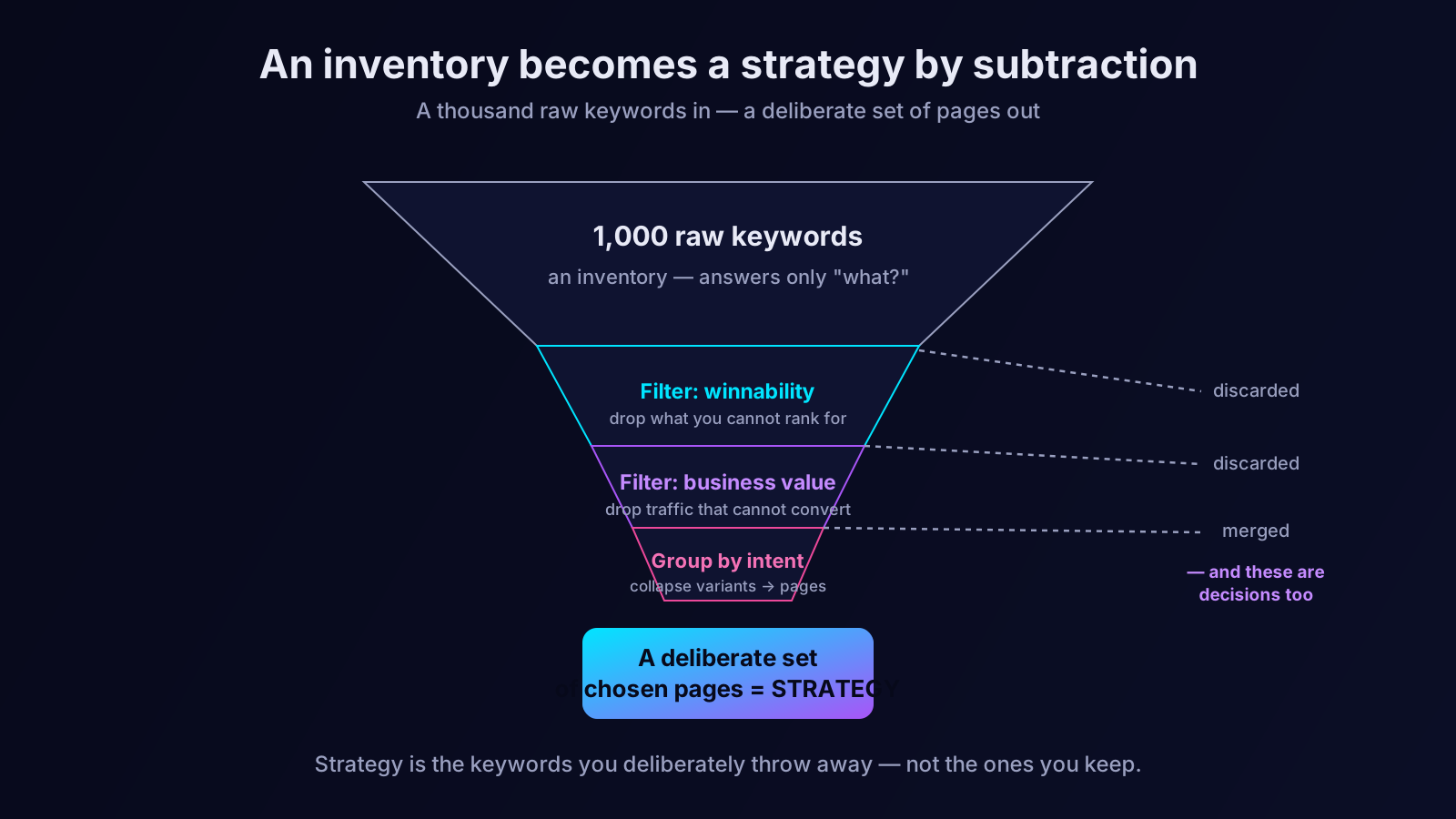
Here is the line that most reframes how teams treat a big list. Strategy is not the keywords you keep. Strategy is the keywords you deliberately throw away.
A thousand-keyword list, treated as a strategy, implies you intend to target a thousand keywords. That is not ambition; it is the absence of a decision. A real strategy looks at the thousand and says: these two hundred are too competitive for us to win in any reasonable timeframe — discard. These hundred and fifty bring traffic with no path to becoming customers — discard. These three hundred are variants of intents already covered by other rows — merge them, not separate pages. What survives that filtering — a few hundred deliberately chosen keywords — is closer to a strategy, precisely because every survivor beat something. A list where nothing was rejected contains no decisions, and a plan with no decisions in it is not a plan.
You do not publish keywords. You publish pages.
This line exposes a category error hiding inside every big keyword list. A list of a thousand keywords feels like a list of a thousand things to do. It is not. The unit you actually publish is a page, and a page serves an intent, not a keyword string.
Many of those thousand keywords are the same intent wearing different words. "How to reduce churn," "ways to lower churn rate," "decrease customer churn," "cut your churn rate" — four rows in the spreadsheet, one page in reality, because a searcher typing any of them wants the identical thing. Until the list is collapsed from keywords into pages, you do not know how much work you are actually facing. The team that says "we have a thousand keywords, that's two years of content" has almost always not done the collapse — and once they do, the thousand keywords frequently become a far smaller, far more achievable set of pages. The number that matters was never the keyword count. It is the page count, and you cannot see it until you stop counting keywords.
A keyword without an intent label is not yet usable.
A keyword string on its own is incomplete. "Email automation" — is that someone wanting to learn what email automation is, or someone ready to buy email automation software? Those are two different searchers, needing two different pages, sitting at two different points in the buying journey. The same words; opposite jobs.
Until each keyword carries an intent label, you cannot decide what page it needs, how to write that page, or where it sits in your funnel. An unlabelled thousand-keyword list is therefore not a thousand usable inputs — it is a thousand half-inputs. The labelling is not optional polish. It is the step that makes the raw material usable at all. A strategy is made of intents, not strings.
Unstructured pages accumulate. Structured pages compound.
Suppose you have done the collapsing and the labelling, and you have a clean set of two hundred planned pages. You still do not have a strategy — you have a better list. The pages need to relate to one another.
Two hundred unconnected pages are two hundred isolated bets, each rising or falling on its own. The same two hundred pages organised into topic clusters — broad pillar pages anchoring groups of specific supporting pages, all interlinked — behave differently. They tell a search engine your site covers each subject with genuine depth, and that demonstrated depth lifts every page in the cluster. The difference between accumulation and compounding is structure. A strategy includes the structure; an inventory cannot. Our guide to topic clusters and how to structure content for SEO shows how the structure is built, and the keywords-to-content-plan workflow shows the full path from list to roadmap.
Strategy is sequence. "Everything" is not an order.
The last thing a list cannot tell you is the most practical: what to do first. A thousand-keyword spreadsheet, even cleaned and clustered, says nothing about order. And "do all of it" is not an order — it is the refusal to choose one.
A strategy assigns a sequence, and the sequence follows reasons. Winnable, commercially valuable pages first, because they prove the program works and keep it funded. Clusters built coherently, so each one starts signalling depth rather than effort being sprinkled thinly everywhere. Pillars after their supporting pages, because a pillar with nothing beneath it has nothing holding it up. The sequence is where strategy becomes executable — it is the answer to "what does the team do on Monday." A list cannot answer that. A strategy must.
The quiet cost of confusing the two
It is worth naming what it actually costs to mistake the inventory for the plan, because the cost is rarely obvious in the moment.
The team that says "we have a thousand keywords" and starts writing from the top of the spreadsheet pays in several currencies. They pay in cannibalization, because the keyword-to-page collapse never happened and pages overlap. They pay in scatter, because no cluster structure was imposed and nothing compounds. They pay in misallocation, because without winnability filtering they spend months on keywords they were never going to rank for. And they pay in lost confidence, because results arrive unpredictably and the program becomes hard to defend to the people funding it. None of these failures looks like a failure at first. They look like an SEO program that is "just taking a while." The root cause is almost always the same: an inventory was put to work as though it were a strategy.
Why the big number feels so reassuring
It is worth pausing on the psychology, because the pull toward "we have a thousand keywords" is strong and understanding it helps you resist it.
A big number is concrete, and content strategy is mostly not. Filtering for winnability is a judgement call. Grouping keywords into pages requires interpretation. Clustering and sequencing are reasoned arguments, not measurements. None of that produces a satisfying figure you can put on a slide. A keyword count does. "A thousand keywords" can be said in a meeting and it lands — it sounds like an asset, like progress, like the team has been busy. The actual strategy, by contrast, is a set of decisions and arguments that are harder to display and harder to take credit for.
So teams gravitate to the number not because they are foolish but because the number is the only part of the work that is easy to point at. The danger is that pointing at it becomes a substitute for doing the harder, less visible work. The discipline here is to notice the comfort the big number provides and treat that comfort as a warning sign rather than a reassurance. If the most quotable fact about your content plan is how many keywords are in the spreadsheet, the plan is probably still an inventory.
What a real strategy can be said in one sentence
Here is a useful test. A genuine content strategy can be summarised in a sentence that a colleague who has never seen the spreadsheet would understand and find meaningful.
"We have a thousand keywords" fails the test — it describes the raw material, not the plan. A real strategy sounds more like: "We are going to own the subject of customer retention by building four interlinked clusters, starting with the lower-competition how-to pages that can rank within a couple of quarters, and holding the broad pillar pages until their supporting content exists." That sentence contains a target, a structure, a sequence, and a rationale. It is defensible. It tells anyone who hears it what the team will do and why.
If you cannot compress your content plan into a sentence of that kind — if the best you can do is cite a keyword count — then the strategic work has not been done yet. The sentence is not a marketing flourish; it is a diagnostic. The ability to state the strategy plainly is itself evidence that the strategy exists. The inability to state it as anything more than a number is evidence that it does not.
The line worth keeping
If a single sentence survives this article, let it be this: a keyword list is a question, not an answer. It asks "here is what the world searches for — now what?" The "now what" is the strategy, and the "now what" is entirely the work of human and machine judgement applied to the list: filtering for winnability, filtering for business value, collapsing keywords into pages, labelling intent, building cluster structure, assigning sequence.
None of that lives in the spreadsheet. The spreadsheet is the easy part — the part a tool hands you in an afternoon. The strategy is everything you do after the spreadsheet exists. So the next time someone in a meeting says "we have a thousand keywords" with that note of pride, the right response is gentle but firm: good — that is the raw material. Now, what is the strategy?
Where an SEO AI agent fits
The reason teams stop at "we have a thousand keywords" is rarely laziness. It is that the work of turning the inventory into a strategy — filtering, collapsing, labelling, clustering, sequencing — is genuinely large and genuinely repetitive, and it is the kind of work that gets postponed under deadline pressure until the team just starts writing from the top of the list.
This is where an SEO AI agent changes things. Orova can take the raw thousand-keyword inventory and do the work that turns it into a strategy: filter out the unwinnable and the commercially irrelevant, collapse keyword variants into actual pages so nothing cannibalizes, label intent on every entry, arrange the surviving pages into topic clusters, and propose a build sequence. What you get back is not a longer list — it is a shorter, structured, ordered roadmap where every decision has been made and is yours to review. The thinking in this article does not change. The agent simply makes sure the inventory does not stay an inventory, so that the next time you open the spreadsheet, you are looking at a strategy.
Let an AI Agent handle your SEO
Orova plans, writes, optimizes, and tracks rankings on its own — you just read the results.
Try it free