
Why Buying Links Is a Slow-Motion Disaster
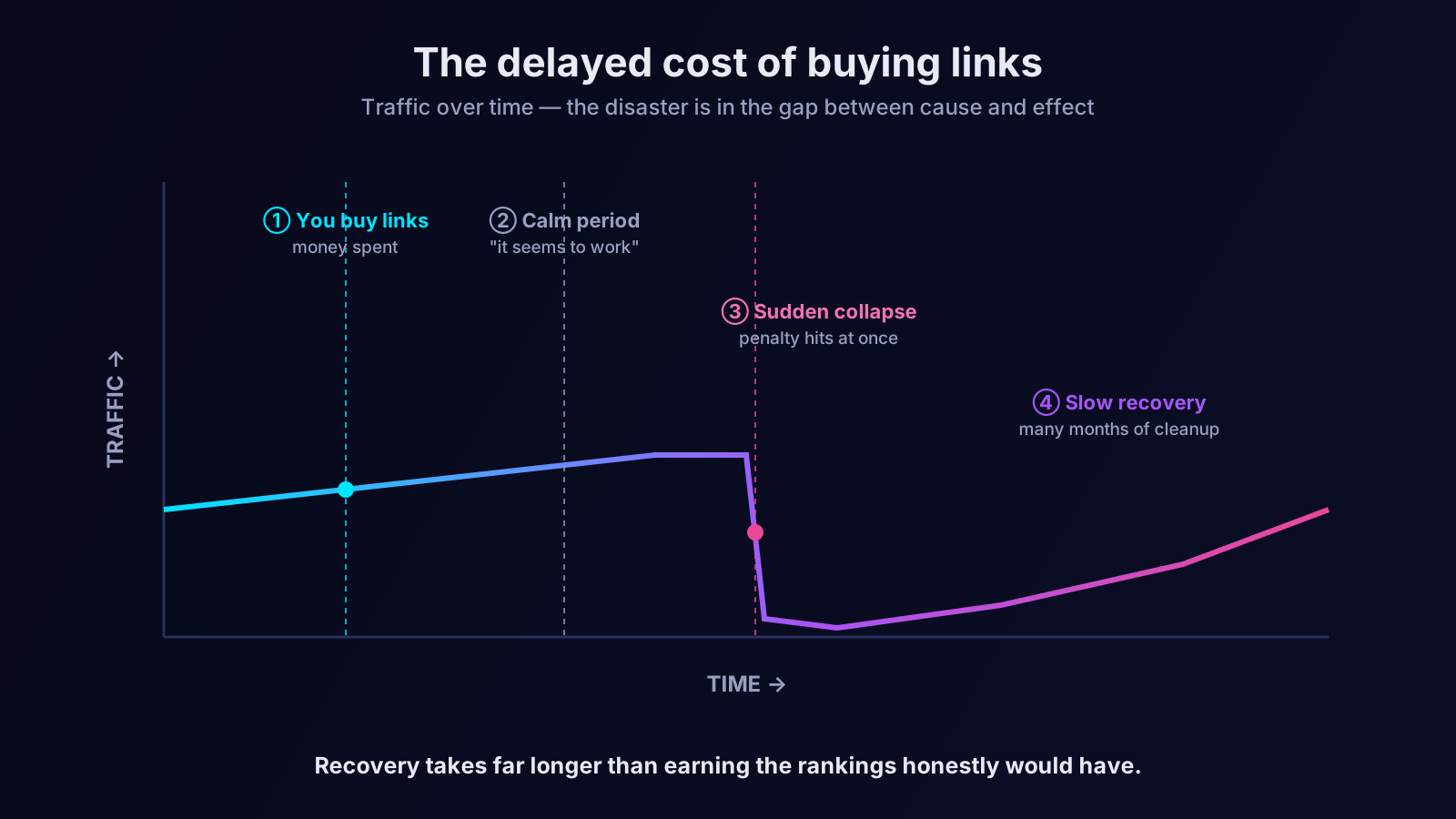
There is a particular kind of advice that sounds reasonable in the moment and turns out to be a trap. "Just buy a few links" is the clearest example in all of SEO. It is offered casually, by people who seem to know what they are doing, and it solves a real frustration — link building is slow, and money feels like a shortcut. The pitch is seductive precisely because the alternative, earning links honestly, takes months of patient work. So you pay, the links appear, and for a while nothing bad happens.
That delay is the whole problem. Buying links is not a tactic that fails immediately and obviously. It is a slow-motion disaster — a decision whose costs arrive gradually, long after the purchase, in a form that is hard to trace back to the cause. This article is a critical case against buying links, written for the person genuinely tempted by it. Not the obvious objection that it is "against the rules," but the practical, structural reasons it is one of the worst decisions a site can make.
Why "it worked for years" is the trap, not the defence
The first thing a link seller will tell you is that buying links worked for a long time and plenty of sites still do it. Both halves of that are true, and both halves are the trap.
It is true that for years search engines could not reliably tell a bought link from an earned one, so buying links produced results. It is also true that this is no longer the case. Search engines have spent more than a decade and enormous resources specifically on detecting and neutralising paid links — that is not a side project for them, it is a central one. The patterns paid links create are exactly what their systems are trained to find. So "it worked for years" describes a window that has closed, and pointing at it is like recommending a route across a river by noting that the ice held last winter.
And "plenty of sites still do it" is not evidence that it works — it is evidence of two other things. Some of those sites are doing it without realising the links are already being ignored, so they are paying for nothing and do not know it. And some of them have not yet had their costs arrive. The slow-motion nature of the disaster means that at any given moment, a population of sites is mid-fall, still looking fine. Survivorship bias makes a failing tactic look survivable. The sites that bought links and got penalised are not in the room recommending it.
The best case is that you wasted your money
Start with the outcome the link seller will never mention: the most likely result of buying links is not catastrophe. It is simply waste.
Search engines do not penalise every paid link they detect. Often they just ignore it — they identify the link as manipulative and decline to count it. From your side, this is almost invisible. The link still exists. It still shows up in a backlink tool. Your link count goes up. Everything looks like it worked. But the search engine is not reading the link, so it does nothing for your rankings at all.
Think carefully about what this means. You have paid real money, on a recurring basis in many cases, for links that produce exactly zero ranking benefit. You may not even know it, because the tools you use to check still show the links as present. You could spend a year and a substantial budget buying links, watch your "link profile grow," and have moved the actual needle not at all. The best-case scenario for buying links is that you have quietly set fire to your budget while believing you invested it. And the best case is the good outcome.
The worse case: the penalty
The worse outcome is that the bought links are not merely ignored but treated as evidence of a manipulative pattern — and your site is penalised for it.
A penalty does not mean a small adjustment. It can mean a steep, sudden drop in rankings across many pages at once, or specific pages losing visibility entirely, or in severe cases the site being removed from results for important terms. The traffic that took years to build can fall in a single update. And here is the part that makes it a true disaster rather than a setback: recovering from a link penalty is dramatically harder and slower than earning the rankings honestly would have been in the first place.
Recovery means identifying every bad link, getting as many removed as you can — which means contacting the very sellers you paid, who have no incentive to help — disavowing the rest, documenting the cleanup, and, if the penalty was applied manually, submitting a reconsideration request and waiting. This process routinely takes many months. During all of it, your traffic stays down. The shortcut that was supposed to save you a few months of honest work has instead cost you a year or more of lost traffic plus the cleanup labour. The maths of the shortcut is catastrophically negative, and you only discover the true price after you have already paid it.
You do not control the links you bought
Here is a structural problem with bought links that even people who accept the risk tend to underrate: once you have paid for a link, you have almost no control over it, and that lack of control is a permanent liability sitting in your profile.
An earned link lives on a site run by someone who linked to you because they wanted to. A bought link lives on a site run by someone selling links — which tells you everything about the kind of site it is. That site may sell links to anyone, including spam operations and penalised sites, putting your link in terrible company. It may get caught and penalised itself, dragging down everything it links to. It may stop existing when the owner abandons it. It may change the link, or the page, or pile a hundred more paid links around yours. The seller may simply remove your link the day you stop paying, so the "asset" evaporates the moment the invoice does.
You bought something you cannot govern, on a site whose entire business model is the thing search engines are hunting. Every bought link is a small piece of permanent risk that you do not own and cannot fix — and a profile full of them is a profile full of liabilities you have to hope nobody examines too closely.
The dependency trap
There is a quieter cost, and it may be the most damaging of all because it shapes how your whole operation behaves. Buying links is habit-forming in a way that hollows out your ability to compete honestly.
When a site starts buying links and sees rankings hold, it concludes — reasonably, from the inside — that bought links are what is keeping it visible. So it keeps buying. The budget becomes recurring. The team stops investing in the slow, real work of earning links, because why would you, when the bought ones appear to be doing the job? Months pass. The site now has rankings that depend on a continuous stream of paid links and a team that has lost the muscle for earning them.
Then the dependency becomes a cage. You cannot stop buying, because stopping might collapse the rankings the purchases are propping up. You cannot easily clean up, because the bad links are now load-bearing. You have built your visibility on a foundation you must keep paying to maintain, and that you can never safely remove. A competitor who spent those same months earning links honestly has built something they own outright — links that keep working whether or not they spend another dollar. You have rented your rankings. They have bought theirs. And rent, by its nature, never stops.
"But my competitor buys links and ranks fine"
This is the objection that keeps the whole practice alive, so it deserves a direct, honest answer.
First, you usually cannot tell. A competitor's strong rankings might rest on excellent content, genuine earned links, brand strength, and topical authority — with bought links contributing nothing — and you have simply assumed the bought links are the cause. Second, even if a competitor is buying links and currently ranking, you are seeing one frame of a slow-motion film. You do not know whether they are about to fall. The sites that bought links and got penalised are not visible to you precisely because they got penalised. Third, and most important: even in the rare case where a competitor is genuinely getting away with it right now, "someone else is taking an undisclosed risk" is not a strategy. It is a dare. You would be betting your site's traffic — the asset your business may depend on — on the hope that an enforcement system explicitly designed to catch this never catches you. That is not a calculated risk. It is a coin flip with your livelihood on it.
The alternative is the thing the shortcut was avoiding
The honest objection to all of this is that earning links is genuinely hard and genuinely slow, and that is the real reason buying looks appealing. That objection is fair. Earning links is slow. But the comparison is not between "slow honest links" and "fast bought links." It is between "slow honest links" and "links that are ignored, or that trigger a penalty, or that trap you in dependency." Once you price in the real outcomes, the honest path is not the slow option — it is the only option that arrives anywhere good.
Earned links — from original research, from definitive content, from genuine relationships and digital PR — have the opposite properties of bought ones at every point. They are real votes of confidence, so they actually work. They carry no penalty risk, because there is no manipulation to detect. You do not have to keep paying for them; a link earned today is still working in three years. They cannot be held hostage by a seller. And the work of earning them builds capabilities — content, research, relationships — that compound into other advantages. Our breakdown of the link-building tactics that still work covers the honest methods in full, and what they share is that they produce links you own outright.
Where an AI agent fits
Most people do not buy links because they think it is a good idea on the merits. They buy links because earning them feels overwhelming — too slow, too uncertain, too much patient work with no guaranteed payoff. The temptation is really a response to that difficulty. So the genuine solution to the temptation is to make the honest path less daunting.
That is where an SEO AI agent helps. Orova can audit your existing backlink profile to show you whether risky paid-link patterns are already present and quietly creating exposure, monitor your link growth for the patterns that precede a penalty, and identify the genuinely relevant, trusted sites in your field worth real outreach. Just as importantly, it analyses your own content to find the pages closest to becoming the kind of original research or definitive resource that earns links without a single dollar changing hands. It makes the slow, honest path concrete and trackable — which is exactly what removes the appeal of the shortcut.
Buying links is a slow-motion disaster because the bill arrives long after the purchase, in a form that is hard to connect back to the cause, and far larger than the shortcut ever appeared to save. The honest path is slower at the start and decisively better at the finish. Build links you own. Never rent the ones you cannot.
Let an AI Agent handle your SEO
Orova plans, writes, optimizes, and tracks rankings on its own — you just read the results.
Try it free