
The 11 Hidden Jobs Behind One SEO Article — and Why I Rebuilt OROVA.VN
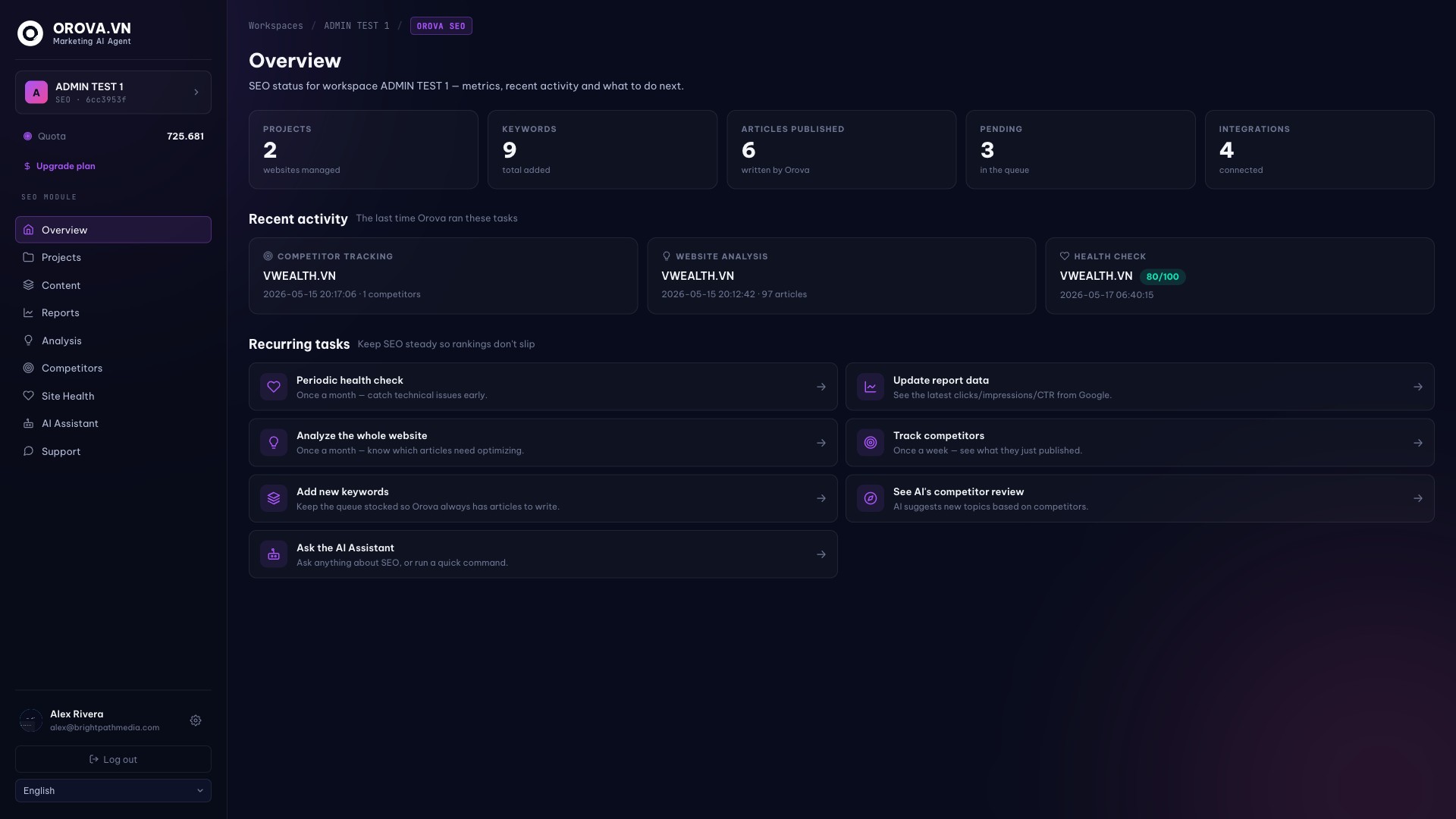
OROVA.VN just shipped version 2 — and I made the call to tear down the entire backend and rebuild the whole system from zero. That decision did not start from a roadmap. It started from a personal pain.
I originally built OROVA.VN to solve one thing: the actual operational work of SEO. Not the theory, not the strategy decks — the daily grind of getting one article researched, written, published, measured, and improved. The longer I sat in a Head of Marketing seat, the clearer it became that this grind is far heavier than anyone outside the work assumes. So before I explain what OROVA.VN does, I want to be honest about the problem it was built for.
Why SEO is brutally hard in SaaS
We are a software company. For one team member to truly understand the software our own company builds — and then use that understanding to persuade another business in their own voice — they realistically need one to two years of experience before the work is even passable.
The tech environment is not the loud, campaign-driven world of retail. In a consumer campaign for everyday essentials, impressions are the deciding factor. In SaaS, the deciding factor is whether the user receives a real, concrete value — and whether applying it actually brings revenue. A typical SEO writer finds this field very hard to crack. For software that is already popular, it is manageable. For software humans have only just invented, there is no sample content on the internet to copy from.
So an SEO team is genuinely hard to scale and hard to clone. It is a cost problem and an industry-specificity problem at the same time. Some SaaS products are global by nature — but no matter how good a writer is, they are limited by language. To produce the same content for a new market, you pay a great deal more just to reach new users, and you are right back to the product-and-operations problem all over again. It is a loop you cannot escape.
SEO is not just writing articles
Here is the thing people forget: SEO is not just writing articles. If it were only writing, life would be easy — optimise to two to four hours per article including quality illustrations, and done. It is never that. Here is everything that is actually hiding behind one SEO article.
1. Keyword research
You are juggling many tools — Google Search Console, Google Keyword Planner — plus external tools to see what competitors are publishing: SEMrush, Ahrefs, Screaming Frog, Surfer, and more.
2. Outline and tone of voice
You have to check all existing content on the site to avoid repeating ideas. Think about it: how many articles can a six-month new hire write inside a company with a ten-year SEO history? They cannot possibly remember everything published — so how do they avoid walking straight into duplicate content?
3. Writing in diverse voices
For someone with one to two years of experience, the writing is nearly the same every time; only the layout changes. How do you get genuinely multi-dimensional angles — humour, narrative, storytelling? Each voice demands practice and a real breakthrough from within the writer. Honestly, hiring more headcount just to get more perspectives on the same topic is a waste of money and budget.
4. Image design
SEO people are usually not designers. You open Canva or Photoshop to edit on top of an existing background — so you are flipping back and forth between writing and designing across many different tools. At a large company, the design team and the content team are separate. But a mid-size company cannot afford that many people to coordinate, so one content person does every single step.
5. Building internal links
An SEO article exists to rank on Google, drive clicks, and convert visitors. To convert them, we constantly route the reader toward other articles. But a site with thousands of articles is not unusual — so how can a human remember all of them, completely and logically? We can only pick the articles we happen to remember being impressed by. That is a bias in choosing which articles drive conversion. Often SEO skips internal linking entirely.
6. Publishing and arranging the words
Google has its own logic for reading an article — it is not "write it, copy-paste it onto the platform, done." The publishing stage itself demands deliberate choices to be SEO-correct: H1, H2, captions, lead-ins, all arranged the way Google likes most. And every time Google changes its algorithm, we have to re-tune each article. Algorithm shifts are not frequent — but now they have been joined by something bigger: AI Overview. Google now reads your site and answers the customer using you as a reference, instead of sending them to click your link. Publishing also means classifying, creating slugs, and tagging to the correct customer intent — and every project has its own intent rule set.
7. Pinging Google and other platforms
To get onto search engines, you switch over to their tools and manually declare each article. There is no automation. None.
8. Reporting and analytics
This is the SEO analyst's nightmare. For every piece of content — and a site with just 1,000 articles is small — you check the numbers over one day, one week, four weeks, one month, six months, one year to see what rose and what fell. Then you map that against search behaviour: click rate, retention, bounce-back-to-homepage rate, conversion rate. With 1,000 articles, how do you even read a weekly report? Many SEOs do not even have a tool to track their own performance, so they live blind and keep writing to hit the article KPI. Eventually you just accumulate piles of junk articles.
9. Site-wide optimisation
Once you have 1,000 articles, you can only really optimise when you can see an overview. Which keywords ranked top, which convert, which have high traffic but have not ranked? Some articles are excellent but have no traffic — do we optimise those or not? You have to break everything into primary and secondary keyword groups, look at the metrics that matter, and decide what to optimise and how. Not many companies in the world even reach this stage. Ten thousand articles is a number you simply cannot handle by hand.
10. Competitor research
Once you stabilise, the question you ask most is: what are competitors doing, what have they already written? A competitor-tracking tool costs an enormous amount — a thousand dollars a month — and still only gives a rough view. The competitor wrote A — am I ready to write B? And writing B loops you straight back to task one.
11. Technical SEO
Content is not tightly related to the technical layer — but you have to understand it to lay content out sensibly. Mobile and desktop load speed, caching, broken links, unindexed links, redirected links, missing meta descriptions, missing CTAs, missing contact buttons, security flags, embedded iframes — there are countless such things. Checking them by hand — until when, exactly?
And then there is the bill
If a business goes this far, the cost is beyond what words can say — it is a genuinely heavy investment in an SEO team. And every business knows it: SEO accounts for a large share of a company's revenue. That is how important the website is. But with a mountain of money poured into tools and people, all working in separate silos across dozens of disconnected apps — where is the time left to actually write? The vicious circle repeats forever: there is not enough energy to wait for analysis because the numbers are missing, and with no analysis, you keep writing blind.
So I built OROVA.VN
From the vantage point of someone in a Head of Marketing seat, I wanted to solve the problems my own team was hitting first — and that is how OROVA.VN came to be. I came up through real-world execution, and the number I measure by is revenue, so I have a perspective that has scraped up against SEO's pain very closely.
OROVA.VN runs the whole loop: self-analyse, research, propose, plan keywords, write articles, optimise, reference competitors, ping Google — and around again.
What I built is not just a set of tools. I built an AI Agent. You talk to the AI and it carries out the full set of tasks for you — and if you prefer to operate things manually, you still can. One capable person wielding an AI Agent can produce the leverage of a whole team: it responds in seconds with all the data. Everything you used to live through over years is now resolved in an instant.
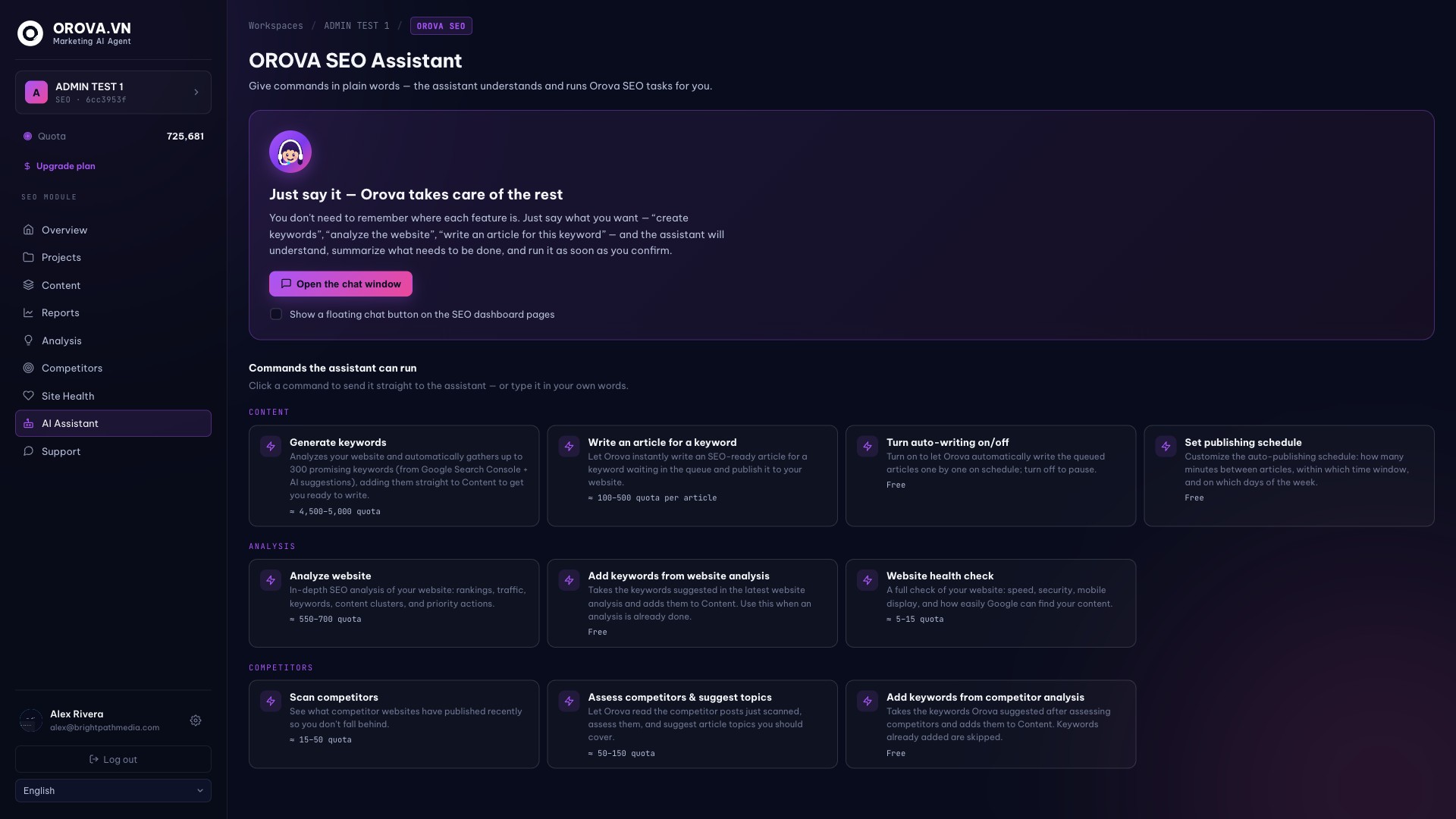
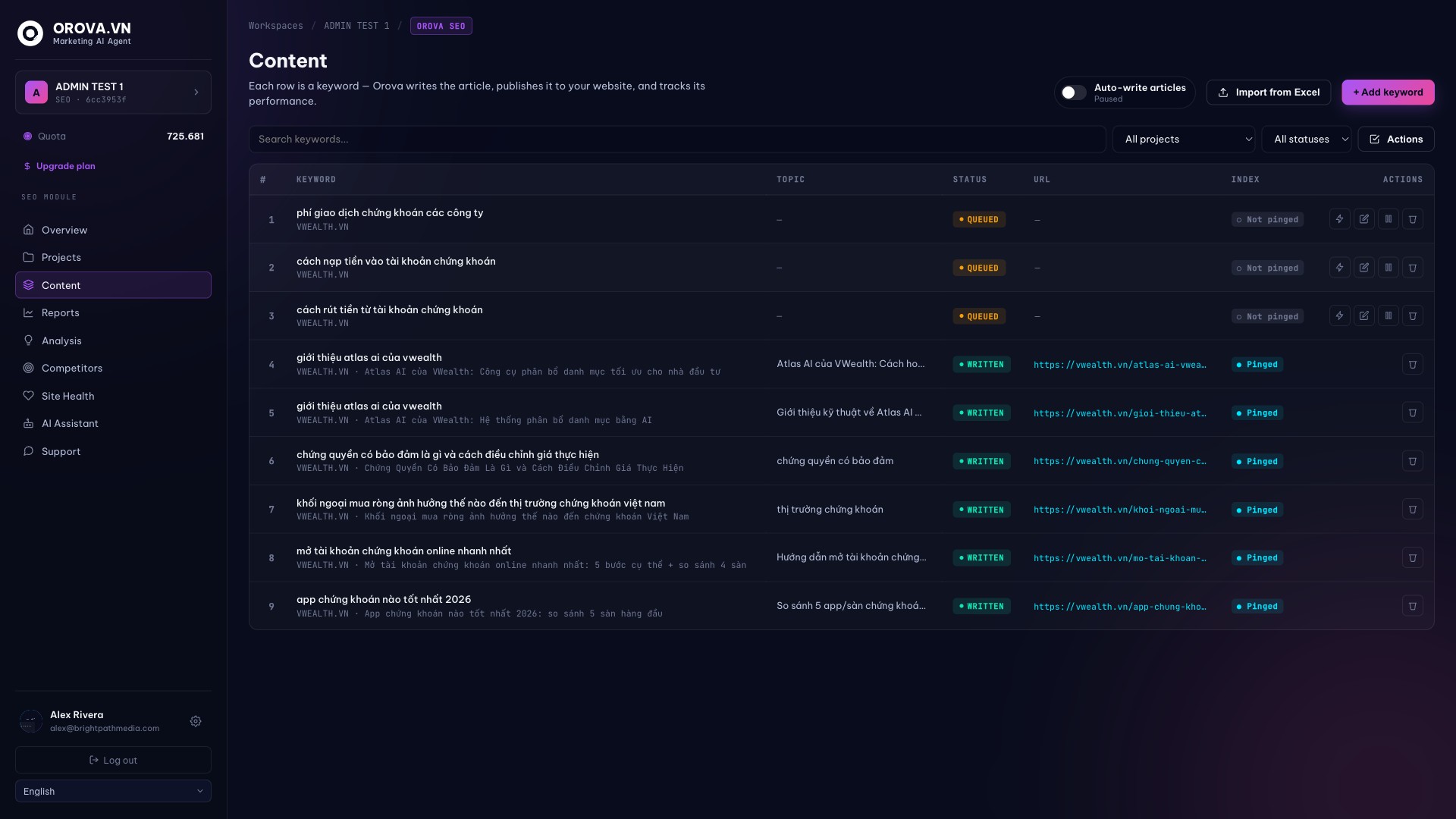
One person, the output of a content team
This is where tasks one through seven collapse into a single screen. Each row is a keyword; OROVA writes the article, publishes it to your website, and tracks how it performs. The back-and-forth across a dozen tools becomes one queue you can watch.
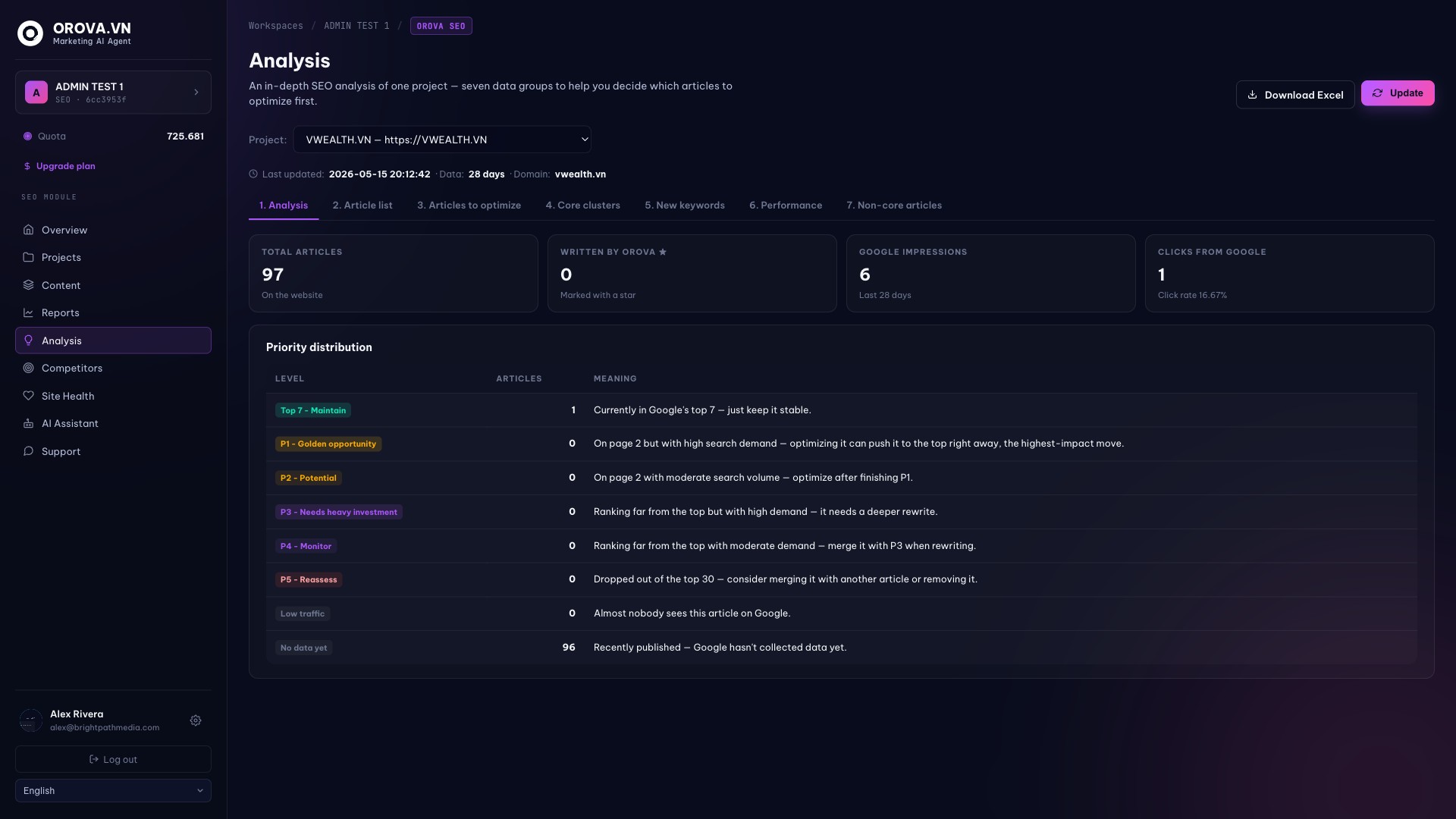
Reporting and site-wide optimisation you can act on
Tasks eight and nine were the heaviest of all — the part where humans give up and write blind. OROVA reads the whole site, groups articles by priority, and tells you plainly what to optimise and why: which articles sit just below the top, which need a heavier rewrite, which to reassess.
Competitors and technical health, watched continuously
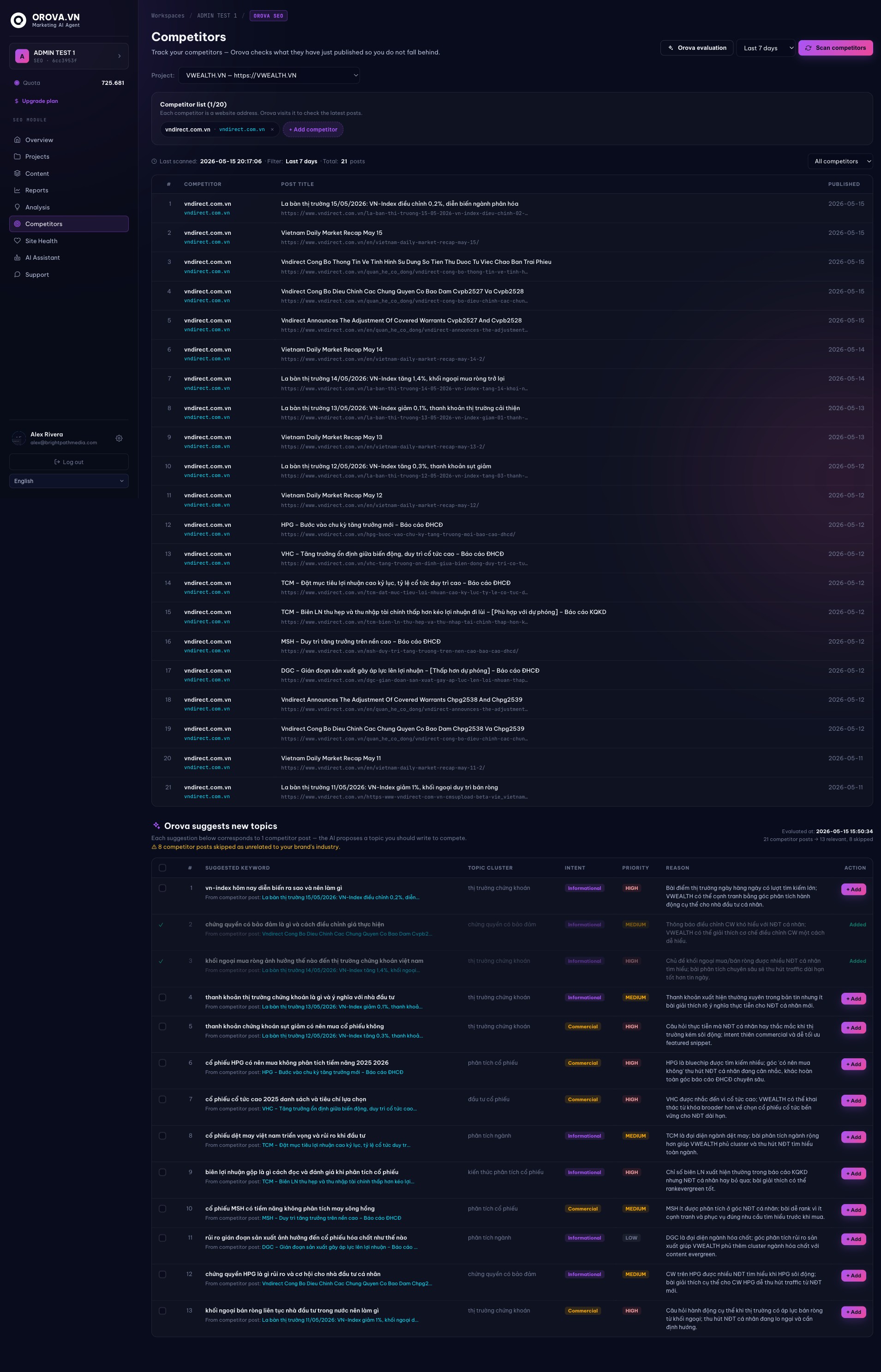
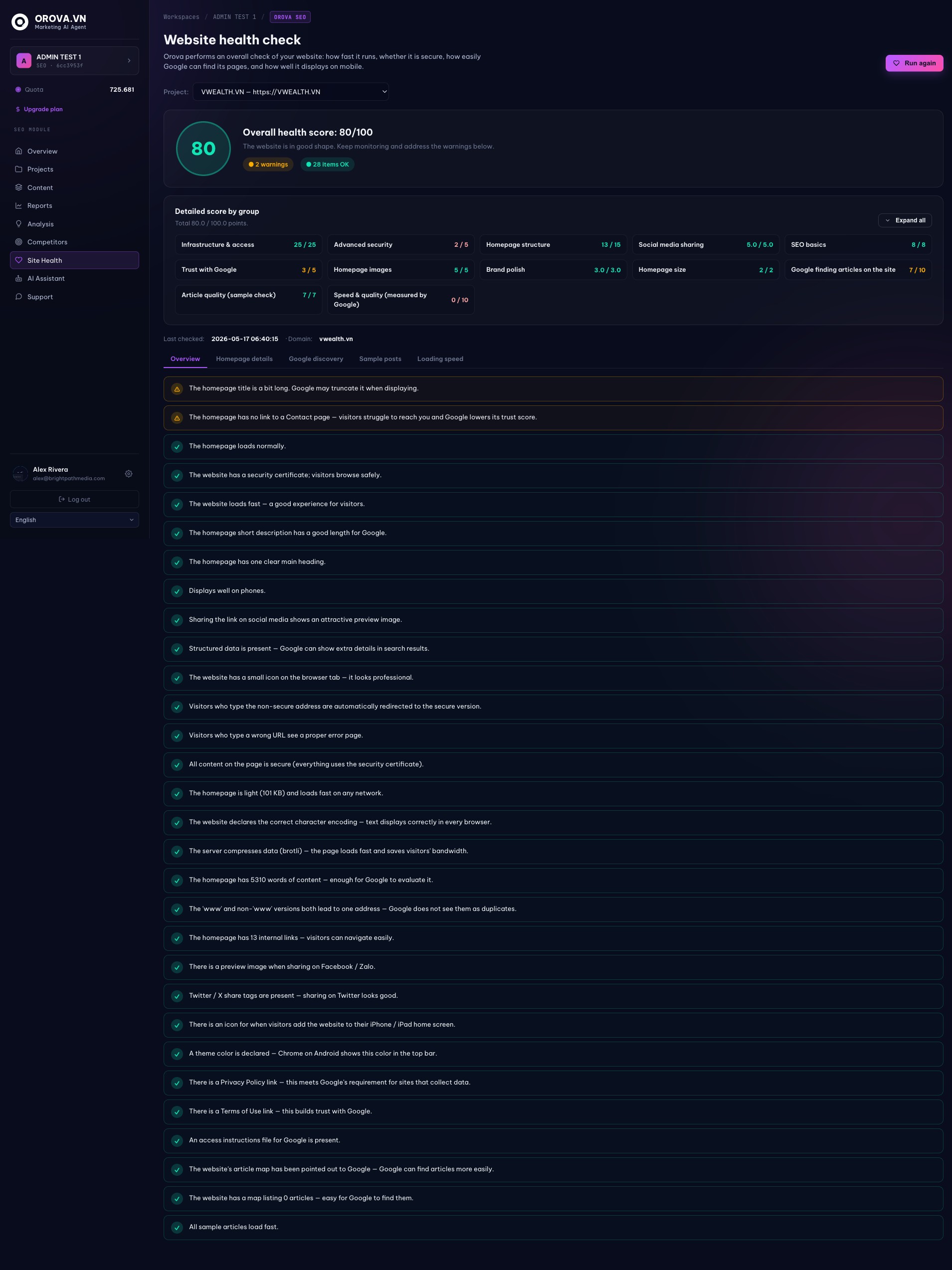
Tasks ten and eleven do not wait for a quarterly audit anymore. OROVA tracks competitors, flags topics they rank for that you do not, and runs a full technical health check on the website — speed, security, broken links, structure — scoring it out of 100 with clear warnings.
A complete AI for an entire marketing department
That is roughly OROVA SEO. I am aiming for something larger: a complete AI for an entire marketing department. OROVA Ads and OROVA Social are being built on top of this foundation. That is exactly why I accepted wiping all the old data to upgrade the backend — for a farther vision, because OROVA can solve far more problems than SEO alone.
If you have ever felt submerged in the SEO pile — the eleven jobs hiding behind one article, the silos, the blind writing — you are not alone. That feeling is the entire reason OROVA.VN exists.
Let an AI Agent handle your SEO
Orova plans, writes, optimizes, and tracks rankings on its own — you just read the results.
Try it free