
Topic Clusters: How to Structure Content So Google Ranks Your Whole Site

Most content teams share the same instinct when traffic stalls: publish more. More posts, more keywords, more words shipped every week. Yet six months later the graph is still flat. The problem is rarely volume — it is structure. Search engines do not reward a pile of loosely related articles. They reward sites that demonstrate genuine depth on a subject, and they surface the single page that most clearly matches a searcher's intent.
That is exactly what a topic cluster is built to do. Instead of treating every post as a standalone bet, a cluster organises your content into a deliberate shape that both Google and your readers can navigate. This guide explains what topic clusters are, why they work, and how to build your first one — step by step, with the mistakes to avoid along the way.
What is a topic cluster?
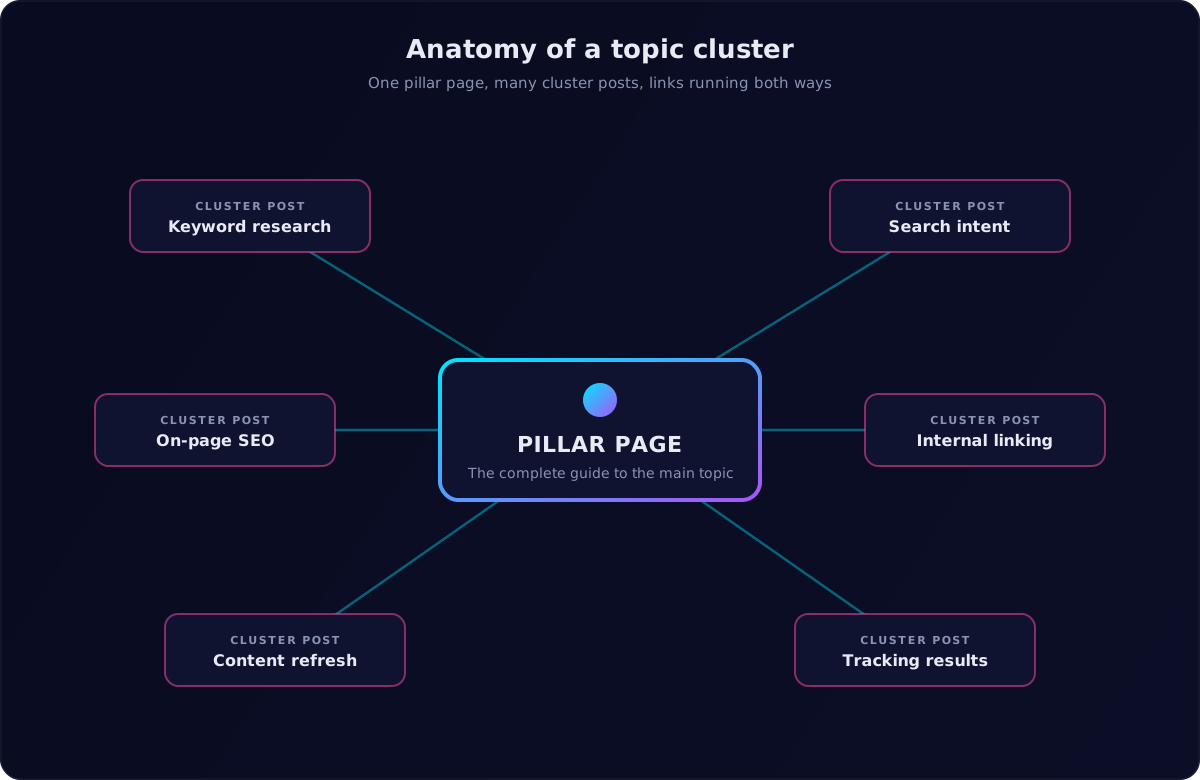
A topic cluster is a group of related pages organised around a single broad subject. It has three parts: one pillar page that covers the broad topic at a high level, a set of cluster pages that each go deep on one narrow sub-topic, and the internal links that connect every cluster page to the pillar and back again.
Think of it as a hub and its spokes. The pillar is the hub — a comprehensive, evergreen page on something like "email marketing" or "SEO content strategy." The spokes are focused articles answering the questions that sit underneath that subject: how to write subject lines, how to segment a list, how to measure open rates. None of these pages competes with the others. Each one owns its own search query, and together they signal to search engines that your site covers the entire subject, not just a slice of it.
The shift sounds small, but it changes how you plan content. You stop asking "what should I write next?" and start asking "what subject do we want to be the obvious answer for, and what pages does that subject need?"
Why topic clusters work
Topic clusters are not a trick or a temporary loophole. They work because they line up with how modern search actually operates — and with how real readers behave once they land on your site.
They build topical authority
Search engines try to estimate how much a site can be trusted on a given subject. A single article on "keyword research" is a weak signal. Fifteen interlinked articles covering keyword research, search intent, competitor gaps, and seasonal demand — all pointing to one authoritative pillar — is a strong one. Demonstrated depth across a subject is what earns a site the benefit of the doubt on competitive queries it could never win with one page alone.
They match search intent precisely
When you stretch one long page to rank for many different queries, it usually serves none of them well. Cluster pages let each query get a page written specifically for it. The searcher lands on something that answers their exact question, which improves time on page, scroll depth, and the odds they keep reading. Those engagement signals quietly feed back into how your pages perform over time.
They spread ranking power
Internal links pass authority between pages. When one cluster page earns a backlink from another site, that value flows along your internal links to the pillar and out to sibling pages. A well-linked cluster lifts every page in it — not just the one that happened to attract the attention. This compounding effect is the real reason clusters outperform scattered posts.
They make content planning sustainable
A blank content calendar is intimidating, and it quietly pushes teams toward whatever feels urgent that week. A cluster turns planning into a finite checklist: the subject is fixed, the sub-topics are already mapped, and the job becomes simply working through them. That structure is easier to brief, easier to delegate, and far easier to keep going for the months it takes search results to respond. Half the reason clusters succeed is not the SEO theory — it is that they make consistent publishing achievable.
The three building blocks, in detail
It is worth being precise about what each part of a cluster needs to do, because most failed clusters fail on one of these three points.
The pillar page is broad but not shallow. It should give a complete overview of the subject — enough that a newcomer can read it alone and feel oriented — while linking out to cluster pages for the depth. A good pillar is long, well-organised, and updated regularly. It targets a high-level, higher-volume keyword that would be almost impossible to rank for with a thin page.
Cluster pages are narrow but thorough. Each one targets a specific long-tail query and answers it better than anything else on the first page of results. A cluster page should never try to cover three sub-topics at once — if it does, it is really three pages wearing a trench coat, and it will be outranked by competitors who gave each query its own focused article.
Internal links are the part teams forget. Every cluster page links up to the pillar, usually with descriptive anchor text. The pillar links down to every cluster page it summarises. And where it makes sense, cluster pages link to each other. Without this linking, you do not have a cluster — you have a folder of unrelated posts that Google has no reason to treat as a set.
How to build your first topic cluster
You do not need to rebuild your whole site. Start with one cluster, prove the model, then repeat. Here is the sequence that works.
- Choose a subject you can realistically own. Pick something central to your business that you can cover better than larger competitors. It should be broad enough to support ten or more articles, but specific enough that you are not competing with the entire internet. "Marketing" is too broad; "local SEO for restaurants" is a cluster you can win.
- Map the sub-topics. List every question, task, and decision a person works through within that subject. Pull ideas from keyword tools, from the "People also ask" box, from sales calls, and from support tickets. Group similar questions together — each group is a candidate cluster page.
- Confirm search intent for each one. Search the target query and look at what already ranks. If the results are all how-to guides, your page must be a how-to guide. If they are comparison pages or tools, a how-to guide will not rank no matter how good it is. Match the format the results are already rewarding.
- Write the pillar page. Build the comprehensive overview that ties the subject together. Structure it with clear headings that mirror your sub-topics, so it reads as a natural table of contents for the cluster you are about to publish.
- Publish cluster pages on a steady cadence. Ship them consistently rather than all at once. Each new cluster page should link up to the pillar as soon as it goes live, and the pillar should be updated to link down to it. Consistency matters more than speed here.
- Wire the internal links deliberately. Once a few pages exist, review the whole cluster and add sibling links where one page naturally references another. Use descriptive anchor text — "search intent" rather than "click here" — so both readers and crawlers understand the relationship.
The order matters. Teams that publish cluster pages first and "get to the pillar later" almost never get to the pillar, and the cluster never sets properly.
A worked example
Imagine a company that sells project-management software and wants to own the subject of "remote team management." That phrase becomes the pillar — a thorough, evergreen guide covering what remote management involves, why it differs from managing in an office, and the areas a manager has to get right.
From there, the sub-topics almost write themselves. Each area a remote manager struggles with becomes a cluster page: running effective stand-ups, setting expectations across time zones, onboarding someone you will never meet in person, measuring output instead of hours, and keeping culture alive without a shared office. That is already five focused articles, each targeting a real long-tail query a manager would type into Google at 9 p.m. while worrying about exactly that problem.
Checking intent reshapes a couple of them. The query "remote team management tools" turns out to return listicles and comparison pages, not advice — so that page becomes a comparison, not a how-to guide. "How to measure remote team productivity" returns step-by-step guides, so that one stays a guide. Each page is then written, linked up to the pillar, and cross-linked where it helps: the onboarding article naturally references the expectations article, and both point home to the pillar.
Nine months later, the pillar is not merely ranking for its head term — it has become the page the company is known for, and every cluster page funnels readers toward the product without a single one of them reading like a sales pitch. That is the quiet payoff of structure: the cluster sells by being genuinely useful.
Mistakes that quietly kill a cluster
A cluster rarely fails loudly. It just underperforms, and the cause is usually one of these:
- Keyword cannibalisation. Two cluster pages target the same query. Google cannot tell which one to rank, so it splits signals between them and both stay on page two. Each page must own a distinct query.
- An orphaned pillar. The pillar exists but cluster pages do not link back to it, or the pillar never got updated to link out. The hub-and-spoke shape only works if the spokes are actually attached.
- Thin cluster pages. Publishing a 400-word post for a query that needs a thorough answer. Depth is what wins long-tail queries; a thin page invites a competitor to take the spot.
- No maintenance. A cluster is not "done" at publication. Rankings drift, facts age, and competitors improve. Clusters need scheduled refreshes to hold their positions.
- Chasing volume over coherence. Adding pages that are only loosely related dilutes the topical signal instead of strengthening it. A focused cluster of twelve beats a fuzzy cluster of thirty.
How to know your clusters are working
Give a cluster three to six months before judging it — topical authority builds slowly. When you do review it, look beyond the ranking of a single page.
The clearest signal is movement across the whole cluster: average position improving for the group, not just one lucky post. Watch impressions for the pillar's head term — even if it is not yet on page one, rising impressions mean Google is starting to consider it. Check that each cluster page is gaining clicks for its own intended query rather than several pages competing for one. And track internal-link engagement: if readers move from cluster pages to the pillar and back, the structure is doing its job for humans, not just crawlers.
If one page is stuck, diagnose it individually — intent mismatch, thin content, or a missing link — rather than rewriting the whole cluster.
It also pays to set a baseline before you start. Note the total clicks and average position for the handful of pages that already cover the subject. A cluster's real success is the lift against that baseline over two or three quarters — not whether one post reached the first page in its third week. Judging a long-term structure by a short-term metric is the fastest way to abandon something that was just about to start working.
Where an AI agent fits in
The hard part of cluster building is not the idea — it is the sustained execution. Mapping sub-topics, checking intent on every query, publishing on a steady cadence, keeping internal links current, and refreshing pages before they slip all demand consistent attention that busy teams rarely have to spare.
This is the kind of structured, repeatable work an AI agent handles well. Orova plans the cluster, drafts each page against its target query, keeps the internal links coherent, and flags pages that need a refresh — so the structure stays intact while you focus on strategy. The model is simple and proven; the value is in running it without gaps. Pick one subject you can own, build the cluster properly, and let the compounding do the rest.
Let an AI Agent handle your SEO
Orova plans, writes, optimizes, and tracks rankings on its own — you just read the results.
Try it free