
The Content Refresh Playbook: Turn Old Posts Into New Wins
Most content teams have a strong instinct for what comes next and a weak instinct for what already exists. Ask anyone what they are working on and you will hear about the upcoming article, the new cluster, the next launch. Ask them about the post they published eighteen months ago that used to rank well and now sits quietly on page two, and you will usually get a blank look. The archive is treated as finished work — published, filed, forgotten.
That is a costly habit, because an existing page that once ranked is the single best content investment available to you. It already has a track record, often has links, and has been evaluated by search engines and judged worthy at least once. Reviving it is faster, cheaper, and more reliable than writing something new from scratch. This article is a complete playbook for the content refresh: how to find pages worth refreshing, what a real refresh actually changes, and how to do it without losing the equity the page has already earned.
Why a refresh beats a new post
Start with the economics, because they are the whole argument. A brand-new article begins life with nothing. No history, no links, no accumulated trust, no proven ability to satisfy searchers. It has to earn all of that from zero, and earning it takes months — if it happens at all.
A page worth refreshing begins with all of that already in place. It has a history of ranking. It may have backlinks pointing at it. It sits in your internal link structure. Search engines have a settled opinion of it, and that opinion has at some point been favourable. When you refresh such a page, you are not building from nothing — you are upgrading an asset that already has a foundation. The ceiling is higher and the climb is shorter. A good refresh can lift a page from page two back to page one in weeks, a result a new article rarely matches in that time.
This is why a mature content strategy spends a meaningful share of its effort looking backward. The archive is not a graveyard. It is a portfolio of assets, most of which depreciate quietly unless someone maintains them.
Why pages decay in the first place
To refresh effectively you need to understand why a page that once ranked stops ranking. Decay is not random; it has identifiable causes, and each one points to a different fix.
The most common cause is the content simply going out of date. The page describes a process, a tool, or a landscape that has changed. The advice is no longer fully correct, the screenshots show an old interface, the examples feel dated. The reader senses staleness within seconds, and search engines, which favour fresh and accurate information for many queries, gradually demote it.
The second cause is the competition improving while you stood still. Your page has not got worse in absolute terms. Everyone else's got better. Three competitors published deeper, clearer, more complete pages on the same topic, and relative to them yours slipped — even though you changed nothing.
The third cause is shifting search intent. What people want from a query evolves. A keyword that two years ago wanted a definition now wants a comparison, or a tutorial, or a tool. Your page still answers the old version of the question. The query moved; the page did not.
Naming the cause matters because it dictates the fix. An out-of-date page needs updating. A page outclassed by competitors needs deepening. A page hit by intent drift needs reframing. A refresh that does not first diagnose the cause is just editing at random.
Step one: find the pages worth refreshing
Not every old page deserves a refresh, and spreading the effort evenly across the archive wastes most of it. The highest return comes from a specific kind of page.
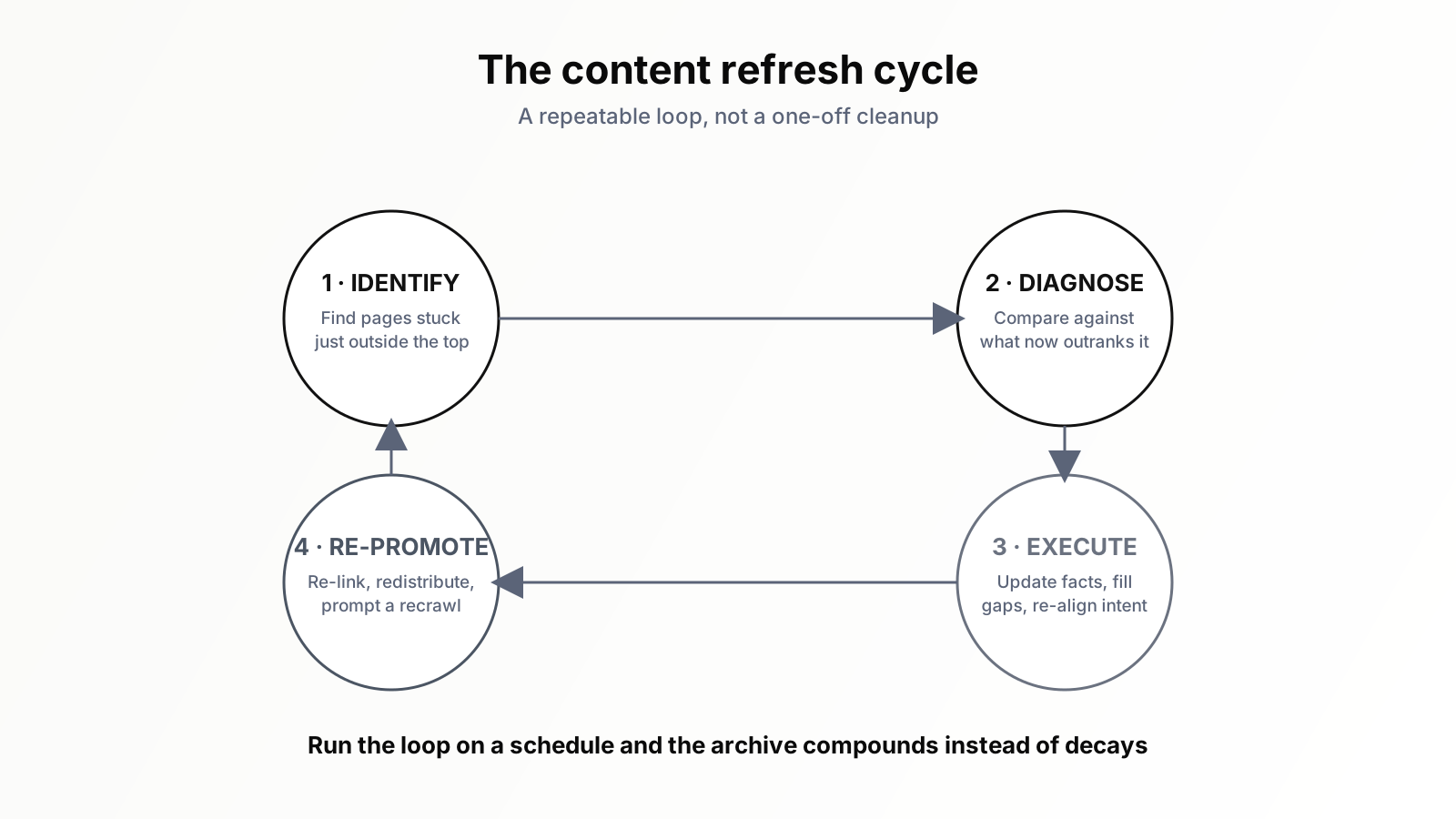
The prime candidate is the page ranking just outside the top results — positions roughly in the eight-to-twenty band — for a query that matters to you. This page is close. Search engines already consider it relevant; it is simply being narrowly beaten. A modest, well-aimed improvement can be the difference between invisible and visible, and on those positions the traffic difference between page two and the bottom of page one is enormous.
The second candidate is the page that has visibly declined — one that used to rank well and has slid. The decline itself is a signal that something specific broke, and broken things can be fixed.
The pages to deprioritise are the ones with no ranking history at all and no links — those are usually pruning or rewriting candidates, not refresh candidates. The refresh playbook is about reviving pages with a pulse, not resurrecting the truly dead.
Step two: diagnose before you edit
With a candidate page chosen, resist the urge to start editing immediately. The refresh that works begins with an honest diagnosis, comparing your page against what currently ranks above it.
Open the top results for the target query and read them as a searcher would. What do they cover that your page does not? Are they more current? More specific? Better structured? Do they answer follow-up questions yours leaves hanging? Then look at your own page with the same cold eye: which facts are stale, which sections are thin, which parts no longer match what the query is actually asking for. The output of this step is a short, concrete list of what is wrong — the brief for the refresh. Skipping diagnosis is how refreshes turn into cosmetic edits that change the publish date and nothing else.
Step three: execute a real refresh
A real refresh is substantive. Changing the date at the top of the page and tweaking a sentence is not a refresh — search engines are not fooled by a date, and neither are readers. A genuine refresh does the work the diagnosis identified.
That usually means several things at once. Updating every fact and example so nothing on the page is wrong or dated. Filling the gaps — adding the sections, the depth, the follow-up answers that the top-ranking competitors have and you lack. Re-aligning to intent if the query has shifted, which may mean restructuring the page so its shape matches what searchers now expect. Improving structure and readability — better headings, clearer formatting, a stronger opening. And tightening — cutting the padding and outdated tangents so what remains is sharper.
The standard to hold yourself to is simple and demanding: after the refresh, the page should genuinely deserve to outrank the pages currently above it. Not "look updated." Be better. If the refreshed page is not honestly stronger than its competition, the refresh is not finished.
Step four: re-promote and re-link
A refreshed page sitting silently in the archive is a job half done. The final step makes sure the work is noticed.
Re-promotion has a few parts. Internal links first: point fresh internal links at the refreshed page from relevant newer content, which both signals importance and speeds up recrawling. Re-distribution next: a substantially refreshed page is, in effect, new — share it again, send it to your audience, treat it as a fresh asset because it now is one. And recrawl prompting: make sure search engines are nudged to come back and re-evaluate the page, so the improvement registers sooner rather than whenever the crawler happens to wander past.
This step is where many refreshes quietly fail. The page genuinely got better, but nothing was done to draw attention to the change, so it took months for search engines to notice — and the team concluded that refreshing "does not work." It does. It just needs the promotion step the team skipped.
How to know a refresh worked
A refresh is not finished when you hit publish. It is finished when you have confirmed it did what it was supposed to do — and that requires knowing in advance what success looks like.
Before refreshing a page, write down the specific outcome you expect: this page should move from its current position into the top results for its target query, and its organic traffic should rise as a result. That stated expectation is what you measure against. After the refresh, give the change a fair window — search engines need weeks, not days, to recrawl and re-evaluate — and then look honestly at whether the page moved. If it did, the diagnosis and execution were sound, and you have a repeatable pattern to apply to the next candidate. If it did not, the refresh is not a failure to forget about; it is information. It usually means one of two things: the diagnosis missed the real reason the page was losing, or the execution was too shallow to genuinely outclass the competition. Either way, you go back, look again, and refresh harder. Treating every refresh as a measurable bet — with a stated expectation and an honest review — is what turns refreshing from a vague good habit into a discipline that visibly compounds.
The mistake of refreshing too lightly
The single most common way a refresh fails has nothing to do with finding the wrong page. It is refreshing the right page too lightly.
Under deadline pressure, "refresh this post" quietly degrades into "change the date and tidy a few sentences." The page looks updated. The publish date is current. And nothing happens, because nothing of substance changed. Search engines do not rank a page because its timestamp is recent; they rank it because it genuinely serves the query better than the alternatives. A cosmetic refresh changes the timestamp and not the substance, so the page keeps losing for exactly the reasons it was losing before — and the team concludes, wrongly, that refreshing does not work.
The cure is to hold every refresh to the standard stated earlier and to take it literally: after the refresh, the page must genuinely deserve to outrank the pages currently above it. That is a high bar, and it should be. If clearing it takes substantial work — new sections, real updates, a structural rebuild — then that is simply what the refresh required. A refresh that took an afternoon and changed almost nothing was never a refresh. It was a date change wearing a refresh's name, and date changes do not move rankings.
Building refresh into your routine
The single biggest reason content refreshes do not happen is that they are nobody's job. New content has owners, deadlines, and a place on the calendar. Refreshing is a vague good intention that loses every scheduling fight against shipping something new.
The fix is to make refresh a scheduled, recurring commitment rather than an occasional cleanup. That means deciding, deliberately, that a fixed share of content capacity goes to the archive every cycle — and putting refresh tasks on the calendar with the same weight as new posts. A team that commits, say, a quarter of its effort to maintaining what exists will, within a year, have an archive that compounds instead of decays. A team that always chooses the new post will keep publishing on top of a slowly rotting foundation, forever wondering why traffic plateaus despite a rising post count.
Where an AI agent fits
The refresh playbook is not complicated, but it is laborious at any real scale. Scanning an entire archive for pages stuck just outside the top results, spotting which pages have declined, diagnosing each one against its live competition, and turning that into specific refresh briefs is a large, repetitive analysis job. On a site with hundreds of posts, doing it by hand is the reason refresh stays a good intention.
This is exactly the kind of structured, ongoing monitoring an SEO AI agent handles well. Orova can continuously watch an archive for decaying and near-miss pages, flag the ones where a refresh would pay off most, compare each candidate against what currently outranks it, and draft a concrete refresh brief — what is stale, what is missing, where intent has shifted. The editorial judgement and the final writing stay with your team. What changes is that the archive is being watched continuously instead of remembered occasionally, so decay gets caught while a page is still close enough to recover cheaply.
Your best next article may already be on your site. It was published a while ago, it used to rank, and it has been quietly slipping while everyone looked forward. Find it, diagnose it, refresh it properly, and re-promote it. That is not a consolation prize for teams without ideas. It is, page for page, the highest-return work in content marketing.
Run your business with AI Agents
Orova is the always-on Biz AI Agent — it plans, runs, and optimizes the work for you. Save time, unlock productivity.
Try it free