
Google Ads Wasted Spend: Negative Keywords and Search-Term Hygiene at Scale
A plumbing company in Ohio once showed me a Google Ads account spending $14,000 a month. When we pulled the search terms report and sorted by cost, the single biggest line item — ahead of "emergency plumber near me," ahead of "water heater installation" — was the query "plumber salary." People researching whether to become a plumber were clicking ads meant for homeowners with a burst pipe. That one term, plus a handful of cousins like "plumbing apprenticeship" and "how to become a plumber," was burning roughly $1,900 a month. Nobody had looked at the report in four months.
This is what wasted spend in Google Ads actually looks like. It is rarely one dramatic mistake. It is a slow, quiet leak made of dozens of slightly-wrong queries, each costing a few dollars a day, adding up to a number that would make any finance team flinch if they saw it itemized. The mechanism behind the leak is well understood and entirely fixable. The reason it persists is more mundane: the work of fixing it is tedious, never finishes, and competes for attention with a hundred more visible tasks. That combination — high impact, low glamour, infinite repetition — is precisely the kind of work that should not be done by hand anymore.
Where wasted Google Ads spend actually comes from
Wasted spend has a precise definition that is worth stating plainly: it is money paid for clicks from searches that had no realistic chance of becoming a customer. Not low-converting clicks — those are a bidding and landing-page problem. Wasted spend is clicks from people who were never in your market at all. The plumber-salary searcher is not a weak lead. They are not a lead. And almost all of this category traces back to two interlocking sources.
Broad match is a faucet you forgot to close
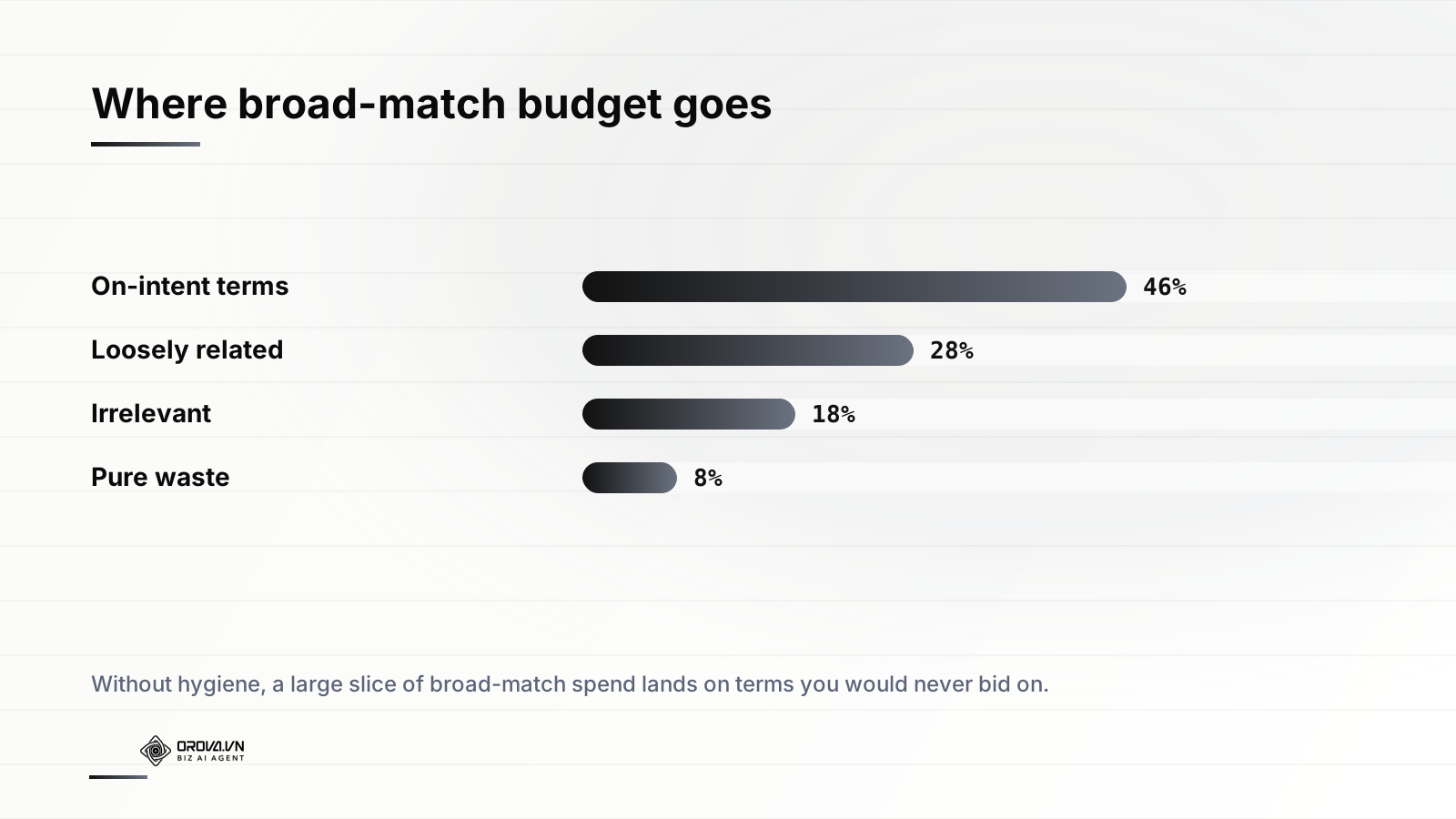
Over the last several years Google has steadily pushed advertisers toward broad match keywords, and the match type itself has grown far more aggressive. A broad match keyword no longer triggers ads only on close variants and synonyms. It triggers on anything Google's models judge to be related to the searcher's intent — which now includes the contents of the landing page, other keywords in the account, recent search behavior, and the broader topic of the query. The keyword "running shoes" can now match "best way to lace sneakers," "are barefoot shoes good for you," or "marathon training plan." Some of those are good. Some are a stretch. Some are pure waste.
None of this is inherently bad. Broad match paired with Smart Bidding and a strong conversion signal is genuinely the most powerful way to find demand you would never have thought to bid on. The problem is the default behavior of the faucet: it is open wide, and unless you actively shape the flow, it pours budget across the full distribution of "related" queries — including the long tail of loosely-related and irrelevant ones. Google's incentive is to spend your budget. Your incentive is to spend it on people who buy. Those incentives overlap a great deal, but not completely, and the gap between them is where wasted spend lives.
The search terms report is the ground truth
The keyword is what you bid on. The search term is what the person actually typed. The search terms report is the only place these two are reconciled, and it is the single most valuable, least-read report in the entire platform. Every dollar of wasted spend shows up there as a row: an actual query, the impressions and clicks it drove, the cost it incurred, and — if you have conversion tracking — whether any of those clicks ever turned into something. Reading this report is how you discover that "plumber salary" exists in your account at all. It is the difference between knowing your keywords and knowing your reality.
The catch is volume. A modestly-sized account running broad match can generate thousands of unique search terms a week, the overwhelming majority of which appear once or twice and never again. You cannot read them all. You cannot even skim them all. And the genuinely damaging terms are not always the ones at the top by cost — sometimes the damage is a hundred different one-dollar queries that share a single irrelevant word.
Negative keywords: the only real defense
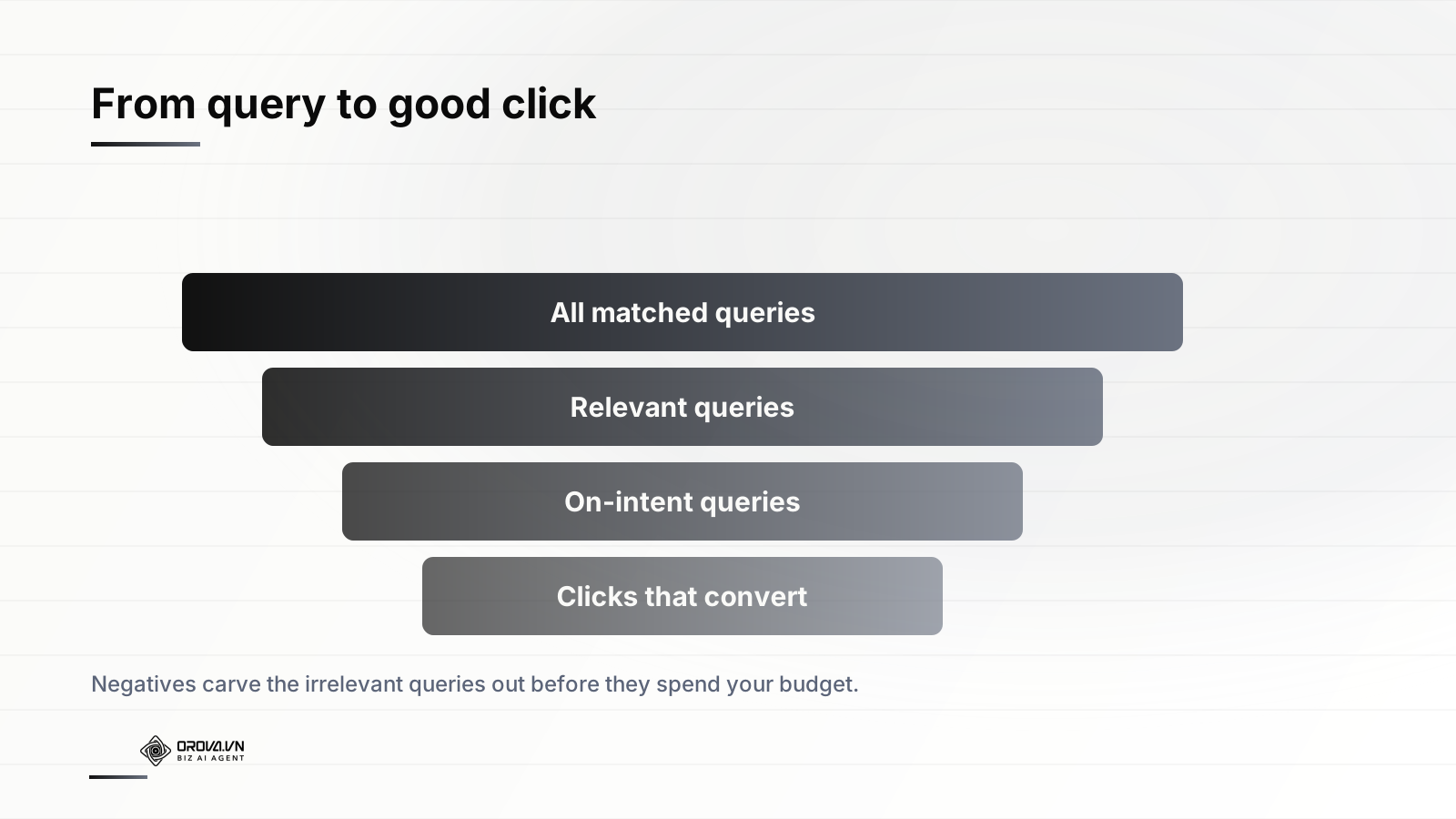
If broad match is the faucet, negative keywords are how you shape the stream. A negative keyword tells Google: no matter how related you think this query is, do not show my ad for it. Add "salary" as a negative and the plumber-salary leak closes, along with every future variation of it. Negatives are the most underused lever in Google Ads, and they are the highest-leverage one available, because a single well-chosen negative can block an entire family of wasteful queries at once and keep blocking them indefinitely.
Match types for negatives work backwards from what you expect
This trips up even experienced practitioners, so it is worth being explicit. Negative keyword match types are stricter, not looser, than their positive counterparts — and negatives never match close variants. A negative broad keyword blocks a query only if the query contains all the words in your negative, in any order. A negative phrase keyword blocks only if the query contains your exact phrase in order. A negative exact keyword blocks only the precise query, nothing else.
- Negative broad — add cheap free and you block any query containing both words. "free cheap software" is blocked; "cheap software" is not. Because negatives ignore close variants, "freebie" would still slip through.
- Negative phrase — add "customer service" and you block "att customer service number" but not "service for customers." Order matters.
- Negative exact — add [jobs] and you block only the standalone query "jobs," leaving "jobs near me" untouched.
Most practitioners default to negative phrase for blocking themes (like "free," "jobs," "salary," "DIY," "wikipedia") and negative exact for surgically removing one specific high-cost query without collateral damage. The mistake to avoid is going too broad with negatives and accidentally suppressing valuable traffic — adding "review" as a phrase negative might also kill "reviewing accounting software," which is exactly the buyer you want.
Negative keyword lists and account structure
Negatives can live at three levels: the ad group, the campaign, and as a shared negative keyword list applied across many campaigns. The shared list is the workhorse of any disciplined account. You maintain one master list of universal junk — competitor brand names you do not want to bid on, "free," "torrent," "jobs," "salary," adult terms, the names of unrelated products that happen to share a word with yours — and apply it everywhere at once. Then you keep tighter, campaign-specific negatives to prevent your own campaigns from cannibalizing each other (so your "enterprise" campaign and your "small business" campaign do not bid against each other on the same query).
A clean negative architecture is not a one-time project; it is a posture. The shared lists grow continuously as you discover new categories of waste, and the campaign-level negatives get tuned as your campaigns evolve. Which brings us to the real problem — not what to do, but how to keep doing it.
Why manual search-term hygiene fails at scale
Every account manager knows they should review the search terms report. Many of them genuinely intend to. The work still does not happen consistently, and understanding why is the key to fixing it. The failure is structural, not a matter of discipline or skill.
The math does not work
Consider a media buyer managing fifteen client accounts, each with a dozen campaigns running broad match. Reviewing search terms properly means, per account, exporting the report, filtering out terms already covered by existing negatives, scanning the remainder for irrelevant patterns, deciding the right match type and level for each new negative, and adding them without accidentally blocking valuable traffic. Done thoroughly, that is thirty to sixty minutes per account. Across fifteen accounts, that is most of a working day every single week, spent on a task with no visible deliverable — no campaign launched, no report sent to the client, nothing to point at. It is the first thing to get postponed, and postponement compounds.
Hygiene is endless by nature
This is the part that makes the work psychologically draining. You can finish building a campaign. You can finish a landing page. You cannot finish search-term hygiene, because the moment you close one set of wasteful queries, the broad-match models begin testing new related queries, some of which will be wasteful in ways you have not seen before. Searchers invent new phrasings constantly. Trends introduce new junk terms overnight. The faucet never stops, so the shaping never stops. Tasks that never end are exactly the tasks humans are worst at sustaining, and the consequence is that hygiene happens in frantic bursts after someone notices the cost-per-acquisition creeping up, rather than as the steady background process it needs to be.
Pattern blindness across thousands of rows
Even when someone does sit down with the report, the human eye is poorly suited to the task. The damaging signal is often not a single expensive term but a pattern distributed across many cheap ones. Forty different queries might each contain the word "manual" — "user manual," "instruction manual," "manual download" — each costing a dollar or two, none individually alarming, collectively a $60-a-week leak that no amount of sorting-by-cost will surface. Spotting that requires you to mentally aggregate words across thousands of rows, which is something humans do badly and computers do trivially.
N-gram analysis: thinking in words, not terms
The technique that breaks the pattern-blindness problem is n-gram analysis, and it is the single most useful analytical method for search-term hygiene. The idea is simple. Instead of analyzing whole search terms, you break every term into its component words (unigrams), word pairs (bigrams), and word triples (trigrams), then aggregate cost and conversions at the word level.
Take three search terms: "free invoice software," "free accounting tool," and "best free crm." Term-by-term, none stands out. But run an n-gram analysis and the unigram "free" jumps to the top — it appears across all three, accumulating cost while converting at near zero. Now you have a decision to make about one word that affects dozens of queries, instead of dozens of separate decisions. That is the leverage. You stop fighting individual fires and start finding the gas line.
How to read an n-gram table
A useful n-gram analysis sorts words and phrases by total cost and shows alongside each one the conversions, conversion value, and cost-per-conversion they accumulated. The patterns you are hunting for are these:
- High cost, zero conversions — a word that absorbed real spend and produced nothing. These are your strongest negative-keyword candidates. "Salary," "jobs," "free," "DIY" frequently show up here.
- High cost, terrible cost-per-conversion — a word that does occasionally convert but at a ruinous rate, dragging down the account average. These need judgment rather than an automatic block; sometimes the right move is a separate campaign with its own budget cap.
- Surprisingly strong performers — n-gram analysis is not only a defensive tool. Sometimes a word converts beautifully, telling you to build a dedicated campaign or ad group around it and bid more confidently.
The discipline of thinking in words rather than terms is what makes hygiene tractable at scale. It collapses thousands of unique search terms into a few hundred meaningful word-level decisions, and it surfaces exactly the distributed patterns that defeat manual review. It is also, conveniently, an entirely mechanical process — which is the whole point.
Why this is work for an AI agent
Step back and look at the shape of search-term hygiene. It runs on a fixed, well-defined dataset (the search terms report). It applies a consistent analytical method (n-gram aggregation against cost and conversion data). It produces a clear class of output (negative keyword recommendations with a match type and a level). It must run continuously, forever, because the underlying stream never stops. And the bottleneck is not judgment — most negative decisions are obvious once the pattern is visible — but the sheer relentless volume of looking.
That profile describes the ideal job for a software agent and a near-worst job for a person. A human reviewing search terms gets tired, gets bored, skips weeks, and misses distributed patterns. An agent does not get tired, does not skip weeks, and finds distributed patterns by default because aggregation is what computers are for. This is not about replacing the strategist. It is about taking the dull, infinite, error-prone layer of the job off the strategist's plate so their attention goes to the decisions that genuinely need a human — offer, positioning, creative, which markets to enter.
What "AI mining search terms continuously" really means
The meaningful version of this is not a once-a-month export and a tidy report. It is a process that runs every day, looks at yesterday's new search terms, runs the n-gram math against each campaign's conversion data, and flags the patterns worth acting on while they are still small. The difference between catching "plumber salary" on day two versus day ninety is the difference between a $40 leak and a $1,900 one. Speed of detection is most of the value, and speed is the one thing manual review can never provide because the report does not read itself.
There is a quality dimension too. An agent can hold the entire account's structure in view at once — the shared negative lists, every campaign's positives and negatives, the cross-campaign overlap — and so it avoids the classic human errors: adding a negative that conflicts with a positive keyword you are deliberately bidding on, or blocking a term in one campaign while paying for it in another. It can check its own recommendations against the full context before it ever proposes them. This kind of whole-account awareness is also why the smartest version of paid-media management is not siloed by platform but coordinated, the way we have argued for running cross-platform ad management with one brain rather than separate tools fighting over the same budget.
Keeping a human in the loop where it matters
Full automation of negatives sounds appealing until you remember the asymmetry of the mistake. A missed negative costs you a few dollars. A wrong negative can silently suppress your best-converting traffic and you might not notice for weeks. That asymmetry is the argument for human-in-the-loop. The clearly-junk negatives — "salary," "free," "torrent," obvious off-topic words with high cost and zero value — can be handled aggressively and automatically. The borderline cases — a word that occasionally converts, a term that might be a competitor brand or might be a generic descriptor — should be surfaced as recommendations a person approves with one click, with a plain-language reason attached: "this word cost $312 across 47 queries and produced zero conversions in 30 days." The human keeps veto power; the agent does the looking.
A practical hygiene workflow you can run today
Whether you automate this or do it by hand, the workflow is the same, and writing it down is the first step to making it consistent.
- Set a cadence and never break it. Daily for high-spend accounts, weekly at minimum for everything else. The cost of a missed week scales with your daily budget.
- Always run n-grams, not just term-by-term scanning. Sort word-level cost descending and start at the top. This is where the distributed leaks hide.
- Maintain shared negative lists as living documents. Universal junk goes on a master list applied account-wide; campaign-specific negatives prevent self-competition. Review the lists quarterly to make sure none have grown so broad they suppress good traffic.
- Mine for winners while you are in there. Hygiene is the same report that reveals your best-performing queries. Promote the strong ones into their own ad groups with tighter, higher-intent targeting.
- Log every change with a reason. When CPA moves, you want to know which negatives you added and why. An audit trail turns hygiene from guesswork into a measurable practice.
- Resist over-blocking. Before adding any negative, ask whether it could plausibly appear in a valuable query. When in doubt, use a tighter match type or block at the campaign level rather than account-wide.
None of this is intellectually difficult. That is the whole point. It is easy to understand and brutally hard to sustain by hand across many accounts, week after week, without it slipping. The leak is not caused by ignorance. It is caused by the gap between knowing what to do and having the bandwidth to do it relentlessly forever.
The bottom line
Wasted spend in Google Ads is not a mystery and it is not unavoidable. It comes from broad match pouring budget across the full range of related queries, and it is shaped by negative keywords informed by honest reading of the search terms report. The technique that makes that reading tractable is n-gram analysis. The reason most accounts leak anyway is that the work is dull, endless, and pattern-heavy in exactly the ways humans handle poorly — and that is the strongest possible argument for handing the relentless part to software while keeping the judgment with a person. Close the faucet a little every single day, and the leak that quietly cost that Ohio plumber $1,900 a month never gets the chance to start.
If you would rather have an agent mine your search terms every day than rediscover this report once a quarter, that is exactly what Orova Ads does. It reads your Google, Meta, and TikTok data daily, runs the n-gram and conversion analysis for you, and recommends the negatives, budget shifts, bid changes, and audience moves worth making — then executes the ones you approve, with human-in-the-loop sign-off and a full audit log of every change. The dull, infinite hygiene runs on its own; you keep the strategy and the final word.
Run your business with AI Agents
Orova is the always-on Biz AI Agent — it plans, runs, and optimizes the work for you. Save time, unlock productivity.
Try it free