
Google + Meta + TikTok in One Brain: The Case for Cross-Platform Ad Management
Open your browser right now and count the tabs. If you run paid acquisition for a growing business in 2026, there is a good chance three of them are Google Ads, Meta Ads Manager and the TikTok Ads platform. Each one is open because each one holds money you are responsible for, and none of them will tell you what the other two are doing. That is the quiet tax of modern advertising: not the platforms themselves, but the gap between them. A campaign that doubled its cost-per-acquisition overnight on TikTok will sit there bleeding budget for hours simply because you happened to be staring at the Google tab when it happened.
Cross-platform ad management is the discipline of closing that gap — treating Google, Meta and TikTok not as three separate jobs but as one budget, one set of goals and one decision flow. It sounds obvious. In practice almost nobody does it well, because the tools were never built to cooperate and the human in the middle can only look at one screen at a time. This article is about why that matters more than most marketers admit, where the real losses come from, and what it actually takes to run three platforms as if they shared a single brain.
Three logins, three blind spots
The siloed model feels normal because it is how the industry grew up. Search and display lived in Google. Social lived in Meta. Then short-form video arrived and TikTok became its own walled garden with its own console, its own pixel, its own reporting quirks. Each platform optimizes ruthlessly for spend inside its own four walls and has no incentive to help you see the bigger picture. Every console is designed to answer one question — "how is my platform performing?" — and to make the next logical action "spend more here."
What gets lost in that design is the only question that actually matters to the business: where should the next dollar go? You cannot answer that from inside a single console, because the console does not know what the other two are returning. So the operator becomes the integration layer. You become the API that moves data between Google, Meta and TikTok, holding numbers in your head, exporting spreadsheets, eyeballing trends. And humans are bad APIs. We forget, we get distracted, we check one platform twice and the other not at all.
The blind spot is structural, not personal
It is tempting to frame this as a discipline problem — if you were more rigorous, you would catch the anomalies faster. But the failure is structural. Consider a realistic week. You have nine active campaigns: four on Meta, three on Google, two on TikTok. To stay genuinely on top of all of them you would need to check each one at least a few times a day, because budgets pace unevenly, auction prices swing, and creative fatigue can flip a winner into a loser within forty-eight hours. That is roughly thirty context switches a day across three interfaces that each load slowly, each label things differently, and each demand a fresh mental model the moment you arrive.
Nobody sustains that. So in reality you triage. You check the platform that spends the most, or the one that broke last time, and you glance at the others. The blind spots are not random — they cluster on the smaller, newer, or quieter accounts, which are frequently the ones that need attention most. A TikTok test campaign with a modest budget is exactly the kind of thing that quietly burns through its allocation at three times the target CPA while you are deep in a Meta audience analysis. By the time you look, the money is gone and the lesson is expensive.
When a "conversion" means three different things
Even when you do manage to look at all three platforms, you are not comparing like with like. This is the part that catches experienced marketers off guard, because the numbers look authoritative. Each console reports conversions, cost per result and ROAS in confident bold figures. The problem is that those figures are computed from three incompatible definitions.
- Attribution windows differ. Meta defaults to a 7-day click window. Google's default for many conversion actions is longer and includes view-through paths you may not realize are switched on. TikTok has its own click and view windows again. A sale that happened once gets claimed, in part, by all three — so if you add up the platform-reported conversions, you will "exceed" your actual order count and feel falsely successful.
- View-through versus click-through. One platform may be crediting itself for impressions that a user merely scrolled past before converting through a different channel entirely. Another counts only clicks. Stacking those ROAS figures side by side is comparing a generous tape measure against a strict one.
- Modeled versus observed. With privacy changes and signal loss, all three platforms now fill gaps with statistical modeling. The proportion of modeled conversions varies wildly between them and over time, which means the precision implied by a number like "2.3x ROAS" is partly fiction.
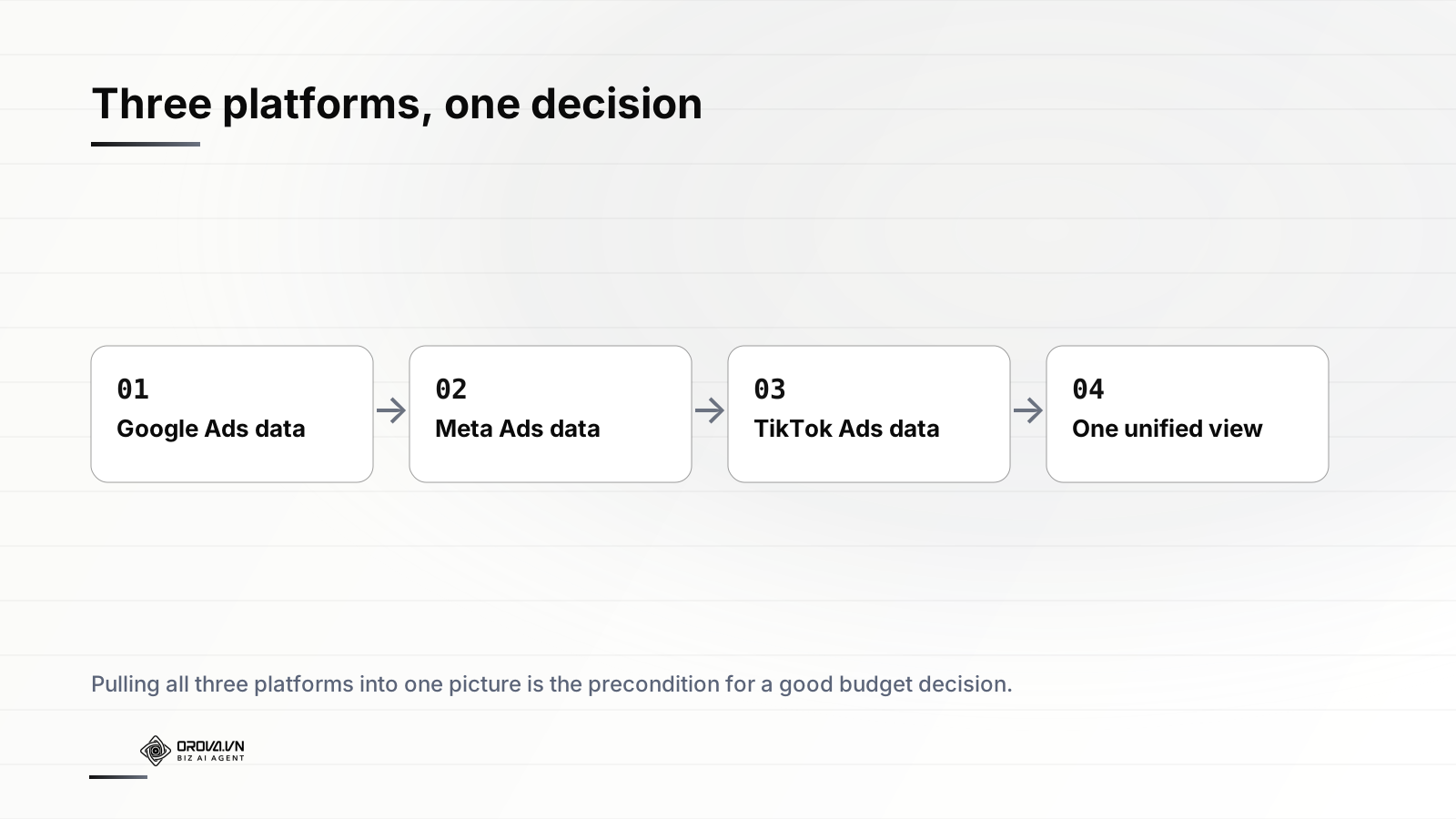
The practical consequence is that the most common cross-platform decision — "shift budget from the weak channel to the strong one" — is routinely made on numbers that are not on the same scale. You move spend toward the platform with the friendliest attribution, not the platform actually driving the most incremental revenue. The reward is a beautiful in-console dashboard and a flat bank balance. If this is new territory, our explainer on what an AI ads agent actually does walks through how a single measurement layer changes these decisions.
Normalization is unglamorous and essential
The fix is not exciting, which is probably why so few teams do it: you have to pick one definition of success and force all three platforms to report against it. That usually means anchoring on your own first-party data — orders, qualified leads, pipeline value from your CRM or commerce backend — and treating the platform-reported conversions as inputs to be reconciled rather than as truth. When you do this, the rankings frequently reshuffle. The channel that looked like your hero on its own dashboard turns out to be claiming credit for demand that already existed, while the channel you were about to cut was quietly bringing in genuinely new customers.
None of this requires exotic tooling in principle. A disciplined analyst with a clean spreadsheet and a lot of patience can normalize three platforms. The catch is time. Doing it properly every day, across every active campaign, is a full-time job on top of the full-time job of actually running the ads. Which brings us to where the hours really go.
Where the day actually goes
Ask any solo media buyer or small in-house team to honestly account for an eight-hour day, and the breakdown is sobering. The work that creates value — deciding what to change and changing it — is the smallest slice. The bulk is mechanical: logging in, waiting for dashboards to load, re-checking metrics because you cannot trust your memory across three systems, exporting numbers, rebuilding the same report you built yesterday, and reorienting yourself every time you switch consoles.
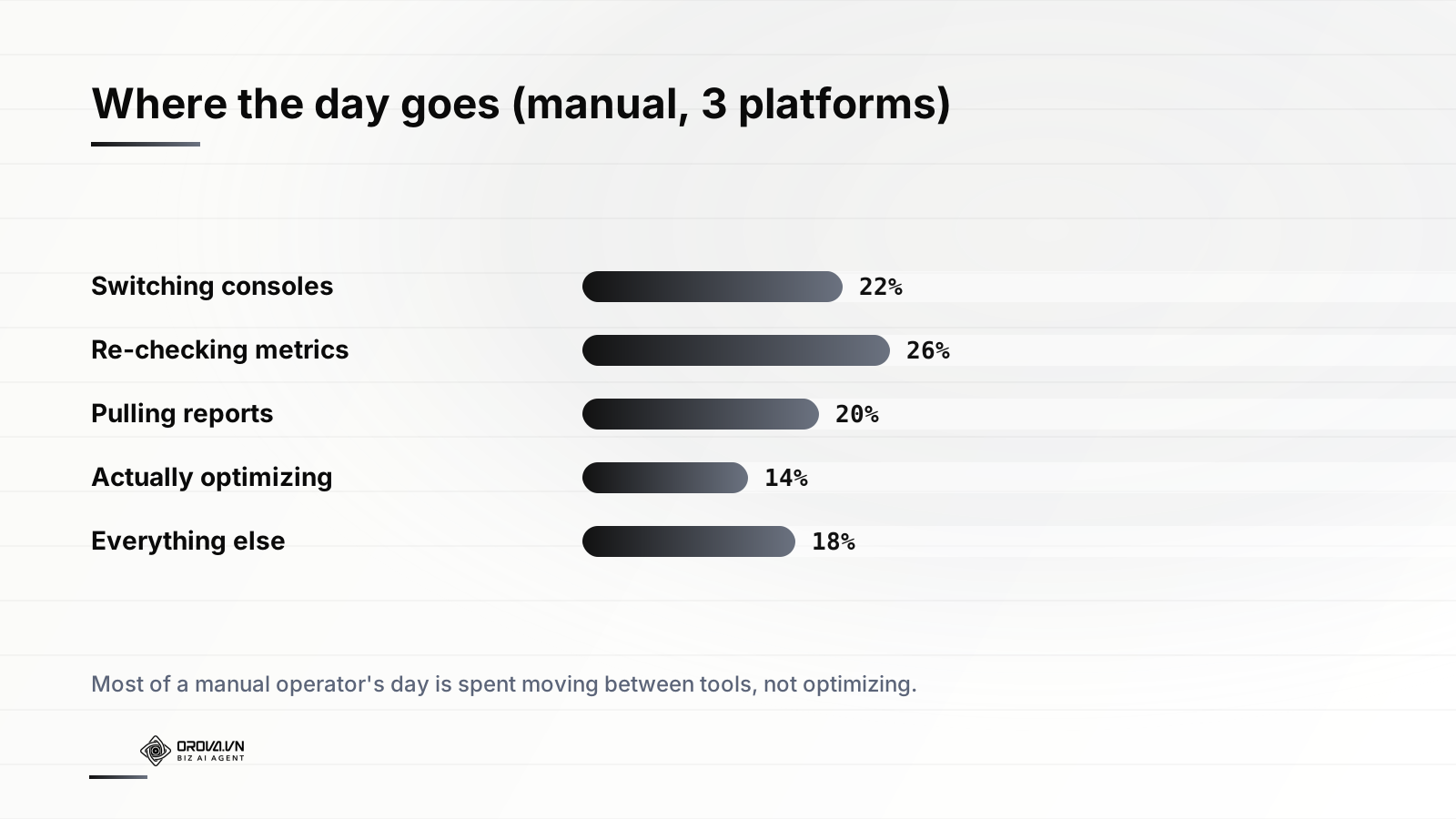
The pattern is consistent: roughly four-fifths of the day is overhead and coordination, and a small remainder is genuine optimization. This is not a sign of laziness or poor process. It is the unavoidable cost of being the human integration layer between systems that refuse to talk to each other. And it compounds. The more platforms you add, the more the overhead grows, while the optimization slice — the part that pays your salary — gets squeezed thinner.
Why this gets worse, not better, as you grow
You might expect that experience and scale would solve this. They do not, for two reasons. First, more budget means more campaigns, more audiences and more creatives to monitor, so the surveillance burden grows faster than your attention. Second, the platforms keep changing. New campaign types, new automated bidding modes, new reporting layouts and new policy rules arrive constantly across all three. Just keeping current with how to read each console is a part-time education. A team that has finally mastered Meta's Advantage+ logic discovers TikTok has shipped a new optimization objective, and the learning treadmill resets.
The result is a hard ceiling. There is a maximum number of platforms and campaigns a person can genuinely manage well, and it is lower than most agencies admit when they pitch you on "omnichannel." Past that ceiling you are not managing; you are reacting, and reacting slowly. The blind spots multiply, the budget leaks widen, and the only honest options are to hire more people, drop platforms, or change the model entirely.
It is worth naming the second-order cost too. When most of your day is overhead, the rare moments you do spend optimizing are low-quality, because you are tired and fragmented. Good budget decisions require holding several variables in mind at once and thinking a step ahead. That kind of thinking does not survive thirty interruptions. So the optimization you do manage tends to be shallow and reactive — bumping a budget here, pausing an obvious loser there — rather than the deliberate, compounding adjustments that actually move performance over a quarter. The silo model does not just steal your hours; it degrades the quality of the work you do with the hours that remain.
One unified picture, one decision flow
The alternative to juggling consoles is to stop thinking in platforms and start thinking in budget and outcomes. In a unified model there is only one question being asked on a loop: given everything I know across Google, Meta and TikTok, what is the single best change I can make right now? That requires two things the siloed model cannot provide — a single picture and a single decision flow.
The single picture means every campaign, on every platform, expressed in the same normalized metrics, refreshed continuously, side by side. Not three dashboards arranged next to each other — one dataset, one definition of CPA, one definition of a conversion, ranked by what each campaign is actually returning against your real business goals. With that picture, the comparisons that were apples-to-oranges become genuinely meaningful. You can finally say, with confidence, that a dollar moved from this Meta campaign to that TikTok ad set will produce more real customers, because both are measured on the same ruler.
From picture to action without a tab switch
The single decision flow is the second half, and the one most "reporting" tools miss. A unified dashboard that still requires you to log into each native console to make the change has only solved half the problem — arguably the easier half. The whole point of seeing everything in one place is to act on it in one place. A unified budget decision should be executable as a unified action: shift this much from there to here, pause that, raise the bid cap on this, expand that audience — across all three platforms, from one flow, with the reasoning attached.
This is also where the daily cadence finally becomes realistic. Manually, checking every campaign on every platform several times a day is impossible. Programmatically, it is trivial. A system that ingests all three platforms can evaluate every active campaign against your targets every single day, surface the handful that genuinely need a decision, and propose the specific change with the data behind it. The thirty context switches collapse into one short review. The optimization slice of the day — the part that was being crushed — expands, because the surveillance and reconciliation overhead has been automated away.
What it takes to fetch all three properly
The promise of "one brain across three platforms" lives or dies on a deeply unglamorous foundation: reliably pulling data out of Google, Meta and TikTok and reconciling it. Each platform exposes its data through an API, and each API is its own small world with its own authentication, rate limits, schema and seasonal breaking changes. This is the part that quietly defeats most homegrown attempts at unification, so it is worth being honest about what it involves.
- Authentication and permissions. Each platform has its own access model — Google Ads with its developer tokens and OAuth scopes, Meta with its app review and access tiers, TikTok with its own approval flow. Getting and keeping valid, correctly-scoped access for all three is an ongoing maintenance task, not a one-time setup.
- Schema reconciliation. The same concept is named and structured differently everywhere. "Campaign," "ad set," "ad group," "objective," "result" — the words overlap but the meanings drift. Mapping all three into one consistent model is the heart of normalization, and it has to be maintained as the platforms evolve.
- Rate limits and freshness. You cannot simply hammer the APIs every minute. Each enforces limits, and data lags reality by varying amounts. A robust system has to fetch on a sensible cadence, handle partial failures gracefully, and be transparent about how fresh each number is.
- Write access, carefully. Reading data is one challenge; pushing changes back — adjusting budgets, bids, on/off states, audiences — is a higher-stakes one. Mistakes here spend real money. This is precisely why automated changes need guardrails and a clear record of what was changed and why.
When this layer works, it disappears, and you simply see the unified picture and act through the unified flow. When it does not, you are back to exports and tab-switching with extra steps. The reliability of the fetch-and-reconcile foundation is the unsexy thing that determines whether cross-platform management is real or just a nicer-looking dashboard.
Why an agent, not just a dashboard
There is a meaningful difference between a tool that shows you a unified picture and one that closes the loop. A dashboard surfaces the problem; you still have to decide and execute. The next step — and the direction the discipline is moving — is an agent that not only sees all three platforms but reasons over them and acts, with you approving the moves. The value is not that a machine replaces judgment; it is that it handles the relentless, repetitive surveillance and reconciliation that no human can sustain across three consoles, then brings you a short list of specific, justified decisions instead of a wall of raw data.
The human stays in the loop for a reason. Budget decisions carry business context a model does not have — a product launch next week, a margin constraint on a particular SKU, a brand-safety concern on a platform. The right division of labor is the machine doing the watching, normalizing, ranking and proposing, and the human doing the approving and steering. That keeps the speed of automation and the accountability of human oversight, with a full record of every change for when you need to understand what happened and why.
This last point — the record — deserves emphasis, because it is what makes delegation safe. In the manual model, when performance dips, you often cannot reconstruct what changed. Did someone adjust a bid? Did the platform's automated bidding shift on its own? Was a budget edited last Tuesday? The history lives in your memory and a few scattered notes. An agent that logs every action it takes, with the data and reasoning attached, turns optimization from a fog of half-remembered tweaks into an auditable trail. When something works, you can see exactly why and repeat it. When something does not, you can trace the decision, correct it, and the correction informs the next round. That feedback loop is impossible to run reliably across three consoles by hand, and it is one of the most underrated reasons to unify in the first place.
A practical way to start
You do not need to rebuild your entire operation overnight to capture most of the benefit. The transition from siloed to unified can be incremental, and the early steps pay for themselves quickly.
- Pick one source of truth for conversions. Before anything else, decide what a "real" conversion means for your business and anchor on your own first-party data. Every platform metric becomes an input to reconcile against it, not a number to trust on its own.
- Standardize your naming and structure. Consistent campaign naming across all three platforms is mundane but makes unification dramatically easier. A shared convention is the cheapest normalization you can buy.
- Measure your overhead honestly. Track for one week how much of your time goes to switching, re-checking and reporting versus actually optimizing. The ratio is usually the most persuasive argument for changing the model.
- Centralize the picture before the actions. Get all three platforms into one normalized view first. Even before you automate any changes, simply seeing accurate, comparable numbers eliminates a whole class of bad budget decisions.
- Automate the watching before the deciding. Let a system handle the relentless daily monitoring and flag what needs attention. Keep approval in your hands at first; expand autonomy only as you build trust in the recommendations.
Each of these steps reduces blind spots and reclaims hours, and they stack. By the time you reach the final step, the daily grind of three consoles has been replaced by a short, high-quality decision session — which is what the job was supposed to be all along.
The bottom line
Running Google, Meta and TikTok as three separate jobs is not a neutral choice; it is a choice to accept structural blind spots, incompatible metrics and a day consumed by overhead. The platforms will never close that gap for you, because their incentives point inward. Cross-platform ad management is the deliberate decision to put one brain in charge of all three — one normalized picture of budget and results, one decision flow that turns that picture into action, and a reliable foundation underneath that keeps the data honest and current.
The marketers who pull ahead in the next few years will not be the ones who work more consoles harder. They will be the ones who stopped being the integration layer and let a single system do the watching, so their own attention is spent where it actually compounds: on judgment, strategy and the decisions a machine should never make alone.
If juggling three ad platforms in three tabs is eating your week, this is exactly the problem Orova Ads was built to solve. It is an AI agent that manages your paid campaigns across Google, Meta and TikTok from one brain — reading your data every day, recommending the specific optimizations that matter, and executing them on budgets, bids, on/off states and audiences, all with human-in-the-loop approval and a full audit log of every change. See how one unified view replaces three blind spots at orova.vn.
Run your business with AI Agents
Orova is the always-on Biz AI Agent — it plans, runs, and optimizes the work for you. Save time, unlock productivity.
Try it free