
What Is an AI Ads Agent? How Autonomous Ad Management Actually Works
Ask ten marketers what an "AI ads agent" is and you will get ten different answers. Some picture a chatbot that writes headlines. Others imagine the "recommendations" tab inside Google Ads. A few think of a script a freelancer wrote to pause campaigns at midnight. None of those is wrong, exactly, but none of them captures what the phrase actually means once you take it seriously. An AI ads agent is not a feature, a suggestion engine, or a clever macro. It is a piece of software that does the job a media buyer does: it looks at what is happening in your accounts, decides what should change, and makes the change happen — repeatedly, on its own schedule, across every platform you run.
That distinction matters because the word "agent" has a specific meaning in software, and the ad industry has been sloppy about borrowing it. This article draws the line clearly. We will define what separates an agent from a dashboard, a tool, and a script; walk through the read-decide-act loop that makes an agent an agent; explain how this works across Google, Meta, and TikTok at once; and dig into the part that most teams care about most — how you keep a system that can spend your money under control. By the end you should be able to evaluate any product calling itself an "AI ads agent" and tell whether it deserves the label.
What an AI ads agent actually is
Start with the verb. An agent acts. The entire field of agentic software is defined by autonomy: the ability to take actions in the world toward a goal without a human triggering each step. A thermostat is a trivial agent — it reads the temperature, compares it to a target, and turns the furnace on or off. No one presses a button. An AI ads agent applies that same loop to advertising, except the "world" is your ad accounts, the readings are performance metrics, and the actions are budget changes, bid adjustments, campaign on/off toggles, and audience edits.
The "AI" half of the term refers to how the agent decides. A thermostat uses one rule. An ads agent has to weigh dozens of signals that interact in messy, non-linear ways: spend pacing, cost per acquisition, return on ad spend, conversion lag, audience fatigue, day-of-week patterns, competitive auction pressure, and the simple fact that yesterday's number might be noise rather than signal. Modern agents combine statistical models, optimization logic, and large language models to turn that mess into a defensible decision — and, increasingly, to explain that decision in plain language a marketer can read and approve.
Why "autonomous" is the load-bearing word
Autonomy is what separates an agent from everything else in your stack, and it operates on a spectrum rather than a switch. At the low end, an agent watches continuously and tells you what it would do. At the high end, it watches, decides, and executes — then reports what it did. Both are legitimate agent behaviors. What makes them agentic rather than merely analytical is that the system, not the human, owns the loop. You set the goals and the boundaries; the agent runs inside them without waiting for you to log in.
This is the part people underestimate. The hard problem in paid media is not knowing what to do once — any competent buyer can optimize a campaign on a good day. The hard problem is doing it every day, on every campaign, on every platform, without skipping the boring ones, without getting tired at 6pm on a Friday, and without forgetting that a campaign you fixed last week has drifted again. Autonomy solves the consistency problem, which is the problem that quietly drains most ad budgets.
Agent vs. dashboard vs. tool vs. script
The clearest way to understand an AI ads agent is by contrast. Four things in the market look similar and are routinely confused with each other. They are not the same, and the differences are practical, not academic.
A dashboard shows; it does not act
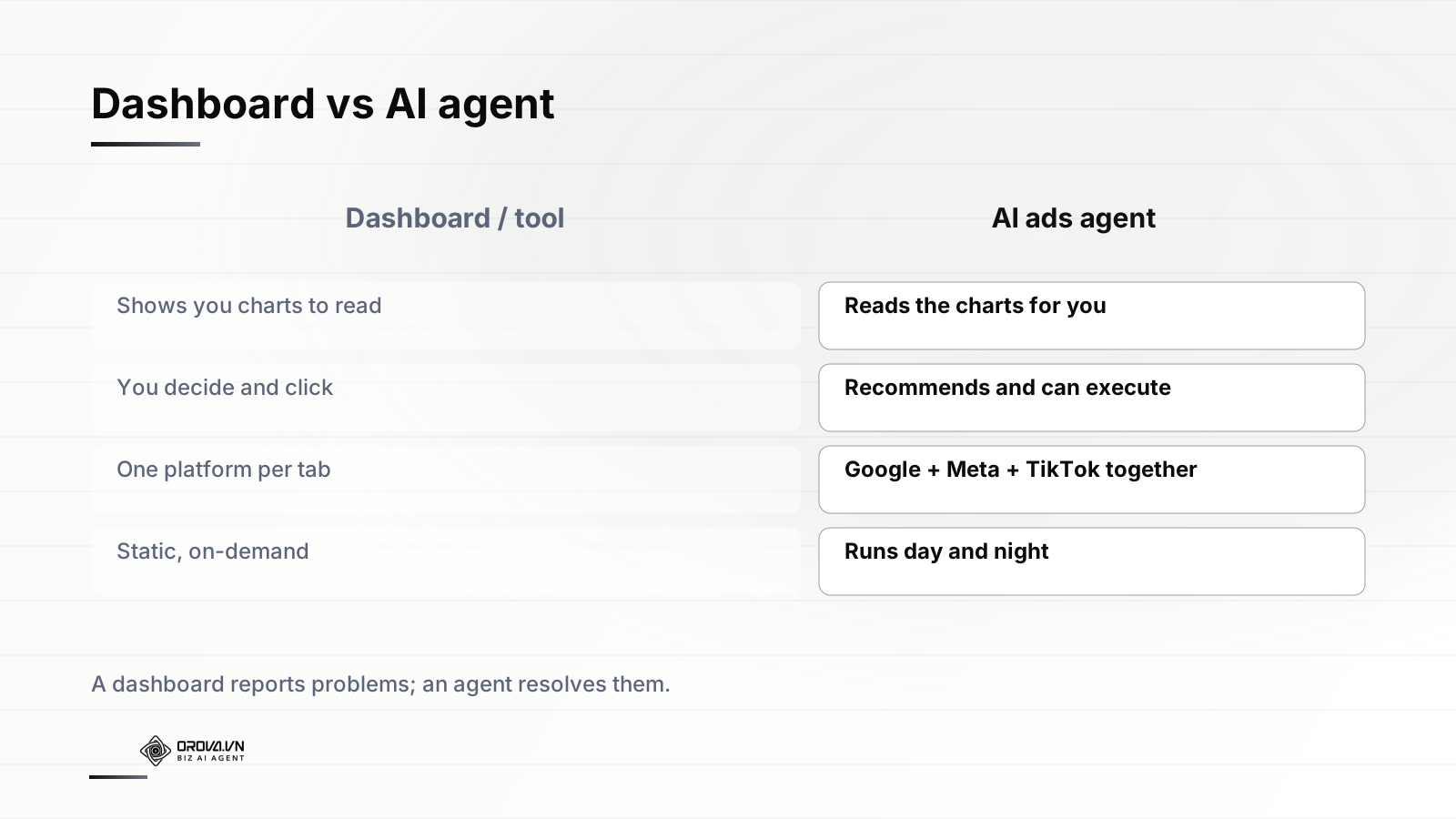
A dashboard aggregates data and presents it. Looker Studio, the native reporting in Ads Manager, a Supermetrics export into a spreadsheet — these are dashboards. They are enormously useful for understanding what happened, and they are completely passive. A dashboard will show you that your cost per lead doubled on Tuesday. It will not lower a bid, shift a budget, or pause the campaign responsible. The human is the actuator. If you stop looking, nothing happens. A dashboard is a window; an agent is a hand.
A tool helps you do one thing faster
A tool is something you operate. An AI copywriter that drafts ten headline variants is a tool. A bid simulator is a tool. A bulk-edit sheet is a tool. Tools amplify a human action — you still decide what to do, and you still press the button. The intelligence might be impressive, but the agency stays with you. The defining test: if you walk away from a tool, it sits idle. It has no loop of its own. Most products marketed as "AI for ads" are tools wearing the word "agent" as a costume.
A script automates a fixed rule
Scripts are closer to agents and are the most common source of confusion. Google Ads scripts, automated rules ("if CPA > $50, pause"), and homegrown Python jobs all take actions automatically. The difference is judgment. A script executes a rule its author wrote in advance. It cannot tell whether a CPA spike is a one-day fluke or a real trend, cannot weigh that spike against the fact that the same campaign drives your best-quality leads, and cannot adapt when the situation it was written for changes. It does exactly what it was told, forever, even when that becomes the wrong thing.
An agent decides. Given the same CPA spike, it considers the volume behind it, the statistical significance, the campaign's role in your funnel, the time of week, and your stated goals — and only then chooses an action, which might be "do nothing and keep watching." A script is a frozen decision. An agent is a live one.
The read-decide-act loop
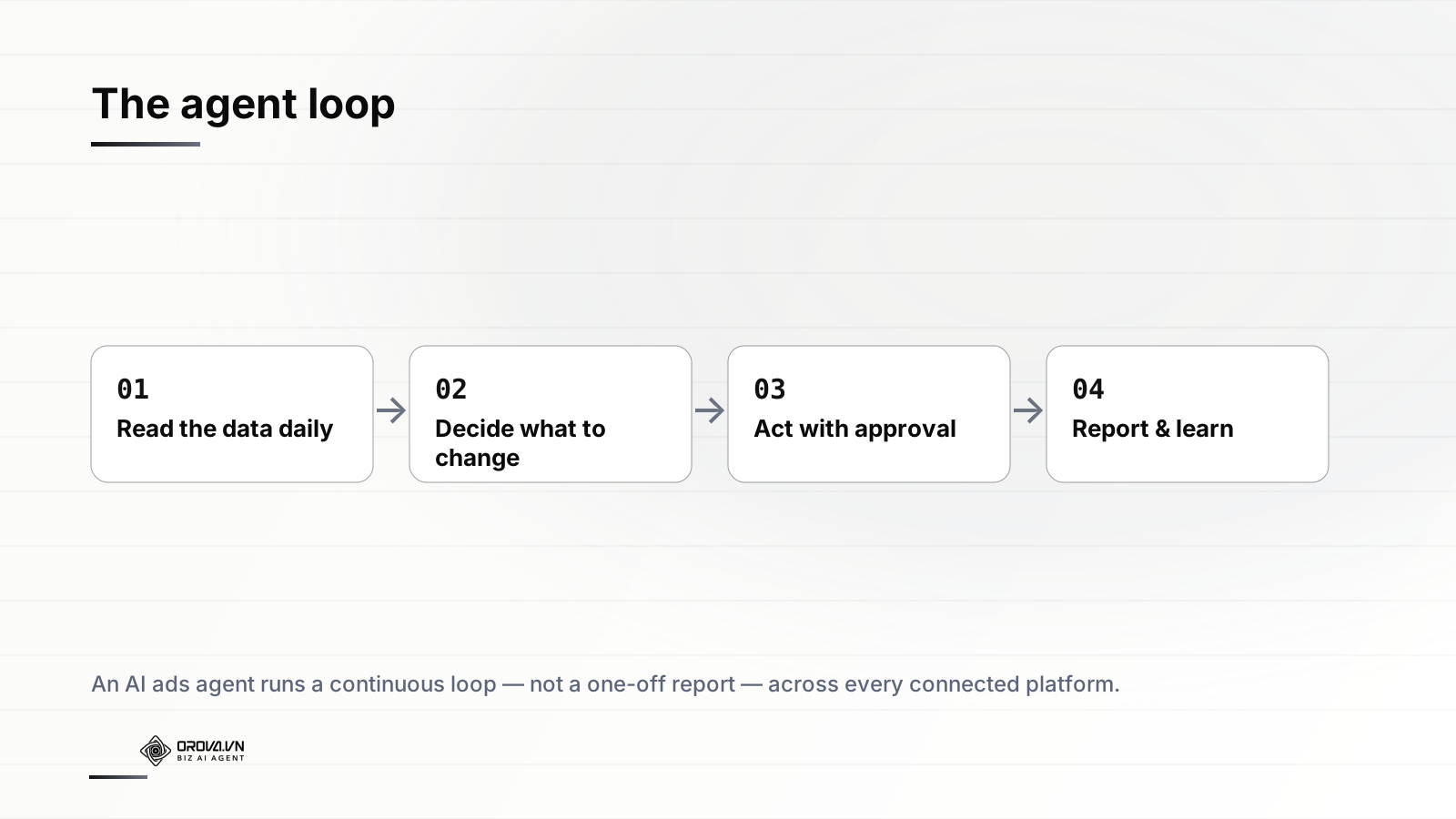
Every genuine agent runs the same three-stage cycle. The sophistication lives in how well each stage is executed, but the shape is universal. Understanding it gives you a checklist for evaluating any product and a mental model for trusting one.
Read: building an honest picture
The loop starts with observation. The agent pulls fresh data from each ad platform's API — spend, impressions, clicks, conversions, conversion value, and the breakdowns beneath them by campaign, ad set, ad, audience, placement, device, and time. Reading sounds trivial and is not. The data arrives late and changes after the fact: conversions attributed to a click can land days later, so today's reported ROAS for yesterday is provisional. A good agent accounts for attribution lag instead of reacting to numbers it knows will move.
Reading also means reading enough. A decision based on three conversions is a guess. A serious agent applies thresholds for statistical confidence and refuses to act on samples too small to mean anything — one of the most important behaviors and one scripts almost never have. The output of the read stage is a clean, current, trustworthy snapshot of every account, normalized so that a "campaign" on Google and a "campaign" on TikTok can be reasoned about side by side.
Decide: turning data into a defensible action
With the picture in hand, the agent decides what, if anything, to change. This is where intelligence earns its keep. The agent compares current performance to your goals (a target CPA, a ROAS floor, a spend pace, a growth target), identifies gaps, and generates candidate actions: raise this budget 20%, lower that bid, pause this fatigued ad, expand that lookalike audience, shift spend from a placement that is burning money to one that is converting.
Then it filters. Not every gap warrants an action, and not every action is safe. The agent weighs expected impact against risk, checks each candidate against your guardrails, and discards anything that violates them. Crucially, it can choose inaction — the most underrated decision in advertising. A mature agent leaves a healthy campaign alone, because the second-most-expensive mistake in paid media is tinkering with something that is working. The output of the decide stage is a short list of specific, justified recommendations, each tagged with the reasoning behind it.
Act: making the change, with a record
Finally the agent acts — or proposes to. In advisory mode it presents recommendations and waits for a human to approve. In auto-execute mode it makes approved categories of change directly through the platform APIs and logs every one. Either way, the action is concrete: a budget moves from $50 to $60, a bid adjusts, a campaign flips off, an audience expands. And every action — proposed, approved, executed, or rejected — is written to an audit log with a timestamp, the before and after values, and the reasoning. That record is what makes autonomy accountable instead of scary, and we will return to it.
Then the loop repeats. Tomorrow the agent reads the results of today's changes and decides again. This closing of the loop is the whole point. A change is a hypothesis; the next read is the test. Over weeks the agent accumulates evidence about what works in your specific accounts, and the optimization compounds. A human doing this by hand on twenty campaigns simply cannot maintain the cadence, which is why manual optimization tends to happen in bursts — a frantic Monday cleanup — rather than as the steady daily discipline the math actually rewards.
Why cross-platform changes everything
Running ads on one platform is a solved problem in the sense that the platform itself offers automation tuned to its own interests. The difficulty — and the opportunity — appears the moment you run Google, Meta, and TikTok together, which describes almost every serious advertiser today.
Three platforms, three dialects
Each platform models the world differently. Google organizes spend into campaigns, ad groups, keywords, and assets, with its own bidding strategies and a heavy reliance on search intent. Meta thinks in campaigns, ad sets, and ads, with audience targeting and the Advantage+ machinery at its core. TikTok has its own hierarchy, its own creative-first dynamics, and an audience that behaves nothing like a search user. Their APIs differ, their metrics are defined differently, and "conversion" does not mean quite the same thing in each. A human managing all three is constantly context-switching between three mental models and three interfaces.
An AI ads agent absorbs that complexity. It speaks all three dialects natively and translates them into one consistent internal view, so you — and it — can reason about your whole media mix instead of three disconnected silos. That translation layer is genuinely hard engineering, and it is the difference between a tool that bolts onto one platform and an agent that manages a portfolio.
Optimizing the portfolio, not the platform
The real prize of cross-platform management is the budget-allocation question no single platform will ever answer for you, because no platform can see the others. Google does not know your TikTok campaigns are returning $4 for every $1 while your Search spend is flat at $1.50. Meta cannot tell you to move money to Google. Each platform optimizes within its own walls and is structurally incentivized to keep your spend inside them.
The most valuable optimization in multi-platform advertising is the one no platform will ever recommend: moving budget away from itself.
An agent that reads all three accounts can finally ask the portfolio question — where does the next dollar earn the most? — and act on the answer, shifting spend toward whatever is performing and away from whatever is not, continuously, as performance shifts. That is the kind of decision that moves overall return more than any amount of within-campaign tuning, and it is precisely the decision a single-platform tool cannot make and a human rarely makes often enough.
Advisory, auto-execute, and the human in the loop
Now the question every reasonable person asks: am I really going to let software spend my money on its own? The honest answer is that you decide how much rope to give it, and good agents are built around that decision rather than around forcing you to surrender control.
Advisory mode: the agent recommends, you approve
In advisory mode the agent does all the reading and deciding but stops before acting. It hands you a list of recommendations — "raise Campaign A's budget 15% (pacing under target, CPA 22% below goal)," "pause Ad 4 (CTR down 40% over seven days, classic fatigue)" — each with its reasoning, and you approve, reject, or edit. This is the natural starting point. It lets the agent earn your trust on evidence: you watch its recommendations for a few weeks, see how often you would have approved them, and calibrate. Many teams run advisory mode indefinitely and treat the agent as a tireless senior analyst that never misses a review.
Auto-execute mode: the agent acts within limits
Once an agent has proven itself, having a human rubber-stamp the same routine, low-risk changes every day becomes the bottleneck. Auto-execute mode lets the agent make changes directly — but selectively. The sensible pattern is to authorize categories of action, not blanket autonomy. You might let the agent adjust budgets within a band, pause clearly fatigued ads, and reallocate spend automatically, while still routing larger moves — launching a new campaign, a budget increase above a threshold, a major audience change — through you for approval. The agent handles the high-volume, low-stakes decisions; you keep the high-stakes ones.
Human-in-the-loop is a design principle, not a mode
"Human-in-the-loop" is often reduced to "a person clicks approve," but the real principle is broader: the human is always able to set the goals, draw the boundaries, inspect the reasoning, override any decision, and turn the whole thing off instantly. The point is not that a human approves every micro-decision — at scale that defeats the purpose — but that humans retain meaningful, continuous control over an autonomous system. A well-built agent makes that control easy to exercise and impossible to lose, no matter how much it is doing on its own.
Guardrails and audit logs: making autonomy safe
Autonomy without constraints is recklessness. The reason a serious AI ads agent can be trusted with a live budget is the safety architecture wrapped around its decisions. Two components carry most of that weight: guardrails that bound what the agent may do, and audit logs that record everything it does.
Guardrails: hard limits the agent cannot cross
Guardrails are the rules the agent must obey regardless of what it thinks is optimal. They are constraints, not suggestions, and good ones operate at several levels. Budget guardrails cap how much the agent may move in a single change and in a day, so no decision can blow up your spend. Performance guardrails stop the agent from chasing a vanity metric off a cliff — protecting volume while it pursues efficiency, or vice versa. Frequency guardrails prevent thrashing, the failure mode where an over-eager system changes the same setting back and forth and never lets a campaign stabilize long enough to learn.
There are also business guardrails that encode things the agent has no way to infer: do not pause the brand campaign even if its direct ROAS looks weak, because it protects the trademark; never exceed this daily spend during the freeze before launch; keep this always-on campaign always on. Guardrails are where your strategy and institutional knowledge live. The agent optimizes inside the box you draw; your job is to draw a good box.
Audit logs: a complete, reviewable record
If guardrails are the brakes, the audit log is the flight recorder. Every action the agent takes — and every recommendation it makes, including the ones you reject — is written down with a timestamp, the exact before-and-after values, and the reasoning that produced it. This record does three things. It makes the agent accountable: when performance shifts, you can trace exactly what changed, when, and why, instead of staring at a mystery. It makes the agent auditable for clients and finance teams who reasonably want to know what an automated system did with the money. And it makes the agent improvable: by reviewing the log you see patterns in its decisions, refine your guardrails, and tighten the goals.
A good audit log is also what lets you grant autonomy with confidence. The fear of automation is loss of visibility — that the machine will do something you cannot see or reverse. A complete log inverts that fear. You are not blindly trusting; you are continuously verifying, with a full record you can read at any time and a settings panel that lets you change the rules or stop the agent the moment you want to. That combination — bounded actions plus total transparency — is what turns "letting software spend my budget" from a leap of faith into a managed, observable process.
Who an AI ads agent is for
This technology is not for everyone, and pretending otherwise does no one any favors. The value of an agent scales with the complexity and consistency burden of your advertising, so it helps to be honest about who benefits most.
In-house teams running real budgets across platforms
If you are a marketing team managing meaningful spend across Google, Meta, and TikTok, you are the core case. You feel the consistency problem daily — too many campaigns, too few hours, the nagging sense that something is drifting in an account no one looked at this week. An agent absorbs the routine daily optimization that eats your team's time and does it without gaps, freeing your people for the work software cannot do: strategy, creative, positioning, and the judgment calls that need a human who understands the business.
Agencies managing many accounts
Agencies live the scaling problem in its purest form. Every new client multiplies the number of campaigns that need daily attention, and headcount cannot keep pace with accounts. An agent lets an agency maintain genuine daily optimization discipline across a large book of business — with audit logs that double as client-ready reporting and guardrails that encode each client's specific rules. The agent does not replace the strategist; it makes one strategist effective across far more accounts than they could manage by hand.
Lean teams and founders punching above their weight
A founder or a one-person marketing team running ads alongside ten other jobs is the case where an agent changes the math most dramatically. You cannot afford a senior media buyer and cannot personally optimize daily, so your ads run on autopilot in the worst sense — set up once and left to drift. An agent gives a lean operation the kind of continuous, disciplined optimization that was previously available only to teams with a dedicated specialist, at a fraction of the cost and without the hire.
Who should wait
If you run a single small campaign on one platform with a budget too small to produce statistically meaningful data, an agent is overkill — there is not enough signal for it to act on, and a human checking in weekly is fine. Agents reward complexity, volume, and the need for consistency. With little of any, the honest advice is to come back when your advertising has grown into the problem the technology is built to solve. You can read more about the practical shape of agent-managed advertising on the Orova Ads overview, and about the broader platform on the Orova site.
The bottom line
An AI ads agent is not a smarter dashboard, a faster tool, or a more flexible script. It is a system that owns a loop — read, decide, act — across every platform you run, and keeps running it long after a human would have stopped looking. Its intelligence is in deciding, including the discipline to decide on nothing. Its safety is in its guardrails and its audit log. And its control sits firmly with you, through the advisory-versus-auto-execute dial and the human-in-the-loop principle that lets you set the goals, draw the boundaries, and switch it off at will.
The shift it represents is simple to state and significant in practice: from optimization as something a person does in bursts, to optimization as something a system does continuously. The teams that adopt it well are not the ones who hand over the keys and walk away. They are the ones who treat the agent as a tireless colleague — give it clear goals, sensible limits, and a budget to manage, then review its work through the log and refine as they go. That partnership, not full automation and not stubborn manual control, is where the results actually come from.
Want to see what this looks like with your own campaigns? Orova Ads is an AI agent that manages your paid advertising across Google, Meta, and TikTok — it reads your campaign data every day, recommends optimizations with the reasoning attached, and can execute budget, bid, on/off, and audience changes for you, all with human-in-the-loop approval and a complete audit log of every action. Start with advisory mode, watch it work, and turn on autonomy when you are ready. Explore how it works at orova.vn.
Run your business with AI Agents
Orova is the always-on Biz AI Agent — it plans, runs, and optimizes the work for you. Save time, unlock productivity.
Try it free