
GEO vs SEO: What Actually Changes and What's Rebranded Hype
Somewhere in your inbox right now there is probably a pitch deck announcing that SEO is dead and that the agency sending it has, conveniently, just launched a Generative Engine Optimization practice. The deck has a new acronym on every slide, a chart where a line labelled "AI search" crosses a line labelled "traditional search," and a retainer that costs forty percent more than the one you signed last year. If you read past the cover slide, the deliverables look strangely familiar: technical audits, content optimization, structured data, authority building. The work has not changed. The invoice has.
This is the awkward truth of the GEO moment. Something real is happening — AI-generated answers are taking a growing share of how people find information, and optimizing for them involves genuinely new problems. At the same time, an entire industry of consultants has discovered that the fastest way to grow revenue in 2026 is to take the services they were already selling, rename them, and present the rename as a revolution. Both things are true at once, which is exactly why the topic is so confusing.
So this article does one job: it separates the part of GEO that is genuinely new from the part that is SEO wearing a fresh lanyard. Not because the underlying shift is fake — it isn't, and we have written a full guide to Generative Engine Optimization that takes it seriously. But because you cannot budget, staff, or buy services sensibly until you know which twenty percent of the discipline is actually different.
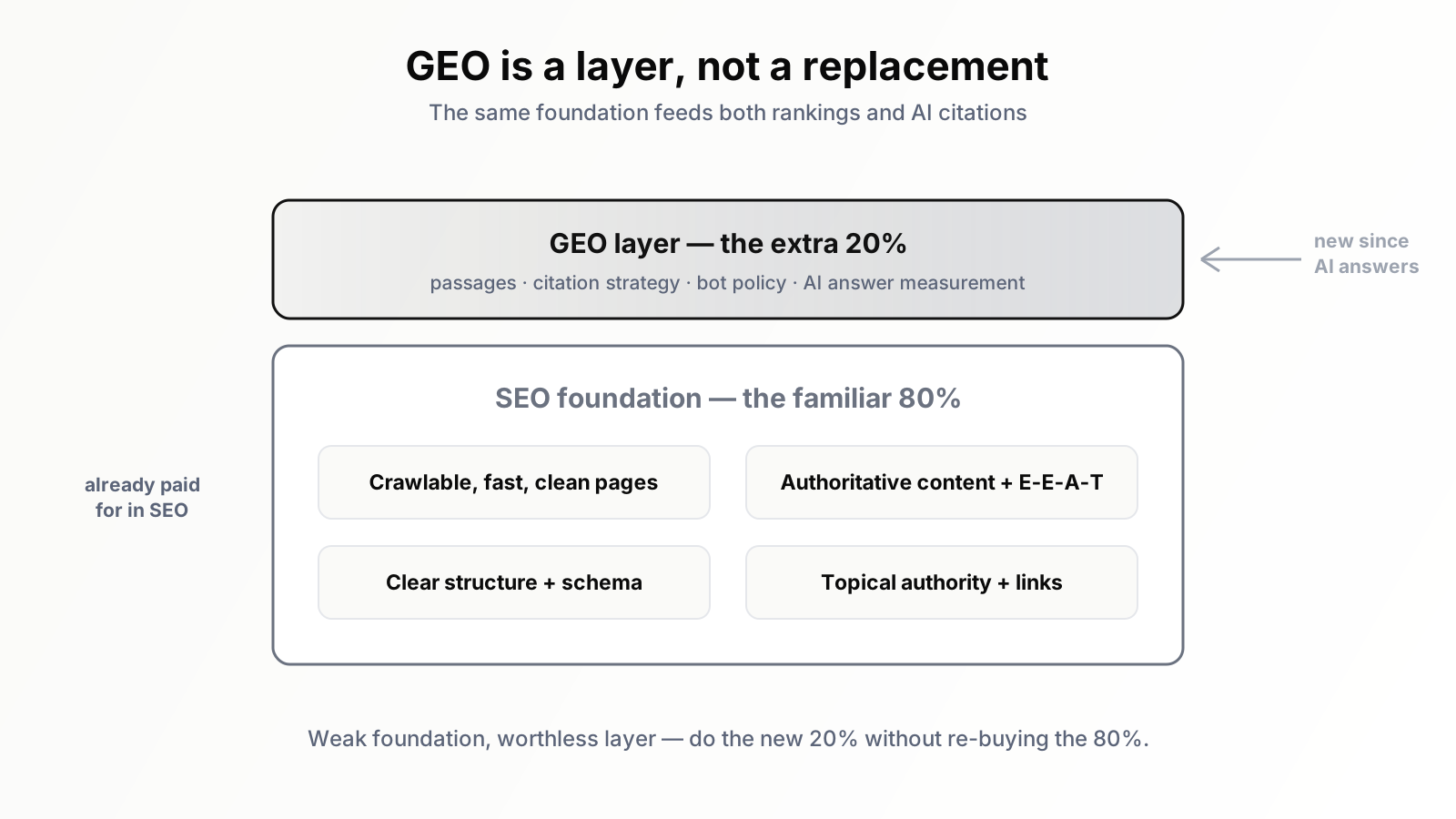
GEO optimizes content to be retrieved, quoted, and cited inside AI-generated answers from ChatGPT, Perplexity, and Google's AI Overviews, while SEO optimizes pages to rank in link-based search results. In 2026 they overlap by roughly eighty percent — the same crawlable, authoritative content feeds both. GEO is best understood as a layer on top of SEO, not a replacement.
The great rebranding
First, a moment of honesty about how we got here. When AI Overviews started appearing on a meaningful share of Google queries and ChatGPT added live search, two things happened in quick succession. Marketing teams panicked, reasonably, because their traffic models were built on blue links. And service providers noticed the panic, also reasonably, because panic is the most profitable emotion in B2B services.
The result was a naming gold rush. The same fundamental offering now circulates as GEO (Generative Engine Optimization), AEO (Answer Engine Optimization), LLMO (Large Language Model Optimization), AISO, AI SEO, and a few others that will not survive the year. The acronyms are interchangeable in most vendor decks, which tells you something: when terms multiply faster than methods, the terms are doing marketing work, not technical work. We covered the AEO framing specifically in our piece on Answer Engine Optimization, and the conclusion there holds here — the label matters far less than the task list underneath it.
None of this means the underlying shift is hype. It means the packaging is. The pattern is familiar to anyone who lived through "mobile-first" agencies, "voice search optimization" retainers, or the brief, expensive era of Web3 marketing consultancies. A real platform change occurs; a layer of genuine new work appears; and around that genuine layer, a much thicker layer of rebranded old work gets sold at new-work prices. Your job as a buyer — or as the person doing this in-house — is to slice those layers apart. So let's slice.
The rebranded eighty percent: things that were always good SEO
Here is the test we will apply throughout this section: if a recommendation would have appeared, word for word, in a competent SEO audit from before generative search existed, it is not a GEO innovation. It may still be important — most of it is — but you should not pay a premium for it, and you should be suspicious of anyone who presents it as new.
Crawlability and clean rendering
Every GEO pitch deck includes a slide about making sure AI systems can access and parse your content. Server-side rendering, clean HTML, fast responses, no content locked behind JavaScript that crawlers struggle to execute. All of it correct. All of it on every technical SEO checklist written in the last decade. Googlebot has rewarded crawlable, renderable pages since before most GEO consultants registered their domains. The only genuinely new wrinkle — managing a wider cast of crawlers — is real, and we will get to it in the next section, because it deserves to be treated as the new thing it is rather than blended into a slide of recycled basics.
Authoritative, well-sourced content
"AI engines prefer content that demonstrates expertise, cites sources, and answers questions directly." Yes. So does Google's ranking system, explicitly, and so did every search quality guideline of the past ten years. The advice to write substantively, attribute claims, and demonstrate first-hand experience predates generative engines entirely — it is the entire substance of E-E-A-T, which Google's quality rater guidelines have described in detail for years. A consultant who presents "show experience and expertise" as a generative-era discovery is describing the floor of competent content work as if it were a penthouse.
Clear structure and scannable formatting
Descriptive headings. Short paragraphs that each carry one idea. Lists where lists belong. Questions answered near where they are asked. This is presented in GEO materials as "chunking content for LLM retrieval," and the framing is not wrong — retrieval systems genuinely do work better with well-segmented content. But notice what the actual recommendation is: structure your pages clearly. That recommendation is old enough to vote. Featured snippets rewarded the exact same formatting for years; so did human readers, who have always skimmed. The mechanism changed; the work order did not.
Structured data and schema markup
Schema markup shows up in GEO decks with the implication that it is a direct pipeline into AI answers. The honest version is more modest: structured data helps search systems understand what your content is — an article, a product, an FAQ, an organization — and that machine-readable clarity plausibly helps any system, generative or classic, process your pages correctly. But schema has been standard technical SEO since the early 2010s. If your site lacks it, fixing that is ordinary hygiene work at ordinary hygiene prices, not a proprietary AI visibility technique.
Topical authority and content depth
The advice to cover a topic comprehensively — pillar pages, supporting clusters, internal links that map the territory — appears in GEO pitches as "training the engines to associate your domain with the topic." Strip the anthropomorphism and what remains is the topical authority playbook that content SEO has run for a decade. It works. It worked before. It will keep working. It is not new.
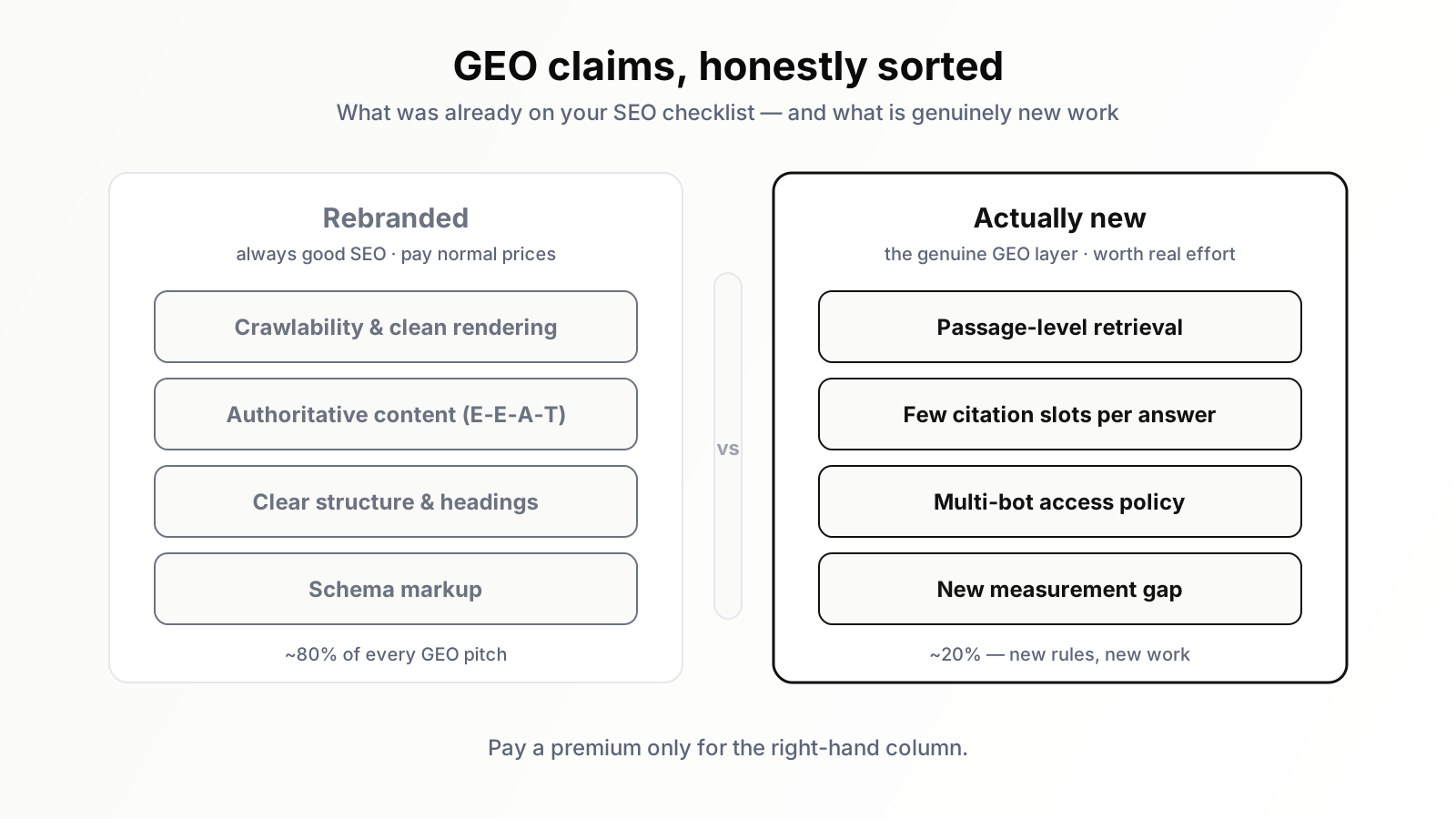
Tally that up and you can see where the eighty percent figure comes from. Crawlable site, authoritative content, clear structure, schema, topical depth: that is the bulk of any honest GEO engagement, and every line of it was already on your SEO checklist. Which is, in a way, good news — if you have been doing SEO properly, most of your GEO foundation is already built and already paid for.
The real twenty percent: what actually changes
Now for the part that justifies the discipline existing at all. These changes are concrete, technical, and not reducible to old advice with new vocabulary. If a GEO engagement is worth anything, this is where the value lives.
Competition moves from pages to passages
Classic SEO competes at the page level: your URL ranks third for a query, and the unit of success is the whole page earning the whole click. Generative engines work differently. They retrieve passages — self-contained chunks of text — and assemble answers from them. A page that ranks first for a query can be passed over for citation because the relevant section is buried, meandering, or dependent on context from three paragraphs earlier, while a passage from a page ranking seventh gets lifted because it answers the sub-question cleanly in one place.
This changes editorial craft in a specific way. It is no longer enough for the page to be good in aggregate; each section needs to stand alone — a heading that states the question, a passage beneath it that resolves the question without requiring the reader (or the retrieval system) to have read anything else. Definitions should be complete where they appear. Claims should carry their own support. A useful internal habit: read each section of an important page in isolation and ask whether it would make sense quoted on its own. For many pages written under the old logic, the answer is no, and restructuring them is genuinely new work — not a rebranded audit line.
Citation slots are scarcer than rankings ever were
A classic results page distributes attention across roughly ten organic links, plus ads, plus whatever features Google has layered in. Position six still got something. An AI-generated answer typically cites a small handful of sources — and a user who got the answer rarely clicks even those. The economics of visibility compress brutally: instead of competing for one of ten positions where partial success exists, you are competing for one of a few citation slots where it mostly does not. Either your content is part of the answer or it is invisible.
That scarcity changes strategy. It pushes effort toward the queries where you have a realistic claim to being a primary source — your data, your direct experience, your niche — and away from broad informational queries where you were always going to be the fourth-best generalist. The tactical detail of earning those slots is its own subject, which we covered in how to get cited by ChatGPT, Gemini, and Perplexity; the strategic point here is simpler. Page-two rankings were a consolation prize. Non-citation is nothing at all.
Crawler management becomes a multi-engine, multi-purpose decision
This is the most concretely new operational task in the entire discipline, and it is also where pitch decks most often get the facts wrong — so let us get them exactly right.
OpenAI operates distinct crawlers with distinct purposes. GPTBot collects content that may be used for training OpenAI's models. OAI-SearchBot indexes content for ChatGPT's search functionality — being findable in ChatGPT search depends on this one, not on GPTBot. They are separate user-agents and you can allow one while blocking the other; a publisher who blocks GPTBot to stay out of training data while permitting OAI-SearchBot to stay visible in ChatGPT search is making a coherent, deliberate choice that was simply impossible to make in the one-crawler world.
PerplexityBot crawls for Perplexity. ClaudeBot crawls for Anthropic. And then there is the one that trips up almost everyone: Google-Extended. Blocking Google-Extended opts your content out of use in training Gemini models. It does not remove you from AI Overviews — AI Overviews are built on Google's normal search index, gathered by ordinary Googlebot. The only way to stay out of AI Overviews via crawler controls is to stay out of Google Search itself, which for almost everyone is no choice at all. Any vendor who tells you Google-Extended governs AI Overviews has not read the documentation, and that single error is a reliable competence test for the whole engagement.
So the new work is real: an inventory of which bots access your site, a deliberate policy matrix of training access versus search access per provider, and monitoring to see which crawlers actually fetch what. None of that existed on an SEO checklist five years ago because none of it existed at all.
Queries stop looking like keywords
People type "crm small business" into a search box. They type — or speak — something much longer into a chat interface: what they do, what they tried, what constraint they have, and what they want, all in one prompt. Conversational queries are longer, multi-intent, and loaded with context that keyword tools were never designed to capture.
The practical consequence is that a keyword list organized around short heads systematically misses how generative engines encounter demand. Content needs to anticipate composed questions — comparisons with constraints, "which X for someone in situation Y" framings, follow-up questions that a conversation naturally produces. Some of this was visible in long-tail SEO, to be fair. But the centre of gravity has moved: in a chat interface the long, composed query is not the tail, it is the head, and planning content around that inversion is a genuinely different exercise.
The measurement gap is real and nobody has fully solved it
SEO matured into a measurable discipline: rank trackers, search console data, click curves, attribution. GEO currently has no equivalent. There is no canonical "rank" inside a generated answer to track — the same prompt can produce different answers for different users, sessions, and days. Google Search Console folds AI Overview impressions and clicks into overall search performance without a separate breakdown, so you cannot cleanly isolate how AI Overviews treat you. Referral traffic from chatgpt.com or perplexity.ai does show up in analytics, and it is worth segmenting, but the volumes are thin relative to the visibility — most people who read an AI answer never click anything, so the citation does its brand work invisibly.
What exists instead is a patchwork: sampling prompts across engines and logging who gets cited, watching crawler activity in server logs, tracking branded search volume as a proxy for answer-driven awareness, and segmenting what referral data does exist. It is honest, useful work — we walk through the practical version in our 12-check GEO audit — but anyone who sells you a dashboard claiming to track your "AI ranking" with the authority of a rank tracker is selling a confidence level the underlying systems do not support. The measurement gap is not a vendor failing; it is a property of how generative engines work right now. Distrust anyone who claims to have abolished it.
The snake-oil detector
Because the genuine changes are real, the grift can hide behind them. Here are the red flags that should end a vendor conversation, or at least sharply shorten it.
- Guaranteed citations. No one controls what a generative engine cites. The engines themselves do not fully control it — outputs vary across sessions for identical prompts. A guarantee of citations is a guarantee the vendor either does not understand the systems or assumes you don't. The same logic applied when agencies guaranteed first-page rankings, and it has aged exactly as well.
- Proprietary "AI submission" or "engine registration." There is no submission portal for ChatGPT, no index registration for Perplexity, no priority lane into AI Overviews. Engines find content by crawling the open web, the same unglamorous way search engines always have. Any deliverable described as "submitting your site to the AI engines" is a deliverable describing nothing.
- llms.txt sold as a ranking hack. llms.txt is a proposed convention — a markdown file suggesting which content AI systems should prioritize. It is an interesting idea, it costs little to add, and no major engine has committed to honoring it. Google's representatives have publicly downplayed it. Adding one is fine; you can do it in an afternoon. Paying a retainer line-item for "llms.txt optimization" presented as a visibility lever is paying for a lottery ticket priced as an annuity.
- "We'll get you into the training data." This pitch misunderstands the mechanism twice over. Training cutoffs mean models were trained on data collected months or years ago — nothing a vendor does this quarter retroactively enters a deployed model's weights. And the citations you actually want come mostly from live retrieval at answer time, not from training-data membership. The phrase "into the training data" in a sales context is a flare signaling that the seller learned the vocabulary but not the system.
- The acronym shuffle. If the proposal uses GEO, AEO, and LLMO interchangeably while the scope-of-work section lists a technical audit, content optimization, and link building at a premium over last year's price for the same items, you are looking at the rebrand in its purest form. Ask one question: "Which line items here would not have appeared in your 2022 proposals?" The length of the silence is your answer.
A fair caveat: a vendor charging honestly for the familiar work plus the new work is not a grifter — that is just the job, and good practitioners exist. The detector is not "they mention GEO." The detector is whether they can articulate, specifically, which parts of the engagement are new and why, and whether their factual claims about crawlers, training, and measurement survive contact with documentation.
The honest verdict
So is GEO real? Yes — in the same way a new floor on a building is real without being a new building.
The shift underneath it is not in dispute. A growing share of discovery now happens inside generated answers, those answers cite a brutally small number of sources, and the systems assembling them have their own crawlers, their own retrieval logic, and their own blind spots. Dismissing all of this as hype is its own lazy take — one we have already dismantled in the context of AI Overviews, and the argument generalizes. The visibility game has genuinely acquired new rules, and teams that ignore them will spend the next few years wondering why their traffic charts and their brand awareness stopped moving together. If you want the full picture of how AI Overviews specifically behave, our complete guide to AI Overviews covers that engine in depth.
But the proportions matter. Roughly eighty percent of what earns AI citations is what earned rankings: a crawlable site, genuinely authoritative content, clear structure, honest expertise signals, comprehensive topical coverage. If your SEO is weak, no GEO tactic rescues you, because the engines retrieve from the same corpus of pages that search ranks. The new twenty percent — passage-level craft, citation strategy, deliberate multi-bot crawler policy, conversational query planning, and a patchwork measurement practice — sits on top of that foundation and is worthless without it.
Which yields a simple buying rule and an equally simple working rule. Buying rule: pay normal prices for the familiar eighty percent, pay for the new twenty percent only from people who can describe it accurately, and pay nothing for guarantees, submissions, or training-data magic. Working rule: keep doing the SEO you should have been doing anyway, then add the genuinely new layer deliberately — restructure key pages for standalone passages, set an explicit bot policy, sample your citation presence across engines, and watch the thin-but-real referral and branded-search signals while the measurement tooling matures.
The discipline is real. The revolution is mostly an invoice. Knowing the difference is the entire game, and it is the part of the work no acronym can do for you. If you would rather not run that whole stack by hand, this is the kind of layered, repetitive work an SEO AI agent platform like Orova is built for — it carries the audits, content structure, and monitoring across both the classic and generative layers, so your team's time goes to the twenty percent that genuinely changed.
Run your business with AI Agents
Orova is the always-on Biz AI Agent — it plans, runs, and optimizes the work for you. Save time, unlock productivity.
Try it free