
E-E-A-T: What Google Actually Rewards in 2026
Few acronyms in search have travelled further with less clarity than E-E-A-T. It appears in conference talks, agency pitches, and the panicked Slack messages that follow every algorithm update. It is invoked to explain ranking gains and ranking losses with equal confidence. And it is, more often than not, misunderstood — treated as a switch you flip, a score you can see, or a checklist you tick off on a Friday afternoon. It is none of those things. E-E-A-T is a description of what trustworthy content looks like, written down so that the people who rate search quality can recognise it. If you want to work with it rather than around it, you have to understand what it actually is and what Google actually rewards.
This article is a working explanation of E-E-A-T for 2026 — what the four letters mean, where the concept sits inside Google's machinery, what genuinely moves the needle, and what is theatre. It is written for people who publish content and want their content to be trusted, not for people who want a magic word to put in a meeting.
What the letters actually stand for
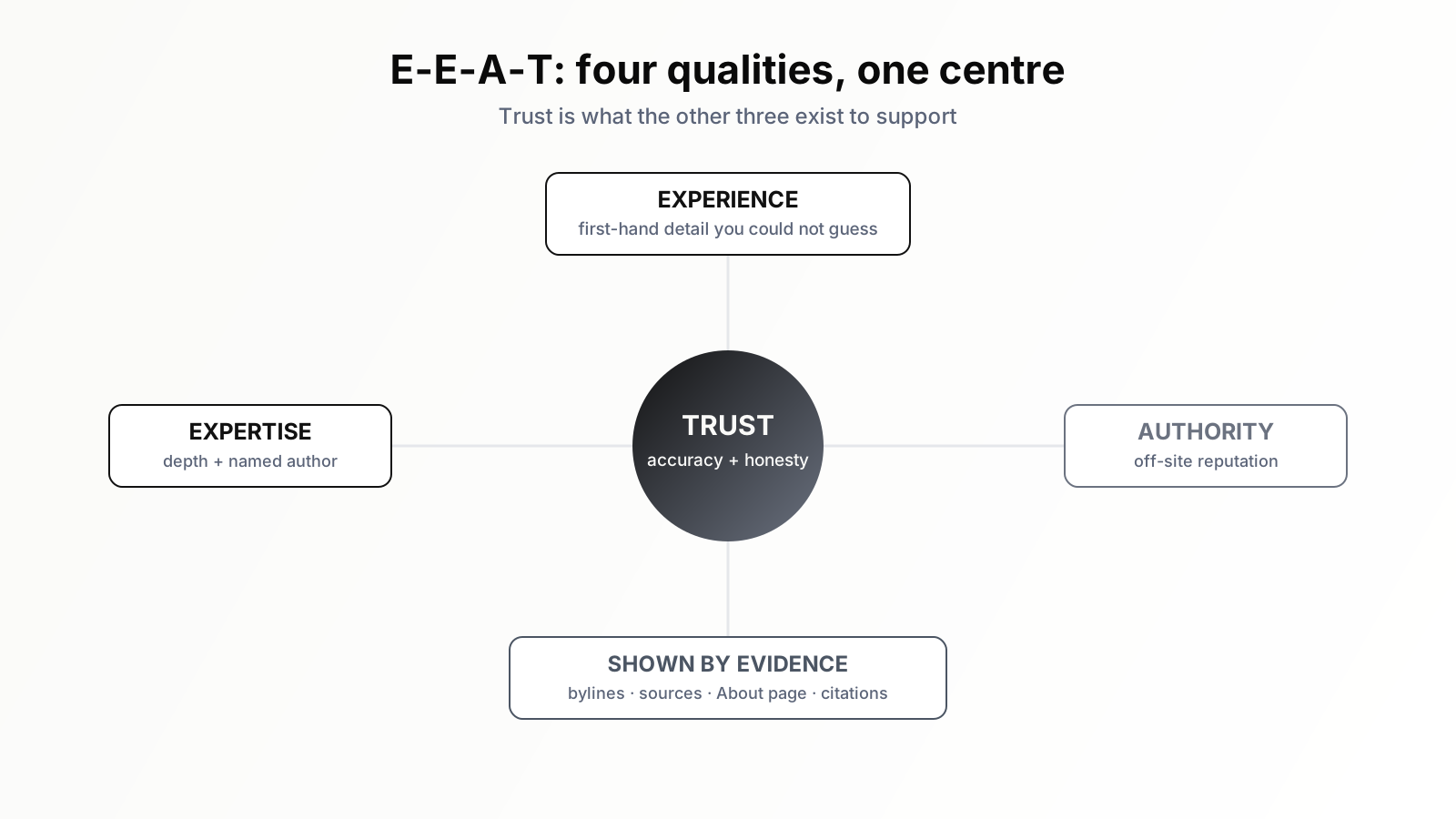
E-E-A-T expands to Experience, Expertise, Authoritativeness, and Trustworthiness. The first E — Experience — is the newest addition, and its arrival was not cosmetic. It signals that Google wants content created by someone who has actually done the thing being described, not merely read about it. A review of a hotel written by a guest who stayed there carries a kind of credibility that a synthesised summary of other reviews cannot. A guide to migrating a database written by an engineer who has performed the migration reads differently from one assembled by someone who has only studied the documentation.
Expertise is the depth of knowledge in a subject. Authoritativeness is the degree to which the creator, the content, and the website are recognised as a go-to source by others in the field. Trustworthiness — which Google has repeatedly described as the most important member of the family — is the accuracy, honesty, safety, and reliability of the page and the site that hosts it. The other three letters, in Google's own framing, exist largely to support trust. A page can be expert and authoritative and still fail if it is not trustworthy; a page cannot be trustworthy in any meaningful sense without some combination of the others backing it up.
E-E-A-T is not a ranking factor — and that matters
The single most important thing to understand about E-E-A-T is structural. It is not a ranking factor. There is no E-E-A-T score in the algorithm, no number Google calculates and sorts by. E-E-A-T is a concept defined in the Search Quality Rater Guidelines — the manual given to the thousands of human contractors who evaluate sample search results.
Those raters do not change rankings directly. Their judgments are aggregate feedback used to test and train Google's ranking systems. When engineers adjust an algorithm, they check whether the change moves results in the direction the raters — applying concepts like E-E-A-T — say is better. So E-E-A-T influences search through a long, indirect chain: it shapes what "good" means to the raters, the raters' verdicts shape how algorithms are evaluated, and the algorithms shape what you see.
This indirectness is not a technicality to wave away. It explains why you cannot "fix your E-E-A-T" the way you fix a broken canonical tag. There is nothing to toggle. What you can do is make your content genuinely embody the qualities the concept describes, so that the many real signals Google's systems do measure — and the human raters sampling your pages — converge on the conclusion that your site is trustworthy.
What Google actually rewards
If E-E-A-T is a description rather than a dial, the practical question becomes: what observable things make a page look like it has Experience, Expertise, Authoritativeness, and Trustworthiness? Google's systems and its raters look for evidence. Here is where the evidence lives.
Visible, accountable authorship
Trustworthy content has an owner. A page that names its author, links to a substantive author profile, and makes clear why that person is qualified to write on the subject gives both raters and readers something to evaluate. An anonymous page, or one bylined to a generic "admin" or "editorial team" with no biography, gives them nothing. This does not mean every blog post needs a celebrity expert attached. It means the chain of accountability should be visible: a real person, with relevant background, who stands behind the words.
First-hand experience, made evident
The Experience letter rewards content that could only have been written by someone who did the thing. The way to satisfy it is not to claim experience but to demonstrate it — the specific detail, the unexpected friction, the thing the official documentation does not mention, the photograph that is obviously yours rather than stock. A reader can tell the difference between "the setup process is straightforward" and "the setup process is straightforward until step four, where the installer asks for a permission the docs never mention." The second sentence is evidence. The first is filler.
Accuracy and honest framing
Trustworthiness rests on getting things right and not pretending. Pages that cite sources, that distinguish established fact from the author's opinion, that update when information changes, and that do not overstate what they know read as reliable. Pages riddled with errors, or that present speculation as certainty, or that bury the fact they are selling something, read as untrustworthy — and that reading, aggregated, is exactly what raters are asked to flag.
Site-level signals of a real organisation
Trust attaches to the whole site, not only the page. A clear "About" page, genuine contact information, transparent ownership, a sensible privacy policy, working customer support, accurate sourcing throughout — these tell a rater they are looking at a real, accountable organisation rather than a disposable content farm. One excellent article on an otherwise opaque site is held back by the company it keeps.
Reputation beyond your own walls
Authoritativeness is, by definition, what others say about you. The quality rater guidelines explicitly instruct raters to research a site's and an author's reputation off-site — in reviews, references, citations, and independent coverage. You cannot self-declare authority. It is conferred by the field. Being cited by other credible sources, mentioned in industry coverage, and recommended in the places your audience already trusts is how authoritativeness is actually built. This is the slowest of the four letters to earn and the hardest to fake.
Why E-E-A-T matters more for some pages than others
Not every page is held to the same standard, and pretending otherwise leads to wasted effort. Google's guidelines reserve the strictest scrutiny for what it calls "Your Money or Your Life" topics — pages that could meaningfully affect a person's health, financial stability, safety, or major life decisions. Medical advice, legal guidance, financial planning, and similar subjects sit in this category.
For YMYL content, weak E-E-A-T is genuinely dangerous and Google treats it as such. A misleading article about a drug interaction or a mortgage can cause real harm, so the bar for demonstrated expertise and trust is high. For a low-stakes hobby blog — a post about a board game, a recipe, a travel anecdote — the same intensity is not required. The honesty is still expected; the credentials are not weighed as heavily.
The practical lesson: calibrate. If your content sits in or near a YMYL area, invest seriously in qualified authorship, sourcing, and review. If it does not, focus your energy on genuine experience and clear, accurate writing rather than manufacturing credentials nobody is asking for.
The theatre to avoid
Because E-E-A-T is widely misunderstood, an industry of E-E-A-T theatre has grown around it — activities that look like they address the concept but address only its surface. They are worth naming so you can stop doing them.
Bolting a thin author box onto every page, populated with an invented job title and a stock headshot, does not create expertise; it creates a fake that a rater researching the author will expose. Stuffing a page with citations to sources that do not actually support the claims does not create trust; it creates a footnote-shaped lie. Adding the words "expert," "trusted," and "authoritative" to your copy does not make the page any of those things. Publishing a wall of low-effort content quickly does not build authority; it dilutes whatever authority you had. And chasing a third-party "E-E-A-T score" from an SEO tool is chasing a number that Google does not calculate and that no tool can see.
The common thread is substitution — replacing the real, slow, costly work of being trustworthy with a cheap signal that resembles it. The quality raters' entire job is to look past those signals to the substance. Theatre does not survive contact with a rater, and increasingly it does not survive contact with algorithms trained on their judgments.
A practical way to work with E-E-A-T
If you cannot optimise a score, what do you actually do? You make a series of honest, concrete commitments and hold to them.
Decide who is accountable for each piece of content and put their name and real qualifications on it. Write from genuine experience wherever the topic allows, and let the specific, hard-won detail show. Cite real sources and frame uncertainty honestly. Maintain the site-level basics — a real About page, real contact details, transparent ownership — so the whole site reads as a legitimate organisation. Earn off-site reputation patiently by being genuinely worth citing. And review high-stakes content with the seriousness it deserves. None of this is a hack. All of it is simply the work of being a publisher people can trust — which is exactly what E-E-A-T was written to describe.
How E-E-A-T connects to the rest of your SEO
E-E-A-T does not stand apart from content strategy; it runs through it. A site organised into coherent topic clusters demonstrates depth in its subject, and depth is one way expertise becomes visible. A disciplined internal linking strategy connects author profiles, supporting evidence, and related pages so that accountability and sourcing are easy for both readers and raters to follow. Trust is not a separate workstream bolted on at the end. It is the natural result of doing the rest of the job well, and a strong content structure makes that result legible.
Where an AI agent helps — and where it cannot
It is fair to ask how AI-assisted content fits into a framework built on experience and trust. The honest answer is that AI cannot supply lived experience and cannot confer authority — those have to come from you. What AI can do is handle the considerable, unglamorous maintenance work that makes E-E-A-T visible at scale: checking that every published page carries a named, accountable author; flagging pages where claims lack a supporting source; surfacing factual statements that have gone stale and need updating; auditing the site for missing About or contact information; and mapping which articles support which, so depth is structured rather than scattered.
That is the kind of systematic, repetitive verification an SEO AI agent is built for. Orova works as exactly that agent — keeping the structural evidence of trust consistent across a whole site so your real expertise and genuine experience are never undermined by a missing byline or an unsourced claim. It does not manufacture E-E-A-T, because nothing can. It makes sure the trust you have genuinely earned is properly shown — and that the rest of your content workflow reinforces it rather than working against it.
Stop treating E-E-A-T as a score to chase or a word to sprinkle. Treat it as what it is: a clear, public description of what a trustworthy source looks like. Build a site that genuinely fits that description — accountable, experienced, accurate, and recognised — and you will not need to ask whether your E-E-A-T is good. The evidence will answer for you.
Run your business with AI Agents
Orova is the always-on Biz AI Agent — it plans, runs, and optimizes the work for you. Save time, unlock productivity.
Try it free