
Conversational Search Queries: How to Write for Them
People Also Ask is the expanding box of related questions Google shows inside search results. Open one and it unfolds a short answer lifted from a page, with a link to the source. Each open also loads more questions, so a single query branches outward into a live map of how searchers phrase the same problem.
That box is the clearest public evidence that people no longer search in fragments. The questions inside it are full sentences carrying context and constraints — "what is a good CRM for a five-person sales team that mostly lives in Gmail" rather than "best CRM small business." If your page is written to match the short phrase a keyword tool handed you, it can rank respectably and still never surface in the box where the real question is being asked.
This guide treats People Also Ask as both a research source and a target. You will see what makes a query conversational, why that phrasing became the default rather than a voice-assistant novelty, and how to mine PAA, Search Console and your own sales calls for the exact wording customers use. Then how to structure the answer — question as heading, 40 to 60 words up front — so it is the passage Google, ChatGPT Search or Perplexity pulls up and quotes.
How the People Also Ask box works, and how to get into it
PAA is Google publishing its own model of which questions cluster together. You search something, the box offers four or five adjacent questions, and expanding any one of them appends more below it. The set is generated per query and reshuffles as you interact with it, which is why two people rarely see an identical box — but the phrasing inside it is stable, and that phrasing is the point. PAA shows you the canonical way Google believes each question gets asked.
Getting quoted in it follows the same logic as every other extracted answer on the results page. Google needs a passage it can lift without editing: a heading that restates the question in its natural form, and directly beneath it a self-contained answer of roughly 40 to 60 words that makes sense with no run-up. Pages already ranking on page one for the parent query are the usual candidate pool, but the passage — not the whole page — is what wins the slot, which is why a well-structured section deep inside a long guide can be pulled while a thin dedicated page is ignored.
Two practical consequences run through the rest of this article. First, harvest the questions before you write, because PAA tells you the shape of the demand for free. Second, build every section as if it might be extracted on its own, since the box, featured snippets and AI answers all reward the same structure.
What makes a query "conversational"
A conversational query has three properties that keyword shorthand lacks. First, it is grammatically complete: it reads like a sentence a person would say aloud, usually a question. "How do I stop my emails going to spam?" instead of "email deliverability fix". Second, it carries context: details about the asker's situation that a two-word query strips away. "for a small Shopify store", "without hiring an agency", "on a free plan". Third, it often exists inside a sequence: it is the second or third question in a session, building on an earlier answer — "okay, but how long does that take?" makes no sense alone and perfect sense as a follow-up.
Those properties change what a good answer looks like. A query like "crm pricing" could mean a dozen things, so pages targeting it hedge: they cover every interpretation and answer none sharply. A query like "how much should a five-person team expect to pay for a CRM per month?" has one interpretation. The intent is fully specified inside the query itself. The page that wins is not the one that covers the topic most broadly — it is the one that answers that exact configuration of intent most directly.
This is the practical insight that should drive your writing: conversational queries trade volume for clarity. Each individual phrasing is searched rarely, sometimes only once, but its intent is so legible that a direct answer converts attention into trust at a far higher rate than a broad page ever does. And as we will see, AI systems have made the volume problem much less important than it used to be.
Why conversational search stopped being a niche
Conversational queries were discussed for years under the banner of "voice search", and most of those predictions aged badly — the famous claim that half of all searches would be voice by 2020 did not survive contact with reality. What actually mainstreamed conversational phrasing was not smart speakers. It was three quieter shifts.
The first was Google's own language understanding. Updates like Hummingbird and later BERT meant Google got genuinely good at parsing natural language, so longer queries stopped returning worse results. Users noticed, gradually, that typing a whole question worked. Mobile keyboards with dictation lowered the cost of producing full sentences. The search box quietly stopped punishing people for writing like people.
The second was the chat interface itself. Hundreds of millions of people now spend time with ChatGPT, Gemini, and similar assistants, where the only way to interact is conversational. That behaviour does not stay in the chat window. Users trained by chat carry full-sentence phrasing back into the Google search bar. Anyone who has watched session recordings or reviewed Search Console data since 2024 has seen the same pattern: queries are getting longer and more often phrased as questions.
The third shift is the most consequential for SEO: the search engines themselves became conversational. Google's AI Overviews answer questions in prose at the top of results, and AI Mode carries a full back-and-forth conversation. ChatGPT Search and Perplexity are conversations with citations. These systems do something important under the hood: they take a user's query and expand it into multiple related sub-queries — Google describes this fan-out technique in its own documentation of AI Mode — retrieving content for phrasings the user never literally typed. Your content is now being matched against conversational variants of queries whether the human typed them conversationally or not. Writing for conversational phrasing is no longer about catching the minority of users who type questions; it is about being retrievable by the machine layer that rephrases everyone's queries as questions. Our complete guide to ranking in Google AI Overviews covers that retrieval layer in depth.
The anatomy of intent inside a conversational query
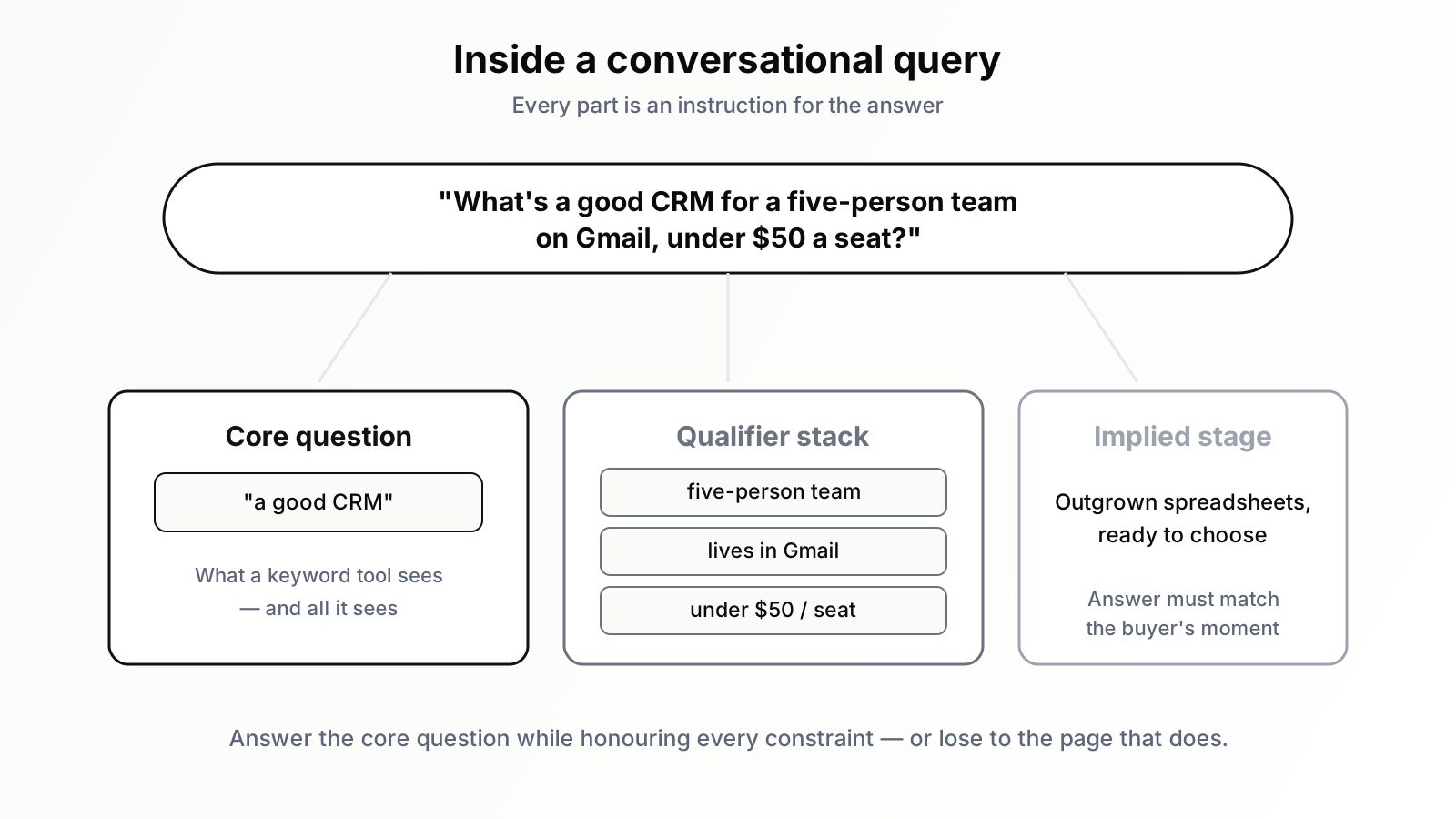
Before you can write for these queries, it helps to read them properly. A useful exercise is to decompose a conversational query into its parts. Take: "what's the cheapest way for a small business to get found on Google without paying for ads?"
- The core question — "way to get found on Google" — the topic a keyword tool would reduce this to ("small business seo").
- The qualifier stack — "cheapest", "small business", "without paying for ads" — three constraints that eliminate most generic content from contention. A page about enterprise SEO retainers fails the first constraint; a page that recommends Google Ads fails the third.
- The implied stage — phrasing like "get found" signals a beginner early in their journey; the same person six months later asks "why did my impressions drop after the core update", a completely different stage.
Every conversational query you target deserves this thirty-second decomposition, because each constraint is an instruction about what your answer must include and exclude. The most common failure mode in question content is answering the core question while ignoring the qualifier stack — writing a generically correct answer to a specifically asked question. Searchers notice instantly, and so do AI engines, which select passages precisely because they match the constraints of the expanded query.
Where to find how people actually ask
You cannot write for real phrasing if your only input is a keyword tool, because keyword tools aggregate phrasings into head terms and discard the conversational texture. You need sources that preserve the original wording.
Search Console, filtered for questions
Google Search Console is the only place you can see actual queries that surfaced your site. Filter the query report with a regex for question patterns — terms like "how", "what", "why", "can", "should", "is it", and their equivalents in your language — and you get a list of real conversational queries you already have impressions for. Sort by impressions with low click-through and you have a priority list: questions Google already associates with you, where your current content is not quite answering well enough to earn the click. These are the cheapest wins in question content, because the relevance battle is already half-won.
People Also Ask
The People Also Ask box is Google publishing its own model of which questions cluster together. Each question you expand reveals more, letting you walk the graph of related questions outward from any seed query. It is the fastest free map of a topic's question space, and we have written a whole piece on treating People Also Ask as a free content strategy consultant — the short version is: collect the questions, but also study their phrasing, because PAA shows you the canonical way Google believes each question is asked.
Your own customer conversations
Support tickets, sales call notes, onboarding chats, and demo Q&A are the richest source of all, because they capture questions in the customer's unedited words — including the follow-up questions that never show up in any tool. The questions people ask after they have received a first answer are often the true commercial intent, and your support inbox is full of them. We documented a full mining process in our piece on the follow-up question goldmine hiding in your support inbox, and the question-research fundamentals live in our guide to question keywords as an SEO goldmine.
Autocomplete, forums, and internal site search
Google autocomplete with question prefixes ("how do I [topic]...", "why does [product category]...") exposes phrasings with real search history. Reddit threads, niche forums, and Facebook groups show questions in the wild, with the frustration and context intact. And your internal site search log — almost always ignored — records what visitors asked your own site and whether they found it. A question typed into your site search that returns zero results is a content brief writing itself.
Writing the answer: structure that mirrors the question
Finding conversational queries is research; the ranking is won in the writing. The principles below are the difference between content that contains an answer somewhere and content that visibly answers.
Use the question as the heading — in its natural form
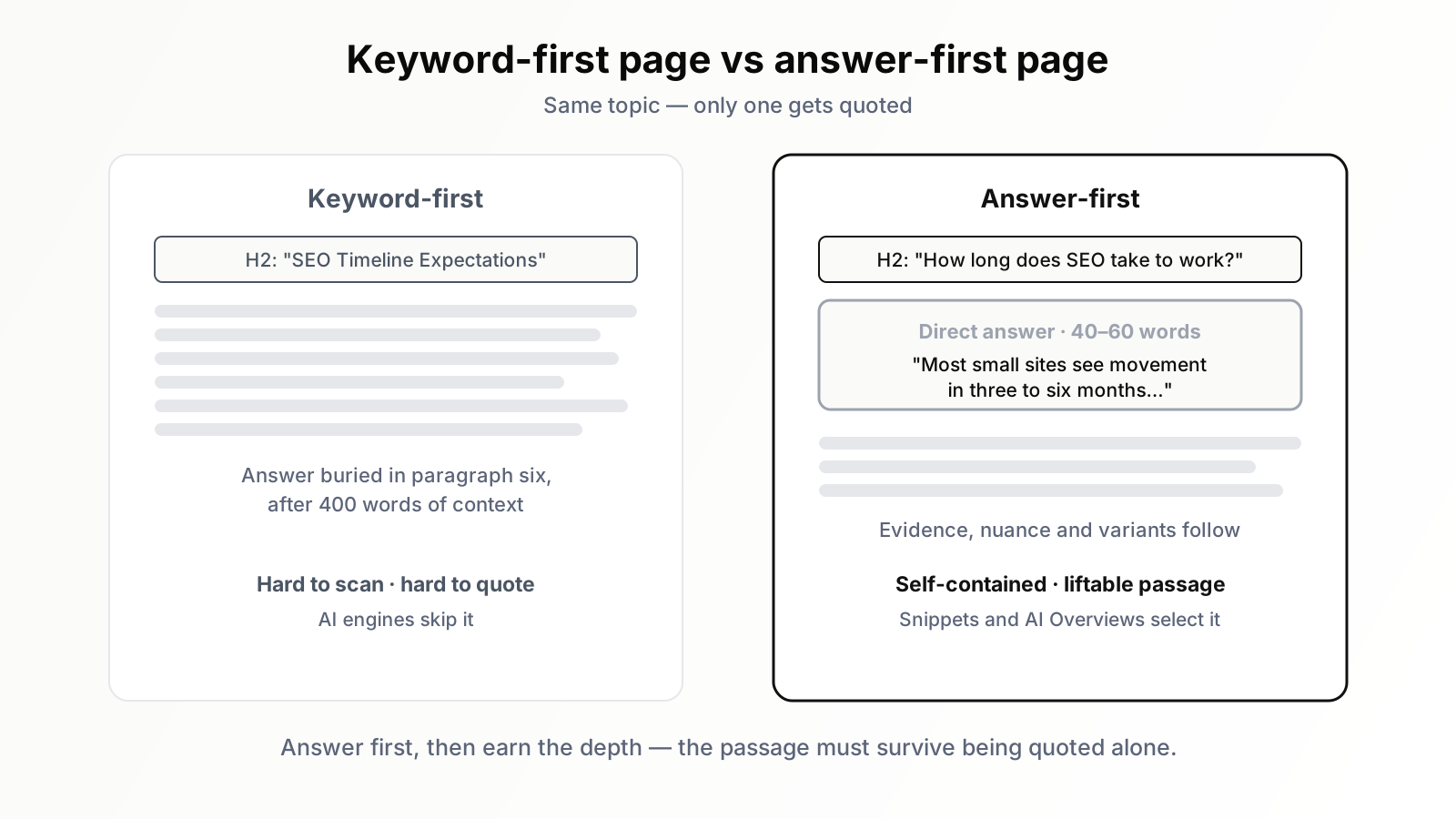
When a section answers a question, make the heading the question, phrased the way people ask it, not a noun-phrase abstraction of it. "How long does SEO take to work?" beats "SEO timeline expectations" every time, for three audiences at once: the scanning human recognises their own question; Google's systems can align the passage to the query; and AI engines lifting passages get a self-describing block. Resist the urge to "optimise" the question into keyword-ese — the natural phrasing is the optimisation now.
Answer first, in 40–60 words, then earn the depth
The single highest-leverage habit in conversational content: the first paragraph under a question heading should answer the question completely, in roughly 40–60 words, as if it were the only paragraph the reader would see. Direct subject-verb-object phrasing. No "it depends" throat-clearing, no "great question" padding, no restating the question. Then — after the answer — give the evidence, the nuance, the exceptions, the steps. This answer-first structure is what featured snippets have rewarded for years and what AI Overviews overwhelmingly select for citation: a self-contained passage that survives being quoted out of context. If your honest answer genuinely is "it depends", say what it depends on in one sentence and give the most common case a number: "Most small sites see measurable movement in three to six months; competitive niches take longer."
Write in the second person, at speaking pitch
Conversational queries deserve conversational answers. That means "you" instead of "businesses seeking to optimise", verbs instead of nominalisations, and sentence lengths a person could say in one breath. This is not dumbing down — the technical content stays — it is matching register. A reader who asked a spoken-style question and lands on a page of corporate passive voice experiences a jolt of mismatch; a reader who lands on prose that sounds like a knowledgeable colleague keeps reading. AI engines, trained to produce conversational answers, also visibly prefer to quote sources whose prose already fits that register.
Honour the qualifier stack with variants
Remember the constraints inside conversational queries. A strong question page acknowledges the major variants of its question rather than pretending one answer fits all. If the question is "how much does a website cost?", the honest page breaks the answer down by the constraint people actually add: for a template site, for a custom build, for ecommerce, monthly versus one-off. Each variant is a short, answer-first sub-section. This is how a single well-structured page can be the best result for dozens of differently-constrained conversational phrasings at once — and how it gets retrieved when an AI engine fans the original query out into exactly those variants.
One page or many? Structuring a question cluster
The classic mistake, once a team discovers question content, is to spin every question into its own thin page — two hundred words, a question title, and a prayer. Google has spent years demoting exactly that pattern, and the helpful content signals have made thin question pages a liability, not an asset. The opposite mistake is stuffing forty questions into one undifferentiated FAQ page where no single answer has room to be the best answer on the web.
The working rule: a question deserves its own page when its best answer needs more than a few hundred words, has its own search demand, or leads to a different next step. "What is schema markup?" deserves a page; the searcher needs a real explanation and their next step is implementation. "Does schema markup help SEO?" is a section inside that page; its complete answer is two paragraphs that naturally lead into the surrounding explanation. Group your collected questions by the page-versus-section test, then arrange the pages in a pillar-and-cluster shape: a comprehensive pillar answering the head question, cluster pages answering the substantial sub-questions, every section inside each page answering the small ones, and internal links binding the family together. The cluster structure matters more in conversational search, not less, because fan-out retrieval pulls from multiple pages of a site that demonstrates coverage of the whole question space.
Inside each page, sequence the questions the way a conversation would flow: definition before comparison, comparison before cost, cost before implementation. A page ordered by the natural follow-up sequence reads as helpful; a page ordered by descending search volume reads as assembled.
The technical layer: schema, FAQs, and formatting
Two pieces of housekeeping help conversational content get machine-read correctly. First, headings: keep a clean hierarchy where H2s carry the major questions and H3s carry variants, because heading structure is the skeleton both crawlers and AI retrieval systems use to segment your page into passages. A page with vague headings ("Going deeper", "The next level") forfeits that alignment.
Second, structured data — with honest expectations. FAQPage schema no longer earns rich results for ordinary websites; Google restricted that treatment to government and health sites back in 2023. Q&A and FAQ markup can still help machines parse your question-answer pairs unambiguously, and it costs little, but do not deploy it expecting visible stars and dropdowns in the results. The formatting that actually moves outcomes is on-page: short answer-first paragraphs, lists for steps, tables for comparisons — the shapes that are easy to quote. For the broader discipline of formatting content so answer engines can lift it cleanly, see our piece on answer engine optimization as SEO's next chapter.
Measuring something designed not to be a head term
Conversational content frustrates traditional reporting, because its value is spread across hundreds of low-volume phrasings rather than concentrated in trackable head terms — and because a good chunk of its consumption now happens inside AI answers that send no click. Measure it accordingly.
In Search Console, watch the count and diversity of question-pattern queries your site appears for, not just clicks on individual ones: a growing tail of question impressions is the leading indicator that your question coverage is being matched. Track impressions-weighted position for your question pages as a cohort. Spot-check whether AI Overviews on your target questions cite you, and whether ChatGPT Search and Perplexity reference your pages when asked your questions directly. And watch the metric that ultimately justifies the work: branded search and direct traffic drifting upward as people who met your answers come back for the source. Zero-click exposure is not zero value — but only if you are deliberately converting visibility into recognition.
One reporting caveat worth knowing: Search Console anonymises very rare queries, so a meaningful slice of your conversational tail never appears in the report at all. If your question pages earn clicks and impressions that the visible query list cannot account for, that hidden tail is usually the explanation. Treat the visible question queries as a sample of the demand, not a census of it, and weight your decisions toward the patterns — which question families are growing, which pages attract them — rather than toward any single phrasing's numbers.
How people ask is the spec, not the noise
The deepest habit shift this requires is treating the phrasing of a question as signal instead of noise. Keyword-era SEO taught everyone to strip queries down to their head terms and write for the abstraction. Conversational search inverts that: the "extra" words — the constraints, the situation, the stage — are the specification for the content. The teams winning question-driven visibility in 2026 are not the ones with the biggest keyword lists; they are the ones who listen hardest to exact wording and answer it most directly, one self-contained passage at a time.
The honest obstacle is volume: hundreds of real questions, each deserving a researched, answer-first treatment, is a serious workload for any content team. That scale problem is precisely what an SEO AI agent like Orova exists to absorb — it mines the question phrasings from your search data, clusters them into a page-versus-section plan, and drafts the answer-first sections for your experts to verify, so the listening stays human and the heavy lifting does not. Start with ten real questions from your own inbox this week, answer each one in sixty words before you write anything else, and you will feel the difference in how the content lands.
Turning this into a system, not a one-off rewrite
Everything above works, but doing it by hand for every topic is slow: digging through forums and review sites to find real phrasings, mapping out every variation of a question, deciding whether it needs one page or several, then wiring up the technical formatting so search engines and AI tools can actually read and quote your answer. It's the kind of work that's easy to do once and hard to keep doing consistently across a whole content library.
This is exactly the part Orova SEO is built to take off your plate — finding how people really ask, structuring the answer to match, and handling the technical formatting underneath so your content is ready to be picked up by both search engines and AI answer tools. If this sounds like the piece that's been slowing you down, it's worth taking a look at how Orova SEO handles it.
Let Orova SEO handle the repetitive part
Keyword research, drafting, refreshing old posts and rank tracking — running automatically on your own site.
Explore Orova SEO