
The Complete Guide to Ranking in Google AI Overviews
Somewhere in the past two years, the most valuable real estate in search stopped being the first organic result. For a growing share of queries, the first thing a searcher sees is a paragraph written by Google itself — an AI Overview, assembled by a language model from a handful of sources it chose to trust, with your page either cited inside it or invisible beneath it. The ten blue links still exist, but they now start further down the screen, below an answer that many searchers never scroll past.
That shift has produced two equally unhelpful reactions. One camp declares that SEO is finished and citations are unwinnable lottery tickets. The other insists nothing has changed and the old playbook still applies untouched. Both are wrong. AI Overviews are not random — they draw on retrieval systems that behave in observable, fairly consistent ways — and they are not the old SERP either. Ranking inside them is a learnable discipline with its own mechanics, and this guide covers those mechanics end to end: what AI Overviews are, how Google selects the sources it cites, what your content needs to look like at the page and passage level, the technical groundwork underneath, how to measure any of it, and how to build a strategy that holds up as the feature keeps evolving.
How do you rank in Google AI Overviews? Be retrievable and rankable for the query and its related sub-questions, then structure content so each section answers one specific question directly in its first sentences. Google's models cite pages that supply clear, extractable, trustworthy passages — so combine answer-first formatting, genuine expertise signals, and clean technical access for crawlers.
What AI Overviews actually are
An AI Overview is a generated summary that appears at the top of Google's results page for queries where Google's systems decide a synthesized answer is helpful. It is produced by a version of Google's Gemini models working together with the core ranking and retrieval systems: the model does not answer from memory alone, it is grounded in documents pulled from the live index, and the overview links out to a set of those documents as citations — sometimes inline, sometimes in a panel of cards beside or beneath the text.
Three properties of the feature matter strategically. First, coverage is selective but expanding. AI Overviews appear mostly on informational and question-shaped queries — explanations, comparisons, how-tos, definitions — and far less on navigational or hot transactional queries, though the boundary keeps moving. Second, the overview is query-specific, not page-specific: Google composes a fresh answer for the query, which means the set of cited sources can differ even between closely related phrasings. Third, and most important, citations are the only way in. You cannot buy placement in an AI Overview and you cannot mark a page up to demand inclusion. The model cites what its retrieval layer surfaced and what its synthesis found useful. Everything in this guide is ultimately about influencing those two steps.
It is also worth separating AI Overviews from their louder sibling. AI Mode is Google's fuller conversational search experience — a chat-style interface that handles longer, multi-part questions. AI Overviews are the ambient version embedded in the classic results page, which is why they matter more for most businesses right now: they intercept ordinary searches your audience was already making, at enormous volume, without the searcher choosing anything new.
How Google chooses what to cite
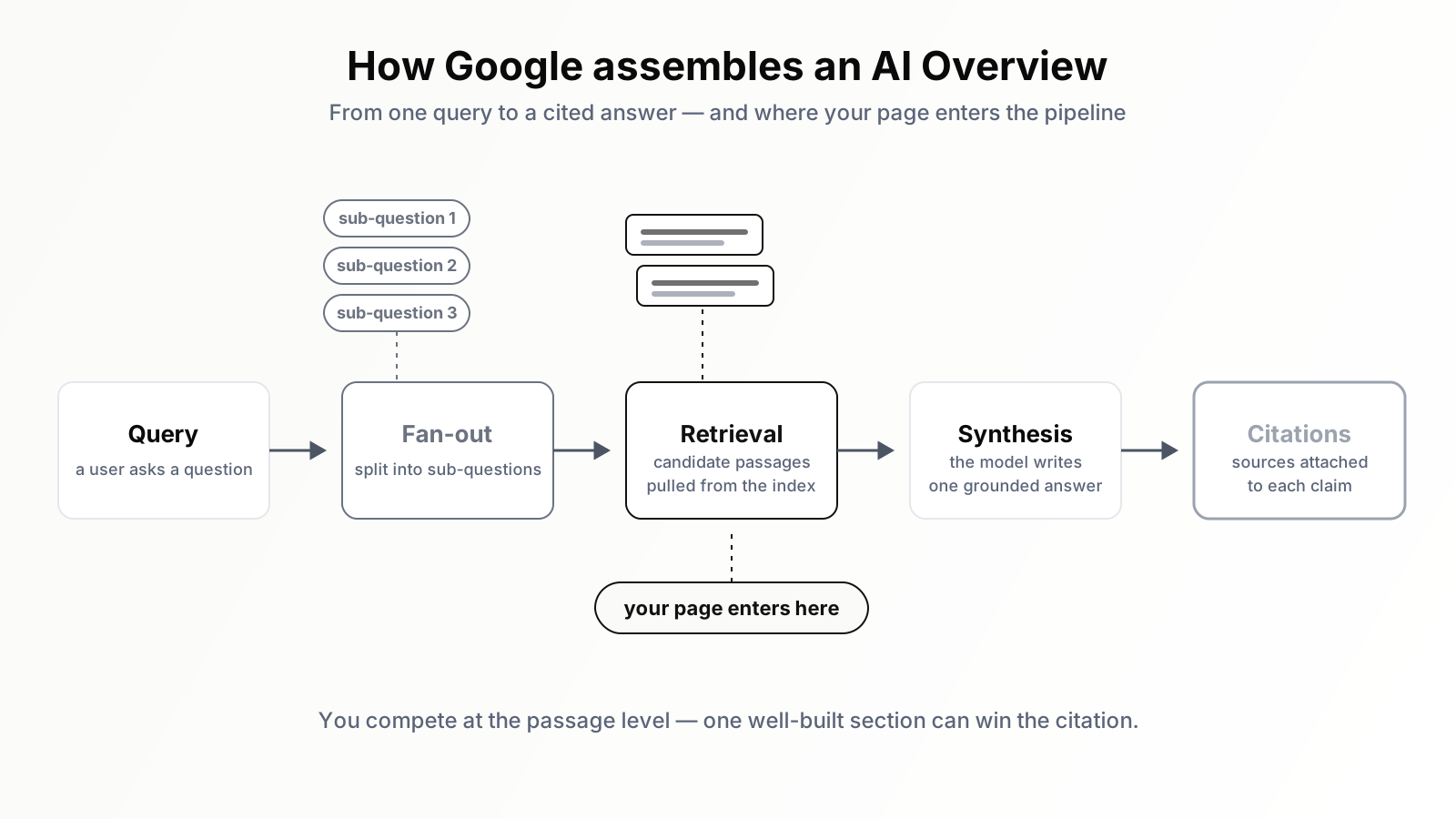
Google has published only an outline of how overviews are built, but the outline, the patents around it, and a great deal of independent testing point at a consistent picture. When a query is eligible, the system does not just look at the query as typed. It expands it — a process often called query fan-out — into a set of related sub-questions. A search for "rank in ai overviews" might fan out into what AI Overviews are, how citations get selected, what content formats work, and how to measure inclusion. Retrieval then runs across that whole set, pulling candidate documents and, crucially, candidate passages from the index. The model synthesizes an answer from those passages and attaches citations to the sources that supported each part of the text.
Each stage of that pipeline implies something you can act on. The fan-out stage means a page that covers the cluster of sub-questions around a topic has more surface area to be retrieved than a page that answers only the literal head query. The retrieval stage means classic ranking strength still matters: study after study has found that a large majority of AI Overview citations come from pages already ranking in the top organic results for the query or for one of its related queries. Retrieval is not a separate, mystical index — it leans on the same systems that have always decided which pages deserve to surface. And the synthesis stage means passage quality decides the final cut: among the retrieved candidates, the model cites the ones whose text most directly and cleanly supports a sentence it wants to write.
That last point deserves emphasis because it is the genuinely new skill. Traditional SEO optimized pages; AI Overview optimization happens at the level of the passage — the individual section, the two-to-four sentence block that a model can lift, verify, and attribute. A page can rank third for a query and contribute nothing to the overview because its information is smeared across fourteen paragraphs of preamble, while a page ranking seventh gets cited because one of its sections states the answer plainly in its opening lines. If you internalize one idea from this guide, make it this one: you are no longer only competing page against page; you are competing passage against passage.
Prerequisite: you still have to rank
Because citations draw overwhelmingly from pages that already perform in organic search, the unglamorous truth is that AI Overview visibility starts with ordinary SEO competence. A page that cannot reach the top twenty results for its target query or any of its sibling queries has almost no path into the overview, no matter how beautifully its passages are formatted. The foundation has not changed: crawlable, indexable pages; real topical depth; internal links that make your site's structure legible; backlinks and mentions that establish the site as a known entity in its field.
What has changed is the shape of the target. Under the old model you optimized one page for one primary keyword and its variants. Under fan-out, the effective target is the question cluster — the head query plus the related questions Google expands it into. This is where a deliberate topic architecture pays off twice: a pillar-and-cluster structure gives you both a comprehensive page that can be retrieved for many sub-questions and focused supporting pages that can each win their narrower question outright. If your site already groups content into clusters around your core topics, you are structurally ahead; if it is a flat archive of disconnected posts, fixing that is the first project, before any passage-level polish. Question-focused keyword research matters more than ever for the same reason — the long, specific, interrogative queries that used to look like low-volume scraps are precisely the sub-questions fan-out generates, and we covered how to mine them in our guide to question keywords.
Writing content that gets cited
Assume your page can be retrieved. The next battle is making its passages the easiest ones for the model to use. Everything below is a concrete, testable practice, and none of it requires sacrificing quality for human readers — done well, it makes content better for them too.
Answer first, elaborate second
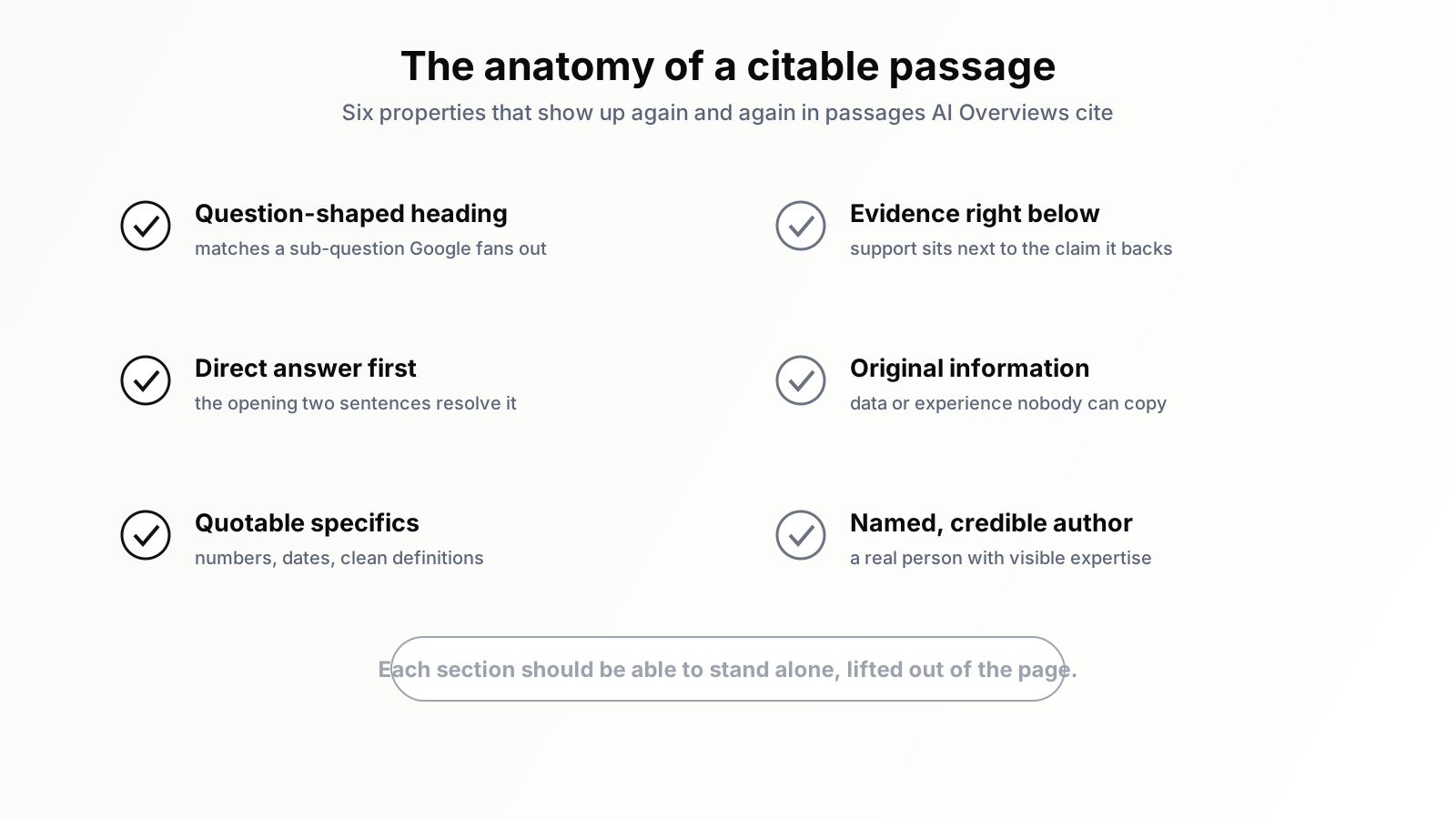
Structure every meaningful section as an inverted pyramid. The heading poses or implies a question; the first one or two sentences answer it completely; the rest of the section adds evidence, nuance, and examples. Models attributing sources favor passages where the claim is self-contained — a sentence that makes sense lifted out of context, without "as we mentioned above" or a paragraph of throat-clearing before the point. Audit your existing pages with a brutal question: if someone read only the first two sentences under each heading, would they have the answer? On most blogs the honest answer is no, and fixing exactly that has become one of the highest-leverage edits in SEO.
One section, one question
Give each sub-question its own clearly bounded section with a descriptive heading, rather than weaving five answers through one essayistic flow. Question-shaped or strongly descriptive H2s and H3s act as retrieval signposts: they tell the system what the passage beneath them is about, in language that often mirrors the fan-out queries themselves. This does not mean writing robotic FAQ pages — it means disciplined structure beneath a natural voice. The page you are reading now follows the pattern: every H2 maps to a question someone asks about ranking in AI Overviews.
Be specific enough to be quotable
Vague text cannot be cited because it asserts nothing. "It depends on several factors" supports no sentence a model wants to write; "citations draw mostly from pages already ranking in the top results, so organic strength remains the prerequisite" does. Prefer numbers, named mechanisms, definite recommendations, and clear conditions over hedged generalities. Where the honest answer genuinely is "it depends," say what it depends on, explicitly — that conditional structure is itself extractable.
Add information that exists nowhere else
When ten retrieved pages all paraphrase the same received wisdom, the model needs only one of them — and the others were retrieved for nothing. Original information is the strongest differentiator available: your own test results, your own data, a framework you developed, a contrarian observation you can defend, real numbers from real work. This is the "information gain" idea — pages that add something beyond the existing corpus earn disproportionate citations — and it shows up clearly in source analyses, including our own study of 300 AI Overviews, where pages with first-party data were cited far above their ranking position. The era when competent summarization of other people's content earned traffic is the part of SEO that genuinely is dying.
Keep facts fresh and dated
Overviews on time-sensitive topics visibly favor recently updated sources. Maintain your important pages: refresh statistics, replace deprecated advice, and show a credible last-updated date that reflects real revision, not a script bumping timestamps. A two-year-old page about an AI feature that has shipped six updates since publication is precisely the kind of source a synthesis system learns to skip.
Trust signals: E-E-A-T in the AI era
Synthesis raises the stakes on credibility, because Google takes responsibility for the words in an overview in a way it never did for a blue link. The systems accordingly weight the trustworthiness of sources hard, and the familiar E-E-A-T framework — experience, expertise, authoritativeness, trust — is the working vocabulary for what they look for. In practice that means visible, verifiable signals: named authors with real credentials and bios; an organization that exists consistently across the web; claims supported by evidence and citation rather than assertion; first-hand experience demonstrated in the content itself, not claimed in the marketing copy. We have written a full breakdown of what Google actually rewards under E-E-A-T, and every word of it applies with more force to AI Overview selection than it did to classic ranking.
One under-appreciated dimension is entity consistency. The retrieval and synthesis systems understand your brand, your authors, and your product as entities in a knowledge graph, assembled from your site, your profiles, and what others say about you. When that picture is coherent — same name, same description of what you do, same areas of expertise, corroborated by third parties — you are an entity the system can confidently associate with a topic. When it is fragmented or contradicted, you are noise. Being mentioned, reviewed, and discussed on sites you do not control is therefore no longer just link building; it is how you become a thing the model knows.
The technical layer
None of the content work matters if the machinery cannot read the page. The technical requirements for AI Overview eligibility are mostly the same as for classic indexing, with a few points of added emphasis.
Crawlability and rendering. Your important content must be present and readable without depending on heavy client-side rendering. Google renders JavaScript, but passage-level retrieval is most reliable when the substance of the page is in the served HTML. If your answers live inside an interactive widget, an image, or a component that hydrates late, they may as well not exist for synthesis purposes.
Structured data. Schema markup does not directly cause citations, and claiming otherwise would cross into the mythology we have debunked before. What it does is remove ambiguity: Article, FAQPage, HowTo, Product, and Organization markup tell the systems unambiguously what a page is, who wrote it, and what entities it concerns, which supports both retrieval and the entity coherence described above. It also keeps you eligible for the classic rich results that still drive clicks below the overview. Our guide to winning rich results with structured data covers the implementations worth doing.
Crawler access policy. Decide deliberately which AI crawlers you allow. Google-Extended is the user-agent token that controls whether your content can be used for training Google's models — but note that blocking it does not remove you from AI Overviews, which are powered by ordinary Search indexing. Separately, GPTBot (OpenAI), ClaudeBot (Anthropic), and PerplexityBot (Perplexity) govern other AI systems. For most businesses that want AI-era visibility, blocking these is self-harm; whichever way you decide, decide it consciously rather than inheriting whatever your robots.txt happened to say in 2023. The proposed llms.txt standard, which offers AI systems a curated map of your content, costs little to add — just hold a realistic view of it: it is a proposal some tools read, not something Google or OpenAI has committed to honoring.
Speed and stability. Core Web Vitals will not put you in an overview, but a site that times out or shifts under the crawler erodes everything upstream. Treat performance as the hygiene factor it has always been.
Measuring AI Overview visibility
Here is the uncomfortable part: measurement is genuinely harder than it was, and anyone selling you a clean dashboard of "AI Overview rankings" is smoothing over real gaps. Google Search Console does not report AI Overview presence as a separate dimension. Impressions and clicks from overviews are folded into normal Search performance data, an overview citation counts as an impression at a high position, and you cannot filter to see them. What you can do is triangulate.
First, track the symptom: impressions holding or rising while clicks and CTR fall on informational queries is the classic signature of an overview absorbing your clicks — we documented the pattern in detail in our analysis of how AI Overviews eat clicks. Segment your queries by intent and watch CTR by segment, not in aggregate. Second, sample directly: take your fifty most important queries, check them for overview presence and citations on a schedule, and log who is cited. Manual at small scale, scriptable at medium scale, and several rank trackers now record overview presence and cited domains as a feature. Third, watch referral patterns and branded search: content that gets cited tends to lift branded queries and direct visits over time, because being named in answers builds memory even when it does not yield an immediate click.
Set expectations accordingly. The goal of measurement here is not a precise citation rank — it is knowing which of your topics trigger overviews, whether you are gaining or losing presence in them quarter over quarter, and which competitors keep getting picked so you can study why.
Strategy: where to actually spend effort
With mechanics and measurement in place, the strategic question is allocation. Not every query deserves AI Overview effort, because the value of a citation varies enormously by intent.
For top-of-funnel informational queries, accept that the overview will absorb many clicks and optimize for presence anyway. Being the cited source on definitional and explanatory queries in your field is brand-building at the moment of curiosity — the searcher learns your name as the authority even when they do not visit, and a meaningful minority click through for depth. This is where answer-first formatting and the passage discipline above earn their keep. The clicks that do come are warmer than the old skim traffic, a dynamic we explored in zero-click search doesn't mean zero value.
For middle-funnel comparison and evaluation queries — "best X for Y," "X vs Y," "is X worth it" — fight hard. Overviews on these queries are common, the searcher is closer to a decision, and the cited sources effectively become the shortlist. Original evaluations, real testing methodology, and honest trade-off analysis win here, because synthesis systems demonstrably prefer evaluative content with evidence over thin listicles.
For bottom-funnel and branded queries, classic SEO still rules: overviews appear less often, and when they do, your own product pages and documentation are the natural citations if they are well structured. The quiet win here is making sure the AI describes you accurately — your pricing page, feature descriptions, and docs are the sources from which models learn what your product is, so keep them current and unambiguous.
Across all three tiers, prioritize queries where you already rank on page one but are not cited — those are the cheapest wins, usually fixable with passage-level rewrites rather than new content. Then move to question clusters where you have authority but no dedicated coverage. Building new topical authority from scratch remains the slowest, most expensive route, exactly as it always was.
A worked example, end to end
To make the workflow concrete, walk one query through it. Suppose you sell scheduling software and want visibility for "how to reduce no-shows." Step one: check whether the query and its siblings trigger overviews — they do, and the fan-out is visible in the related questions: why do customers miss appointments, do reminder texts work, how far in advance should reminders go out, should you charge no-show fees. Step two: audit who is cited and why. Typically two or three of the citations are top-five organic pages, and at least one is a lower-ranking page with original data — say, a study on reminder timing. Step three: map your assets. You have a page ranking eighth that mentions reminders in passing across a long essay. Step four: restructure it — one H2 per sub-question, the answer in the first two sentences of each, your own usage data added where you have it ("across our customer base, two reminders cut no-shows roughly in half" is citable; "reminders help" is not). Step five: strengthen the cluster with one focused supporting page on the sub-question you can win outright, interlinked with the pillar. Step six: log overview presence for the query set before and after, and give it weeks, not days.
Nothing in that sequence is clever. It is the same six steps for every query cluster you care about — which is exactly the point. Teams that win citations are not the ones with a secret; they are the ones that run this loop more times, on more clusters, with more original data per page, an advantage that compounds with every quarter the work continues — and one that explains most of the patterns in how Google assembles these answers.
Mistakes that waste your effort
A few failure modes recur often enough to call out. Chasing the overview instead of the question cluster — optimizing one page for one query while ignoring the fan-out, then wondering why a competitor with a deeper cluster gets cited. Formatting without substance — bolted-on FAQ blocks and answer-shaped paragraphs wrapped around the same generic content; the model has the substance from someone else already. Blocking crawlers in a panic — cutting off AI user-agents to "protect content" and thereby vanishing from the systems your buyers now ask. Treating this as separate from SEO — spinning up an "AI optimization" workstream disconnected from the ranking work that actually feeds retrieval; the disciplines are one discipline, a point the wider industry conversation about answer engine optimization keeps relearning. And measuring nothing — shipping passage rewrites without a before-and-after sample of overview presence, which makes learning impossible.
How this evolves from here
AI Overviews will keep changing — coverage expands, citation formats get redesigned, AI Mode keeps absorbing more complex queries — and any guide that pretends to a frozen rulebook is lying. But the direction of travel is stable, and it favors the same things this guide has argued for: sources that answer specific questions directly, demonstrate real experience, contribute original information, and exist as coherent, trusted entities. Those properties were good SEO before generative search and they are the selection criteria within it. The work is not exotic. It is structured, passage-level, measurable content engineering, applied consistently across every topic you need to own — which is to say, it is a volume problem as much as a knowledge problem.
That volume is where most teams stall, and where automation earns a place: Orova runs this loop as an SEO AI agent — researching the question clusters around your topics, drafting answer-first content built for citation, keeping technical signals consistent, and tracking the impression-versus-click patterns that reveal your overview presence — so a small team can apply this playbook across hundreds of queries instead of ten. However you resource it, start now, with the queries you already half-own: check which trigger overviews, see who is cited, and rewrite your best-ranking passages to be the easiest answer in the room. The sources being chosen today are accumulating an advantage that will be expensive to take back later.
Run your business with AI Agents
Orova is the always-on Biz AI Agent — it plans, runs, and optimizes the work for you. Save time, unlock productivity.
Try it free