
"Zero-Click Search" Doesn't Mean Zero Value
There is a phrase that has been quietly draining the confidence out of content teams for a few years now, and it has accelerated sharply since AI Overviews arrived. The phrase is "zero-click search." It describes a search that ends without the user clicking through to any website — the answer was delivered on the results page itself, or inside an AI-generated summary, and the journey stopped there.
The phrase has hardened into a piece of received wisdom, usually delivered with a grim face: "zero-click search is killing SEO." And from there it is a short step to a conclusion that costs companies real money: if the search produced no click, it produced no value, so why invest in being visible?
That conclusion is wrong. It rests on a hidden assumption — that a click is the only thing worth having from a search — and that assumption does not survive examination. This article is built around a handful of plain statements meant to dislodge it, because the way you think about zero-click search determines whether you adapt to it or surrender to it.
"A click is a means, not an end."
Start with the assumption itself. Why did anyone ever want a click? Not for its own sake. A click was never the goal. A click was the mechanism — the way you got a person's attention onto your page so that something valuable could happen there: they learned who you were, they trusted you a little more, they remembered your name, eventually some of them bought something.
The click was the bridge to the value. It was never the value. And once you see that clearly, the phrase "zero-click" loses its terror. A search with no click is a search where one particular bridge was not crossed. It is not, automatically, a search where no value changed hands. Whether value changed hands depends on what happened on the results page itself — and increasingly, things happen there.
"You were seen, even if you were not clicked."
Here is the value that survives a zero-click search, and it is not small.
When your brand is named as the source of an AI Overview's answer, or appears in a cited snippet, the user saw you. They saw your name attached to a credible, useful answer to a question they cared about. They did not click — but they registered that you exist, that you know this subject, and that a search engine or an AI tool considered you worth citing.
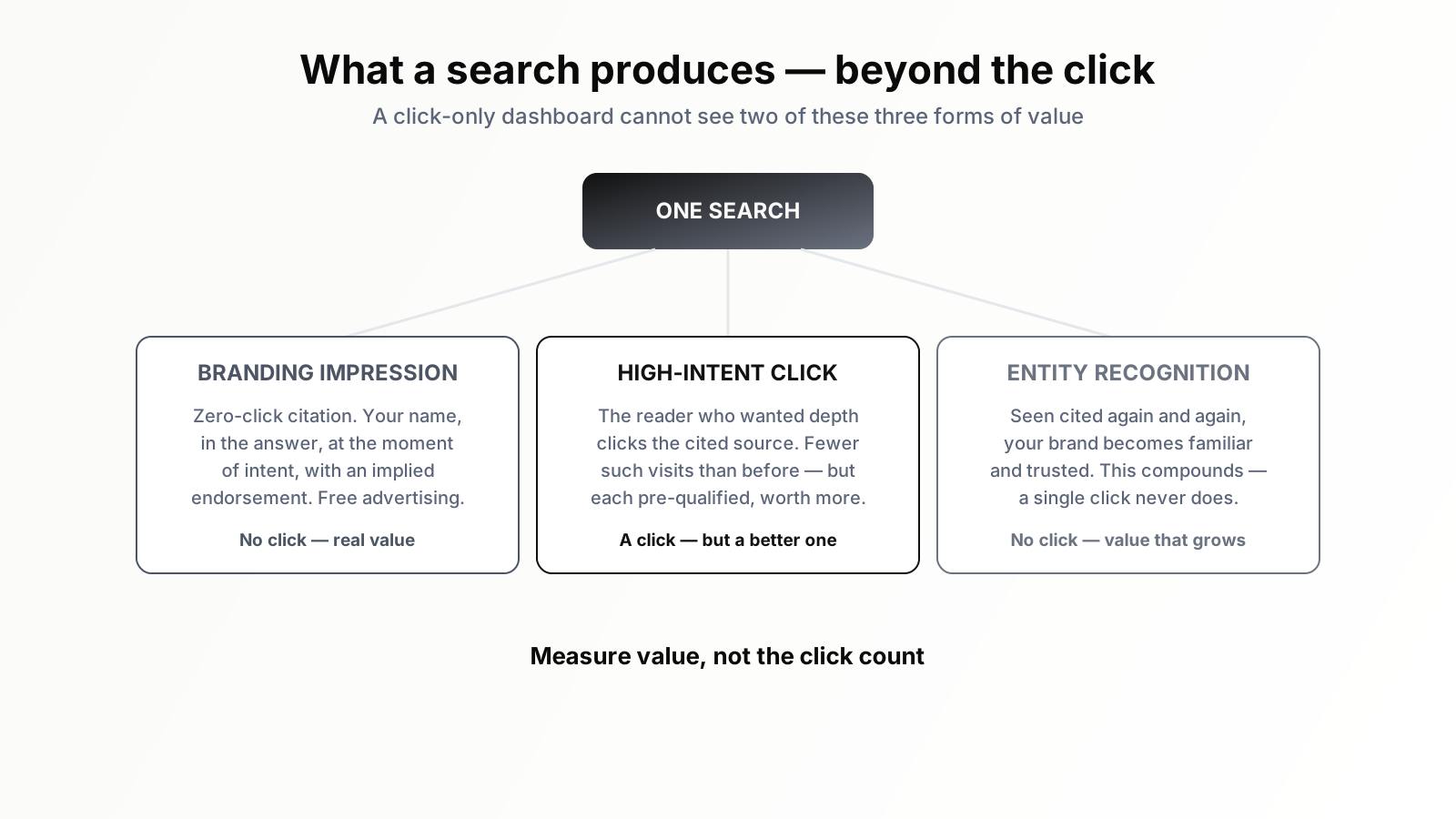
That is an impression. Marketers have spent enormous budgets, for a century, to buy impressions — to get a brand name in front of the right person at the right moment, associated with the right idea. A zero-click citation delivers exactly that, at the precise moment the person was thinking about your topic, with the implied endorsement of the engine that surfaced you. Calling that "zero value" is a category error. It is branding, delivered free, at the point of intent.
"The click you do get is worth far more than it used to be."
Now look at the other side of the zero-click world, because the framing "all clicks are disappearing" is simply false.
Clicks still happen. But the composition of clicks has changed. The searches that end without a click are disproportionately the shallow ones — someone wanted a fact, a date, a quick definition, and the results page handed it over. Those were always your lowest-value visits: nine seconds on the page, no engagement, no memory of you, no chance of conversion.
The clicks that still happen are disproportionately the deep ones. Someone read the AI summary, found it useful, and wanted more — the full reasoning, the supporting detail, the original source. So they clicked through to a cited page. That visitor arrives already interested, already partly convinced, already pre-qualified by the summary that sent them. A click like that is worth several of the shallow clicks it replaced.
So the honest accounting is: zero-click search took your cheap clicks and left you a smaller number of expensive ones. Your total click count dropped. Your click quality rose. If you only watch the count, you will mourn a loss that is partly an upgrade.
"Recognition compounds; a single click does not."
There is a longer-term value to zero-click visibility that the doom framing cannot see at all, because it only counts single sessions.
Think about what happens when the same person sees your brand cited in answers to three or four different questions over a few weeks. No single one of those was a click. But cumulatively, something real has happened: your name has become familiar, and familiarity is the raw material of trust. The next time that person needs what you sell, they do not start from zero. They start from "I have seen that name before, attached to good answers, on this exact subject."
That is brand recognition, and it compounds. A single click is a one-time event — the visitor came, the visitor left, and the meter resets. Repeated zero-click visibility builds an asset that does not reset: a brand the market increasingly recognises and trusts. AI tools, in particular, increasingly understand the world through recognised entities, and being a recognised entity is built precisely through this kind of repeated, cited presence. A run of zero-click impressions can be worth more, over time, than the single click the old web would have given you instead.
"Measuring only clicks means mismeasuring your own success."
If the value of search has partly moved off the click, then a measurement system built entirely on clicks is now lying to you — not maliciously, just structurally.
A dashboard that tracks only organic sessions will show a zero-click world as pure decline. Sessions down, therefore failure. But that same period might have seen your brand cited far more often, your branded search volume rising, your conversion rate from the remaining traffic improving because the remaining traffic is better. The click-only dashboard cannot see any of that. It reports a loss while you are, on the measures that matter, gaining.
The fix is to measure value, not just clicks. Watch conversions from organic, not only sessions — fewer, better visits should hold or grow conversions even as sessions fall. Watch branded search growth as a proxy for the recognition that zero-click visibility builds. Watch citation presence where your tools can observe it. A measurement system honest about a zero-click world counts the impression, the recognition, and the conversion — not only the click.
"You cannot reverse it, so the only useful move is to adapt."
One more plain statement, because a lot of energy is being wasted on its opposite.
Zero-click search is not a temporary glitch that will be rolled back. It is the direct result of search engines and AI tools getting better at answering questions immediately — and "answer the question faster" is what users want and what these companies are competing to deliver. The trend has momentum because it serves the user. It is not going to reverse because publishers find it inconvenient.
That means the only move with any return on it is adaptation. Resenting zero-click search, or waiting for it to go away, or building forecasts on its disappearance — all of that is effort spent on an outcome you cannot influence. The effort that pays is the effort spent becoming the kind of source that wins the zero-click citation and earns the high-intent click: clear answers, original substance, structure an answer engine can use, a brand worth recognising. We cover the mechanics of that in our guides to answer engine optimisation and getting cited by ChatGPT, Gemini, and Perplexity.
"The chart that scares your boss is measuring the wrong thing."
There is a particular meeting that plays out in content teams everywhere right now, and it is worth describing because it is where the false conclusion does its real damage.
Someone presents the traffic chart. Organic sessions are down. The line slopes the wrong way, and in a room trained to read that line as the scoreboard, the mood drops. The unspoken question becomes: is content still worth funding? Budgets get questioned. Hiring gets paused. The team that was publishing confidently last year starts publishing defensively, or stops.
The tragedy is that the chart everyone is staring at may be describing a success. If that same period saw the team's articles cited more often in AI answers, branded search rising, and conversions from the remaining organic traffic holding steady or climbing, then the business is doing better on every measure that pays — and the only chart on the screen is the one measure that no longer captures it.
This is why the framing matters so much. It is not an abstract debate about metrics. It is the difference between a leadership team that cuts a working channel because of a misleading chart, and a leadership team that sees the channel clearly and keeps investing. The phrase "zero-click search" makes the misleading chart sound like proof of decline. It is not proof of anything except that you are measuring sessions in a world where sessions are no longer the whole story.
The practical defence is to never present the sessions chart alone. Put it beside conversions from organic, beside branded search volume, beside whatever citation signal your tools can observe. A sessions line falling while conversions hold and branded search rises tells a completely different — and accurate — story: not "the channel is dying" but "the channel is shedding its cheapest traffic and keeping its value." Same data. Honest framing. Opposite decision.
"Zero-click is brutal to commodity content — and that helps you."
A final reframe, because the zero-click world is not equally hard on everyone.
Zero-click search and AI summaries are devastating to thin, generic content — the page that exists only to restate a common fact loses its clicks completely, because the results page now states that fact directly and for free. If your content was commodity content, the zero-click world is genuinely punishing, and pretending otherwise would be dishonest.
But if your content is original, deep, and genuinely useful, the same zero-click world quietly works in your favour. It strips the cheap clicks away from your weakest competitors, removes the incentive to mass-produce filler, and rewards exactly the qualities good content already has — by citing it, recommending it, and sending it the high-intent clicks. The phrase "zero-click search" describes a threat to mediocre content and an opportunity for excellent content. Which of those it is for you depends on what you publish.
Where an AI agent fits
Adapting to a zero-click world is not complicated to understand — this article is the understanding — but it is a lot to execute: making content the kind of source that earns citations, restructuring pages so answer engines can use them, deepening commodity pages, and rebuilding measurement around value rather than raw clicks. That is sustained, detailed work across a whole library.
That is the work an SEO AI agent is built to carry. Orova can audit content for the qualities a zero-click world rewards — clear answers, original substance, citation-ready structure — flag the commodity pages most exposed to the shift, and help you focus on the metrics that actually capture value rather than the click count that no longer tells the whole story. The reframe in this article does not change. The agent removes the workload that stops most teams from acting on it.
"Zero-click search" is one of the most quietly damaging phrases in marketing, not because the phenomenon is not real, but because the word "zero" smuggles in a false conclusion. The clicks dropped. The value did not. It moved — onto the impression, the recognition, the better click, the compounding brand. Count what actually matters, and the zero-click world stops looking like an ending and starts looking like what it is: a new place to win.
Run your business with AI Agents
Orova is the always-on Biz AI Agent — it plans, runs, and optimizes the work for you. Save time, unlock productivity.
Try it free