
How to Get Cited by ChatGPT, Gemini, and Perplexity
A new kind of visibility has appeared, and most content teams have not yet decided how seriously to take it. When someone asks ChatGPT, Gemini, or Perplexity a question, the tool often answers with synthesised text and a short list of cited sources. Being one of those cited sources is a real form of exposure — your brand named inside the answer, a link the user can follow, a recommendation delivered by the tool itself.
The obvious question is: how do you get cited? This article takes that question apart analytically. Rather than offering a tidy checklist as if the answer were settled, it works through how citation actually happens in each major tool, what the tools have in common, where they differ, and which actions follow logically from that analysis.
First, separate the two kinds of answer engine
The most useful analytical move at the start is to recognise that "getting cited by AI" is not one problem. The major tools fall into two groups that work differently enough to need different thinking.
The first group retrieves from a search index. Google's AI Overviews are the clearest example: the candidate sources are drawn largely from Google's existing index, which means classic search ranking is tightly coupled to citation eligibility. Perplexity also performs live retrieval against the web for most queries. For this group, the logic is: be findable and rankable through normal search, because that is the doorway into the candidate pool.
The second group answers, in some modes, primarily from training data. A base large language model responding without a live browsing step is drawing on what it absorbed during training — a snapshot of the web from some past period. Citation here is less about live ranking and more about whether your content and brand were prominent and well-represented in the data the model learned from.
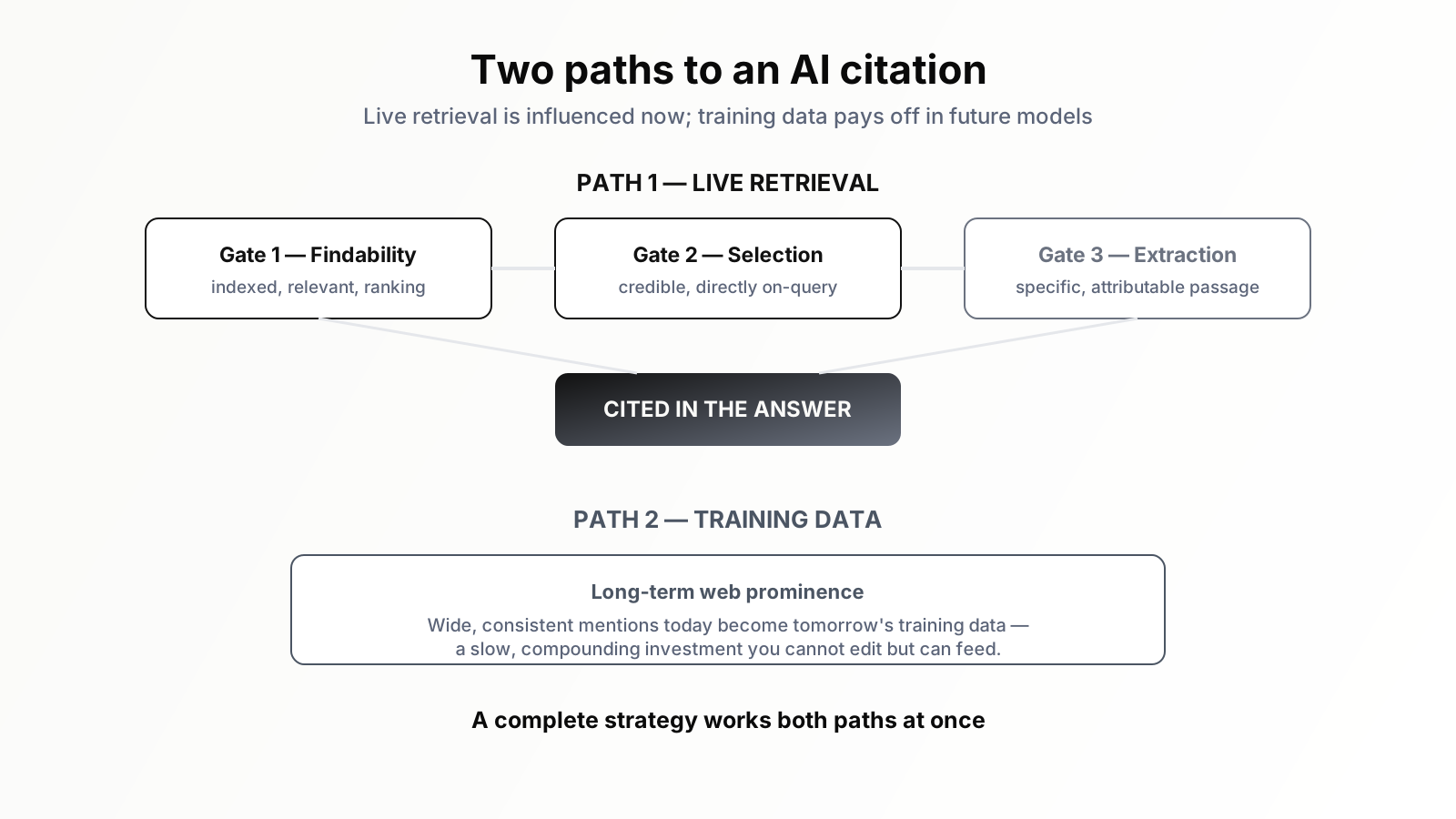
Most real tools blend both modes. ChatGPT can answer from training data or browse live depending on the query and configuration. Gemini draws on Google's strengths in live retrieval. Perplexity leans heavily on live search. The practical consequence of this analysis: you cannot optimise for "AI citation" with a single tactic, because there are two distinct mechanisms, and a complete strategy addresses both.
The retrieval mechanism: what gets you into the pool
Take the retrieval-based mode first, because it is the more directly influenceable.
When a tool retrieves live, it runs something like a search, gathers candidate pages, reads them, and synthesises. To be cited, your page has to clear three sequential gates, and analysing them in order tells you where to focus.
Gate one is retrieval: your page must be found by the tool's search step for the relevant query. This is governed by classic discoverability — the page is indexed, it is relevant to the query, it ranks reasonably. If you fail gate one, nothing else matters; you were never a candidate.
Gate two is selection: among the retrieved candidates, the tool must choose your page as one it actually reads and uses. Selection favours pages that visibly and directly address the query, that come from sources the system treats as credible, and that are substantial enough to contribute real information.
Gate three is extraction and attribution: the tool must find, in your page, a passage clear enough to use, and the information must be specific enough that citing your page is the natural thing to do. A page that states something concrete and attributable gets named. A page that only repeats generic knowledge gets absorbed without a citation, because the tool could have got that from anywhere.
The analysis points to a clear priority order. Discoverability first — if you are not findable, you cannot be cited. Then visible relevance and credibility — so you survive selection. Then extractable, specific, attributable content — so you actually get named rather than silently absorbed.
The training-data mechanism: what gets you into the model
The training-data mode is less directly controllable, but it is not a black box, and ignoring it leaves part of the strategy undone.
A model trained on a large slice of the web will have absorbed your content and your brand in rough proportion to how prominent and well-represented they were in that slice. A brand mentioned widely, consistently, and in clear association with a topic is more likely to surface in the model's answers on that topic. A brand barely present in the training data is effectively invisible to that mode.
You cannot edit a model's training data. But you can influence what future training runs absorb, because future training data is just the future web — and you are publishing into it now. The content you put out, the mentions you earn, the consistency with which your brand is associated with your subject: all of that becomes part of what tomorrow's models learn from. This reframes the training-data mechanism as a slow, compounding investment rather than something to dismiss as uncontrollable.
What the tools have in common
Having separated the mechanisms, the analysis is more useful if it now finds the common ground — the actions that help across both modes and all three tools.
Clarity helps everywhere. A page that states its key points plainly is easier for a retrieval-based tool to extract from and was easier for a training process to represent accurately. Ambiguous, meandering content is penalised by both mechanisms.
Specificity helps everywhere. Concrete, attributable information — a defined process, a named concept, a precise claim — gives any tool a reason to cite you rather than absorb you anonymously. Generic content is, by definition, available from everywhere, so no single source needs naming.
Credibility helps everywhere. Both retrieval selection and training-data prominence favour sources the wider web treats as trustworthy: real expertise, accuracy, a recognised presence in the subject area. There is no mode in which being a low-trust source is an advantage.
Structure helps everywhere. Clear headings, direct answers placed early, well-formed lists, one idea per section — this makes a page easier for a retrieval tool to parse now and was easier for a training process to learn from cleanly.
The common ground turns out to be substantial: be clear, be specific, be credible, be well-structured. That is not new advice, and that is the point. Good content practice was already most of the answer. The AI tools changed the stakes and added a few specifics; they did not overturn the fundamentals.
Where the tools differ — and what to do about it
The differences are smaller than the common ground but still worth analysing, because they shift emphasis.
For Google's AI Overviews, classic SEO is the dominant lever. The candidate pool comes from Google's index, so ranking well in normal Google search is close to a prerequisite for being cited. If you treat AI Overview citation as a sub-goal of strong Google SEO, you are most of the way there. Our piece on answer engine optimisation covers the structural details.
For Perplexity, live retrieval and clear sourcing dominate. It searches the web for most queries and is built around showing its citations, so being findable, relevant, and clearly attributable for the query matters most. Perplexity tends to reward pages that directly and visibly answer the question asked.
For ChatGPT, the picture is mixed and mode-dependent. In browsing mode it behaves like a retrieval engine; without browsing it answers from training data. The implication: for ChatGPT you genuinely need both halves of the strategy — live discoverability for the browsing mode, and long-term web prominence for the training-data mode.
For Gemini, Google's retrieval strength means live findability matters, with training-data prominence as a supporting factor — broadly a blend of the Overview and ChatGPT pictures.
The differences refine where you push hardest. They do not create four separate, incompatible strategies. A content library that is genuinely discoverable, clearly written, specific, credible, and well-structured performs well across all of them.
The actions that follow from the analysis
Pulling the analysis together, here is what to actually do, in priority order.
Get and stay discoverable. Solid technical SEO and genuine search ranking are the doorway to every retrieval-based citation. This is non-negotiable and comes first.
Answer the question directly and early. Every page that targets a real question should state a clear, complete answer near the top, under a heading that poses the question. This serves extraction in retrieval mode and clean representation in training mode.
Be the origin of something specific. Original data, a named framework, a concrete first-hand example, a plainly stated expert judgement — give the tools information that can only be attributed to you. Generic content is absorbed without credit; original content compels the citation.
Structure for machines and humans together. Descriptive headings, direct definitions, well-formed lists, comparison tables, one idea per section. This is good writing and good AEO at the same time.
Build long-term web prominence. Earn genuine mentions, keep your brand consistently associated with your topic, maintain clear and consistent author and organisation identities. This feeds future training data and reinforces retrieval-time credibility.
Measure what you can. Watch for citations in the tools where it is observable, track referral traffic from AI surfaces separately, and monitor branded search as a proxy for growing recognition. The measurement is imperfect, but partial signal beats none.
The mistakes that quietly cost you citations
Analysis is sharper when it includes the failure modes, so here are the recurring mistakes that keep otherwise-good content from being cited — each one a direct inversion of a principle above.
The first is burying the answer. A page that opens with a long, scene-setting preamble and only reaches the actual answer halfway down has failed the extraction gate before it ever started. The information might be excellent, but a tool scanning for a clean passage will find a competitor's clearer page first. The fix is structural and costs nothing: pose the question in a heading, answer it directly in the next two or three sentences, then go deep.
The second is hedging everything. Writers, anxious to be accurate, sometimes qualify every statement so heavily that nothing in the page is quotable. "It can sometimes depend on a range of factors, though results may vary" is unattributable mush — no tool can lift it and present it as a useful answer. Accuracy does not require vagueness. State the clear, defensible claim plainly, then add the genuine caveats as separate, also-clear sentences.
The third is publishing pure commodity content. A page that contains only what fifty other pages already contain gives no tool a reason to cite it specifically. The information gets absorbed into the synthesised answer with attribution to no one, or to whichever source the tool happened to find most convenient. Without a piece of original substance — data, a framework, a concrete example — a page can be useful and still be uncitable.
The fourth is structural chaos: missing headings, walls of undifferentiated text, lists that should be tables and tables that should be prose. A tool parses structure to understand a page; when the structure does not map to meaning, the tool's confidence in what the page says drops, and a low-confidence source is a poor citation candidate.
The fifth is invisibility as an entity. A page from a site the tool has no reason to recognise as credible on the subject competes from behind, however good the page itself is. This one is the slowest to fix, because it is fixed by the long work of becoming genuinely known — but naming it as a failure mode at least stops teams from being puzzled when strong pages on weak sites go uncited.
None of these mistakes is exotic. They are ordinary, common, and entirely fixable — which is the encouraging part. Most content does not fail to get cited because the subject is too competitive. It fails because of an avoidable structural or substance problem that an honest audit would catch.
A realistic expectation
One honest closing point from the analysis. You cannot guarantee a citation from any of these tools. They are probabilistic systems making selection decisions you do not control, and anyone promising guaranteed AI citations is selling certainty that does not exist.
What you can do is shift the odds, substantially, in your favour — by being discoverable, clear, specific, credible, and well-structured, you make your content the kind of source these tools repeatedly choose. Across many queries and over time, that improved probability compounds into real, visible citation presence. The goal is not to game a single answer. It is to become, reliably, the sort of source answer engines reach for.
Where an AI agent fits
The analysis above is clear, but acting on it across a real content library is a large, detailed, ongoing job: auditing discoverability page by page, checking that each page answers its question early, identifying where original substance is missing, fixing structure, tracking citations across several tools that all report differently. It is exactly the sort of work that gets planned and then never finished.
That is where an SEO AI agent earns its place. Orova can audit content for AI-citation readiness — flagging pages that are hard to discover, that bury their answers, that lack specific attributable substance, or whose structure resists extraction — and help reshape them so ChatGPT, Gemini, and Perplexity are more likely to find, use, and name them. The analysis in this article tells you what to do; the agent makes doing it across an entire library realistic rather than aspirational.
Getting cited by AI tools is not magic and not luck. It is the visible result of being genuinely findable, genuinely clear, and genuinely worth citing — across two distinct mechanisms and three tools that, analysed properly, turn out to want mostly the same thing. Build for that, and the citations follow.
Run your business with AI Agents
Orova is the always-on Biz AI Agent — it plans, runs, and optimizes the work for you. Save time, unlock productivity.
Try it free