
Answer Engine Optimization: SEO's Next Chapter
For twenty years, the goal of search optimisation was stable enough to fit in one sentence: get your page to appear high in a list of links so a person clicks it. The list was the product, the click was the prize, and every technique — keywords, links, structure, speed — served that single outcome.
That sentence no longer describes the whole job. A growing share of search now ends not with a list of links but with a generated answer: Google's AI Overviews, the conversational replies of ChatGPT and Gemini, the cited summaries of Perplexity. These are answer engines, and optimising to appear inside the answers they generate is a distinct discipline. It has a name — answer engine optimisation, or AEO — and this is a practical guide to doing it.
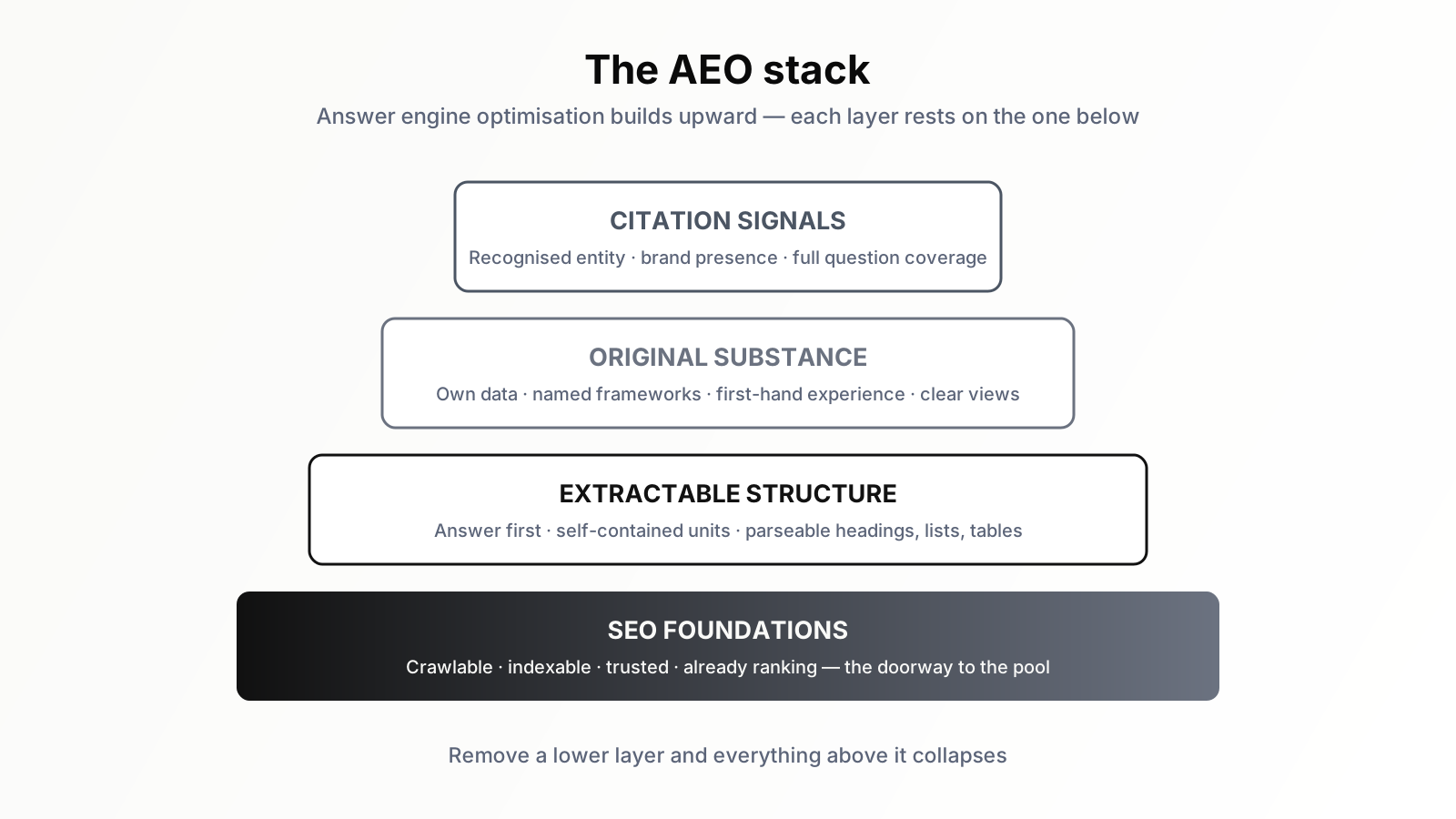
AEO does not replace SEO. It extends it. The technical foundations, the content quality, the topical authority that SEO has always demanded are still required; an answer engine will not cite a page it cannot crawl or trust. AEO adds a second target on top of the familiar one: not just rank in the list, but be selected, quoted, and named in the answer. This article covers how to hit that second target.
What an answer engine actually does
To optimise for answer engines you have to understand, at a working level, how they assemble an answer. The details vary by product, but the shape is consistent.
The engine receives a query. It identifies a set of candidate sources — for Google's AI Overview, these are drawn largely from its existing search index; for a tool like Perplexity, from a live retrieval step. It then reads those sources, extracts the relevant passages, synthesises them into a coherent answer, and — in most cases — cites some of the sources it used.
Two facts in that process matter enormously for optimisation. First, the engine does not invent its answer from nothing; it builds it from real source pages. That means there is a slot to compete for — the slot of "page the engine draws from." Second, the engine works by extraction. It pulls specific passages out of pages. So a page that states its key points in clear, self-contained, extractable units is far easier to use than a page where the answer is diffused across rambling paragraphs. AEO, at its core, is the practice of making your content easy to extract from and worth citing.
The foundation: AEO sits on top of SEO
Before any AEO-specific tactic, the SEO fundamentals have to be in place, because answer engines inherit them.
The page must be crawlable and indexable. An answer engine, especially one drawing from a search index, cannot cite a page it cannot access. The page must be on a site with genuine topical authority — engines preferentially draw from sources they have reason to trust on the subject. The content must be accurate and well-supported, because engines are increasingly tuned to avoid citing unreliable sources. And the page should already rank reasonably for its target query, because for index-based answer engines, ranking well is strongly correlated with being in the candidate pool.
The practical implication is reassuring: AEO is not a separate project that competes with your SEO work. It is a layer added to it. If your internal linking, your site structure, and your content quality are sound, you have already done most of the work. AEO refines the rest.
Technique one: answer the question first
The single highest-leverage AEO technique is structural and simple. State the direct answer to the page's core question clearly, completely, and early — ideally within the first paragraph or two, immediately after a heading that poses the question.
Think about what the extraction step needs. An answer engine scanning your page for a passage to use wants a clean, self-contained statement of the answer. If your page buries the answer in the eighth paragraph, after a long preamble, the engine has to work harder to find it and may give up and use a competitor's clearer page instead. If your page leads with a crisp, complete answer, you have handed the engine exactly the passage it wants.
This does not mean every page becomes a thin FAQ. The full page can — and should — go deep after the direct answer. The structure is: pose the question as a heading, answer it directly and completely in the next two or three sentences, then expand with depth, nuance, examples, and caveats. The direct answer earns the citation. The depth earns the click from the person who read the answer and wanted more.
Technique two: write in extractable units
Answer engines extract passages, so write in passages that extract cleanly.
A self-contained unit is a sentence or short paragraph that makes complete sense if lifted out of the page and read alone. "It depends on several factors" is not extractable — out of context it says nothing. "Crawl budget matters mainly for sites with more than roughly ten thousand pages; smaller sites almost never need to think about it" is extractable — lift it anywhere and it still carries its full meaning.
Practically, this means: front-load the substance of each paragraph rather than building to it. Avoid pronouns that depend on the previous sentence for meaning where a noun would be clearer. State definitions completely. Make list items full thoughts, not fragments. None of this makes the writing worse for human readers — clear, self-contained sentences are good prose anyway. It simply also makes the page machine-extractable, which is the AEO goal.
Technique three: use structure the engine can parse
Answer engines parse the structure of a page to understand it, so give them structure that maps cleanly to meaning.
Use descriptive headings that state what the section covers — better still, headings phrased as the question the section answers, because that maps directly onto how people query. Use ordered lists for sequences and steps, unordered lists for sets of parallel items; an engine answering a "how to" query can lift a well-formed ordered list almost verbatim. Use tables for comparison data, because comparative queries are common and a clean table is trivial to extract. Keep one main idea per section, so the engine can match a section to a query without ambiguity.
Where it genuinely fits the content, structured data markup helps too — marking up FAQs, how-to steps, and other defined content types gives the engine an explicit, machine-readable description of what the page contains. Markup is a supporting signal, not the main event, but it removes ambiguity, and removing ambiguity is the whole game.
Technique four: give the engine something only you have
Extractable structure gets you into the candidate pool. Original substance gets you cited.
Consider the engine's position. For a generic query, it has dozens of interchangeable sources that all say the same standard things. It can synthesise an answer from them and cite almost anyone — or no one in particular. But when one source contains something the others do not — a specific data point, a named framework, a distinctive expert claim — the engine often has to cite that source by name, because the information is attributable to it and exists nowhere else.
So the most reliable way to earn a citation is to make your page the origin of something. Original research or data from your own work. A named framework or model you created. A specific, concrete example with details that signal first-hand experience. A clear expert judgement stated plainly enough to be quoted. Generic content can be summarised without attribution. Original content, by its nature, demands the citation. This is also exactly the content that survives the broader shift we examine in our piece on AI Overviews and clicks.
Technique five: build entity and brand recognition
Answer engines, like search engines before them, increasingly understand the world in terms of entities — defined things, including organisations and people — and their relationships. An engine is more likely to cite a source it recognises as a known, credible entity on a topic.
This makes brand-building an AEO activity. The more your brand is mentioned, in context, across the web — referenced by other sites, discussed in your subject area, consistently associated with your topic — the more an answer engine recognises you as a real entity with authority on that subject. Consistent author identities, clear and complete information about your organisation, and genuine mentions across the web all feed this recognition. AEO is partly technical and partly structural, but it is also partly the slow, old-fashioned work of becoming genuinely known for something.
Technique six: cover the question fully, including the follow-ups
Conversational answer engines do not handle isolated queries; they handle conversations. A user asks a question, reads the answer, and asks a follow-up. An engine that can satisfy the follow-up from the same source it used for the first answer has a strong reason to keep drawing from — and citing — that source.
So a strong AEO page anticipates the natural follow-up questions and answers them on the same page or within the same tightly linked cluster. If the core question is "what is answer engine optimisation," the obvious follow-ups are "how is it different from SEO," "how do I do it," "do I still need SEO." A page or cluster that answers the whole chain becomes a complete, reusable source for an entire conversation, not just one turn of it. This is simply topic-cluster thinking — the subject of our guide to topic clusters — applied to the conversational shape of answer engines.
How to measure AEO
You cannot manage what you do not measure, and AEO needs metrics that the traditional SEO dashboard does not include.
Track citations: where it is technically possible, monitor whether and where your content is being cited inside AI Overviews and answer-engine responses for your target queries. Track AI referral traffic: visits arriving from answer-engine surfaces, kept separate from classic organic, so you can see the new channel growing or shrinking on its own. Track branded and entity search: if your AEO and brand-building work is succeeding, more people search for you by name over time. And keep tracking conversions from all of it, because the point of being cited is not vanity — it is to bring the pre-qualified reader who clicks through and acts.
The measurement story is still maturing, and the tooling is imperfect. But "the measurement is hard" is not a reason to skip it. It is a reason to start now, while the channel is young and competitors are still ignoring it.
Where AEO is heading
It is worth a brief, honest look forward. The specific products will keep changing — interfaces, citation styles, which engine dominates. But the underlying shift is durable: a meaningful and growing share of human questions will be answered by a synthesising engine rather than a list of links, and those engines will keep needing real source pages to build their answers from.
That means the AEO discipline is durable even though its details will move. Clear answers, extractable structure, parseable formatting, genuinely original substance, recognised authority, full coverage of a question and its follow-ups — those will keep being what makes a page useful to an answer engine, whatever the engine looks like next year. Optimise for the principles, not the current interface, and your work survives the next product update.
Where an AI agent fits
Everything in this article is doable by hand, and none of it is conceptually difficult. But notice the volume. Restructuring pages to answer first, rewriting paragraphs into extractable units, adding parseable structure, auditing where your content lacks original substance, anticipating follow-up questions, tracking citations across surfaces — across a real content library, that is a large, ongoing, detail-heavy body of work.
That combination — structured, repetitive, judgement-laden, and high-volume — is what an SEO AI agent is built to handle. Orova can assess content for AEO readiness — flagging pages that bury their answers, paragraphs that will not extract cleanly, sections missing original substance, and questions whose follow-ups go unanswered — and help restructure them so answer engines can find, parse, and cite them. The discipline in this article does not change. The agent removes the fatigue that otherwise stops a team from applying it across every page.
Answer engine optimisation is SEO's next chapter, not its replacement. The links did not vanish; a new layer was added above them. The teams that learn to write for that layer — clear, extractable, original, structured to be cited — will be visible in both the answers and the links. The teams that keep optimising only for the old list will, slowly and quietly, disappear from the place where searches increasingly end.
Run your business with AI Agents
Orova is the always-on Biz AI Agent — it plans, runs, and optimizes the work for you. Save time, unlock productivity.
Try it free