
AI SEO Tools: What They Do Well and Where They Fail
Here is what usually happens: someone on the team reads a handful of articles about AI search, gets nervous, and within a week your task list has schema markup, author bios, a content rewrite, and a request for "AI SEO tools" all sitting on top of the regular content calendar. Six weeks in, everyone is tired. Ten weeks in, most of it is quietly dropped and nobody mentions it in the next planning meeting.
The issue is not that the team lacks skill or effort — it is that none of this was ever ordered. Trust signals get built before there is anything worth trusting. Tracking gets set up before there is content worth tracking. Tools get bought before anyone knows what the tool is supposed to measure. Each piece depends on something that has not been done yet, so nothing quite works, and the whole effort feels like busywork with no visible payoff — especially now that SparkToro puts the share of US Google searches ending without a click at 68% in early 2026, up from 60% in 2024.
This article gives you the order instead of the pile. It breaks a year into four quarters, each with a clear theme, a short list of things to actually produce, and a way to check honestly whether you are done before moving to the next step. If you run search for a small team and already have a working content program, by the end you will know exactly what to do first, second, third, and fourth — and what to leave alone entirely.
AI SEO Tools: The Categories and What Each Is For
AI SEO tools fall into four groups, and they are not equally useful.
Content generation — draft articles from a keyword. Fast, and the output is a first draft that needs real editing. Publishing it untouched is how sites get flooded with pages nobody reads.
Content optimisation — analyse what ranks and tell you what your draft is missing. Genuinely useful, because it is comparison rather than invention.
Technical analysis — crawl a site and prioritise faults. The most reliable category: the input is factual and the judgement is narrow.
Agents that act — the newest group, which does the work rather than advising. Useful in proportion to how much you can verify what they did.
Where all of them fail: deciding whether a topic is worth writing about for your business. That is a commercial judgement, and no tool has the context to make it.
The other thing none of them tell you is whether any of it worked. The rest of this article covers a twelve-month tracking approach that answers that.
Why this order and not another
The sequence follows three rules, and naming them now will save you from the most common re-ordering temptations.
Rule one: foundation before format. Rewriting content into answer-first shape is the most visible, most satisfying work in the whole migration — which is why everyone wants to start there. But an answer-shaped paragraph on a page that crawlers cannot reach, attributed to an author who does not exist, on a site whose entity is ambiguous, earns nothing. Quarter one is deliberately the unglamorous quarter.
Rule two: production before measurement. A citation-tracking program installed before you have any citation-worthy content will report zeros for months and get cancelled. Measurement lands in quarter three, after two quarters of work have given it something to measure. (The exception is baseline capture — a handful of numbers you record in month one precisely so the later comparison is possible.)
Rule three: routine before expansion. The migration is finished not when every page is rewritten — it never will be — but when the new way of working has become the default way: every new brief is answer-first, every month has its citation audit, every quarter has its review. Quarter four builds that routine. Expansion to new clusters, new engines, and new markets comes after, on top of a loop that already runs.
Quarter 1 (months 1–3): foundation and trust
Month 1 — baseline and technical audit. Before changing anything, record where you are. Capture current organic clicks and impressions from Search Console, current rankings for your top fifty queries, and — critically — run your twenty most important queries through Google (noting which trigger AI Overviews and who gets cited), ChatGPT Search, and Perplexity, screenshotting the answers. This thirty-minute exercise is your before photo; in month twelve it will be the difference between knowing the program worked and merely believing it. Then run the technical audit: crawlability, indexation coverage, page speed, rendering (is your main content present in the HTML without JavaScript execution?), canonical hygiene, sitemap accuracy. The checks specific to the AI era are few but important — verify in your server logs or CDN analytics which AI crawlers (GPTBot, ClaudeBot, PerplexityBot, Google-Extended) are visiting and confirm your robots.txt treats each one the way you have consciously decided to treat it, rather than the way a security plugin decided years ago.
Month 2 — fix what the audit found. Unsexy by design. Indexation gaps closed, render-blocking problems solved, redirect chains collapsed, the crawler policy deliberately set. If your audit found little, use the month to bring structured data up to standard: Organization and Person markup site-wide, Article markup on posts, FAQ markup where genuine FAQs exist — the practical playbook we laid out in our guide to winning rich results with structured data applies unchanged, because the same markup that earns rich results disambiguates your content for every other machine reader.
Month 3 — the trust layer. This is the month most classic programs have never scheduled at all. Every author on the site gets a real page: name, photo, credentials, experience, links to their external footprint, Person schema. Every post gets a real byline. The company's About page gets rebuilt as an entity statement — who you are, what you do, who vouches for you — with sameAs links to your authoritative profiles. If your niche touches money or health, add visible editorial standards. None of this produces a traffic bump in month three, which is why undisciplined programs skip it; all of it determines whether engines staking their reputation on synthesised answers are willing to use you as a source. The full argument for why this layer decides AI-era outcomes is in our piece on E-E-A-T in the AI era.
Exit criterion for Q1: a crawler fetching any important page gets clean HTML with the content present, attributed to an identifiable human, on a site whose organisational identity is machine-readable. If any clause of that sentence is false, do not start quarter two.
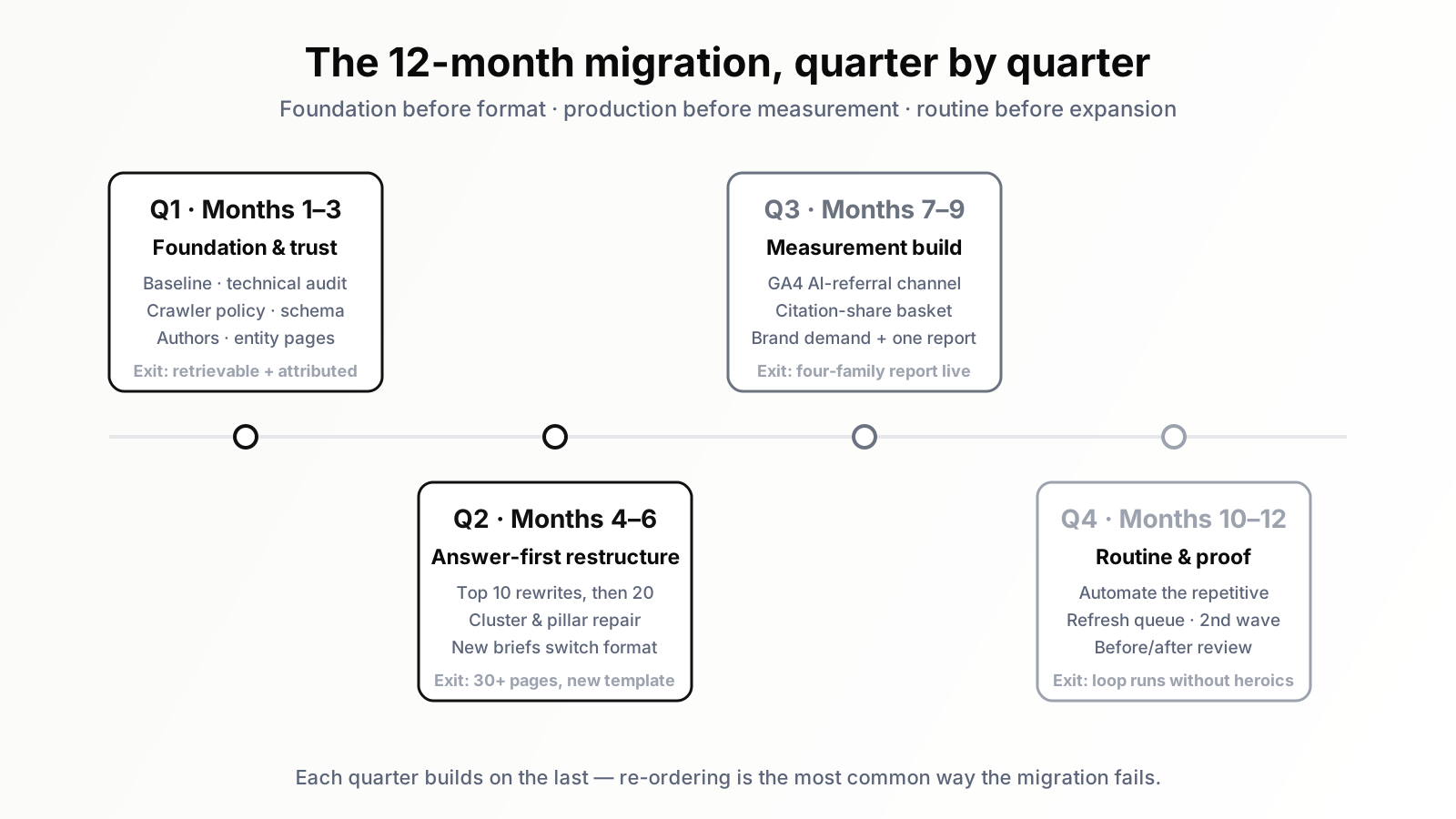
Quarter 2 (months 4–6): the content restructure
Month 4 — triage, then the first ten. You cannot rewrite everything, and you should not try. Pull your informational pages and rank them by a simple score: current impressions times strategic value of the topic. Take the top ten. For each, identify the core question it answers and the sub-questions it should answer, then restructure: a direct 40-to-60-word answer immediately after the introduction, question-shaped H2s each followed by a self-contained answer paragraph before any elaboration, tables and lists where the content is genuinely tabular, and a named author whose expertise plausibly covers the topic. The complete format specification is in our answer-first content guide; the summary is that you are converting pages written to be read into pages that can also be cleanly quoted.
Month 5 — the next twenty, plus cluster repair. Velocity doubles in month five because month four built the skill. Alongside the rewrites, repair the architecture around them: every rewritten page should sit in an explicit cluster — linked to its pillar page and to its sibling articles with descriptive anchors. If a priority topic has no pillar, writing one becomes a month-five deliverable. Engines judging whether you are an authority on a topic read your internal link graph as evidence; isolated excellent pages are read as accidents.
Month 6 — new production switches over, and the first re-test. From this month forward, every new brief is born answer-first: the question, the short answer, the cluster, the links, the author are fields in the brief template, not afterthoughts. Then re-run your month-one query basket across the engines. Six months is early — do not expect transformation — but you should see first movement: a citation here, an AI Overview appearance there, your rewritten pages winning featured snippets. Whatever you find, record it next to the baseline.
Exit criterion for Q2: thirty-plus priority pages restructured, every priority topic has a linked pillar, and the brief template has permanently changed. The habit matters more than the count.
Quarter 3 (months 7–9): measurement that can see the AI era
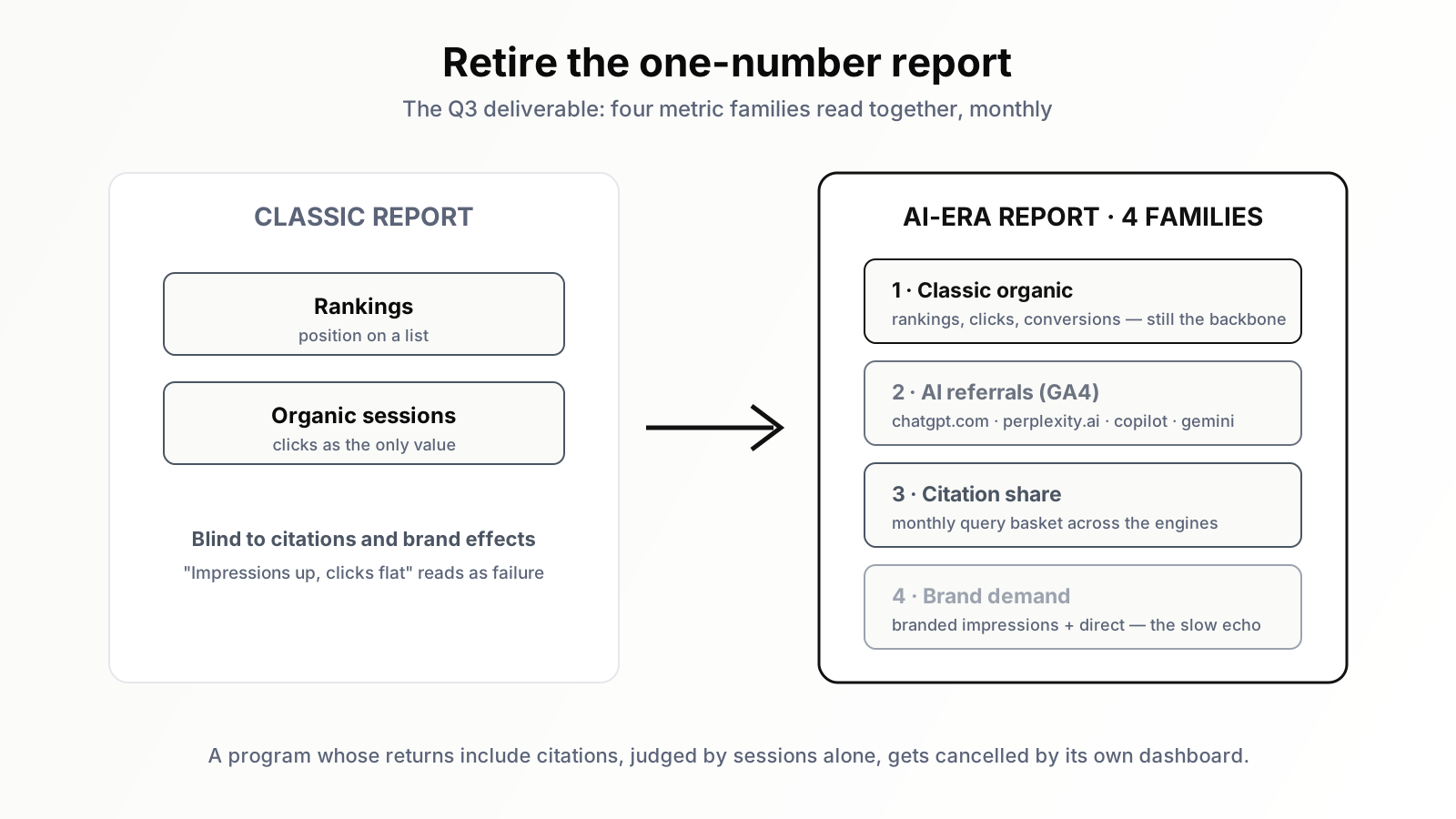
Month 7 — the GA4 build. Out of the box, GA4 buries AI-engine traffic inside generic referral noise. Build the custom channel group that isolates sessions from chatgpt.com, perplexity.ai, copilot.microsoft.com, gemini.google.com and their variant hostnames into an "AI referral" channel, and wire landing-page reporting so you can see which pages those sessions enter through. The exact configuration, regex patterns included, is documented in our GA4 setup guide for AI search traffic. While you are in the data, annotate the GSC pattern you will increasingly see — impressions climbing while clicks flatten — so nobody in a future meeting reads it as failure; it is the statistical signature of being shown inside answers.
Month 8 — citation share tracking. Formalise the query-basket exercise into a monthly instrument: a fixed basket of thirty to fifty priority queries, run monthly through AI Overviews, ChatGPT Search, and Perplexity, recording for each whether an AI answer appears, whether you are cited, and who else is. A spreadsheet is genuinely sufficient at this scale. The output is citation share per engine over time — the single number that tells you whether the content program is converting into AI-era visibility. Month eight is also when you should run a structured self-audit of the gap between you and whoever currently owns the citations you want; the twelve checks in our GEO audit are the checklist for exactly that comparison.
Month 9 — brand demand and the unified report. Add the slowest, truest metric: branded search impressions and clicks from GSC, trended monthly, alongside direct traffic. Rising brand demand with flat organic clicks is the classic signature of answer-borne visibility doing its work invisibly. Then assemble the single monthly report that shows all four families together — classic organic, AI referrals, citation share, brand demand — one page, four trends, read in one meeting. This report is the deliverable that protects the program's budget in month eighteen, because it makes returns visible that session counts alone would hide.
Exit criterion for Q3: the four-family report exists, has two months of history, and someone outside the SEO team has seen and understood it.
Quarter 4 (months 10–12): make it a routine, then prove it
Month 10 — automate the repetitive layer. By now the recurring workload is visible and substantial: monthly citation runs, rank checks, technical monitoring, refresh-candidate detection, report assembly. Month ten is when you decide, task by task, what stays manual and what gets delegated to tooling or agents. The honest rule: anything done the same way every month with no judgment in the doing is a delegation candidate; anything involving what to claim, what to publish, or what the data means stays human. Done well, automation here is what makes the routine survivable for a small team — it converts the program from a heroic effort into a background process with human checkpoints.
Month 11 — the refresh loop and the second wave. With monitoring running, work the queue it produces: pages whose citations were lost to a competitor, pages ranking well but never cited (usually a format problem), pages cited for queries you had not targeted (usually an expansion opportunity). Month eleven is also when the second wave of rewrites — the next thirty pages by the same triage score — runs as routine work inside the normal calendar, which is itself the proof that the migration succeeded: what required a dedicated quarter in Q2 now happens inside business as usual.
Month 12 — the review. Re-run the full month-one baseline: rankings, clicks, the query basket across all engines, screenshots. Lay the before and after side by side. A realistic good outcome at month twelve, for a site that started with a functioning classic program, looks like: citation presence on a meaningful minority of basket queries (own-niche queries first), a small but cleanly measured AI-referral channel with above-average engagement quality, brand demand trending up, and classic rankings no worse — usually better, because everything in this roadmap is also classic best practice. Present it with the four-family report, set the next year's targets in citation share and brand demand rather than sessions alone, and write the one-page version of what you learned for whoever runs the program after you.
Exit criterion for Q4 — and the whole roadmap: the program runs monthly without anyone summoning special effort, and the year-over-year comparison exists in writing.
What deliberately did not make the roadmap
A sequencing plan is defined as much by what it excludes as by what it schedules, and three fashionable items were left out on purpose.
llms.txt is a month-two footnote, not a milestone. Creating the file takes an hour and costs nothing, so do it while you are touching robots.txt anyway — but no major engine has committed to consuming it, and a roadmap that presents it as a deliverable is padding. The same logic applies to any single-engine trick currently circulating: if a tactic only works because of how one engine behaves this quarter, it does not belong on a twelve-month plan.
New-engine chasing is excluded entirely. The plan optimises for Google's AI surfaces, ChatGPT Search, and Perplexity because that is where the audience demonstrably is. Every additional engine added to the basket costs monthly tracking time forever; add one only when your own referral data — not a press release — shows it sending you users.
A separate "GEO program" is excluded for a deeper reason: it would institutionalise the false idea that AI visibility is a different discipline with a different team. Every deliverable above serves both classic rankings and AI citations simultaneously — that is precisely why the migration is affordable. The moment a company stands up two programs, they begin disagreeing about the same pages, and the roadmap dies in the crossfire.
Resourcing: what this actually costs in hours
Roadmaps that ignore capacity are fiction, so here is the honest accounting, calibrated for the one-to-three-person team this plan assumes.
Quarter one is the heaviest in specialist time but lightest in writing: the audit and fixes consume roughly a quarter of one person's time across months one and two, more if the fixes require engineering tickets that wait in someone else's queue — which is the single most common source of schedule slip, so file those tickets in week two, not week six. The trust month is mostly coordination: chasing colleagues for bios and photographs takes longer than writing the schema. Budget for that social latency.
Quarter two is the heaviest in writing. A disciplined answer-first restructure of an existing page takes two to four hours once the skill is built — the first few take a full day each, which is why month four only asks for ten. Thirty pages across the quarter is therefore real but achievable: roughly one rewrite per working day at peak, alongside a deliberately thinned new-content calendar. Cutting new production by a third for one quarter to fund the restructure is almost always the right trade; the rewritten pages have existing impressions to convert, while new pages start from zero.
Quarters three and four are light in hours and heavy in discipline: the GA4 build is a day, the citation basket is half a day per month, the unified report is two hours once templated. The risk is never capacity; it is that small recurring tasks without a calendar slot silently stop happening. Put the citation run and the report in the calendar as recurring meetings with themselves, in month seven, and they will still be happening in month eighteen.
Can the roadmap compress? To nine months, yes, if Q1 finds little to fix — overlap the back half of Q2 with the front half of Q3, since measurement-building and rewriting do not compete for the same skills. To six months, only for small sites (under a hundred pages) with engineering support on tap; below that, you are not compressing the roadmap, you are skipping quarters, and the failure modes below explain what that buys you. Stretching to eighteen months works fine for solo operators — keep the order, halve the monthly load, and accept that the citation curve arrives later but just as surely.
The three ways this roadmap fails
Forewarned is forearmed, and the failure modes are consistent enough across teams to list.
Failure one: skipping Q1 because it is boring. The team starts with rewrites in month one, sees nothing by month four (because the trust and technical layers were never fixed), concludes AI search "doesn't work for us," and stops. Sequencing is the entire point. If you only respect one rule in this article, respect foundation-before-format.
Failure two: measuring with the old instrument. The program is judged in month eight on organic sessions alone, the AI-era returns are invisible to that metric, and the budget moves elsewhere — six weeks before the citation curve would have become undeniable. This is why the four-family report is a Q3 deliverable and not an optional extra: it is the program's life insurance.
Failure three: declaring victory at month six. The opposite error. Early citations arrive, the team announces the migration complete, the routine never gets built, and within two quarters the citation share erodes to whoever kept working. AI-era visibility is a flow, not a stock; the routine in Q4 is the product, and everything before it was setup.
Twelve months from now, the teams that followed a sequence — any disciplined sequence, though we naturally prefer this one — will hold citation positions that are structurally hard to take from them, for the same reason good link profiles were hard to take: engines keep returning to sources that have repeatedly proven reliable. The window where those positions are cheaply available is open now and will not stay open. If you want the routine without building every instrument yourself, this entire loop — audits, citation tracking, refresh detection, the unified report — is what Orova runs as a product, so your twelve months can be spent on the content only you can write.
Where this gets slow if you do it by hand
Following this roadmap by hand is doable, but the part that eats the most hours is not writing content or fixing pages — it is the tracking. Checking whether your pages get cited in AI Overviews, ChatGPT Search, or Perplexity means running searches manually, again and again, and logging what you see in a spreadsheet that goes stale within weeks.
Orova SEO exists to take that specific part off your plate — it automates the checking and tracking of AI citations so you are not the one doing it by hand every week. If Quarter 3 of this roadmap sounds like the part you would rather not do yourself, it is worth a look.
Let Orova SEO handle the repetitive part
Keyword research, drafting, refreshing old posts and rank tracking — running automatically on your own site.
Explore Orova SEO