
Product Page SEO: Ranking Pages That Exist to Sell
There is a quiet division of labour on most company websites. The blog does the ranking, and the product pages do the selling. Content teams pour their effort into guides and tutorials because those are the pages that "do SEO", while the pages that actually carry the revenue — the product pages, the service pages, the feature pages — are written once by whoever launched them, approved by a product manager, and never touched again. Then everyone wonders why the blog gets fifty thousand visits a month and the demo requests still come from paid ads.
This is backwards. The most valuable organic visitor you can possibly attract is one who searches for the thing you sell, with money in hand, and lands directly on the page where they can buy it. No nurture sequence, no retargeting, no three-week email drip. Product page SEO is the discipline of earning those visitors, and it is harder than blog SEO precisely because the page has a second job: it has to sell. A guide can ramble. A product page that rambles loses the sale, and a product page that says nothing loses the ranking. This guide covers how to do both jobs on one page — keyword mapping, page anatomy, copy, structured data, internal linking, and the technical traps that quietly keep commercial pages out of the index.
Product page SEO means making the pages that sell your product rankable in their own right: target commercial keywords the page can honestly satisfy, write substantial original copy that answers pre-purchase questions, add Product or Service structured data, route internal links from your blog content to the page, and fix the technical issues — thin copy, duplicate variants, orphaned URLs — that keep commercial pages invisible.
Why product pages are so hard to rank
Start with an honest accounting of the disadvantages, because they explain almost every failure pattern you will see in the wild.
Product pages are thin by default. A typical SaaS feature page has a headline, three benefit bullets, two screenshots, and a call to action — perhaps a hundred and fifty words of actual text. A typical e-commerce product page has a name, a price, a spec table, and a manufacturer description shared with two hundred other retailers. Search engines need text to understand what a page is about and evidence to believe it is the best answer for a query. A page with a hundred and fifty words gives them almost nothing to work with, especially when a competitor's page on the same query offers eight hundred words of genuinely useful detail.
Nobody links to them. Editorial links flow to content that teaches, surprises, or provides data — which is to say, to blog posts and research pages. Almost nobody links to a pricing page or a product page from an external site unless they are reviewing the product. So product pages start with weak authority and, unless you deliberately route internal links to them, they stay weak. On many sites we audit, the highest-converting page on the domain receives fewer internal links than a three-year-old blog post about an abandoned feature.
They get treated as design artefacts, not content. Product pages are usually owned by product marketing or a design team, built in a page builder, and evaluated on conversion rate alone. Headings are chosen for visual rhythm, not for query relevance. Text is trimmed because "people don't read". The result is a page that looks beautiful, converts the visitors who arrive from ads, and is essentially unreadable to a search engine trying to match it to a commercial query.
And they sit in the most competitive part of the SERP. Commercial queries are where the money is, so everyone fights for them — competitors, marketplaces, affiliate review sites, comparison aggregators. You are not just competing against other vendors; you are competing against entire business models built on intercepting buyers before they reach you.
None of this means commercial pages cannot rank. It means they do not rank by accident, the way a good blog post occasionally does. Every position a product page earns is engineered.
Map the query before you touch the page
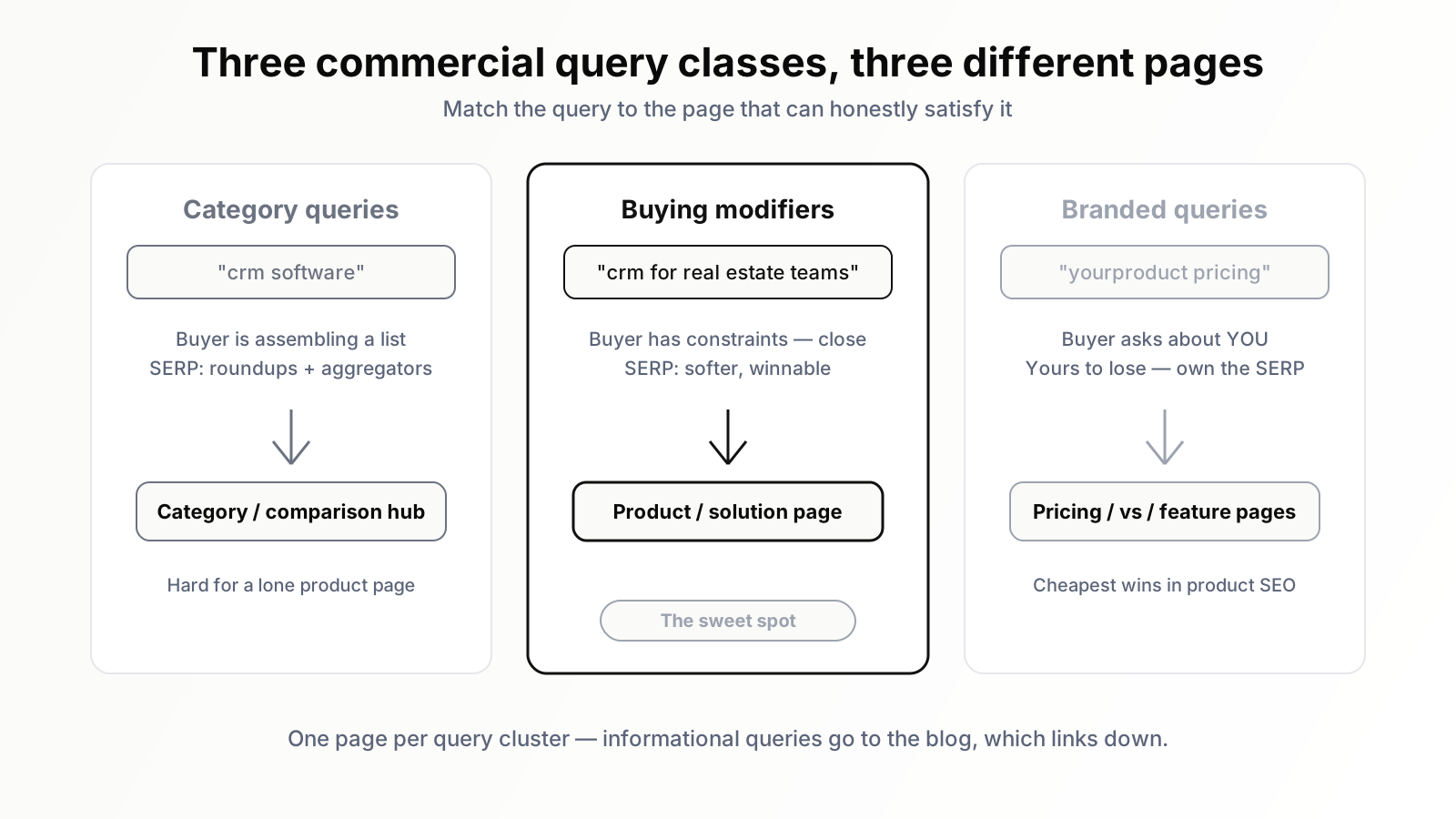
The single most common product page SEO mistake is targeting the wrong query class. Before writing a word, classify the keywords in your space into three buckets and be ruthless about which bucket your page belongs in.
Category queries — "crm software", "email marketing tool", "standing desk" — are searched by people early in a purchase, comparing options. Look at what actually ranks for them: usually listicles, review aggregators, and category pages, not individual product pages. If the top ten results for a query are all "best X tools" roundups, a lone product page will struggle no matter how good it is, because Google has decided the dominant intent is comparison, not purchase. Your product page can sometimes crack these, but your realistic assets for category queries are often a category page, a comparison hub, or a genuinely excellent piece of content — not the product page itself.
Product-class queries with buying modifiers — "crm for real estate teams", "email tool with free plan", "standing desk under $400" — are the sweet spot. The searcher has constraints, which means they are close to a decision, and the SERPs are usually softer because the big roundups target the head term. A well-built product or solution page that speaks directly to the modifier ("built for real estate teams", with proof) can win these outright. Most companies have far more of these queries available than they realise, and each one deserves its own page or its own clearly addressed section.
Branded and near-branded queries — "yourproduct pricing", "yourproduct vs competitor", "yourproduct integrations" — are yours to lose, and companies lose them constantly. Search your own brand plus "pricing", "review", "alternatives", and your top three feature names. Every query where a third-party site outranks you is a leak: a buyer asking a question about your product and getting the answer from someone else, often an affiliate with an incentive to redirect them. Owning your branded SERP is the cheapest win in all of product page SEO.
Once you have the buckets, assign exactly one page per query cluster. This is where cannibalisation creeps in: a blog post titled "What is the best CRM for real estate?" and a solution page targeting "crm for real estate" will compete with each other, and Google will often pick the blog post — the page that cannot convert. The fix is structural, and it is the same logic that makes hub-and-spoke content architecture work: informational queries go to blog content, commercial queries go to commercial pages, and the blog content links down to the commercial page so that authority flows where the revenue is.
The anatomy of a product page that ranks and sells
Here is the structure we recommend, element by element. None of it is exotic; the discipline is in actually doing all of it.
Title tag and H1: name the thing and the outcome
The title tag should contain the commercial keyword and a reason to click, in that order: "Real Estate CRM — Close More Listings with Less Admin". The H1 can be more conversational, but it must still contain the query language. A surprising number of product pages have H1s like "Work smarter, not harder" — pure slogan, zero query relevance. Search engines weigh the H1 heavily when deciding what a page is about; spending yours on a slogan is spending your strongest on-page signal on nothing.
The first screen: answer "is this for me?" in five seconds
Above the fold, a buyer needs three things: what the product is, who it is for, and proof it works — a customer count, a rating, a recognisable result. This is conversion advice as much as SEO advice, and the two converge here: the same clarity that earns a scroll also gives search engines an unambiguous topical statement at the top of the document. We covered the conversion side in depth in the five-second above-the-fold test; the SEO side is simply that your opening paragraph should be a clean, literal description of the product that could stand alone as a search snippet.
The body: answer every pre-purchase question on the page
This is where thin pages die and strong pages win. List every question a buyer asks before purchasing — sales calls, support tickets, and chat logs are full of them — and answer each one in a crawlable, headed section. For a SaaS product: how does the trial work, what does implementation take, which tools does it integrate with, what happens to my data, how is it priced, what support is included. For a physical product: dimensions, materials, compatibility, warranty, shipping, returns. Each answered question is both a conversion objection removed and a long-tail query served. Pages built this way routinely rank for dozens of question-shaped queries they never explicitly targeted — the same dynamic that makes question keywords such a reliable goldmine — because the answers are sitting there in clean, extractable blocks.
Specifications and features: structure them as content, not decoration
Spec tables, feature grids, and plan comparisons should be real HTML — actual table or list markup with text labels — not images, not icon grids with three-word captions, not content injected by JavaScript that only renders on interaction. Structured, text-based specs are what search engines extract for snippets and what comparison-minded buyers scan first. If your feature grid is a screenshot exported from a design tool, you have hidden your most query-rich content inside a JPEG.
Social proof with substance
Logos are weak. Testimonials with specifics — a name, a role, a number — are strong, for buyers and for the expertise signals search engines increasingly reward. A page that demonstrates real customers achieving real outcomes is doing E-E-A-T work in exactly the sense Google's own quality guidance describes: first-hand experience, evidenced. Where you have review data, mark it up (more on schema below) and keep it honest; fabricated ratings are both a policy violation and a trust grenade.
The FAQ block: the most underrated section on commercial pages
A genuine FAQ — eight to fifteen real questions, answered in two to four sentences each — adds three hundred to six hundred words of query-relevant text in a format buyers actually read. The key word is genuine. FAQ sections stuffed with keyword variations ("What is the best real estate CRM?" answered with "Our product is the best real estate CRM") are transparent to users and increasingly to ranking systems. Pull the questions from your actual support inbox and answer them the way your best support agent would.
Writing copy that serves both readers
The craft challenge of product page copy is that it has two audiences with different reading styles, and you cannot pick one. Buyers skim, search engines parse. Three principles reconcile them.
Lead with the benefit, anchor with the literal. "Never lose a lead again" means nothing to a search engine and little to a skeptical buyer. "Automatic lead capture from your website, email, and phone calls" is literal, query-relevant, and more persuasive anyway because it is concrete. The pattern that works: a benefit-led heading, followed immediately by a literal sentence describing the mechanism. You get the emotional hook and the parseable substance in adjacent lines.
Write at the length the decision deserves, not the length the template allows. A $9/month tool can sell from four hundred words. A $30,000/year platform cannot — buyers researching a five-figure decision want depth, and pages that provide it outrank and outconvert pages that gesture at it. The right length is "every pre-purchase question answered, nothing padded". For most B2B product pages that lands between eight hundred and two thousand words of real text, most of it below the fold where it costs nothing visually and earns everything organically.
Kill the lorem-ipsum voice. Product pages attract a particular dialect of nothing: "seamlessly integrate", "powerful insights", "take your workflow to the next level". Every one of these phrases is interchangeable across ten thousand products, which means it differentiates you from none of them and matches no query a real buyer types. Replace each with the specific thing it gestures at. "Seamlessly integrates" becomes "two-way sync with Gmail and Outlook, set up in four minutes". Specificity is simultaneously the best conversion copy and the best SEO copy, which is the closest thing this discipline has to a free lunch.
Structured data: the commercial page's unfair advantage
Structured data matters more on commercial pages than anywhere else on your site, because commercial pages are eligible for the rich results that actually change click behaviour: price, availability, review stars, product carousels.
For physical products, Product schema with nested Offer data (price, currency, availability) and AggregateRating where you have genuine reviews is the baseline. Google has expanded product rich results steadily, and product pages with complete, accurate markup are eligible for treatments — price annotations, stars, image-rich listings — that bare pages are not. For SaaS, SoftwareApplication schema carries name, category, and pricing; for service businesses, Service schema plus LocalBusiness where geography matters. On all of them, accuracy is non-negotiable: markup that contradicts the visible page (a schema price that does not match the displayed price, ratings with no visible reviews) invites manual actions and accomplishes nothing.
Two honest caveats. First, schema is an eligibility signal, not a ranking boost — it makes you a candidate for rich treatment; it does not move your position. Second, FAQ rich results were restricted by Google in 2023 to government and health sites, so do not expect FAQ markup to produce expandable snippets for a commercial page — the FAQ content still earns long-tail rankings, but the markup no longer buys SERP real estate for most sites. We have covered the broader discipline in our guide to winning rich results with structured data, and the persistent misconceptions in schema markup myths; both apply doubly to product pages because the stakes per click are higher.
Internal linking: aim your blog at your money pages
Here is the structural fix for the "nobody links to product pages" problem: you link to them. Deliberately, contextually, and at scale.
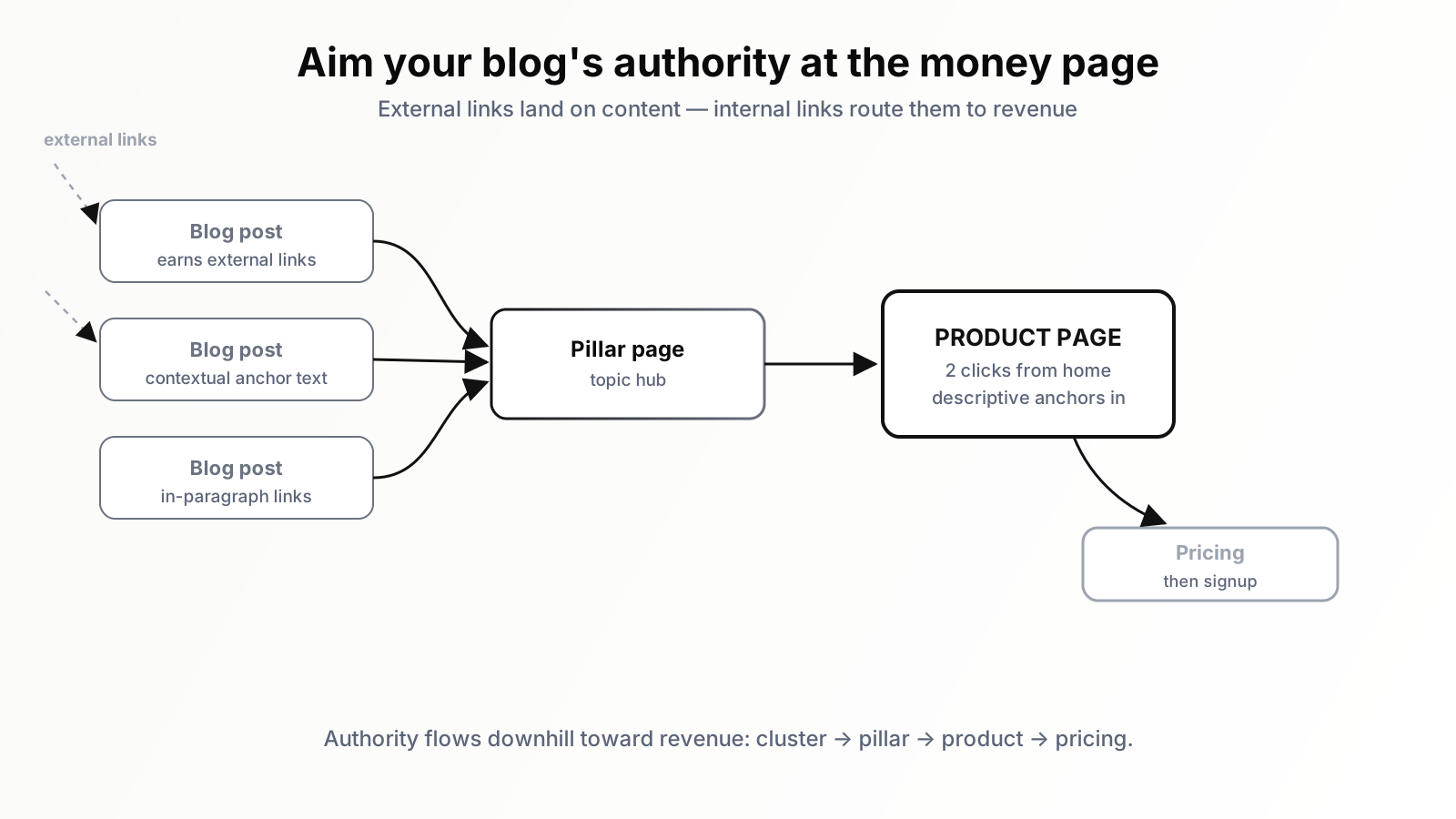
Audit your blog for every post that is topically adjacent to a product page — every post about lead management should offer a contextual link to the CRM page, every post about email deliverability should link the email product. Not a banner, not a footer CTA that crawlers discount, but an in-paragraph link with descriptive anchor text: "a CRM built for small teams" rather than "click here". Each contextual link does two jobs: it passes authority from the pages that earn external links to the pages that earn revenue, and it tells search engines, through anchor text, exactly what query the product page should rank for.
Then check the reverse direction and the page's position in the site structure. Money pages should be reachable within two clicks of the homepage, present in the main navigation where defensible, and never dependent on a JavaScript menu that crawlers may not expand. The pattern to aim for: blog cluster pages link up to a pillar, the pillar links across to the relevant product page, the product page links onward to pricing and signup. Authority flows downhill toward revenue. On most sites the gap here is enormous — fixing internal links to commercial pages is routinely worth more than any copy change, because it is the difference between a strong page nobody vouches for and the same page with fifty internal endorsements.
The technical traps that sink commercial pages
Commercial pages have their own technical failure modes, distinct from blog content, and several are silent.
Variant duplication. E-commerce products with size and colour variants often generate a URL per variant, each with identical copy — fifty near-duplicate pages diluting one product's signals. The standard fix is canonicalising variants to a primary product URL, or parameter handling that keeps variants out of the index, while leaving genuinely distinct products (different models, not different colours) as separate indexable pages.
Faceted navigation explosions. Category filters that generate crawlable URL combinations (?colour=blue&size=m&sort=price) can spawn millions of thin URLs that exhaust crawl budget before the real pages get visited. Decide which facets deserve indexable pages (usually one or two with real search demand — "blue standing desks" maybe, "blue standing desks sorted by price ascending" never) and block or noindex the rest.
Out-of-stock and retired products. Deleting a discontinued product's page throws away every signal it accumulated. The better pattern: keep the page live with a clear status, link to the successor or nearest alternative, and only 301 to the replacement when one genuinely exists. For temporarily out-of-stock items, keep the page indexed and the schema availability accurate — pulling pages in and out of the index with stock levels is churn that helps nobody.
JavaScript-dependent content. Tabs, accordions, and "load more" sections that inject content on click may be invisible at crawl time depending on implementation. The test is simple: view the rendered HTML in Search Console's URL inspection and confirm the spec table, the FAQ, and the feature copy are actually in the DOM. If your page's best content lives behind an interaction, assume the crawler never saw it until proven otherwise.
Speed and stability. Commercial pages accumulate scripts — chat widgets, heatmaps, A/B testing frameworks, retargeting pixels — and each one taxes Core Web Vitals on exactly the pages where both rankings and conversion are most price-sensitive to slowness. Budget the third-party scripts on money pages the way you budget spend.
The supporting cast: comparison, alternatives, and pricing pages
A product page rarely wins commercial SERPs alone. The buyers you want are also searching "yourproduct vs competitor", "alternatives to competitor", and "yourcategory pricing" — and each of those query families deserves a dedicated page built for it. Comparison pages capture buyers actively weighing options; we have broken down why comparison pages are the highest-intent content most teams never write. Alternatives pages intercept your competitors' churning customers, with traps of their own covered in our critique of the alternatives-page playbook. And the pricing page — usually the second-most-visited page on a B2B site — is a search asset most teams have never once optimised; our account of rewriting a pricing page for search covers what changed when we treated ours as one. Together these pages form a commercial cluster: interlink them, keep them honest, and they reinforce each other the same way blog clusters do.
Measuring what a product page earns
Blog metrics do not transfer. A product page ranking position eight for a high-intent modifier query may be worth more than a blog post ranking first for an informational head term, so measure accordingly. In Search Console, segment commercial pages into their own view and watch query-level impressions and position for the buying-modifier terms you mapped — impressions growth on those queries is the leading indicator, arriving months before clicks. In analytics, track the page's organic entrances against signups, demo requests, or purchases, and assign value per entrance; this is the number that justifies the work to whoever owns the budget. The instrumentation is standard GA4 fare — landing-page reports, key events, and channel segmentation, as covered in what SEOs should actually track in GA4 — the discipline is in looking at commercial pages separately instead of letting blog traffic drown them in the averages.
Expect slower movement than content SEO. Commercial SERPs are sticky, trust accumulates gradually, and a realistic timeline for a properly rebuilt product page to claim its modifier queries is three to six months. The compensation is that the rankings, once earned, are dramatically more valuable per visit and considerably more durable than informational positions, which churn with every content refresh your competitors ship.
The page that pays the bills deserves the effort
Product page SEO is unglamorous. There is no viral upside, no thought-leadership halo — just the patient work of mapping queries, answering buyer questions in crawlable text, marking up what is true, and aiming your site's authority at the pages that convert. But the economics are lopsided in its favour: a product page that climbs from invisible to position four on twenty modifier queries can outproduce an entire quarter of blog publishing, because every visitor it attracts arrived ready to buy. Most of your competitors are still treating their money pages as design artefacts. That is the opportunity.
The grind in all of this is knowing which commercial queries you are gaining on, which pages are leaking, and which buyer questions are still unanswered — across every product page at once. That monitoring layer is exactly what Orova automates: it watches your commercial keywords, flags the pages losing ground, and turns the audit in this guide from an annual project into a standing dashboard, so the pages that pay the bills get attention before the numbers dip rather than after.
Read next: Landing Page SEO: Rank the Page and Keep the Visitor
Let Orova SEO handle the repetitive part
Keyword research, drafting, refreshing old posts and rank tracking — running automatically on your own site.
Explore Orova SEO