
Schema Markup Myths That Waste Your Time
Schema markup occupies a strange place in the SEO conversation. It is genuinely useful — and it is also surrounded by more confident misinformation than almost any other technical topic. Walk into a forum or read a handful of guides and you will be told that schema boosts rankings, that more schema is better, that FAQ markup is a guaranteed traffic win, that every page needs every applicable type. Most of this is wrong. Some of it actively wastes time. A little of it can get a site into trouble.
This article is a deliberate cleanup. It takes the most common schema markup beliefs, holds each one up against how structured data actually works, and separates the part worth keeping from the part worth discarding. Schema is worth doing. It is just not worth doing for the reasons most people think.
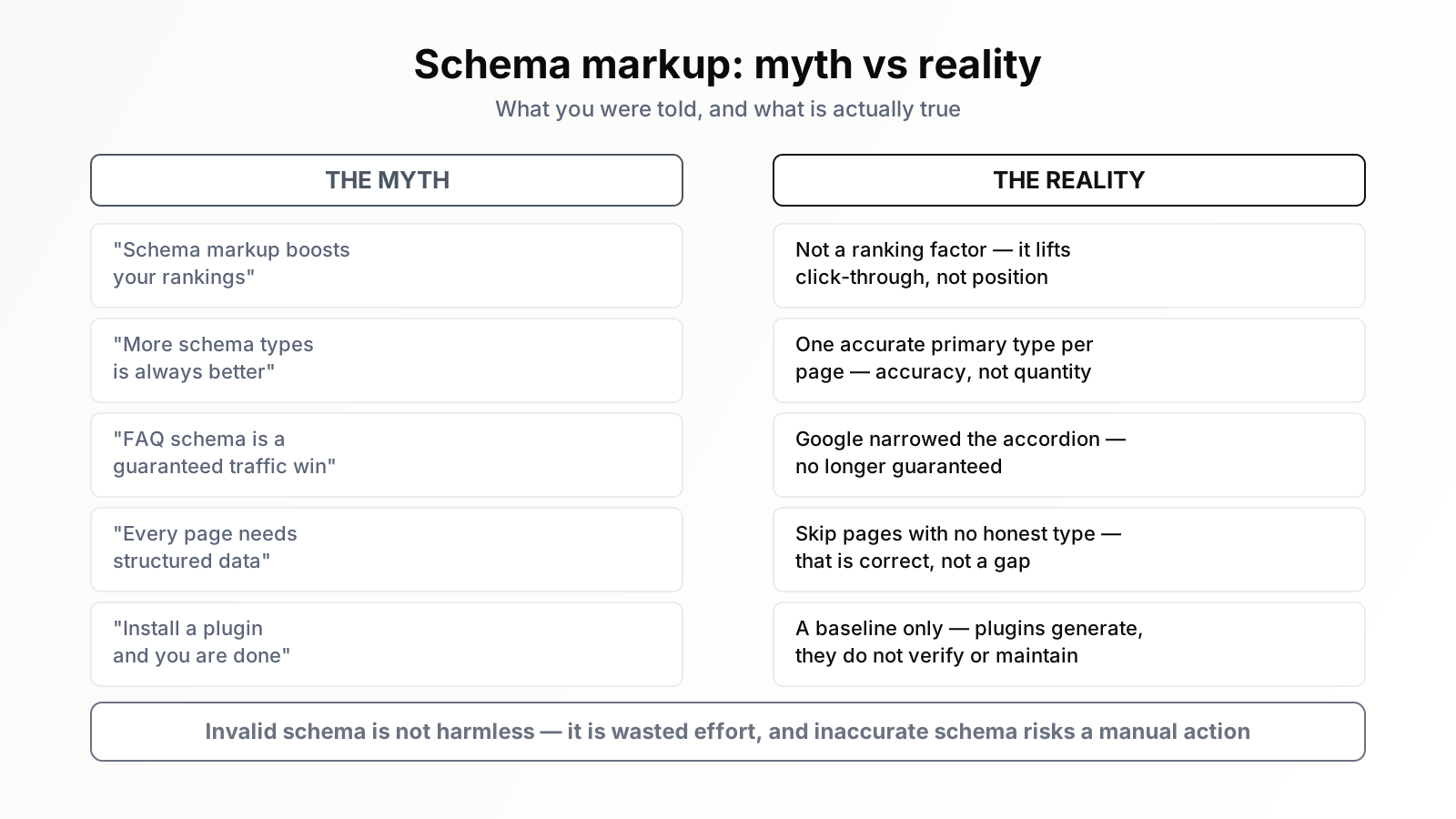
Myth one: schema markup boosts your rankings
This is the foundational myth, the one that makes all the others seem worth chasing. The belief is that adding schema markup to a page lifts it up the results — that there is a "structured data ranking factor" rewarding pages that have it.
There is not. Google has stated plainly and repeatedly that structured data is not a ranking factor in the sense people mean. Adding valid schema to a page at position seven does not move it to position three. The ranking algorithm weighs relevance, content quality, links, and many other signals — schema markup is not among the levers that change position.
What schema actually does is change how your listing appears once it ranks. Valid markup of a supported type can make the page eligible for a rich result — star ratings, a breadcrumb trail, an answer card — and a richer listing tends to earn a larger share of clicks at the same position. So schema can increase your traffic. But it does so through click-through rate, not through ranking. The distinction is not pedantic. If you believe schema raises rankings, you will add it to pages indiscriminately expecting them to climb, and when they do not, you will conclude schema is useless. Both the expectation and the conclusion are wrong. Schema makes the rank you already have more valuable. That is the real, and still worthwhile, benefit.
Schema markup does not move your page up the results. It makes your spot on the results worth more clicks.
Myth two: more schema is always better
Once a team accepts that schema is good, the next mistake follows naturally: if some is good, more must be better. So they pile types onto pages — Article and FAQ and HowTo and Product and Review — on the theory that more structured data means more signals means more benefit.
It does not work that way. Schema is only useful when it is accurate and when the type genuinely matches the page. Adding HowTo markup to a page that is not a how-to does not give you a bonus signal; it gives you invalid markup that search engines ignore. Adding Product schema to a blog post to chase star ratings is not clever; it is a misrepresentation that risks a manual action. The value of schema is not in quantity. It is in correctly describing what the page actually is.
The right mental model is one primary type per page, matching the page's real purpose, plus the small set of universally applicable types — BreadcrumbList for the page's position, Organization site-wide. A blog post is an Article. A pricing page is a Product or Offer. A genuine step-by-step guide is a HowTo. You pick the type that is true and you stop. Stacking on additional types because they are technically available adds maintenance burden and risk, not benefit.
Myth three: FAQ schema is a guaranteed traffic win
For a while this one was almost true, which is why it persists. FAQ rich results — the expandable question accordions under a listing — were widely shown, took up real space, and pushed competitors down the page. Teams added FAQ schema to everything, and for a window of time it worked.
That window has largely closed. Google significantly narrowed where FAQ rich results appear, restricting them to a much smaller set of sites and removing the accordion from most listings that previously showed it. If you add FAQ schema today expecting the accordion, you will most likely not get it. The guaranteed traffic win is no longer guaranteed, and treating it as one is planning around a feature that has mostly gone away.
This does not make FAQ schema worthless. Valid FAQ markup still gives search engines and AI answer surfaces clean, explicit question-answer pairs, and that structured clarity has independent value as answer engines grow. The correction is to the expectation. Add FAQ schema where you have genuine questions and answers because it describes the content accurately — not because you are counting on a rich result that, for most sites, is no longer on the table. And the broader lesson generalises: rich result features change. Any schema strategy built on the assumption that a specific feature will keep behaving the way it does today is built on sand.
Myth four: every page needs structured data
The completionist instinct says every page should have schema, and a page without it is somehow unfinished. This produces busywork — teams hunting for a type to apply to pages that have no natural one, contorting a page's content to fit a schema rather than the reverse.
Schema is useful where a page maps cleanly to a supported type that can earn a rich result or feed an answer surface: articles, products, recipes, events, how-tos, local businesses. Plenty of pages do not. A generic "about us" page, a sparse contact page, a miscellaneous landing page — there may simply be no type that genuinely fits, and forcing one adds maintenance cost for no benefit. Skipping schema on a page that has no honest type is not a gap in your SEO. It is correct. Schema is a tool for specific content patterns, not a universal checkbox every URL must satisfy.
Myth five: install a schema plugin and you are done
Many CMS platforms have plugins that generate schema automatically. The myth is that installing one completes the job — schema handled, move on.
A plugin is a starting point, not an endpoint. Automated schema generation reliably handles the easy, universal cases — Article, Breadcrumb, Organization — and that is genuinely valuable. But a plugin cannot make the judgement calls. It cannot know that a particular page is a HowTo rather than a generic Article. It cannot verify that the review rating in the markup matches a rating actually visible on the page. It cannot tell that a template change three months ago left the markup describing content that no longer exists. Plugins generate; they do not verify accuracy or maintain correctness over time.
So a plugin gives you a baseline, and you still need to do the work it cannot: choose the right type for non-standard pages, confirm the markup matches the visible content, and re-check it as the site changes. "I installed the schema plugin" and "the site's structured data is correct" are two different statements, and the gap between them is exactly the part that matters.
Myth six: invalid schema is harmless — it just does nothing
This is the most dangerous myth, because it makes carelessness feel safe. The belief is that if your schema is broken or inaccurate, the worst case is simply that it does not work — no rich result, no harm done.
Invalid or inaccurate schema is not neutral. There are real downsides. Markup with errors is ignored, so the effort to create it is wasted — that much is merely disappointing. But schema that misrepresents the page — claims a rating that is not visible, lists FAQ answers that are not in the content, states a price that differs from the page — violates Google's structured data guidelines, and the consequence can be a manual action for spammy structured data. A manual action is a far more serious problem than simply not having a rich result; it is a trust penalty that takes real work to clear.
So inaccurate schema carries genuine downside risk, and even merely-invalid schema costs the effort spent producing it. This is precisely why validation is not optional. Every block of structured data should pass Google's Rich Results Test and accurately describe content that a human can actually see on the page, before it ships. "Schema can only help" is false. Honest, validated schema helps. Sloppy schema ranges from wasted effort to active liability.
Myth seven: schema is something you set up once and forget
One last myth, quieter than the others but just as costly. It is the assumption that structured data is a setup task — you add it, it works, you move on, and it stays correct on its own. It does not.
Schema markup decays for two independent reasons, and both are outside your control. The first is that the Schema.org standard itself evolves: types are added, properties are deprecated, recommendations shift. Markup that was fully recommended two years ago may now use a property Google has stopped supporting. The second reason is that your own pages change. A template gets redesigned, a section of content is removed, a layout is restructured — and the JSON-LD block, written separately from the visible HTML, does not change with it. Now the markup references a rating, an author, or an FAQ that is no longer on the page. It has silently become inaccurate, which — per the rule established earlier — has shifted it from helpful to harmful, without anyone touching the schema at all.
This is why structured data belongs in a recurring audit, not a one-time checklist. The correct mental model is that schema is a living layer of the site that has to be re-validated periodically against both the current standard and the current state of the pages it describes. A team that "set up schema" three years ago and never looked again does not have working structured data — it has structured data that was correct once and has been drifting ever since. Treat it as maintenance, not as a finished project, and this myth stops costing you.
What is actually true about schema markup
Strip the myths away and a clear, modest, genuinely useful picture remains.
Schema markup does not raise rankings — it makes the ranking you already hold more valuable by enabling richer, higher-clicking listings, and by feeding clean facts to AI answer surfaces. The right approach is one accurate primary type per page that has a genuine match, plus the universal types, and no schema at all on pages with no honest type. FAQ schema is fine to add for accuracy but not to rely on for a rich result. Plugins give you a baseline and not a finished job. And every block must be validated and faithful to the visible page, because inaccurate markup carries real risk.
That is not a thrilling story. It will not promise a ranking jump. But it is the true one, and a schema program built on it produces steady, real gains, while a program built on the myths produces wasted effort and avoidable risk.
Where an SEO AI agent fits
Doing schema correctly is not hard in principle — it is hard in practice because it is detailed, repetitive, and decays. Every page needs the right type chosen, every block needs to match the visible content, and every block needs to stay valid as pages and the Schema.org standard both change. That is a maintenance load most teams cannot sustain manually across a real site, which is how the myths take hold: "install the plugin and you're done" is appealing precisely because the honest alternative is tedious.
This is the work an SEO AI agent is suited to. Orova can scan a site, identify the genuinely appropriate type for each page, generate accurate markup from the content that is actually present, validate every block against Google's requirements, and flag schema that has drifted out of sync with its page or out of date with the standard — continuously, not once. The strategic decisions in this article stay with you. The relentless verification and upkeep, the part the myths exist to wish away, is what the agent carries. For more on this layer of search, see our overview of how an SEO AI agent changes content marketing.
Schema markup deserves a place in your SEO work. It just deserves an honest one. Drop the belief that it boosts rankings, that more is better, that FAQ is a free win, that every page needs it, that a plugin finishes the job, and that broken markup is harmless. Keep the accurate, validated, well-matched version — and let it do the real, modest thing it is genuinely good at.
Run your business with AI Agents
Orova is the always-on Biz AI Agent — it plans, runs, and optimizes the work for you. Save time, unlock productivity.
Try it free