
SEO Search Engine Optimization Explained for Beginners
Every few months, someone declares that SEO — search engine optimization, the practice of getting your site found in search results — is dead. First it was mobile, then voice search, then AI Overviews. You read the headline, feel a jolt of panic, and start wondering if the work your team did last year just became worthless.
Here is where businesses lose money: they rebuild their whole approach around whatever the newest headline says, instead of building something that survives the headline. Budget and time get poured into tactics tied to one platform or one update, and the moment that platform changes again, the work gets thrown away and the whole cycle starts over. It doesn't help that the numbers keep shifting under everyone's feet — 68% of US Google searches in the first four months of 2026 ended without a click at all, up from 60% just two years earlier, according to SparkToro. Meanwhile, the businesses that just kept doing the basics well — clear content, a site that actually works, a reputation people trust — kept showing up through every one of these so-called funerals.
This article walks through what actually determines whether your business gets found, and it has barely changed in fifteen years — only the packaging around it keeps changing. By the end, you will know which fundamentals are worth investing in no matter what the next update claims, and how to plan your budget so your team stops rebuilding from scratch every time the industry panics again.
The trend cycle, and who profits from it
Begin with an unkind but accurate observation: the panic is a business model. Every algorithm era mints a cohort whose income depends on the claim that everything you know is obsolete. New-paradigm agencies need the old paradigm to be dead, or there is nothing to migrate you from. Tool vendors need a new metric to sell dashboards for. Conference circuits need this year's track to differ from last year's. None of these people are lying, exactly — they are selected. The voices that say "mostly the old rules still apply, also here are three real adjustments" do not go viral, do not fill workshops, and do not close enterprise contracts. The voices that say "SEO is dead, GEO is everything" do.
We dissected the loudest current version of this in "AI Overviews killed SEO" is the laziest take of 2026, so here we only need the structural point: when the incentive landscape rewards announcing discontinuity, the announced amount of discontinuity will always exceed the real amount. Your job, as the person whose budget is being fought over, is to estimate the real amount. The most reliable way to do that is to look at what survived every previous announcement — because whatever survived five funerals is a good bet to survive the sixth.
Fundamental one: content that answers the actual query
Strip away the vocabulary and every search system ever built has had one objective: given an expression of need, return the thing that satisfies it. In 2010 the need was expressed as three keywords; in 2026 it may be a five-sentence conversational question with two follow-ups. The retrieval machinery went from lexical matching to embeddings to retrieval-augmented generation. And through every one of those revolutions, the winning move for a publisher was identical: understand precisely what the person is trying to resolve, and resolve it more completely and more honestly than anyone else.
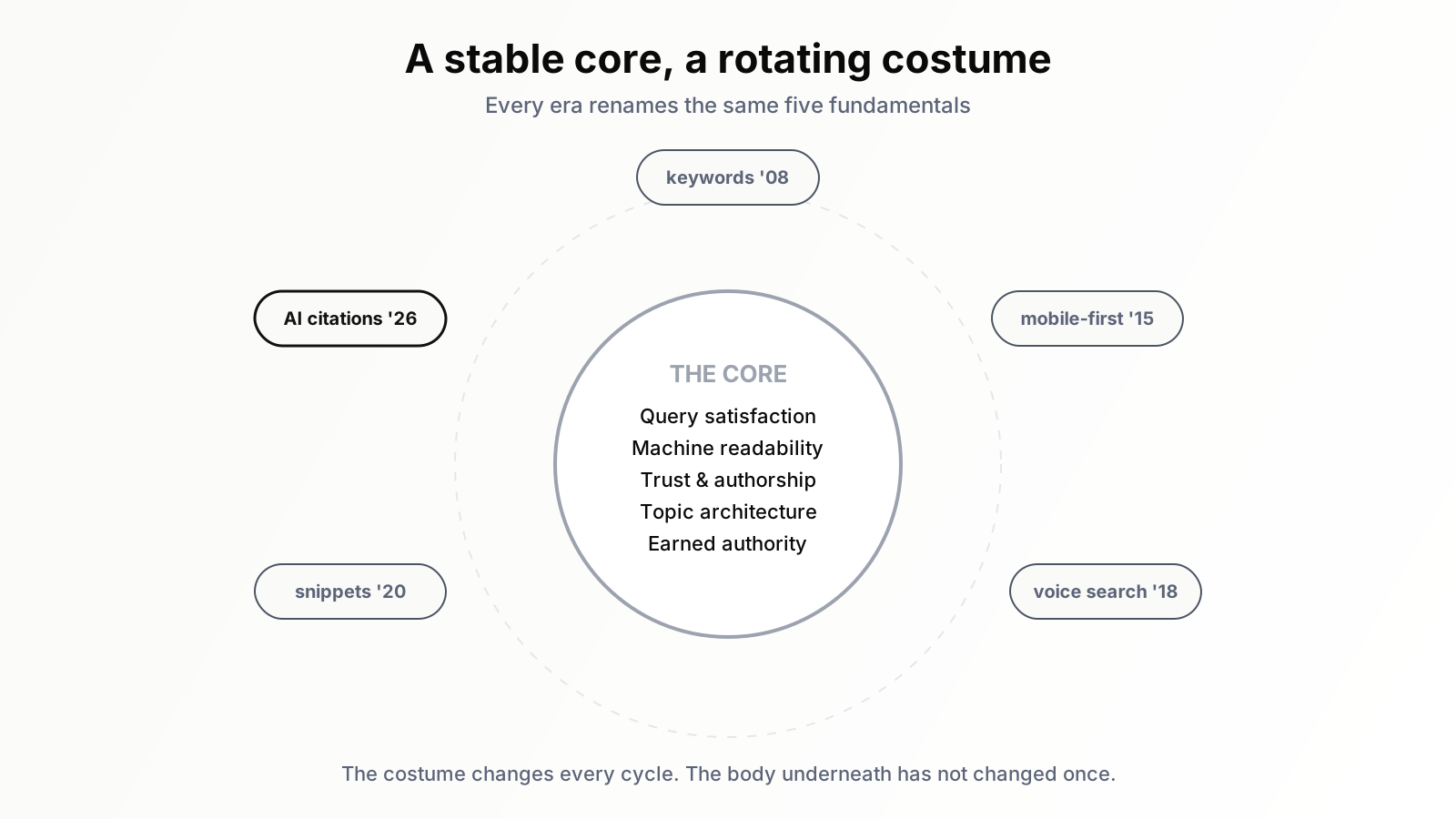
Consider what the eras did to this fundamental. Keyword-density era: answering the query looked like using the words. Semantic era: answering the query looked like covering the topic. Snippet era: answering the query looked like a crisp extractable definition. AI era: answering the query looks like a 40-to-60-word direct answer under a question-shaped heading. The costume changes every time; the body underneath — query satisfaction — has not changed once. A team that internalised the fundamental adapts its formatting in a week. A team that only ever learned the costume has to relearn its job every cycle, which is why the trend-chasers are perpetually exhausted and perpetually behind.
The critique sharpens here: most "AI content strategies" currently being sold are query satisfaction with worse economics. Publishing two hundred thin AI-generated posts to "cover the topic for the engines" fails for the same reason article spinning failed in 2011 and doorway pages failed in 2006 — systems whose existence depends on user satisfaction are eventually selected to detect and discard unsatisfying content. They always have been. Betting against that selection pressure has been the single most consistently losing bet in the history of this industry.
Fundamental two: a site machines can actually read
The least fashionable fundamental, and the one with the longest unbroken record. Googlebot in 2008 needed fetchable URLs and parseable HTML. GPTBot, ClaudeBot, and PerplexityBot in 2026 need — fetchable URLs and parseable HTML. The cast of machines reading your site has tripled; their requirements are embarrassingly unchanged. Fast responses, content present without executing a framework's worth of JavaScript, sensible status codes, canonical clarity, an honest sitemap.
Here is the irony the panic obscures: the AI era made this boring layer more decisive, not less. A classic SERP showed ten results, so a partially-crawlable site still appeared somewhere. A synthesised answer cites three or four sources; there is no page two of an AI Overview. Retrieval failures that used to cost positions now cost existence. And yet — watch where the budgets go. Teams that have never once looked at which bots their CDN is blocking are buying "AI visibility platforms." We have audited sites whose security stack had been silently serving challenge pages to every AI crawler for a year while the marketing team A/B tested prompt phrasing in their content. The five-layer model in our master framework for the AI search era puts technical foundation at the bottom of the stack for exactly this reason: nothing above it functions when it is broken, and it is broken far more often than dashboards admit.
Fundamental three: being someone worth trusting
Expertise, authoritativeness, trust — the industry has called it E-A-T, then E-E-A-T, and treats each renaming as a revelation. The underlying selection pressure predates the acronym by decades: any system that recommends sources gets judged on the quality of its recommendations, so every such system, from a librarian to a link-based algorithm to a grounded language model, converges on preferring identifiable, accountable, demonstrably competent sources. We covered the mechanics in what Google actually rewards with E-E-A-T; the era-survival point is different and blunter.
Every algorithm era has punished, eventually and severely, the publishers who treated trust as a presentation-layer trick. Exact-match domains with fake authors died in Panda. Parasite content died across multiple updates. Anonymous affiliate sites with "medically reviewed by" badges and no doctors died in the medic-era updates. The AI era's version is already visible: engines that must stand behind synthesised answers cite conservatively, and the citation pools for consequential topics skew brutally toward sources whose expertise survives independent checking. The boring work — real authors, real credentials, original evidence, an entity machines can verify — has paid in every era and pays more in this one. The trend work — this season's trust costume — has been a write-off five times out of five. That is not a moral claim; it is an actuarial one.
Fundamental four: architecture that organises knowledge
Sites are not piles of pages; they are graphs, and every generation of search technology has read the graph as evidence of what a site knows. Reasonable surfers, siloing, hub-and-spoke, topic clusters, "topical authority" — the names rotate through the conference circuit like fashion seasons, and underneath them sits one unchanged principle: group related content, link it coherently with descriptive anchors, make the relationships between your ideas legible. We have made the architectural case in our explanation of the hub-and-spoke model and shown the measurable difference in why topic clusters beat standalone posts, so here is just the survival evidence: this fundamental is the only one the AI era arguably strengthened the most. Conversational search decomposes user needs into chains of related sub-questions; an engine assembling an answer to a chain naturally favours sources whose coverage maps the chain. A well-built cluster is precisely that map. The standalone viral post — the trend-chaser's favourite artefact — has never been worth less.
And the critique, once more: architecture is unfashionable precisely because it is slow. It does not demo well. There is no architecture launch announcement. It is six months of disciplined linking and gap-filling that turns a blog into a reference work — after which engines of every architecture, lexical or generative, treat you differently. Every shortcut sold as a substitute for this work since 2009 has decayed within two years. The work itself has never once stopped compounding.
Fundamental five: authority you did not give yourself
The last fundamental is the oldest: what other credible actors say about you outranks what you say about yourself. PageRank operationalised it with links; every subsequent system has kept some descendant of it, because self-assertion is free and therefore worthless as a signal. The AI era did not repeal this — it laundered it through new surfaces. Engines deciding which sources to retrieve and cite lean on authority signals from the same old web graph, and increasingly on something adjacent: how often and in what contexts your brand is mentioned across the corpus the models were trained and grounded on. Being talked about, accurately, in credible places — the oldest marketing outcome there is — now also shapes what a language model believes about your category.
Which makes the era's actual lesson almost comically traditional: do things worth citing. Original research, honest comparisons, tools people use, data nobody else has. The link-building tricks of every previous era — directories, exchanges, guest-post farms, PBNs — each worked briefly and died, and their AI-era descendants will die the same death on the same schedule. The publishers who never needed the tricks never noticed the updates. There is a quiet lesson in that sentence, and it is the entire thesis of this article.
Three autopsies: how previous funerals actually ended
Because the strongest evidence for the thesis is the historical record, it is worth performing three brief autopsies on previous "ends of SEO" — not to mock anyone's 2018 predictions, but because each one shows the same anatomy the current panic shows, and each one ended the same way.
Autopsy one: voice search. The claim, circa 2017–2019, was that half of all searches would soon be spoken, screens would disappear, and only "position zero" would exist — therefore everything about your program had to be rebuilt around conversational long-tail phrases and speakable markup. What actually happened: voice became a real but bounded interface for commands and quick facts, the dedicated voice-optimisation industry evaporated, and — here is the instructive part — the underlying preparation that mattered turned out to be answering specific questions directly in extractable passages. Which is to say: the people who responded to the voice panic by doing the fundamental (question-shaped content, direct answers) accidentally pre-optimised for featured snippets and, later, for AI Overviews. The people who bought voice-specific tooling and "Alexa skill strategies" wrote it all off. Same panic, two responses, opposite outcomes — and the difference was whether the response was a fundamental or a costume.
Autopsy two: mobilegeddon. The 2015 mobile-friendly update was preceded by months of apocalypse coverage and followed by — a sensible, durable shift that punished sites that were genuinely hostile to the majority of their users. The fundamental underneath ("be readable on the devices your readers actually use") was so obviously a fundamental that in hindsight the panic looks absurd. But note what the panic sold at the time: emergency migrations to separate m-dot sites, which the industry then spent five years migrating back off because they fragmented the very crawlability and authority that fundamentals two and five protect. The panic did not just waste money; it actively damaged the boring layers. That pattern — trend response degrading fundamental layers — is the most expensive failure mode in the cycle, and it is happening right now to teams deleting content or blocking all crawlers "because of AI scraping" without doing the business analysis first.
Autopsy three: featured snippets and the first zero-click panic. When snippets began answering queries on the results page, the discourse was a dress rehearsal for today's: Google is stealing our content, clicks are dying, publishing is over. What practitioners learned within two years was more interesting: snippet presence built brand recognition that showed up as branded search and direct traffic, the queries that lost clicks were mostly the ones whose clicks had little commercial value anyway, and winning the snippet required — once again — clear, extractable, well-structured answers from trustworthy sources. The value did not vanish; it moved one step downstream and became harder to measure with the old instruments. If that sentence sounds exactly like the AI Overview situation, that is because it is the same situation with a larger language model attached.
Three eras, one anatomy: a real change, an exaggerated funeral, a costume industry, and underneath it all the same five fundamentals quietly deciding the outcome. The AI era is bigger than any of these three — genuinely, materially bigger. The anatomy is still identical.
The Monday morning version: how to budget against the cycle
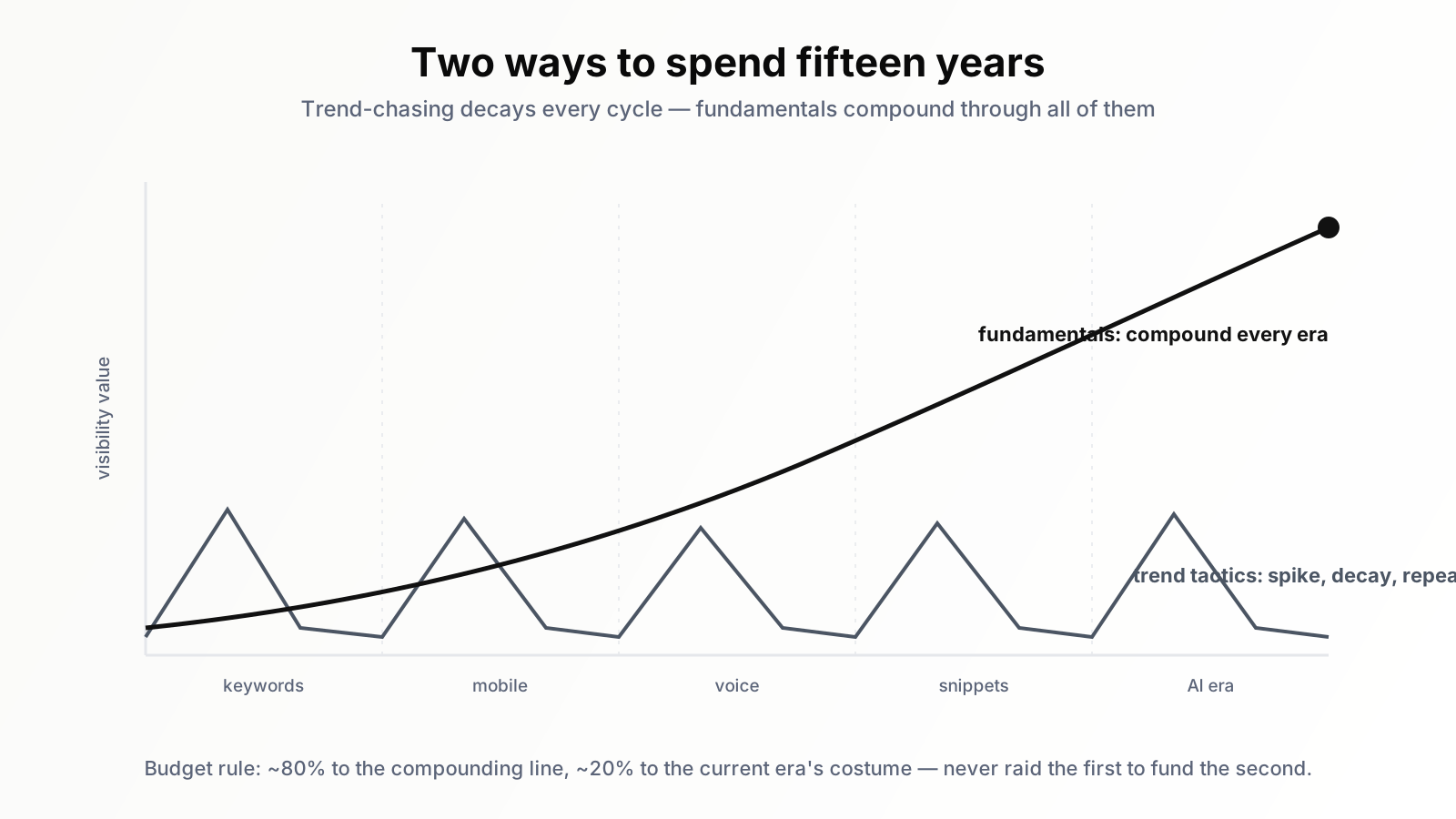
Critique without an alternative is just commentary, so here is the operating rule we recommend, concrete enough to use in your next planning meeting. Split the search budget explicitly into two lines. The fundamentals line — roughly eighty percent — funds only work that passes the test from the synthesis above: query satisfaction, machine readability, trust evidence, architecture, citable assets. This line does not get re-litigated when a new engine launches; it is the program. The era line — the remaining twenty percent — funds the current era's costume: this year, answer-first reformatting, citation tracking, AI-referral measurement, crawler policy. The era line is allowed to change every year. The fundamentals line is not allowed to be raided to fund it.
The split does two jobs. Financially, it caps the damage any panic can do: the worst case is twenty percent spent on a trend that fades, while the compounding work continues uninterrupted. Politically — and this is the underrated part — it gives you a ready answer when leadership reads a "GEO replaces SEO" headline and asks why your program looks unchanged. The answer is: it is not unchanged, the era line is fully deployed against exactly that shift, and here is the citation-share trend to prove it; meanwhile the fundamentals line is why we will still be visible when the next era arrives. Teams without the explicit split end up renegotiating their entire strategy every time a competitor's press release trends, which is how five-era losing streaks happen.
And if you want a one-question version for evaluating any individual proposal: ask the vendor, the consultant, or yourself what happens to this investment if the specific engine behaviour it targets changes next quarter. Work that survives that question is fundamentals. Work that does not, you now know how to classify — and which budget line, if any, it deserves to compete for.
The honest synthesis: what the new era actually asks of you
None of this argues that 2026 requires nothing new. It requires real adjustments, which we have documented in detail across this series: answer-first formatting, citation tracking, AI-referral measurement, crawler policy, entity hygiene. The point of the critique is proportion. Those adjustments are perhaps twenty percent of the work, layered on top of the eighty percent that has not changed since before some of your competitors' marketing managers finished school. The teams in trouble are not the ones that missed a trend; they are the ones that have spent five consecutive eras missing the constant — and the value still flowing through every era, click or no click, is the subject we treated in zero-click search doesn't mean zero value.
So here is the test to run on any tactic anyone tries to sell you this year, including us. Ask: does this work because it makes the site genuinely more useful, more trustworthy, more readable by machines, better organised, or more independently validated? If yes, it is a fundamental in this era's costume — buy it, it will survive the next update and the next engine. If it works only because of a quirk in how one engine currently behaves, it is a trend — rent it cheaply if you must, but never fund it from the fundamentals budget. Fifteen years of funerals have not produced one exception to this rule.
The boring conclusion, then, which is the only kind that survives: keep doing the unglamorous work, adjust the costume when the era changes, and let the panic cycle exhaust the people who profit from it. The fundamentals do not trend because they do not change — and they do not change because they are not tactics at all, but descriptions of what it means to deserve attention. Machines keep getting better at detecting exactly that, which is the best long-term news a serious publisher could ask for. The tedious part — the audits, the monitoring, the refresh queues that keep the fundamentals actually maintained rather than merely admired — is the part worth automating, and that is the unglamorous job Orova was built to do while you get on with deserving the attention.
What this means for your time
Keeping up with every fundamental in this article by hand takes real time: writing content that answers real questions, making sure your site is structured so search engines can read it, building trust signals, organizing your pages logically, and earning the kind of recognition that boosts your ranking. Doing all of that consistently, on top of running your business, is where most owners fall behind — not because the ideas are hard, but because there are a lot of small moving parts to track.
Orova SEO is built to handle that ongoing work for you, so the fundamentals get applied consistently without you having to manage every detail yourself. If that sounds useful, it is worth taking a look and seeing whether it fits how you work.
Who has time to redo this every eighteen months
Doing this properly by hand means someone on your team is constantly checking whether your content still answers real questions, whether your site still loads and reads cleanly for search engines, and whether the signals of trust you have built are actually being tracked over time. That is not a one-time task — it is ongoing monitoring across five fundamentals, and doing it manually eats hours every single month, hours most small business owners do not have.
This is the part Orova SEO takes off your plate. It watches those fundamentals for you and automates the repetitive checking and reporting, so you are not starting from zero every time a new update makes headlines. If that sounds useful, it is worth taking a look.
Stop rebuilding every eighteen months
Keeping up with all five fundamentals by hand is a real time sink: checking whether your content actually answers what people are searching for, making sure your site is structured in a way search engines can read, tracking the trust signals and links that build authority, and doing it all again every time something shifts. Most business owners do not have a team sitting around to monitor this continuously, so it gets checked once and forgotten — until the next panic headline.
Orova SEO is built to take that ongoing monitoring off your plate, automatically checking the fundamentals that matter and flagging what needs attention before it becomes a problem. If you would rather spend your time running the business than re-auditing your site every time a new update makes headlines, it is worth taking a look.
Let Orova SEO handle the repetitive part
Keyword research, drafting, refreshing old posts and rank tracking — running automatically on your own site.
Explore Orova SEO