
The Hub-and-Spoke Model Explained Without the Jargon
Somewhere in the great archive of marketing terminology, between "synergy" and "growth hacking," sits the phrase "hub-and-spoke content model." It sounds like something you would need a certification to understand, or at least a slide deck with a lot of arrows. It is not. It is, genuinely, one of the simplest ideas in all of SEO, and it has been made to sound complicated by people who get paid by the syllable. This article is going to explain it without the jargon — and, where the jargon shows up anyway, point at it and laugh.
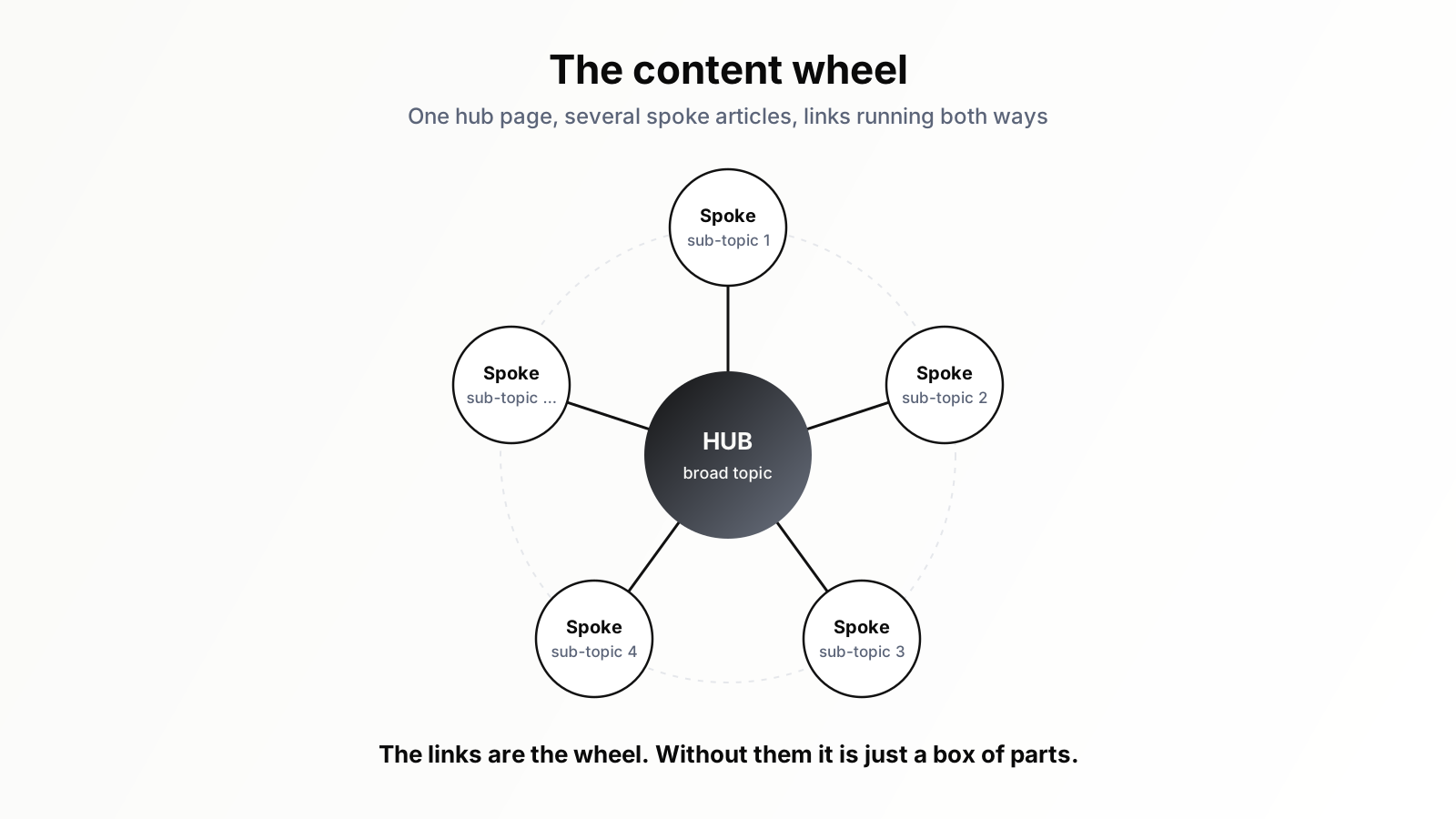
Here is the whole concept, delivered immediately so you can leave early if you want: you have one big page about a broad topic, and several smaller pages each about one piece of that topic, and they all link to each other. That is it. That is the hub-and-spoke model. Everything else in this article is just elaboration, examples, and gentle mockery of how needlessly mysterious people have made this.
Why it is called hub-and-spoke (a bicycle wheel, basically)
The name comes from a bicycle wheel, which is reassuring, because a bicycle wheel is a thing most of us have successfully understood since approximately age six.
The hub is the bit in the middle. The spokes are the thin metal rods radiating out from it. The hub connects to every spoke; every spoke connects back to the hub. The wheel works because of that structure — the hub holds everything together, and the spokes give the wheel its strength. Remove the hub and you have a sad pile of rods. Remove the spokes and you have a small metal disc that rolls nowhere.
Content works the same way, and that is the entire metaphor. The hub is your one big page on a broad subject. The spokes are your smaller pages, each on one narrow part of that subject. The links between them are what make it a wheel instead of a heap. You now understand the hub-and-spoke model as well as anyone charging four figures to explain it on a webinar. Congratulations. You may put "content architecture" on your CV.
The same thing with three different names
A brief but important public service announcement. As you read about this, you will encounter the same idea wearing different hats, and the hats are designed to confuse you.
"Hub-and-spoke model." "Topic cluster." "Pillar and cluster pages." These are, for all practical purposes, the same thing. The hub is the pillar. The spokes are the cluster pages. A "topic cluster" is the whole wheel. Different writers picked different metaphors and now the internet contains three vocabularies for one concept, and beginners reasonably assume they are three things they need to learn separately. They are not. They are one thing with a wardrobe. If you would like the version of this explained with the pillar/cluster vocabulary instead of the bicycle one, our topic clusters guide is the same wheel from a different angle.
What the hub page actually does
Let us spend a moment on the hub, because its job is the most misunderstood.
The hub page covers a broad topic across its full width. Not deeply — broadly. Imagine your subject is a country. The hub is the map of the whole country: it shows you every region, names every city, gives you a sense of the place, but it does not tell you which café in the third district has the good coffee. The hub orients. It says "here is the entire subject, here is how the parts fit together, and here — follow this link — is where you go for the detail on each part."
The most common mistake people make with a hub page is treating it like a very long spoke. They pick a broad topic, then write ten thousand exhausting words going maximally deep on everything, and end up with a page that is both unreadable and pointless, because it has eaten the job of every spoke and left them nothing to do. A hub is a map, not the territory. It should make you want to explore — and then hand you the links to do it.
What the spoke pages actually do
The spokes are the easy part, and also the part people accidentally get right, because a spoke page is just a normal good article.
Each spoke takes one narrow piece of the broad subject and covers it properly — deeply, completely, the way a single focused article should. If the hub is the map of the country, a spoke is the detailed neighbourhood guide: it does one district, but it does it thoroughly, including the café with the good coffee. A spoke does not try to cover the whole subject. It does not need to. It has eight siblings doing the other parts, and a hub above tying them together.
The one rule for spokes: each spoke should own one distinct piece, and the pieces should not overlap. If two spokes are both basically about the same narrow thing, you have built a wheel with two spokes welded together, which is not a better wheel — it is a wheel with a confusing lump and two pages competing for the same search.
The links: the part everyone forgets, the part that matters most
Here is where most attempts at this fall apart, and it is darkly funny, because it is the easiest part to do and the easiest part to skip.
People will diligently write a hub page. They will diligently write nine spoke articles. They will look at the pile of ten pages and think "I have built a content cluster." They have not. They have built ten pages that happen to be about related things. A pile of bicycle parts in a box is not a bicycle. The thing that turns the box of parts into a wheel is the links — and the links are, somehow, the step that gets left out.
The rule is uncomplicated. The hub links down to every spoke. Every spoke links up to the hub. Optionally, closely related spokes link sideways to each other. Do that, and the box of parts becomes a wheel: the hub holds everything together, authority flows around the structure, search engines see a tightly connected set of pages on one subject, and readers can navigate from the big picture to the detail and back. Skip it, and you have ten lonely pages and a vague sense of disappointment. The links are not the boring administrative part of the model. The links are the model.
Why bother with a wheel at all?
Fair question. Why not just write good articles and let them fend for themselves? Because lonely articles fend poorly, and a wheel does three things a pile of pages cannot.
First, it lets you rank for the hard stuff. The broad topic — the head term — is competitive, and a single page rarely takes it. But a hub page backed by a full wheel of spokes can, because the spokes collectively prove your site has real depth on the subject, and that depth is what eventually earns the hub the right to rank for the big term.
Second, it pools authority. Every spoke links to the hub, so the hub gets stronger with every spoke you add. Internal links are votes, and the hub is built to collect them.
Third, it keeps readers. A reader who lands on one spoke is one click from the hub and from eight sibling spokes. Instead of reading one page and leaving, they explore. A wheel is sticky in a way a flat list of posts never is.
How to build one without overthinking it
Because the concept has been over-mystified, people assume building one must be an elaborate ritual. It is not. Here is the entire process, stripped of ceremony.
Pick a broad topic your buyers actually care about — wide enough to break into eight to fifteen pieces, narrow enough to still be one coherent subject. List the pieces; each piece is a spoke. Write the spokes, one focused article each, no overlaps. Write the hub: a section per piece, each section a friendly summary that hands off to its spoke. Then — and this is the step you are now contractually obligated not to skip — link them. Hub down to every spoke, every spoke up to the hub. Stand back. You have built a wheel.
That is the whole method. It is not difficult. It is just disciplined, and discipline is less photogenic than complexity, which is why the simple version rarely gets the webinar.
The mistakes, briefly and affectionately
A short tour of how people break the wheel, offered in the spirit of helping you not.
The hub that ate everything: a hub so deep it does every spoke's job, leaving the spokes redundant. Make the hub a map.
The box of parts: hub and spokes all written, no links between them. A wheel is defined by its connections. Link the parts.
The wobbly topic: a hub topic so broad it has no edges and the spokes sprawl forever. If you cannot list the spokes, the topic is too wide.
The duplicate spokes: two or three spokes secretly about the same narrow thing, competing with each other. One piece, one spoke.
The abandoned wheel: a cluster built once and never maintained, so it slowly desyncs from reality. A wheel needs the occasional tightening.
How big should a wheel be?
A reasonable question once you start building: how many spokes does one wheel need? People want a number, and the honest answer is a range with a principle attached.
A wheel with two or three spokes barely counts as a wheel — it does not have enough structure to send a strong "this site has depth" signal, and the hub has too few pages linking up to it to gather much authority. A wheel with forty spokes is usually not one wheel but several wheels that should have been separated, because a topic broad enough to need forty spokes almost always contains two or three distinct sub-subjects, each of which deserves its own hub.
The comfortable zone is roughly eight to fifteen spokes per wheel. That is enough structure to demonstrate real depth and to give the hub a meaningful pool of upward links, while still being small enough that one team can actually finish it and keep it maintained. If your topic naturally produces only five solid spokes, build a five-spoke wheel — do not invent four thin spokes to hit a number. And if it produces thirty, stop and look for the seam: there are probably two wheels in there pretending to be one. Let the genuine shape of the subject set the size of the wheel, not a target.
What happens when a wheel is finished
It is worth describing the payoff concretely, because "build a content cluster" is abstract and the result is not.
A finished wheel changes how your site behaves on the subject. The hub page becomes a genuine contender for the broad, competitive head term — not because the hub page is individually brilliant, but because the wheel of spokes behind it proves depth, and proven depth is what eventually earns the right to that term. The spoke pages start ranking more easily for their narrower queries, because they are no longer lonely pages but pages backed by a structure. Readers who land anywhere on the wheel tend to stay longer, because there is always somewhere relevant to go next. And the site as a whole starts to read, to a search engine, as a place that knows this subject — which makes every future page you add to the wheel a little easier to rank than the last.
That last effect is the one worth waiting for. A wheel compounds. The first few spokes are hard work for modest return. But once the structure is real, each new spoke joins a wheel that already has authority, and the return per spoke climbs. A finished wheel is not just a tidy way to organise content — it is the point at which content starts paying you back faster than you put it in.
Where an AI agent fits
The hub-and-spoke model is genuinely simple to understand and genuinely tedious to execute fully. Breaking a topic cleanly into spokes, writing the hub so it summarises without cannibalising, and — the eternal weak point — actually wiring every single link in both directions and keeping them right as the wheel grows: that is a lot of careful, unglamorous connecting. It is exactly the work that gets started and not finished, which is why so many "clusters" are really just boxes of parts.
This structured, link-heavy assembly is what an SEO AI agent handles well. Orova can take a broad topic, split it into non-overlapping spokes, draft a hub and its spokes with the map-versus-detail boundary respected, and — the part humans skip — propose the complete set of hub-to-spoke and spoke-to-hub links, then flag gaps as the cluster expands. The model stays as simple as a bicycle wheel. The agent just makes sure you end up with a wheel and not a box.
So the next time someone says "hub-and-spoke content architecture" in a meeting and lets it hang in the air like a magic spell, you can translate it on the spot: one big page, several small pages, all linked, like a bicycle wheel. It was never complicated. It was just dressed up. Now go build a wheel — and do not, whatever you do, forget the spokes.
Let Orova SEO handle the repetitive part
Keyword research, drafting, refreshing old posts and rank tracking — running automatically on your own site.
Explore Orova SEO