
We Restructured 60 Posts Into 4 Clusters — Here's What Happened

There is a particular kind of blog that looks productive and performs terribly. It has dozens of posts. It publishes regularly. The archive page scrolls for a satisfyingly long time. And yet the traffic is flat, the rankings are mediocre, and nobody can explain why, because by every visible measure the team is doing the work. We had exactly that blog: sixty-some posts, years of effort, and results that did not match the input. This is what happened when we stopped adding posts and instead restructured the ones we had into four topic clusters — and what the pattern of results taught us.
A note on what this article is and is not. It is an honest account of a restructuring project framed around what we observed. It is not a pile of precise statistics — we are not going to tell you traffic rose by some exact percentage, because single-case numbers like that are easy to misread and easy to fake, and the specific figure matters far less than the direction and the mechanism. What we will give you is the qualitative pattern: what moved, what did not, in roughly what shape, and why.
The blog we started with
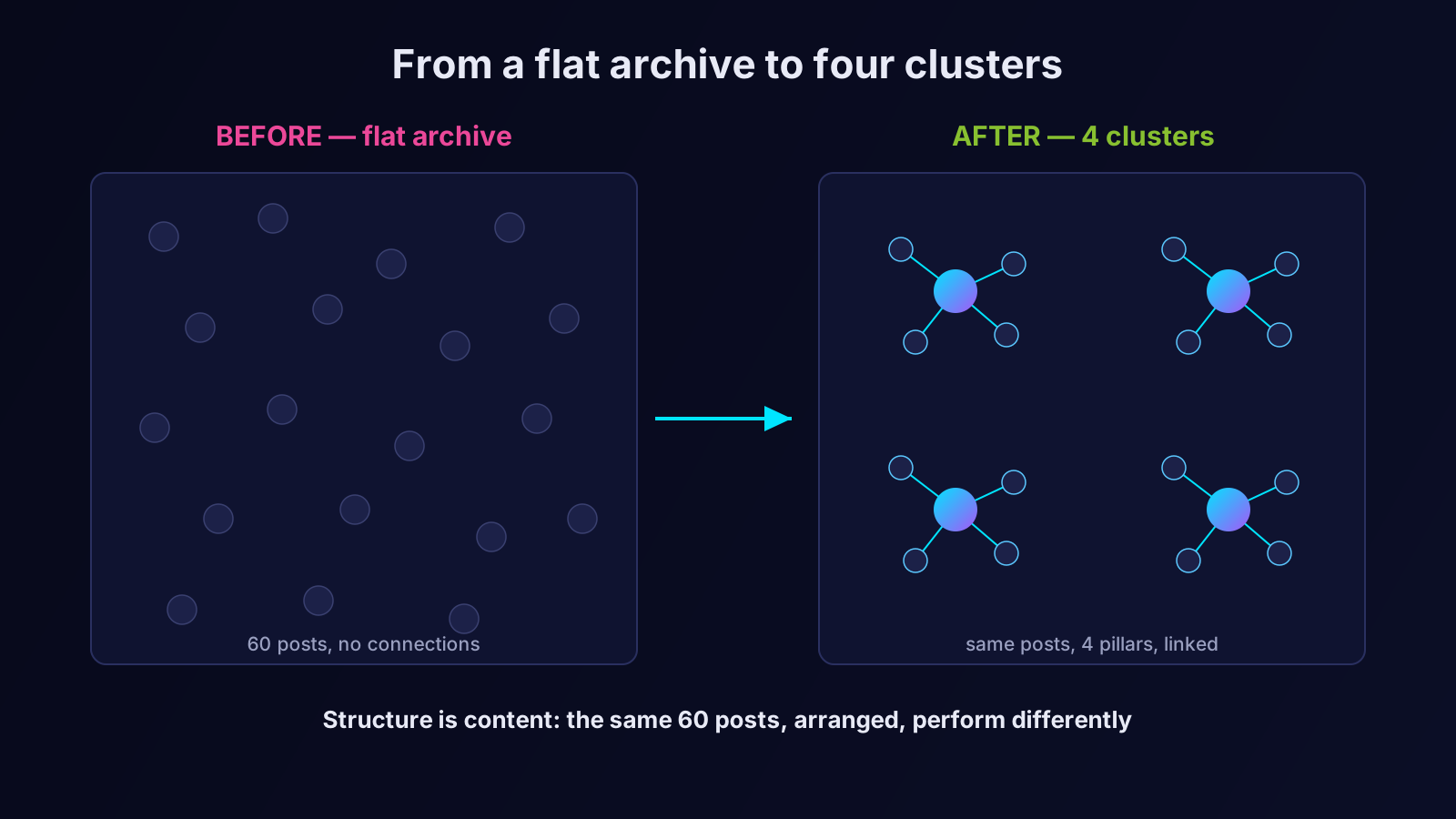
The honest description of our starting point: a flat archive. Sixty-odd posts, each one written as a standalone piece, ordered by publication date and connected to nothing. Some were genuinely good articles. Some were thin. Most sat in between. But the defining feature was not quality — it was isolation. No post led naturally to another. No group of posts signalled "this site has real depth on this subject." It was sixty separate bets, each one fending for itself.
The performance reflected the structure. A handful of posts ranked acceptably. The large majority sat in the deep pages of the search results — technically indexed, effectively invisible. Traffic was flat not because we had stopped working but because the work had no compounding structure. Each new post was another isolated bet added to a pile of isolated bets. The pile grew. The results did not.
Why we restructured instead of writing more
The instinctive response to a flat blog is to publish more — more posts, more often, surely the numbers turn eventually. We had been doing exactly that for a long time, and it had not worked. So we asked a different question: not "what should we write next?" but "what is wrong with what we already have?"
The answer was structure. We had reasonable content arranged into nothing. Sixty posts with no clusters, no pillars, no internal linking pattern — just a flat list. So before writing a single new article, we decided to take the sixty posts we already owned and impose a structure on them. No new content. Just architecture applied to existing content.
How we sorted sixty posts into four clusters
The first task was to read every post and write down, in a few words, what each one was actually about. Not what its title implied — what it covered. That alone was revealing: several posts were not about what their titles suggested, and a few were about almost the same thing as other posts.
With sixty short descriptions in front of us, the clusters became visible. The posts grouped naturally into four broad subjects — four areas our content already, unintentionally, concentrated on. We named those four subjects, and each became a cluster. Then every post was assigned to exactly one cluster, based on the subject it genuinely served. A few posts did not fit any of the four cleanly; those we set aside for a later decision rather than forcing them.
The exercise turned an undifferentiated list of sixty into four labelled groups of roughly a dozen to twenty posts each. That sorting, before anything else, was the first useful thing the project produced — simply seeing the shape of what we already had.
The four pillar pages we had to build
Four clusters needed four pillar pages — and we had none. Every cluster was all spokes and no hub. So the one piece of new writing in the whole project was four pillar pages, one per cluster, each covering its broad subject across its full width and built to link down to the posts in that cluster.
Building the pillars also forced a useful audit. To write a pillar that covered a subject completely, we had to list every sub-topic of that subject — and then check which sub-topics we already had a spoke for. Most were covered. A few had no spoke at all: visible gaps in the cluster. We noted those gaps as a future content list, but we did not stop to fill them. The restructuring came first.
The internal linking pass
With four clusters defined and four pillars built, the largest single task remained: the linking. This is what actually converts a sorted list into a working set of clusters, and it was the most laborious part of the project by a wide margin.
For every cluster we did two things. Each pillar page got links down to every spoke post in its cluster. And every spoke post got a link back up to its pillar — which meant editing all sixty-odd existing posts, one at a time, to add that upward link, plus a few sideways links between closely related spokes. It was slow, repetitive, unglamorous work. It was also the work that mattered most, because before it the clusters existed only on our planning document; after it they existed on the actual website, as a real web of connected pages. Our internal linking strategy guide describes the linking patterns we followed here in detail.
What moved — the pattern we observed
Now the part you came for. We will describe the shape of what happened, honestly and without invented precision.
The change was not instant. Restructuring is not a switch; search engines re-crawl, re-evaluate, and re-rank over weeks and months, and the early weeks looked like nothing at all was happening. Patience was required, and if you do this, you should expect the same quiet start.
When movement came, it came in a recognisable pattern. The pages that improved most clearly were not, as we had half-expected, the brand-new pillar pages. They were the existing spoke posts — the ones that had been sitting unchanged in the deep pages of the results. We had not rewritten them. We had only added the upward link to a pillar and placed them inside a cluster. And a meaningful share of them climbed. The structure around a post, it turned out, was affecting how that post performed, even though the post's own words had not changed.
The pillar pages improved too, but more slowly — which made sense. A pillar's strength comes substantially from the spokes linking up to it, and that authority accumulates gradually. The pillars started weak and strengthened over time as the cluster's signals settled.
And the overall direction of blog traffic turned upward — not in a dramatic spike, but in a sustained change of slope. The same sixty posts, reorganised, produced more than the sixty posts scattered. We had added almost no new content. We had added structure, and structure compounded.
What did not move — the honest other half
A research framing that only reports the wins is not research; it is a brochure. So here is the honest other half: not everything improved.
The genuinely thin posts did not climb. A short, shallow article placed inside a cluster is still a short, shallow article — structure cannot manufacture substance that was never there. Those posts stayed where they were, and the lesson was clear: restructuring lifts content that has real quality but lacked structure; it does not rescue content that lacked quality.
The posts that did not fit any cluster — the ones we had set aside — did nothing, because we had done nothing with them. They remained orphans. Eventually we made decisions about them: some were rewritten to fit a cluster, some were merged into other posts, some were removed. But left alone, an orphan stays an orphan.
And a small number of posts turned out, on inspection, to be quietly competing with each other for the same query — two spokes that were really one spoke. Putting them in a cluster did not fix that; we had to merge them. The restructure surfaced the problem; it did not solve it for free.
What the pattern actually teaches
Step back from our single case and the lesson generalises into something worth keeping.
The first lesson: structure is content. We had treated our blog's results as purely a function of how many posts we had and how good each one was. We were missing a third variable entirely — how the posts were arranged — and that variable turned out to be powerful. Sixty posts in clusters are not the same asset as sixty posts in a flat list, even when the posts themselves are identical.
The second lesson: before you write more, look at what you have. We had spent a long time adding to a pile when the pile itself was the problem. A restructuring project can unlock value that is already sitting on your site, paid for, just badly arranged.
The third lesson: structure amplifies quality but does not replace it. The good-but-isolated posts were the big winners. The thin posts stayed thin. Clusters are a multiplier on real substance, not a substitute for it.
Would we do it again?
Yes — and we would do it earlier. The restructuring was, hour for hour, the highest-return SEO work we had done, precisely because it did not require producing new content. It took content we had already paid to create and made it perform closer to its potential.
If your blog is a flat archive of standalone posts, the most valuable project in front of you may not be the next post. It may be reorganising the posts you already have. Our topic clusters guide covers the structure to reorganise toward.
How long the project actually took
It is worth being honest about the cost, because "restructure your blog" can sound like a weekend job and it is not.
The reading and tagging phase — going through sixty-odd posts and writing down what each was genuinely about — was slower than expected, because doing it properly meant actually re-reading the posts, not skimming titles. The sorting into four clusters was quick once the tags existed. Writing the four pillar pages was a meaningful block of work, since a pillar has to cover its whole subject and that is a long page. And the linking pass — editing every existing post to add an upward link, plus the downward links from the pillars — was the single longest phase, because it was sixty separate small edits, each one trivial and the whole set tedious.
Spread across a normal workload, the project ran over several weeks. That is not a reason to avoid it; the return justified the time many times over. But it is a reason to plan it as a real project with a real allocation, not a task you squeeze into a slow afternoon. A restructuring that gets started and abandoned halfway is arguably worse than not starting — you end up with two clusters built and forty posts still orphaned, a blog that is neither flat nor properly structured.
What we would do differently next time
Hindsight produced a short list of changes we would make if we ran the project again.
We would tag posts as we go, permanently. The reading-and-tagging phase produced a useful map of our content — and then we let it go stale. If we had kept a living record of which cluster every post belonged to, the next restructure, and every new post's placement, would have been far easier. The map should be a maintained document, not a one-off artefact.
We would deal with the thin posts up front. We left the genuinely weak posts inside their clusters and hoped structure would help; it did not. Next time we would decide each thin post's fate — rewrite, merge, or remove — as part of the restructure, not as a vague future task. A cluster is cleaner without dead weight in it.
And we would resist the urge to fill every gap immediately. Building the pillars surfaced missing spokes, and the temptation was to stop and write them. We were right to resist — finishing the structure first was the correct call — but we underestimated how strong the temptation would be. Next time we would write the gap list down formally, as a separate content plan, so it stops nagging and becomes a calm queue.
Where an AI agent fits
The honest obstacle to a restructuring project is that it is enormous, manual, and boring. Reading sixty posts and tagging what each is really about, sorting them into clusters, drafting pillar pages, identifying gaps, and then editing all sixty posts one at a time to wire up the internal links — that is days of careful, repetitive work, and it is exactly the kind of project that gets approved, started, and quietly abandoned around post fifteen.
This is structured, large-scale analysis and wiring, which is what an SEO AI agent is built for. Orova can read an existing blog, classify every post by its true subject, propose cluster groupings, flag duplicates and orphans, draft the pillar pages, identify the content gaps, and generate the full internal linking plan — turning a multi-week manual slog into a structured proposal you review and approve. The judgement stays yours; the exhausting inventory and wiring stop being the reason the restructure never gets finished.
We thought our problem was that we needed more posts. Our problem was that the posts we had were arranged into nothing. Four clusters, four pillars, one long linking pass — and the same blog, restructured, started to compound. Before you write the next post, look hard at the ones already on your site. The asset may already be there. It may just need a shape.
Let an AI Agent handle your SEO
Orova plans, writes, optimizes, and tracks rankings on its own — you just read the results.
Try it free