
Why Topic Clusters Beat Standalone Posts Every Time
Two teams set out to win the same subject with content. Both write good articles. Both publish consistently. Both put real effort in. One arranges its articles into topic clusters; the other publishes them as standalone posts. A year later, the two blogs are not close — and the gap is not explained by effort, talent, or budget. It is explained by structure. This article is an analytical breakdown of why topic clusters beat standalone posts, taken mechanism by mechanism, so the advantage is not a slogan you accept on faith but a system you understand.
The claim "topic clusters outperform standalone posts" is repeated everywhere and explained almost nowhere. So we are going to do the explaining. There are four distinct mechanisms by which a cluster beats a pile of standalone posts. None of them is magic. Each is a concrete, traceable cause. Understand all four and you will never again treat your content as a list.
First, define the two things precisely
An analysis is only as good as its definitions, so let us be exact about what we are comparing.
A standalone post is an article written and published as a self-contained unit. It targets a topic, it tries to rank on its own merits, and it has no structural relationship to the other posts on the site. A blog of standalone posts is a flat list — fifty, eighty, two hundred individual articles, each fending for itself, connected to the others only by sharing a domain and an archive page.
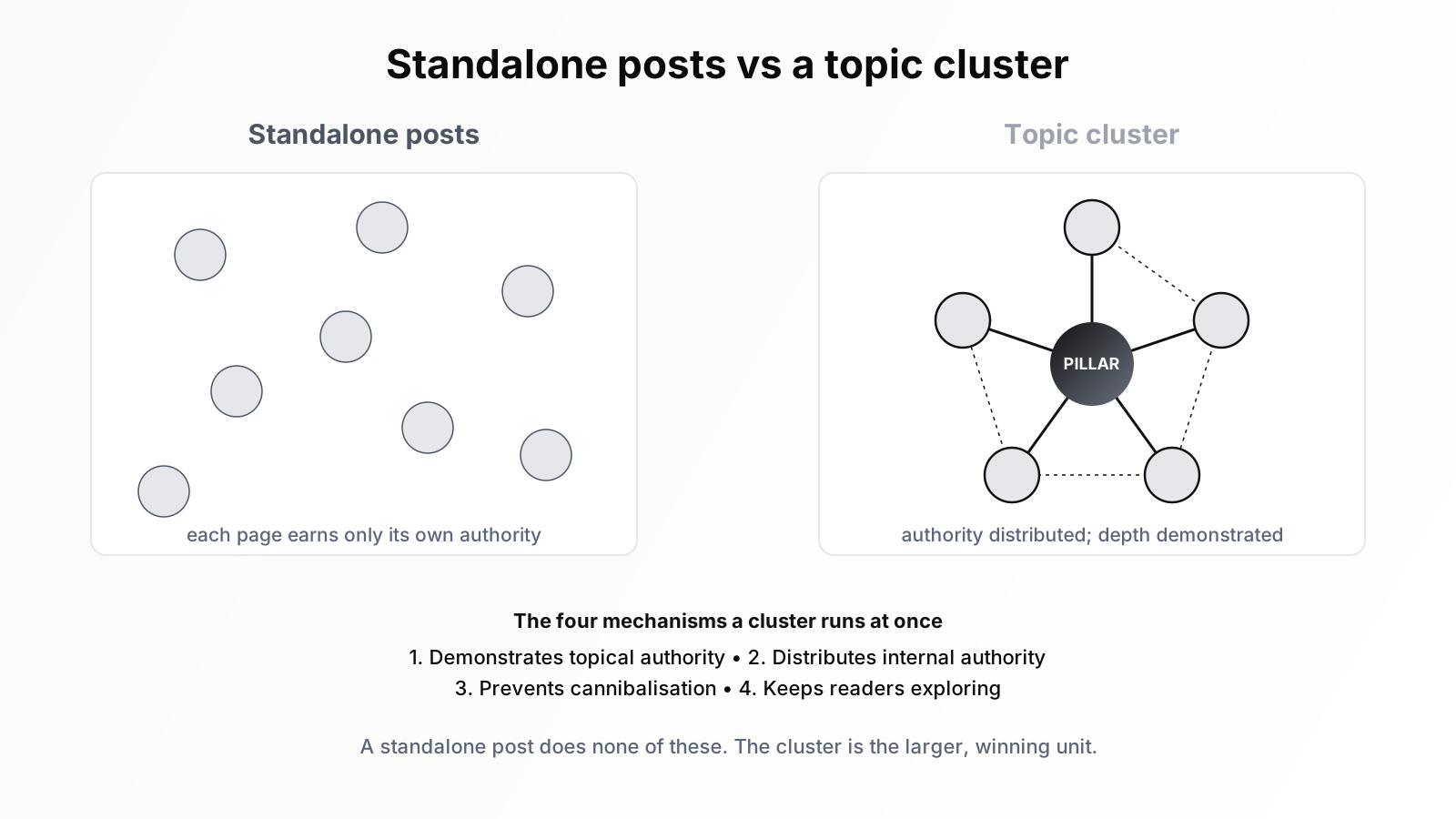
A topic cluster is a deliberately structured group of articles on one broad subject. It has a pillar page covering the whole subject broadly, and a set of cluster pages each covering one sub-topic in depth, with internal links binding the pillar to every cluster page and every cluster page back to the pillar. The unit of a cluster is not the article. It is the cluster.
That last sentence is the whole analysis in miniature. Standalone publishing optimises one article at a time. Cluster publishing optimises a structure. Everything that follows is a consequence of that difference in unit.
Mechanism one: clusters demonstrate topical authority
The first mechanism is the most important, so we will spend the most time on it.
Search engines do not only ask "is this individual page good?" They also ask, in effect, "does this site know this subject?" A site that has demonstrably deep, broad coverage of a topic is treated as more trustworthy on that topic — and its pages, all of them, rank more easily for queries within it. This is topical authority, and it is earned at the level of the subject, not the page.
Here is why structure determines whether you earn it. Ten standalone posts loosely about a subject look, to a search engine, like ten loosely related pages — there is no signal that says "these belong together and collectively cover this subject in depth." Ten articles arranged into a cluster, with a pillar and a dense internal linking pattern, send exactly that signal, unmistakably: a hub covering the whole subject, spokes covering every part, all interconnected. The structure is the evidence of depth.
And the payoff is shared. When a cluster establishes topical authority, that authority lifts every page in the cluster, not just the pillar. A standalone post earns only whatever authority it can generate alone. A cluster page inherits the authority of the entire cluster around it. That is the difference between each article carrying its own weight and each article being carried by the structure it sits in. For the full picture of how this works, our topic clusters guide covers the structure end to end.
Mechanism two: internal links distribute authority efficiently
The second mechanism is about how authority moves around your site.
Internal links pass authority between pages. A page that receives many internal links from relevant pages is treated as more important than a page that receives few. This is true on any site — but a flat blog of standalone posts barely uses it, because standalone posts, written in isolation, tend to link sparingly and somewhat randomly, if at all. The authority that exists on the site sloshes around without direction.
A cluster turns internal linking from an afterthought into a designed system. Every cluster page links to the pillar, so the pillar accumulates authority from the whole cluster and becomes strong enough to compete for the broad head term. Cluster pages link to each other where relevant, so authority circulates among related pages instead of pooling uselessly. The structure routes authority deliberately to where it does the most good.
The analytical point: a flat blog has internal authority but wastes it. A cluster has the same internal authority and directs it. Same raw material, vastly different efficiency — and efficiency, compounded across dozens of pages, becomes a large gap. Our internal linking strategy guide details the routing patterns.
Mechanism three: clusters avoid the cannibalisation that flat blogs invite
The third mechanism is about a problem clusters prevent — a problem flat blogs actively create.
When you publish standalone posts over months or years with no overarching structure, you have no map of what you have already covered. The natural, almost inevitable result is overlap: two or three posts, written at different times by people who did not consult a plan, all targeting roughly the same query. This is keyword cannibalisation. When it happens, your own pages compete with each other, search engines cannot tell which to rank, and all of the competing pages are weakened. A flat blog does not just permit cannibalisation — it manufactures it, because there is no structure preventing two articles from claiming the same ground.
A cluster is, by construction, a defence against this. Building a cluster starts with mapping the subject into distinct, non-overlapping sub-topics, and assigning exactly one page to each. The structure makes the question "do we already have a page for this?" answerable at a glance, because the cluster is the map. One sub-topic, one page, on purpose. Cannibalisation cannot easily creep in, because the structure is designed to keep every page on its own ground.
So one team spends part of its year fighting itself — its pages competing, its rankings split — and never quite realises that is what is happening. The other team's structure quietly prevents the whole problem. That is not a small edge. It is the difference between your effort accumulating and your effort partially cancelling itself out.
Mechanism four: clusters serve readers better, and reader behaviour feeds back
The fourth mechanism connects content structure to human behaviour, and human behaviour back to rankings.
Consider a reader who arrives on a standalone post, gets their answer, and finds — at the end — nothing. No obvious next step, no related depth, no path onward. They leave. The post did its job for one query and the visit ends there.
Now consider a reader who arrives on a cluster page. They get their answer, and they also find a link up to the pillar for the broader picture and links across to sibling pages on related sub-topics. If they have more questions — and engaged readers usually do — the cluster gives them somewhere to go. They read a second page. Maybe a third. The cluster keeps them.
This matters beyond pure courtesy. A reader who explores several pages is a reader who is genuinely served, and the behavioural signals that exploration produces — deeper engagement, longer sessions, more pages per visit — are signals search engines can observe and that correlate with content people find valuable. A cluster, by giving readers a coherent journey rather than a dead end, tends to generate healthier engagement. And that healthier engagement feeds back into how the pages perform. The structure serves readers, and serving readers is itself rewarded.
Putting the four mechanisms together
Now combine them, because the real argument is cumulative. A topic cluster, versus a pile of standalone posts, does four things at once: it demonstrates topical authority that lifts every page in it; it routes internal authority deliberately instead of wasting it; it prevents the self-competition that flat blogs breed; and it gives readers a journey that produces healthier engagement signals.
No single one of these is a knockout. Together, compounding across dozens of pages and many months, they are decisive. This is why the two teams from the opening end the year so far apart. It was never about who wrote better articles. It was that one team's articles were each fighting alone while the other team's articles were each backed by a structure doing four kinds of work on their behalf.
The honest limits of the cluster advantage
Analysis demands honesty about where the advantage stops, so a few caveats.
A cluster does not rescue weak content. The four mechanisms amplify articles that are genuinely good; they do nothing for articles that are thin. Structure is a multiplier on substance, not a replacement for it.
A cluster is more work to plan. Standalone publishing lets you write whatever you fancy this week. Cluster publishing requires up-front mapping and ongoing structural discipline. The advantage is real, but it is not free.
And a half-built cluster underdelivers. A pillar with no spokes, or spokes with no links back to the pillar, captures only a fraction of the four mechanisms. The advantage is in the complete structure; a structure left unfinished leaves most of the benefit on the table.
When a standalone post is still the right call
An honest analysis should also identify where the standalone post wins, because it is not always wrong — and treating "everything must be a cluster" as dogma leads to its own mistakes.
A standalone post is the right unit when the topic is genuinely isolated — a subject that has no natural neighbours, that does not branch into sub-topics, and that no realistic cluster would contain. Some topics are simply singletons. Forcing a singleton into a cluster means inventing artificial siblings for it, and artificial siblings are thin pages that drag the whole structure down.
A standalone post is also the right unit for genuinely time-bound content — a response to a news event, an announcement, a reaction piece. That content's value is in its timing, not in its structural depth, and wiring it into a cluster is effort spent on a page whose relevance expires anyway.
The point of the cluster argument is not that every page must belong to a cluster. It is that your core subjects — the topics you actually want to rank for, the topics your buyers care about — should be covered as clusters rather than as scattered posts. Around that structured core, a handful of standalone posts for singletons and timely pieces is perfectly fine. The mistake the analysis targets is not the occasional standalone post. It is a whole blog that is nothing but standalone posts, with no structured core at all.
How the gap widens over time
One more analytical point, because it explains why the two teams from the opening end so far apart specifically over a long horizon.
In the first month or two, the cluster team and the standalone team look similar. The cluster team is, in fact, slightly behind — it spent time on mapping and structure that the standalone team spent on simply publishing. If you measured at week eight, you might conclude clusters were not worth it.
But the four mechanisms are compounding effects, not one-time boosts. Topical authority accumulates as the cluster fills out. Internal authority concentrates more on the pillar with every spoke added. The cannibalisation that the standalone team is unknowingly breeding gets worse, post by post, as their unmapped blog grows. And the reader-retention advantage scales with the number of interlinked pages available to explore. Every one of these effects strengthens with time and size. So the gap does not open at a constant rate — it widens at an increasing rate. The standalone team's blog gets harder to manage as it grows; the cluster team's blog gets stronger as it grows. That diverging trajectory, not any single month's snapshot, is the real case for clusters.
The verdict
The analysis resolves cleanly. Topic clusters beat standalone posts not because of any single dramatic factor, but because a cluster is a structure that does four distinct kinds of work — authority demonstration, authority distribution, cannibalisation prevention, and reader retention — while a standalone post does none of them. The standalone post is the smaller unit, optimising one article. The cluster is the larger unit, optimising a system. The larger, well-designed unit wins, and it wins by more the longer the comparison runs.
Where an AI agent fits
Understanding why clusters win is straightforward. Building and maintaining them is not — it is sustained structural work. You have to map subjects into non-overlapping sub-topics, plan pillars and spokes, write each page to its role, wire the internal links in both directions, watch for cannibalisation as the site grows, and keep pillars in sync as spokes are added. The advantage is in the complete, maintained structure, and completing and maintaining structure is exactly where teams run out of energy.
This is structural, ongoing work, which is what an SEO AI agent is designed to carry. Orova can map a subject into a cluster, plan the pillar and spokes, draft the pages to their roles, propose the full two-way internal linking, flag emerging cannibalisation, and keep the structure synchronised as it grows — so the cluster advantage you understand in theory actually gets built and maintained in practice. The four mechanisms only pay out if the structure is real and kept whole.
Stop thinking of your blog as a list of articles. Start thinking of it as a set of structures. The team that wins a subject is not the team that wrote the most posts or even the best posts — it is the team whose posts were arranged into clusters doing four kinds of work at once. Structure is not decoration on top of content. Structure is content's force multiplier.
Run your business with AI Agents
Orova is the always-on Biz AI Agent — it plans, runs, and optimizes the work for you. Save time, unlock productivity.
Try it free