
"AI Overviews Killed SEO" Is the Laziest Take of 2026
Every few years the same obituary gets republished with a new cause of death. SEO was killed by Florida in 2003, by Panda in 2011, by mobile in 2014, by voice search in 2017 — remember when half the industry's conference slots were devoted to a future where nobody typed? — by zero-click SERPs in 2019, and by ChatGPT in 2023. The corpse has now been pronounced dead again, this time by AI Overviews, and the eulogy is everywhere: LinkedIn carousels, agency pitch decks, panicked board memos, and a thousand thinkpieces with titles like the one this article is wearing ironically.
I want to take the take seriously enough to dismantle it properly, because it is not entirely wrong — it is something worse: half right in a way that licenses exactly the wrong responses. "AI Overviews killed SEO" is what a real, specific, manageable change sounds like after it has been compressed for engagement. The compression is the laziness. So let us decompress it: what the doomers get right, where the logic falls apart, who benefits from the funeral, and what the people quietly winning right now are doing while everyone else argues about the death certificate.
Did AI Overviews kill SEO? No. They redistributed clicks — informational queries lose many, commercial and branded queries far fewer — while making organic strength a prerequisite for citation, since most cited sources already rank in the top results. Search demand didn't disappear; the work shifted toward earning citations and the clicks that still convert.
First, concede what's true — because the doomers aren't hallucinating
A critique that pretends nothing changed is as lazy as the take it attacks, so let's put the real losses on the table without flinching.
Click-through rates on informational queries have genuinely fallen where overviews appear — not by rounding-error amounts, but enough to bend traffic charts that had grown for a decade. Multiple independent datasets, ours included, show the same signature: impressions steady or rising, clicks sagging, the gap being eaten by an answer the searcher reads instead of clicking. We documented the pattern in detail in AI Overviews are eating your clicks, and nothing since has reversed it. Publishers whose business was monetizing informational pageviews — ad-supported recipe sites, definition farms, "what time does the game start" journalism — are not being dramatic when they report real damage. The traffic those pages lived on is structurally diminished, and no amount of optimization brings back a click whose entire purpose was answered in two sentences above the links.
Also true: measurement got murkier exactly when stakes got higher. Google folds overview impressions into regular Search Console data with no separate dimension, so the industry is diagnosing its most significant change in years through frosted glass. And the psychological observation underneath the doom is fair too — a generation of marketers built careers on a stable contract (rank, get clicked, attribute revenue) and that contract has been unilaterally rewritten. The grief is real. The analysis built on the grief is where things go wrong.
A short autopsy of SEO's previous deaths
Before dissecting the current obituary, it pays to read the old ones, because the genre has rules and they repeat with embarrassing fidelity. Each death announcement follows the same arc: a real platform shift produces real losses for a visible cohort; the losses get generalized from that cohort to the entire discipline; a transition period of murky measurement lets the generalization survive contact with reality longer than it should; and then, two or three years later, everyone quietly observes that the discipline is larger than ever, reshaped around whatever the shift actually rewarded.
Run the pattern against history. The mobile transition genuinely destroyed desktop-only experiences — and generalized into "apps will replace search" predictions that look comic in hindsight, while mobile search volume went on to dwarf desktop. Voice search was going to make screens obsolete by 2020; the cohort that pivoted entire strategies to "position zero for smart speakers" burned budgets on a behavior change that never arrived at scale, while the boring work of structured answers turned out to matter for entirely different reasons. Featured snippets and the zero-click panic of 2019 are the closest dress rehearsal for today: the same impressions-up-clicks-down charts, the same publisher anguish, the same "Google keeps everything now" framing — followed by a multi-year period in which the sites that optimized for snippet presence built measurable brand advantages while the sites that retreated lost both clicks and presence.
Two lessons from the genre's history apply directly. First, the cohort suffering most visibly is never a random sample — it is always the businesses most exposed to the specific thing that changed, and reasoning from their experience to yours requires checking whether you share the exposure, not sharing their mood. Ad-monetized informational publishers are today's most-exposed cohort; if you sell software or services, your exposure profile is structurally different in exactly the ways the intent data shows. Second, every previous "death" transferred value from late adapters to early ones rather than destroying it. The pattern is consistent enough that the rational response to an SEO obituary is not grief or denial — it is to ask, as quickly as possible, what is the new selection criterion, and who is being slow about it?
The four logical failures inside the lazy take
Failure one: "fewer clicks" became "zero value"
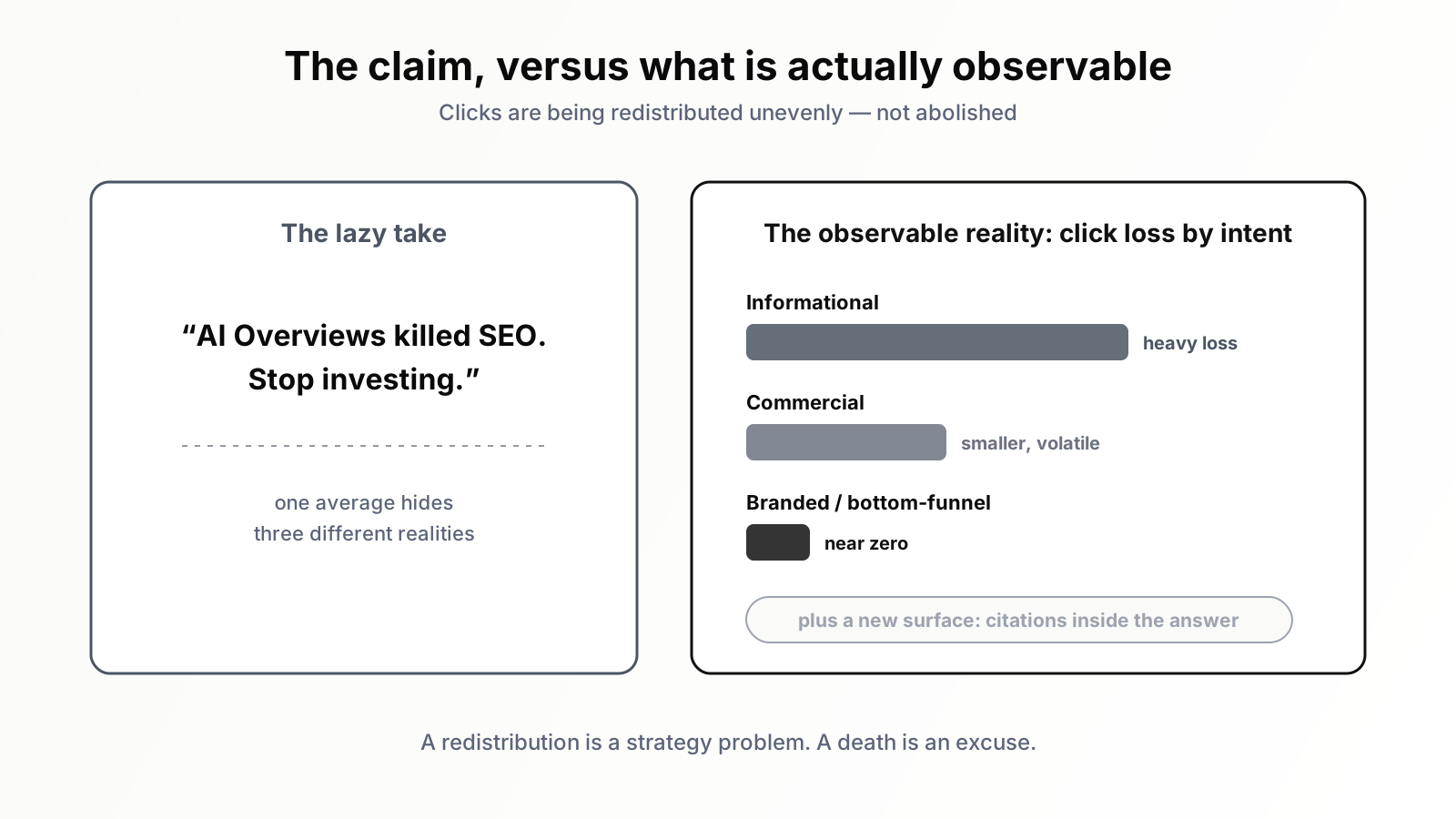
The doom argument needs every lost click to equal lost business, and that only works if you never segment. Do the unfashionable thing and split queries by intent, and the apocalypse becomes a redistribution. The informational top of the funnel — always the highest-volume, lowest-converting layer — is where the click losses concentrate. Commercial-investigation queries lose meaningfully less, branded and transactional queries barely move, and the clicks that survive an overview are demonstrably warmer: someone who read a synthesized answer and still clicked through wants depth, which is why several teams (ours among them) see conversion rates per session rising on pages that lost raw traffic. Averaging an annexed top-of-funnel with a stable bottom into one scary trendline is how you get a funeral announcement out of a reallocation — the precise confusion we unpacked in zero-click search doesn't mean zero value. If your dashboard can't distinguish a lost skim from a lost buyer, your dashboard is writing the obituary, not the market.
Failure two: the value of being the answer is priced at zero
The lazy take counts the click that didn't happen and ignores what happened instead: the searcher read an answer, and that answer had sources. Being the source cited in the overview — having your framing, your numbers, your name inside the synthesized answer for the questions that define your category — is treated as worthless because it doesn't fire an analytics event. By that accounting, a hundred years of brand advertising never happened, since billboards don't get clicked either. Citation presence builds the slow assets — recognition, authority, branded search — that the same doomers will happily celebrate when the channel is a podcast appearance instead of an AI answer. The visibility didn't vanish. It moved up the page and changed format, and the refusal to value anything that isn't a session is an analytics limitation cosplaying as market analysis.
Failure three: if SEO were dead, citations would be random — they're not
Here is the part of the lazy take that collapses fastest under contact with data. If AI Overviews had actually replaced the ranking ecosystem, the sources they cite would be disconnected from organic performance. Instead, every credible analysis — industry-wide studies and our own 300-query audit alike — finds the overwhelming majority of citations going to pages that already rank in the top organic results for the query or its siblings. The machine that decides retrieval eligibility is the machine SEO has always fed. Declaring SEO dead because of AI Overviews is declaring the qualifying rounds irrelevant because someone added a final. The final made the qualifiers more important, not less: now ranking is the cost of entry to a second competition — passage selection — that most of your competitors haven't realized is happening. "Dead" is a strange word for a discipline that just became a prerequisite.
Failure four: the conclusion doesn't follow even from the premises
Grant the doomer every premise — clicks down, measurement broken, Google self-dealing. The conclusion "therefore stop investing in organic search" still doesn't follow, because the question was never whether the channel got harder; it's what the alternative is. Search demand did not evaporate — people ask more questions of more engines than ever. Your buyers are still typing their problems into boxes; the boxes just answer back now. Abandoning the surface where that happens doesn't reallocate your visibility, it donates it — every query you retreat from gets answered anyway, sourced from whoever stayed. Paid acquisition costs keep climbing, social reach is rented and algorithmically fickle, and the one channel where authority compounds is the one being declared dead. The lazy take, followed to its practical end, is a recommendation to exit the only compounding channel right before its consolidation phase — which brings us to who is making that recommendation.
The funeral has sponsors
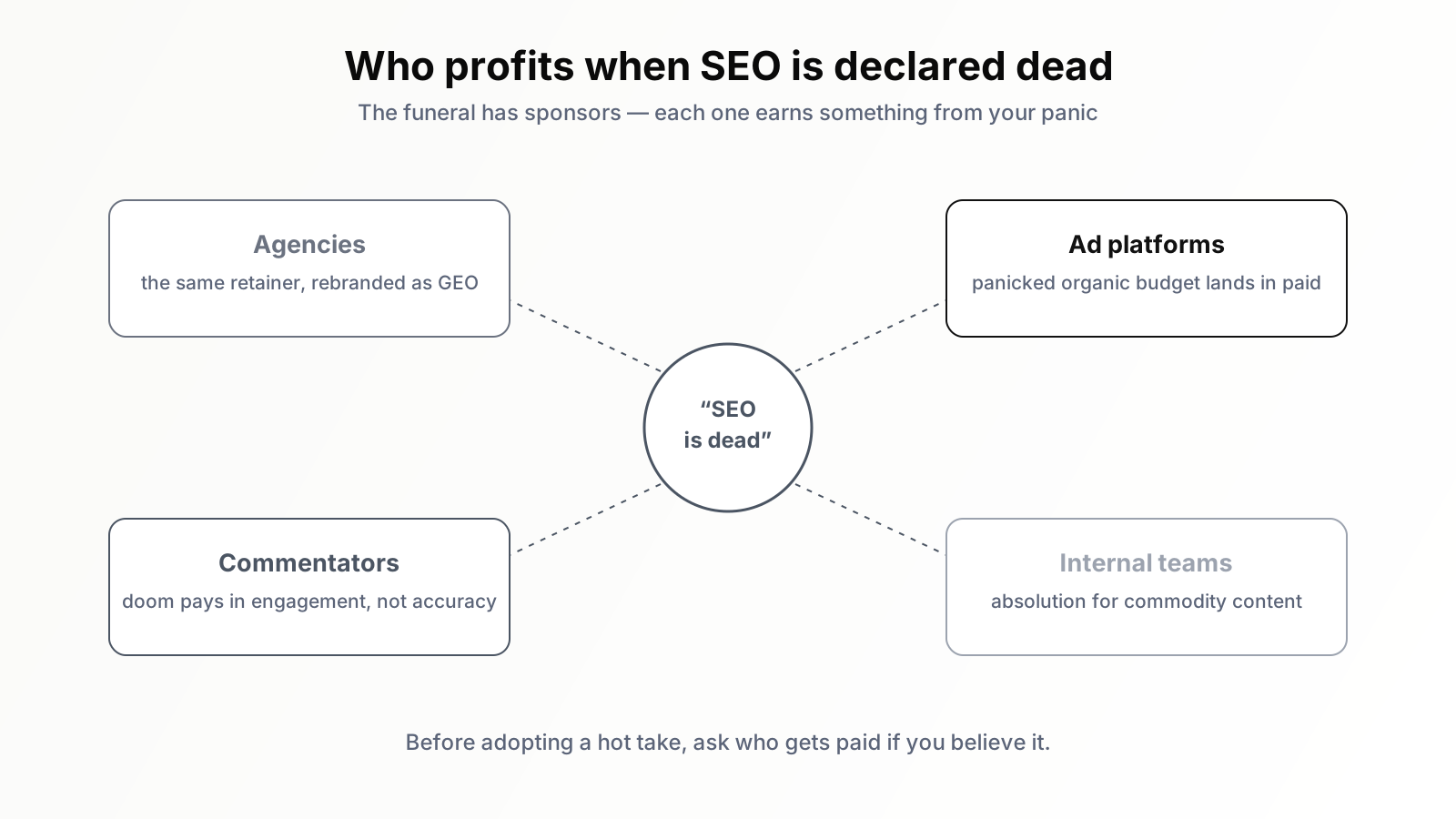
Be appropriately cynical about where the loudest obituaries come from, because "SEO is dead" is one of the most reliably monetizable sentences in marketing. Agencies selling rebranded "AEO/GEO packages" need the old discipline dead so the new acronym looks like a different purchase — we took that rebranding apart in our piece on answer engine optimization, and the short version is that the work inside the new package is mostly the work inside the old one. Ad platforms benefit when organic confidence collapses, because panicked budgets flow to guaranteed placements. Newsletter prophets get engagement from apocalypse that nuance never delivers. And inside companies, "the channel died" is a far more comfortable post-mortem than "our content was summarizable commodity and the synthesis layer called our bluff." None of this means every pessimist is selling something. It means the take's popularity is not evidence of its accuracy, and the incentives all point one direction.
That last internal version deserves one more sentence, because it is the take's most corrosive function: it grants absolution. A decade of content strategies built on paraphrasing the top result — adding nothing, measuring nothing, publishing volume — was always vulnerable to the first system that could summarize. AI Overviews didn't kill that content's value; they revealed it was already near zero by making the redundancy machine-visible. The obituary lets that strategy die a hero. It wasn't one.
What the non-lazy version of the take would say
There is a defensible, rigorous version of the pessimist position, and it deserves to be stated better than its proponents state it: the informational-content business model is structurally impaired; visibility is bifurcating into citations you can't fully measure and clicks that concentrate lower in the funnel; Google's incentives now conflict with publishers' more directly than ever; and the skills mix of the average SEO team is misaligned with where selection now happens. Every clause of that is true, and none of it amounts to death — it amounts to a harder, more concentrated, more interesting discipline. The honest framing is a consolidation: the work still pays, but it pays fewer, better operators — the ones who treat passages as the competitive unit, put original data where summaries can't follow, value citations like the brand surface they are, and measure by intent band instead of by aggregate. That is not a eulogy. That is a job description.
And the historical pattern says consolidations reward early movers brutally well. The mobile "apocalypse" minted the teams that rebuilt for it first; the featured-snippet era handed years of outsized visibility to whoever restructured content before the guides existed. The current moment has the same shape: selection criteria are visible, most of the market is either grieving or rebranding, and the actual playbook — laid out in our complete guide to ranking in AI Overviews — is being executed by a minority. Lazy takes create arbitrage for whoever ignores them. They always have.
The boardroom version, and how to answer it
The lazy take does its worst damage not on LinkedIn but in budget meetings, where it arrives compressed even further: "I read that AI killed SEO — why are we still funding this?" Anyone defending an organic program in 2026 needs a better answer than indignation, so here is the three-part version that has actually worked, in rooms where it mattered.
First, reframe the asset. The company does not own "traffic"; it owns the answers to a set of questions that buyers in its category ask. Those questions are now answered in two places — classic results and synthesized overviews — and the same underlying investment feeds both, because the overviews demonstrably cite from what already ranks. Defunding the program doesn't avoid the AI shift; it forfeits both surfaces simultaneously, including the one the board is worried about.
Second, show segmented numbers, not aggregates. One slide: clicks and conversions by intent band, with the informational losses isolated and the commercial layer shown holding. A second slide: which category-defining questions currently produce overviews, and whose names appear in them. Nothing disciplines a "channel is dead" conversation faster than the competitor's name inside the answer to "best tool for X." The fear flips polarity in real time — from "why fund a dying channel" to "why are they in the answers and we are not."
Third, price the alternative honestly. The informational clicks that were lost were the cheapest, least convertible visits the company received; replacing the visibility they represented with paid impressions at current auction prices costs a multiple of the content budget — recurring, forever, with nothing owned at the end. Compounding versus renting is an argument boards understand natively. The obituary survives in rooms where nobody segments and nobody prices the counterfactual; it rarely survives both.
The Monday-morning test
A take is only as good as the actions it produces, so here is the cleanest way to expose the laziness: ask what "AI Overviews killed SEO" tells you to do on Monday morning. The honest answer is nothing — or worse than nothing. It tells you to stop publishing (donating your query surface to whoever keeps showing up), to slash the content team (destroying the capacity you'll need when leadership notices competitors inside the answers), or to "pivot to brand" in some unspecified way that usually means buying the reach you used to earn. Doom is not a strategy; it is the absence of one wearing a confident expression.
Now run the same test on the redistribution framing, and a concrete Monday materializes immediately. Pull your queries from Search Console and tag them by intent band, because the bands are living under different regimes and aggregate numbers are lying to you. Check your top fifty queries for overview presence and note who gets cited — twenty minutes that tells you more about your actual exposure than a quarter of thinkpieces. Find the pages ranking top ten on overview-bearing queries without a citation, and restructure their key sections answer-first; in every dataset we have seen, that is the cheapest visibility recovery available right now. Identify the three questions in your category where being the cited source would matter commercially, and put something on those pages no summary can replicate — your data, your tests, your measured numbers. Then set up the before-and-after sampling so you learn from your own moves instead of from LinkedIn. None of this is heroic. All of it beats attending a funeral.
The test generalizes, and it is worth installing permanently: any analysis of the AI search shift that cannot survive the question "and therefore I should do what, specifically?" is content about the change, not thinking about it. The discourse is full of weather reports. What pays is agriculture.
Stop attending the funeral
So no — AI Overviews did not kill SEO. They killed the assumption that a ranking is the same thing as a click, they killed the business of summarizing other people's knowledge, and they killed the comfort of measuring everything that matters in one column. What remains is the actual discipline: understanding what people ask, being the most trustworthy source of the answer, and proving it in a form machines can verify and humans can act on. That discipline is currently underpriced precisely because the obituary is so popular, and it rewards exactly the unglamorous loop — audit, restructure, add original substance, measure by intent, repeat — that engagement-bait can't be bothered with.
The loop is also, frankly, a grind at scale, which is the honest reason many teams reach for the funeral instead — and the layer where an agent like Orova earns its keep, running the per-query auditing, passage restructuring, and intent-segmented measurement continuously so the humans can spend their hours on the one thing no machine supplies: knowing something worth citing. The market will sort itself the way it always does after a death announcement. The people who left will explain why leaving was wise. The people who stayed will own the answers.
Run your business with AI Agents
Orova is the always-on Biz AI Agent — it plans, runs, and optimizes the work for you. Save time, unlock productivity.
Try it free