
AI Overviews Are Eating Your Clicks — Now What?
Open Google for almost any informational query today and the first thing you see is not a list of ten blue links. It is a block of generated text — an AI Overview — that answers the question before you have scrolled an inch. The links are still there, pushed down, smaller, optional. For a great many searches, the user reads the summary, gets what they came for, and never clicks anything at all.
If you run a blog, this is not a neutral product update. It is a direct change to the deal SEO has operated on for two decades. The implicit contract was simple: rank well, earn the click, get the visitor. AI Overviews quietly rewrote that contract, and a lot of content teams are still behaving as though the old terms apply. This article is a critical look at what actually changed, what the panicked reactions get wrong, and what a clear-eyed response looks like.
What AI Overviews actually do to your traffic
Let us be precise about the mechanism, because vague dread is not a strategy. An AI Overview sits at the top of the results page and synthesises an answer from multiple sources. It does three things at once, and only one of them is good for you.
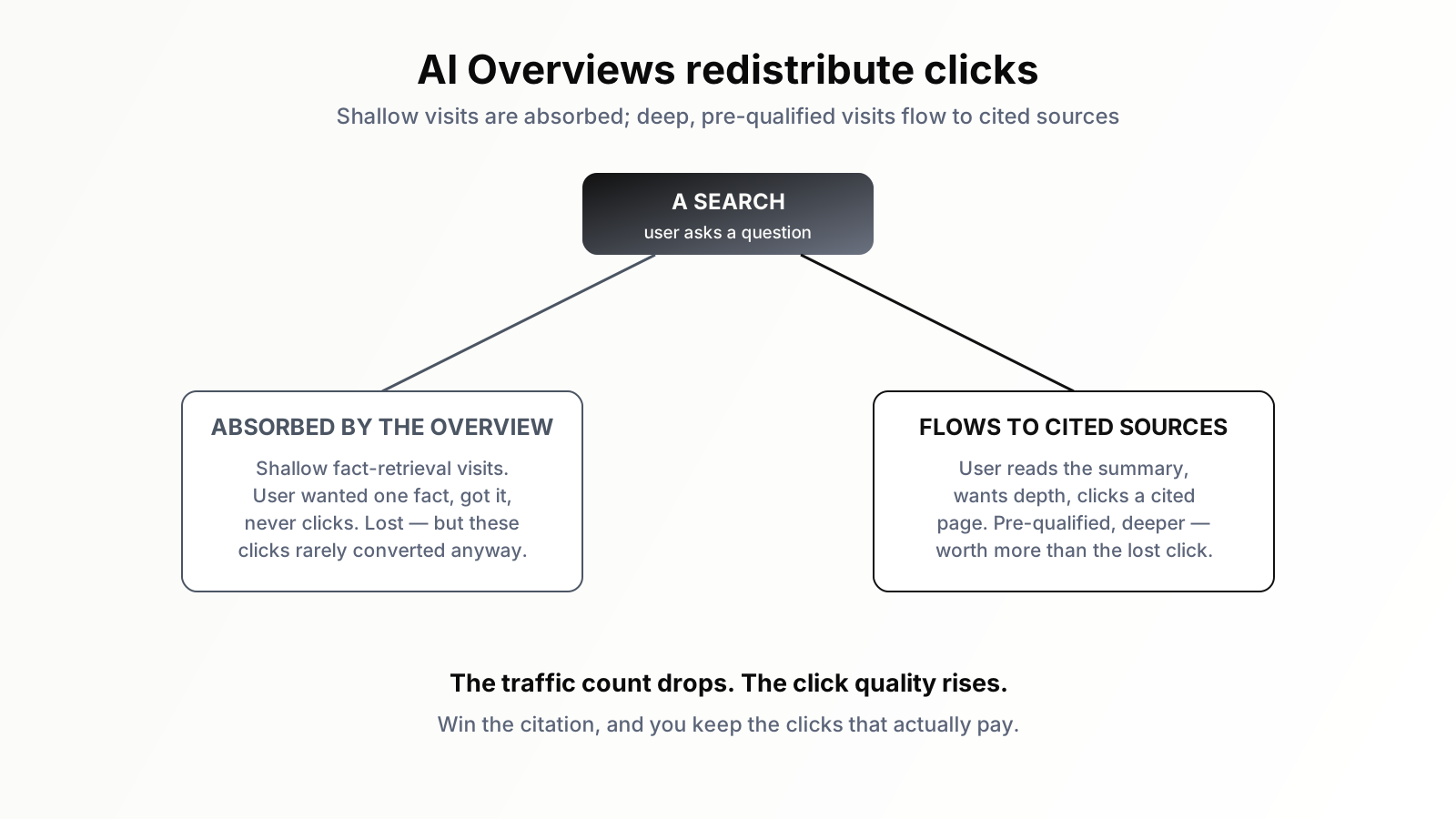
First, it satisfies the query directly. For a searcher who wanted a quick fact — a definition, a date, a simple how-to step — the Overview ends the journey. There is no reason to click, so they do not. That is the click you lost.
Second, it occupies the space your snippet used to own. Even when a user does eventually scroll to the organic results, your listing is now below a large block of content that was not there before. Lower placement, in practice, means lower click-through, even when your ranking position number has not moved at all.
Third — and this is the part the doom narrative skips — the Overview cites sources. It links to the pages it drew from. A user who reads the summary and wants more depth, or wants to verify a claim, or wants to see who said it, can click straight through to a cited page. That click did not exist before either. It is new, and it is worth more than the click you lost, because the person taking it has already been pre-qualified by the summary.
So the honest picture is not "AI Overviews destroy traffic." It is "AI Overviews redistribute traffic" — away from shallow, fact-retrieval clicks, and toward deeper, intent-rich clicks for the pages that get cited. Whether that redistribution helps or hurts you depends entirely on which kind of content you publish.
The reaction that gets it wrong
The most common response in content teams right now is some flavour of paralysis dressed up as prudence. "SEO is dying, so why invest?" "Google is stealing our content, so let us complain about it." "Let us wait and see how this settles before we change anything."
Every one of those reactions is a mistake, and it is worth saying why bluntly.
"SEO is dying" is wrong because search did not go anywhere. People still have questions, they still type them into Google, and Google still routes a significant share of them to web pages — both through the organic links and through the Overview's citations. The channel changed shape. It did not close.
"Google is stealing our content" is emotionally satisfying and strategically useless. Whatever you think of the fairness of it, Google is not going to remove AI Overviews because a blogger is annoyed. Building your plan around an outcome you cannot influence is not a plan; it is a grievance. The energy spent being aggrieved is energy not spent adapting.
"Wait and see" is the most dangerous of the three because it sounds responsible. It is not. While you wait, the competitors who adapt now are accumulating the citations, the structured content, and the topical authority that the new system rewards. "See how it settles" assumes a calm endpoint that may never arrive — and assumes you can catch up instantly once it does, which you cannot. The teams that win the AI Overview era are the ones who started adapting while it was still uncomfortable and unclear.
What the panic misses: the clicks you lost were the cheap ones
Here is the uncomfortable reframe. Sort your historical traffic by what each visit was actually worth, and a pattern appears. A large share of informational search traffic was always low-value: someone wanted a single fact, landed on your page, grabbed it, and left in nine seconds. They did not read your argument. They did not see your product. They did not subscribe. They were never going to.
That visitor showed up beautifully in your traffic chart and contributed almost nothing to your business. AI Overviews are, to a large extent, absorbing exactly that visitor — the one who wanted a fact, not a relationship. If your traffic graph is down but your conversions are flat, that is the signal: you lost volume that was never converting anyway.
This does not make the loss painless. If your business model was built on raw pageviews — programmatic ad revenue, for instance — then losing low-value clicks still costs real money, and pretending otherwise would be dishonest. But if your blog exists to support a product, a service, a SaaS, then the loss is far less severe than the headline number suggests, because the clicks that drive revenue are the deep ones, and the deep ones are exactly the clicks AI Overviews route to cited sources.
The content that loses, and the content that wins
If you accept that the question is "which content gets redistributed away from you, and which gets redistributed toward you," then the strategic priorities become concrete.
The content that loses is thin, generic, and easily summarised. A 600-word page that defines a term, lists five obvious tips, and offers no original thought is, functionally, a worse version of what the AI Overview now produces instantly. It was always commodity content; the Overview just made the commodity free and instant. Pages like that will quietly lose their clicks, and no amount of complaining will bring them back.
The content that wins has at least one quality the Overview cannot replicate. Original data the model has to cite because it exists nowhere else. A genuine point of view — an argument, a contrarian take, a hard-won opinion — that a summary flattens and therefore makes a reader want the full version of. Depth that genuinely cannot be compressed into three sentences without losing the thing that made it useful. Demonstrated experience: a real account of having done the thing, with the specific details that signal a human was actually there.
Notice that this is not a new content philosophy invented to survive AI Overviews. It is the same advice good SEO writers have given for years — be original, be deep, be genuinely useful. What changed is the penalty for ignoring it. Before, mediocre content underperformed. Now, mediocre content gets eaten. The Overview did not change what good content is. It changed how expensive it is to publish bad content.
Getting cited is the new ranking
The most important shift in mindset is this: in an AI Overview world, being cited by the summary is at least as valuable as ranking below it. The citation puts your brand name inside the answer the user reads first. It sends you a click from someone who has already been told your page is worth consulting. It is, in effect, a recommendation from Google embedded in the most prominent element on the page.
So a serious content team now has two goals where it used to have one. Rank in the organic results, yes — that still matters. But also, structure and write content so it is the kind of source an AID Overview pulls from and names. That second goal is the new discipline, and it is the subject of a fast-growing practice some are calling answer engine optimisation. We cover the structural side of that in our companion piece on answer engine optimisation, and the citation-earning tactics specifically in our guide to getting cited by ChatGPT, Gemini, and Perplexity.
What to actually do, this quarter
Enough diagnosis. Here is the concrete response, ordered by what to do first.
Audit your existing content honestly. For each significant page, ask one question: is this easily replaced by a three-sentence generated summary? If yes, that page is at risk, and you have two choices — deepen it until it is no longer commodity, or accept that it will fade and stop investing in it. Be ruthless. The audit is uncomfortable precisely because it is useful.
Shift your new-content brief. Every new article should be required to contain something an Overview cannot generate: a piece of original data, a clear argument, a specific lived example, a genuine recommendation. If a draft contains none of those, it is commodity content, and commodity content is no longer worth publishing.
Build for citation, not just ranking. Answer the core question clearly and early in the page, so a model can extract it. Use clean structure — descriptive headings, direct definitions, well-formed lists — so the page is easy for an answer engine to parse and quote. Make your original contributions explicit and quotable rather than buried.
Change what you measure. Pure organic sessions is now a partly misleading metric, because it conflates the cheap clicks you are losing with the valuable clicks you are keeping. Track conversions from organic, track branded search growth, and — where your tools allow — track citations and referral traffic from AI surfaces. Measure the thing that pays, not the thing that flatters.
The opportunity hiding inside the threat
It is worth ending on the part the doom narrative refuses to see. AI Overviews are brutal to mediocre content — and that is good news for anyone willing to be better than mediocre.
For years, the web has been flooded with thin, derivative, search-engine-bait articles, and they cluttered the results and stole clicks from genuinely good pages through sheer volume. AI Overviews are, in effect, a filter. They make commodity content worthless, which removes the incentive to mass-produce it, which clears space. The teams that respond by publishing original, deep, genuinely useful content are not fighting a losing battle against AI Overviews. They are being actively selected for by them.
The threat and the opportunity are the same event seen from two angles. If your content is thin, AI Overviews are eating your clicks and you should be worried. If your content is excellent — or you are willing to make it excellent — AI Overviews are quietly removing your weakest competitors and handing you citations. Which story you live in is, to a degree that should be encouraging, up to you.
Where an AI agent fits
Adapting to AI Overviews is not conceptually hard — this whole article is the concept — but it is a lot of work. Auditing every page for "is this commodity," restructuring content so answer engines can parse it, rewriting briefs, tracking a new set of metrics across surfaces that do not report cleanly: that is sustained effort, and it competes with everything else a small team has to do.
This is the kind of structured, repetitive, judgement-plus-volume work an SEO AI agent is built for. Orova can audit a content library for commodity pages at risk from AI Overviews, flag where structure makes a page hard for an answer engine to cite, and help shape briefs around the original data, arguments, and experience that summaries cannot replicate. It does not change the strategy in this article — it just removes the fatigue that stops most teams from carrying it out. The AI Overview era rewards the content teams that adapt fastest, and adapting fast is exactly what an agent makes possible.
AI Overviews are eating your clicks. Some of those clicks were never worth much, and losing them is survivable. The clicks that are worth something now go to the pages that earn a citation — and earning citations is something you can start doing this quarter. The contract changed. The teams that read the new terms and adapt will be fine. The ones still arguing about the old terms will not.
Run your business with AI Agents
Orova is the always-on Biz AI Agent — it plans, runs, and optimizes the work for you. Save time, unlock productivity.
Try it free