
GSC Impressions but No Clicks? Diagnose the Real Cause
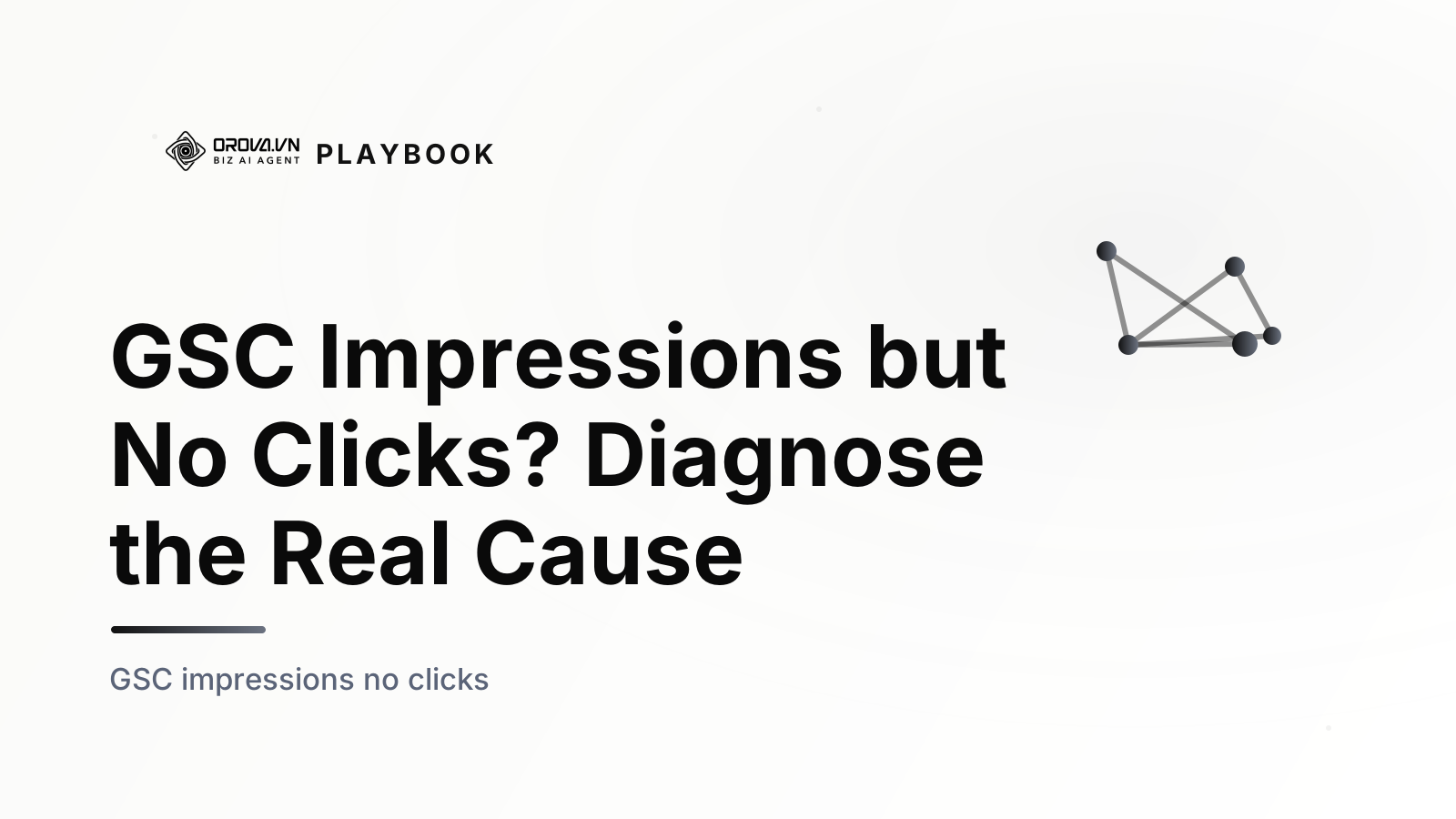
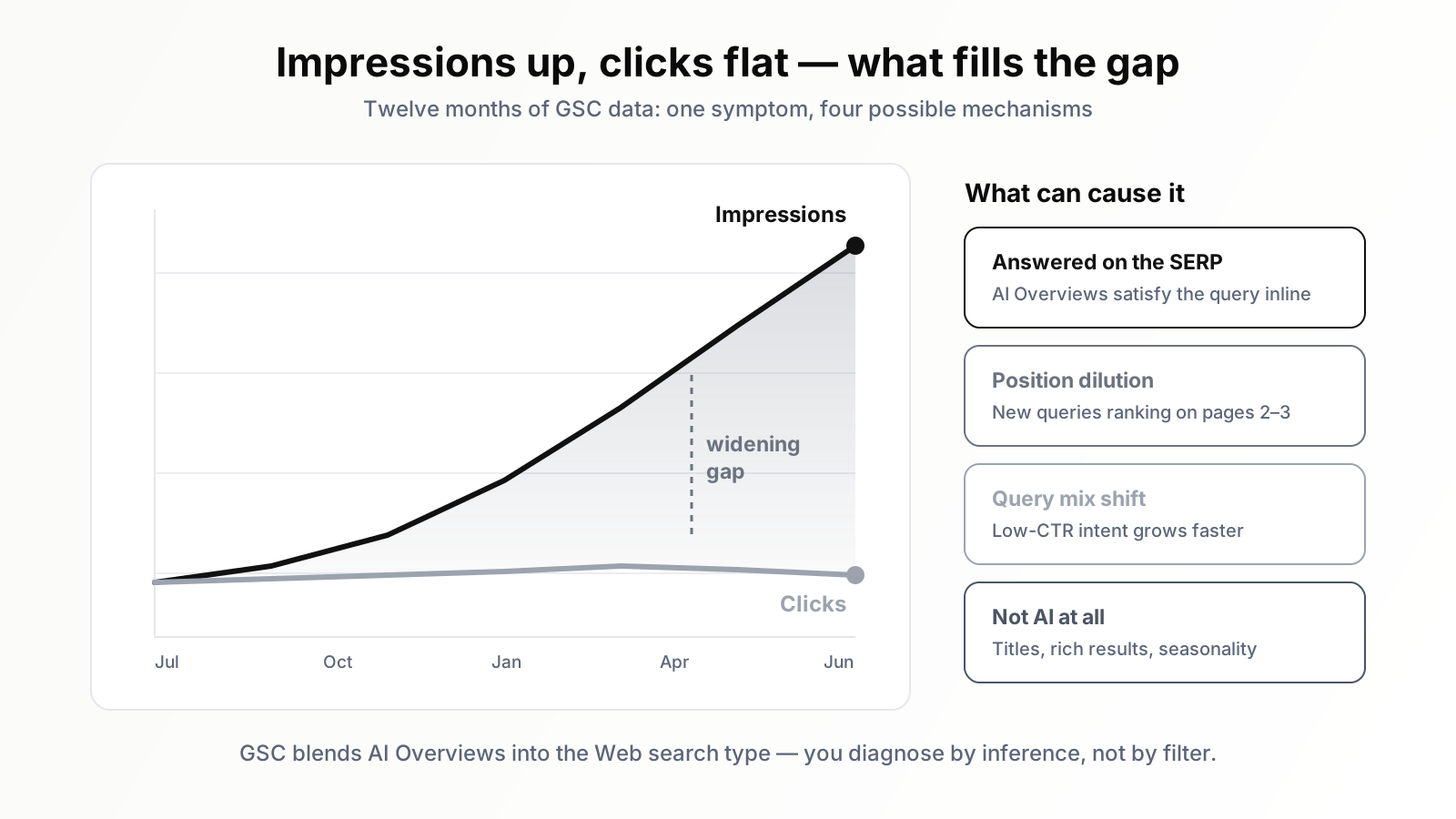
Open Google Search Console, set the date range to the last twelve months, and look at the performance chart. If your property is like most of the ones we have examined in 2026, you are looking at a specific and now-familiar shape: the impressions line climbs steadily, sometimes steeply, while the clicks line runs flat — or drifts gently downward — underneath it. The gap between the two lines widens month after month. Average CTR, which is just one line divided by the other, erodes accordingly.
This chart has become the defining diagnostic puzzle of modern SEO. It looks like failure, and it is routinely presented as failure — in agency reports, in board decks, in panicked Slack messages. But "impressions up, clicks flat" is not one phenomenon. It is the visible surface of at least four different underlying mechanisms, only some of which are bad news, and only one of which has anything to do with AI answering your queries for you. Treating them as a single problem leads to the wrong fixes: rewriting titles that were never the issue, abandoning content that is actually working, or blaming AI Overviews for what is really a query-mix shift.
This article is a diagnostic walkthrough. We are not going to set up GA4 channel groups, build a dashboard, or propose a grand framework for AI visibility — those are separate jobs. We are going to do one thing: read the GSC data properly, layer by layer, so that by the end you can say with reasonable confidence which mechanism is producing your particular flat clicks line, and what — if anything — you should do about it.
The short answer
The most common cause: your content is being shown more often — in AI Overviews, in lower positions, for newly matched queries — but searchers are increasingly answered on the results page itself, so impressions inflate while clicks do not follow. To diagnose your specific case, segment the data three ways: by position, by query type, and by branded versus non-branded — in that order.
First, an honest constraint: GSC will not tell you directly
Before any analysis, one technical fact has to be stated plainly, because a remarkable amount of advice on this topic quietly pretends otherwise: Google Search Console does not report AI Overviews as a separate search type or filter. Impressions and clicks from AI Overviews are folded into the "Web" search type, blended invisibly with classic blue-link results. There is no toggle, no dimension, no report that isolates them. When your page appears as a cited source inside an AI Overview, that counts as an impression; if someone clicks the citation, that counts as a click — and both land in the same bucket as everything else.
The consequence is uncomfortable but unavoidable: you cannot directly prove, from GSC data alone, that AI Overviews caused your flat clicks line. Anyone who claims to have read it straight off the GSC interface is overstating what the tool exposes. What you can do — and what the rest of this article is for — is build an indirect case through elimination and inference. You rule out the mathematical artifacts, you rule out the query-mix shifts, you rule out the non-AI technical causes, and then you examine whether the residual pattern is consistent with SERP features absorbing clicks. That kind of layered inference is legitimate analysis. A screenshot of a falling CTR line with "AI Overviews did this" written on it is not.
It is worth internalizing this constraint early, because it changes the posture of the whole exercise. You are not looking for a smoking gun. You are doing differential diagnosis: listing the conditions that produce this symptom, testing for each one, and seeing which survives. If you want the full background on how AI Overviews are assembled and when they appear, our complete guide to AI Overviews covers the mechanics; here we will take them as a known suspect and focus on the forensic work.
Layer 1: the mathematics of averages — is the growth itself diluting your CTR?
The first layer is the least dramatic and the most frequently missed: impressions growth can flatten your clicks-to-impressions ratio without anything going wrong at all, purely through arithmetic.
Here is the mechanism. Suppose your site historically ranked for 5,000 queries, mostly in positions 3 through 8, with a healthy CTR. Then Google begins matching your pages to 4,000 additional queries — broader matches, tangential topics, long-tail variants — but at positions 15 through 40. Page-two and page-three rankings generate impressions (the page was technically "shown" in results the user could have scrolled to) but they generate almost no clicks, because almost nobody scrolls there. Your impressions chart leaps upward. Your clicks chart barely moves, because the new impressions are structurally clickless. Your average CTR collapses — and yet every single query you ranked for last year may be performing exactly as well as it did last year.
This is dilution, not decline. And it is often a leading indicator of future growth: Google testing your content against new queries at low positions is frequently the first stage of those queries climbing into clickable territory. Panicking at this stage — rewriting pages, consolidating content — can kill rankings that were on their way up.
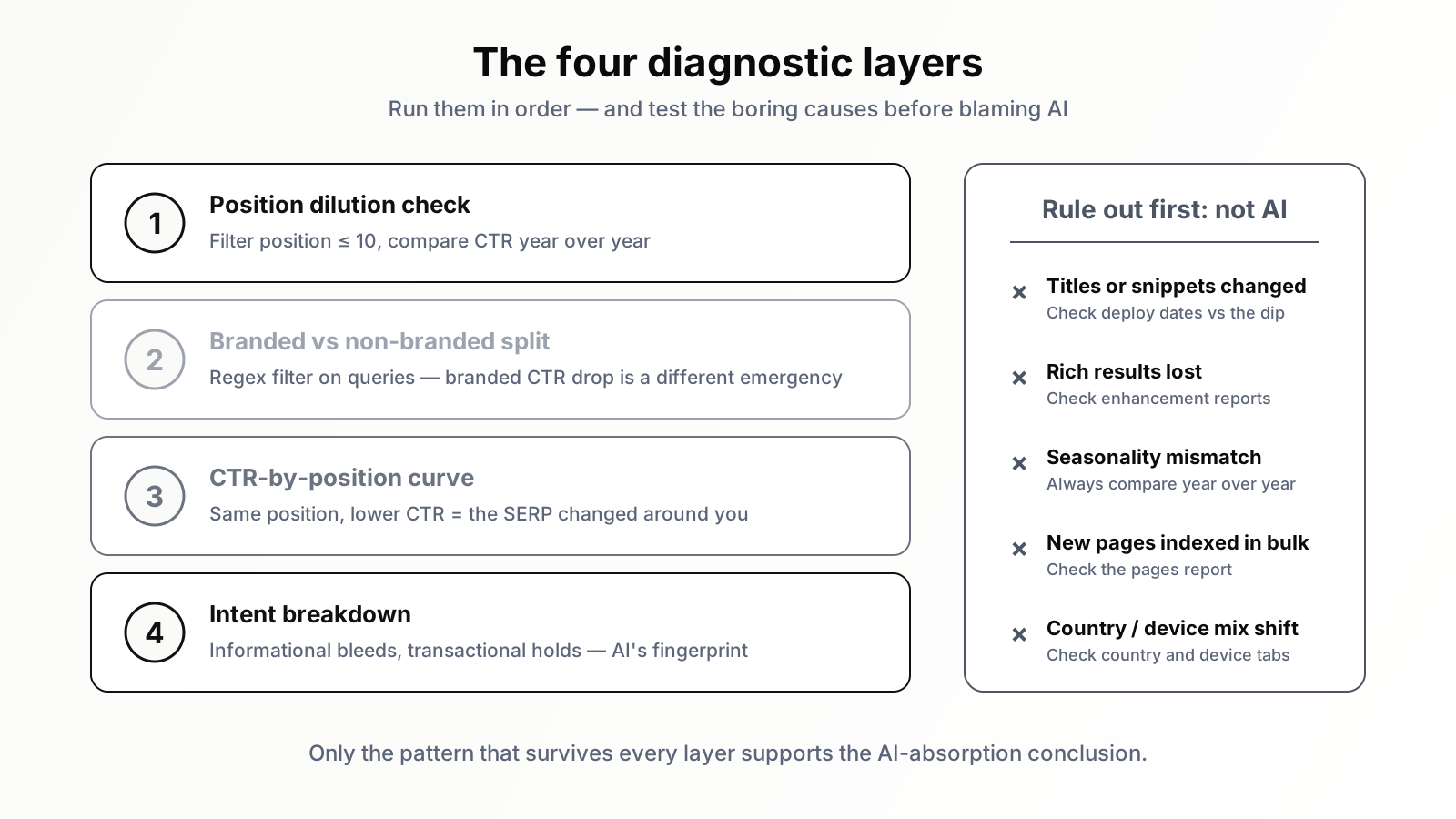
The test is simple and takes five minutes. In the GSC performance report, compare two views of the same period-over-period date range. First, the totals as-is. Second, the same comparison after you export the query-level data and look only at rows where position is 10 or better in both periods. If clicks and CTR among those established, page-one queries are stable, your flat clicks line is a dilution artifact: the "problem" is that you got more visible at positions that never produce clicks anyway. If, however, CTR has dropped even among the queries that held their page-one positions, dilution is not the explanation — something is genuinely absorbing clicks at the top of the SERP, and you proceed to the next layers.
One refinement worth the extra effort: check the count of distinct queries in each period. A property whose impressions doubled while its distinct query count also roughly doubled is almost certainly looking at query expansion, not click theft. A property whose impressions rose on a stable query set is more interesting — the same searches are happening more often, or your pages are appearing in more SERP surfaces per search, which is exactly the fingerprint AI Overview citations leave.
Layer 2: query mix — separate branded from non-branded before you conclude anything
The second layer splits the data along the most important fault line in any GSC dataset: queries that contain your brand name versus queries that do not. These two populations behave so differently that any metric blending them is close to meaningless.
Branded queries — your company name, your product names, common misspellings of both — carry navigational intent. The searcher has already decided to visit you; the search is just the route. Branded CTR is therefore normally high and remarkably stable, often several multiples of non-branded CTR. Non-branded queries are where you compete for strangers, and where SERP features, competitors, and AI answers all fight you for the click.
Set up the split with a regex filter on the query dimension in GSC — a pattern that matches your brand and its variants, applied once as "matches regex" for the branded view and once as "doesn't match regex" for the non-branded view. Run the same year-over-year comparison on each population separately. The two-by-two of outcomes reads like this:
- Branded stable, non-branded CTR down: the most common 2026 pattern. Your brand is intact; the competitive, informational SERPs are where clicks are being absorbed. This is consistent with AI Overviews and SERP features, and you continue to Layer 3 to firm it up.
- Branded CTR down: a different and more serious situation, and almost never an AI story. Something is intercepting people who were specifically looking for you — a competitor bidding on your name, a sitelinks or knowledge-panel change, a reputation problem occupying your branded SERP, or a technical issue with your homepage snippet. Investigate this first; it outranks every other finding in this article.
- Both stable, but totals look bad: revisit Layer 1 — you are almost certainly looking at dilution from new low-position queries, and the blended average misled you.
- Both down sharply: check the non-AI causes in the later section before reaching for any SERP-feature explanation — broad simultaneous decline usually means something changed on your side or in how Google renders your results.
A note on interpretation: rising branded impressions with stable branded CTR is one of the quietest pieces of good news in this whole dataset. It means more people are searching for you by name — which, in an era where users discover brands inside AI answers and then search for them directly, is partial evidence that your invisible exposure is converting into demand. We will come back to that in the final section.
Layer 3: the CTR-by-position curve — the closest thing to a fingerprint
The first two layers rule explanations out. This layer is where you build the positive case, and it rests on a simple idea: position is the control variable. If your page ranked number 3 last year and ranks number 3 today, its position-driven click expectation has not changed. So if CTR at position 3 has fallen, something other than ranking changed on that results page — and the prime suspects are the features sitting above and around the organic results, AI Overviews chief among them.
The method, step by step:
- Export query-level data for two comparable periods — this quarter versus the same quarter last year is ideal, because matching the season controls for demand cycles. Use the export with query, clicks, impressions, and position columns; for properties with deep query sets, pull via the Search Analytics API or the bulk export so you are not truncated to the interface's row limit.
- Bucket queries by rounded position — 1, 2, 3, and so on through 10 — within each period, and compute the aggregate CTR of each bucket (total clicks in the bucket divided by total impressions in the bucket, not an average of per-row CTRs, which would weight tiny queries equally with huge ones).
- Plot the two curves on the same axes. You now have your property's own click-through curve, this year versus last year.
Healthy curves lie nearly on top of each other. The signature you are looking for is a vertical compression at the top of the curve: CTR at positions 1 through 3 visibly lower this year than last, with the gap narrowing toward positions 8 through 10. That shape says: the pages did not move, the searchers did not leave, but something interposed itself between the searcher and the top organic results. AI Overviews sit above position 1 and answer the query inline; their arrival on a query set produces exactly this compression. So do other features — expanded People Also Ask blocks, video carousels, shopping units — which is why this remains inference rather than proof. But it is strong inference, because the alternative explanations (your snippets got uniformly worse across hundreds of queries at the same moment, searcher behaviour changed only on your keywords) require far bigger coincidences.
Two refinements sharpen the picture. First, run the curve separately for the branded and non-branded populations from Layer 2; top-of-curve compression that appears only in non-branded data is the cleanest version of the signal. Second, spot-check a sample of the worst-compressed queries by actually searching them: if eight out of ten now show an AI Overview where last year they showed blue links, your inference has eyes-on confirmation. For a deeper treatment of how much click volume these features absorb and what survives them, see our analysis of whether AI Overviews are eating your clicks.
Layer 4: which queries are bleeding — intent type as the final cut
The last analytical layer asks the data one more question: what kind of queries are losing clicks? Because AI answers do not absorb clicks uniformly — they absorb them in proportion to how completely a short text answer satisfies the query's intent.
Sort your CTR-decline queries (same position, lower CTR, from Layer 3) into rough intent buckets. The pattern that emerges on most properties looks like this:
- Definitional and informational queries — "what is X," "X meaning," "how does X work" — are hit hardest. A two-paragraph answer fully satisfies the searcher; the AI Overview provides exactly that; the click becomes unnecessary. CTR collapses of half or more at unchanged positions are common here.
- How-to and checklist queries take a heavy but less total hit. Simple procedures get answered inline; complex, tool-dependent, or screenshot-dependent procedures still earn the click because the searcher needs the full walkthrough.
- Comparison and "best X" queries sit in the middle and are volatile — AI answers summarize options, but buyers close to a decision still click through for depth, pricing, and credibility checks.
- Transactional and navigational queries — product names, "pricing," "login," "buy" — are largely spared. You cannot purchase inside an answer box, and navigational intent terminates at your site by definition.
- Local queries are similarly resilient: their intent resolves in maps and physical visits, not in summaries.
This distribution is diagnostic gold, for two reasons. First, it is another fingerprint: if your CTR losses concentrate precisely in the informational bucket while transactional CTR holds, the AI-absorption hypothesis gains force, because no title-tag problem or technical regression selects its victims by intent. Second, it converts diagnosis into strategy. The traffic you are losing is disproportionately the top-of-funnel, low-commercial-intent traffic; the traffic that converts is disproportionately the traffic that survives. Many properties showing alarming aggregate CTR decline find, on this cut, that their revenue-bearing query set is nearly untouched. That finding does not make the chart prettier, but it changes the meeting about it entirely — a point we develop in our piece on why zero-click search does not mean zero value.
When it is not AI at all
Differential diagnosis only works if you genuinely test the boring hypotheses, so before any conclusion lands in a report, walk through the non-AI causes that produce the same chart. Each has a distinguishing test.
Title and snippet changes. If you — or your CMS, or a plugin migration — rewrote titles and meta descriptions, CTR can fall at unchanged positions with no AI involvement whatsoever. Google also rewrites titles it dislikes. The tell: the decline starts on a specific date that matches a deployment, and it affects the templated page types you changed rather than selecting by query intent. Check your change log against the GSC date axis before blaming anything external.
Lost rich results. If your pages carried review stars, FAQ accordions, or other structured-data enhancements and lost them — through a markup error, a policy change, or Google tightening eligibility — your listings shrink visually and CTR drops at the same position. The tell: the GSC enhancement and appearance reports show the eligible-item count falling off a cliff, and the affected pages are exactly the ones that had the markup.
Seasonality and demand shifts. Comparing a high-intent season against a browsing season manufactures CTR decline out of nothing. The tell: the pattern repeats in last year's data at the same calendar point. This is why every comparison in this article is year-over-year, not period-over-previous-period.
A burst of newly indexed pages. If you launched a large content batch, a new section, or — a common 2026 accident — let a faceted navigation or parameter set get indexed, thousands of new pages enter the impressions pool at deep positions and dilute everything, which is Layer 1 wearing a different hat. The tell: the page-level report shows the impression growth concentrated on URLs that did not exist or were not indexed last year.
Country and device mix. Impressions growth arriving disproportionately from countries or devices where you convert poorly drags blended CTR down. Thirty seconds with the country and device tabs settles it.
Only when these are checked and excluded does the residual — same queries, same positions, same season, same snippets, lower CTR, concentrated in informational intent — justify the conclusion that the SERP itself is absorbing your clicks.
What to actually do once you know
Diagnosis without consequence is trivia. Here is how each finding translates into action.
If it was dilution (Layer 1): do nothing destructive. The new low-position queries are an expansion frontier, not a problem. Identify the clusters where the new impressions concentrate, and strengthen those pages so the positions climb into clickable range. Report the metric honestly: "CTR fell because our footprint grew" is a sentence stakeholders can understand if you show them the position breakdown.
If branded CTR fell (Layer 2): drop everything else. Audit the branded SERP by hand, check competitor ads on your name, verify your sitelinks and knowledge panel, and fix whatever is intercepting people who already chose you.
If the curve compressed and intent analysis confirms AI absorption (Layers 3–4): this is the structural case, and it demands three parallel responses rather than one heroic fix.
First, change what you count. Raw clicks are no longer a clean proxy for search performance, because a growing share of your search value arrives without a click attached. Shift primary KPIs to qualified clicks (clicks on commercial-intent query groups), conversions from organic, and conversion rate per session — the searchers who do click past an AI answer arrive better-informed and convert at higher rates, which partially offsets the volume loss. Your measurement stack needs to reflect that; our guide to what SEOs should actually track in GA4 covers the conversion-side setup that makes this shift concrete.
Second, compete for the citation instead of mourning the click. Pages that get cited inside AI Overviews retain a path to visibility and to the subset of clicks those citations still drive; pages that are neither cited nor clicked simply vanish from the journey. Practically, this means answer-first formatting: open sections with a direct, self-contained answer in the first sentences, structure pages so each subsection resolves one specific question, and keep claims attributable and specific — the properties extraction systems prefer to quote. You are writing for two readers now: the human who clicks, and the system that summarizes.
Third, instrument the channels GSC cannot see. Some of your AI-era visibility shows up not in Search Console but in GA4, as referral sessions from AI assistants and answer engines that link out. That measurement lives on the analytics side — we walk through the setup in measuring AI search traffic in GA4 — and it pairs with one more GSC habit: trend your branded query impressions monthly. Rising brand search alongside falling informational CTR is the classic signature of a brand being learned inside AI answers and sought out directly afterward. It is indirect evidence, but in a measurement environment built on indirection, a consistent set of indirect signals is what conviction looks like.
Reading the chart like an analyst
The widening gap between impressions and clicks is not a verdict; it is a question, and GSC gives you enough resolution to answer it if you refuse to read the blended averages at face value. Decompose by position to clear the arithmetic. Split branded from non-branded to find out whether the damage touches the people who already know you. Hold position constant and compare CTR curves to detect the SERP changing around your stable rankings. Cut by intent to see exactly which kind of demand is being answered without you — and accept, throughout, that GSC will never hand you a labeled "AI Overviews" line, so your conclusion is built from converging inference, honestly framed. Teams that run this analysis quarterly stop arguing about whether the sky is falling and start reallocating effort to the queries, formats, and KPIs that still pay. If you would rather not rebuild the exports by hand every quarter, Orova monitors your Search Console data continuously and flags this exact divergence pattern — with the position and query-mix breakdown attached — so the diagnosis is waiting for you instead of the other way around.
Let Orova SEO handle the repetitive part
Keyword research, drafting, refreshing old posts and rank tracking — running automatically on your own site.
Explore Orova SEO