
AI SEO: What It Means and How to Actually Do It
You publish content, your rankings look fine on paper, but the traffic and leads that used to follow are quietly shrinking. Customers are asking questions in ChatGPT, Perplexity, and Google's AI Overviews and getting a full answer with a short list of sources — and your site is often not one of them. You are not imagining it: this is happening across whole industries right now, and no one on your team has a clear answer for what to do about it. When an AI Overview shows up on a search, the top-ranking page sees a 34.5% lower average click-through rate than similar queries without one, according to Ahrefs — which means ranking #1 the old way is quietly worth less than it used to be.
The problem is that most AI SEO (getting found and cited by AI search tools, not just ranked in the old list of links) advice right now falls into one of two useless camps. Either someone tells you SEO is dead and you should chase whatever new tactic is trending this month, or your team keeps polishing the same old checklist as if nothing changed — meanwhile the AI answer engines are already deciding who gets mentioned and who gets skipped, using rules that are related to old SEO but not identical to it.
This article gives you a straightforward way to think about the problem instead of another list of scattered tips. You will walk away knowing exactly what changed and what did not, a five-part framework you can apply to your own business, a simple recurring routine to keep it working over time, and the common mistakes that quietly waste marketing budget in this new environment. By the end, you will be able to sit down with your team and set a clear, defensible plan instead of reacting to every new headline.
What People Mean by AI SEO
AI SEO covers two different things that often get mixed up, and it is worth separating them before going further.
Using AI to do SEO work — tools that research keywords, draft articles, find technical faults or write meta descriptions faster than a person could. This is a productivity story. The work is the same as it always was; the speed changes.
Optimising so AI systems cite you — getting your content quoted inside Google's AI Overviews, ChatGPT answers or Perplexity results. This is a visibility story, and it is genuinely new. When an AI answers a question directly, most people never click anything. Being the source it quotes is now worth more than being the fifth blue link.
The second one is where the real shift is, and it needs different work: clear direct answers near the top of a page, facts stated plainly enough to be quoted, and enough credibility signals that a machine trusts you. The framework below covers exactly that.
What actually changed — and why it forces a strategy revision
Start with the facts, because strategy built on vibes fails. Three structural changes define search in 2026.
First, the answer moved above the links. Google AI Overviews now appear on a substantial share of informational queries, synthesising an answer from multiple sources and citing them in an expandable panel. Google's AI Mode goes further: a fully conversational search experience where the user may refine a question four or five times without ever seeing a classic results page. We unpacked the retrieval-and-synthesis mechanics in our analysis of how Google builds an AI Overview, and the practical consequence is simple: for many queries, being the source an answer is built from matters as much as ranking under it.
Second, search fragmented across engines that are not Google. ChatGPT Search answers with live web retrieval and links. Perplexity built its entire product around cited answers and sends real, measurable referral traffic. Copilot sits inside the Microsoft ecosystem at work. None of these on its own rivals Google's volume, but together they own a meaningful and growing slice of high-intent question-asking — especially among the technical and professional audiences many B2B companies sell to.
Third, the click decoupled from the value. When an AI engine answers using your content, the user may get your expertise, your framing, and your brand name without ever visiting your site. Click-through rates on queries with AI Overviews are measurably lower; impressions rise while clicks stay flat. That breaks the funnel math that justified content budgets for twenty years, and it forces a new question into every strategy meeting: if the click is no longer guaranteed, what is the content for? The honest answers — citations, brand presence in answers, and the smaller but higher-intent traffic that still clicks — are the foundation of everything that follows.
What did not change — and why panic is also a mistake
Now the other half of the truth, which the doom merchants skip. The retrieval layer underneath every AI search engine is still a search engine. Google's AI Overviews are grounded in Google's index and ranking systems. ChatGPT Search retrieves from a Bing-backed index. Perplexity runs its own crawler over the same public web. Which means: content that cannot be crawled cannot be cited. Content that does not rank well in retrieval rarely gets selected for synthesis. Sites with weak authority signals lose citation share to sites with strong ones.
Every fundamental you have already invested in — crawlability, site speed, intent-matched content, internal linking, backlinks, structured data, topical depth — still compounds. The work is not wasted; it is prerequisite. What changed is the layer on top: how content must be structured to survive extraction, how trust must be made machine-readable, and how success must be measured. An honest strategy keeps the foundation and rebuilds the floors above it. That is exactly what the framework does.
The master framework: five layers
Picture the strategy as a stack. Each layer depends on the ones beneath it, and effort spent on an upper layer is wasted if a lower layer is broken. Teams fail in both directions — some never get past layer one and wonder why they are invisible in AI answers; others obsess over citation tactics while their site takes nine seconds to load.
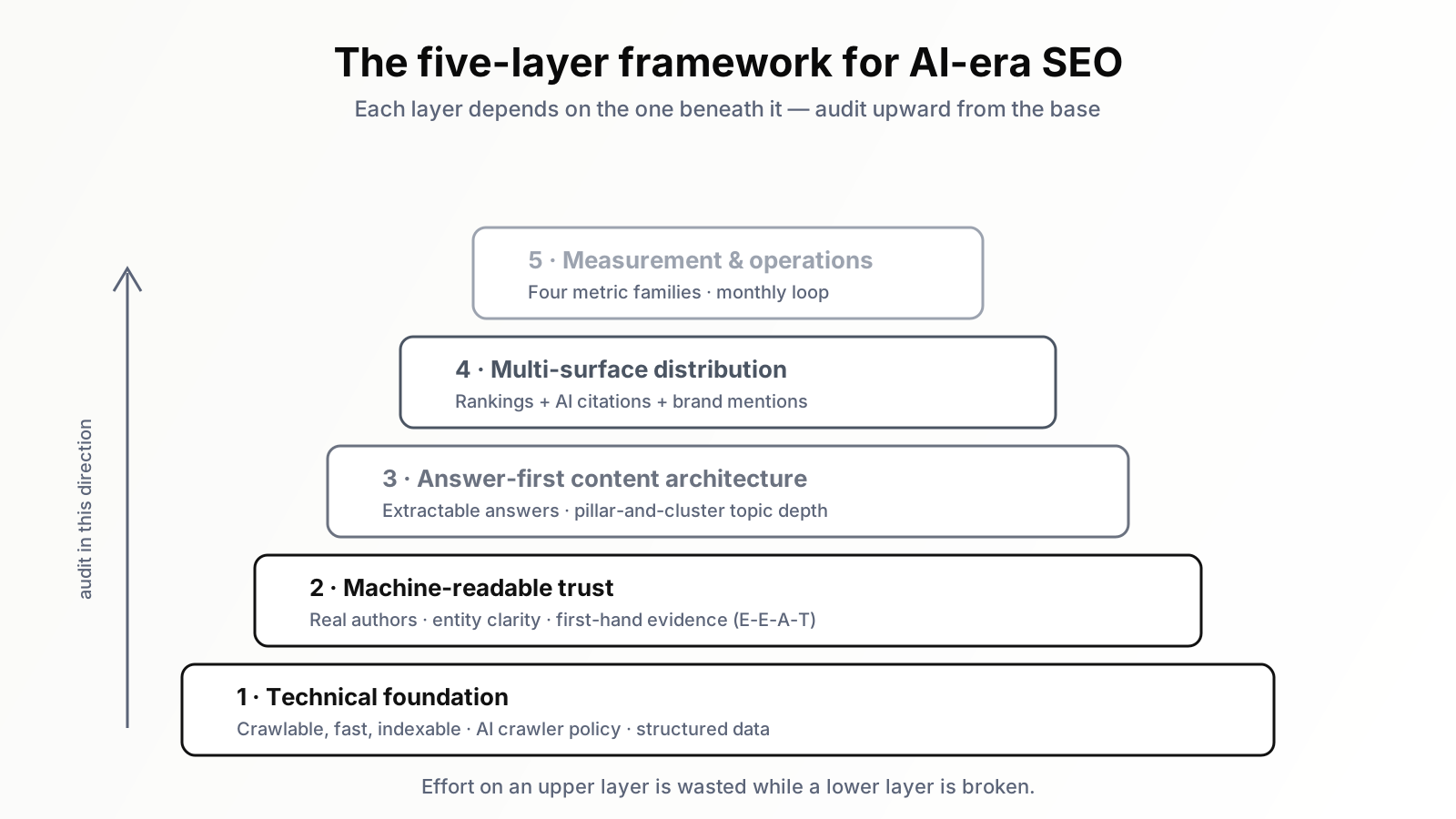
Layer 1 — Technical foundation: be retrievable everywhere
The base layer is the least glamorous and the most binary: either machines can fetch, parse, and index your content, or nothing else in this framework matters. In the AI era this layer has a wider definition than classic technical SEO, because the set of machines that matter has grown.
The classic checklist still applies: clean crawlable URLs, fast pages, working canonical logic, an accurate sitemap, no orphaned content, server-rendered or properly hydrated HTML so the main content is present without JavaScript gymnastics. To that, the AI era adds crawler policy as a strategic decision. GPTBot (OpenAI), ClaudeBot (Anthropic), PerplexityBot (Perplexity), and Google-Extended (Google's control for AI training use) are real user-agents hitting real sites every day, and your robots.txt stance toward each is now a business decision about visibility versus content control — one we argued should be made deliberately, not by reflex, in our piece on blocking AI crawlers. For most companies whose business model is being found, the answer is to allow retrieval-oriented bots, because a blocked crawler is a guaranteed zero citations from that engine.
Structured data also lives here. Schema markup does not directly cause AI citations, but it disambiguates entities, qualifies pages for rich results, and gives every parser — classic or generative — a cleaner machine-readable summary of what a page is. Article, FAQ, Product, Organization, and Person markup remain the workhorses. The proposed llms.txt standard — a markdown file summarising your site for language models — is worth the hour it takes to create, with the honest caveat that no major engine has committed to using it; treat it as a cheap option, not a strategy.
Layer 2 — Machine-readable trust: prove who is speaking
When a model synthesises an answer from a handful of sources, it must decide which sources to trust, and the systems that feed it lean heavily on signals of experience, expertise, authoritativeness, and trustworthiness. E-E-A-T was always Google's quality compass; in the AI era it became harder currency, because an engine staking its own reputation on a synthesised answer is even more conservative about sourcing than a ranked list ever was. The strategic work is making your trustworthiness legible to machines, a theme we developed fully in E-E-A-T in the AI era.
Concretely, this layer has three components. Authors: real names, real bios, real credentials, Person schema, consistent bylines across the site and across the web. Anonymous content is cheap for AI engines to discount. Entity clarity: your organisation should be an unambiguous entity — consistent name, sameAs links to authoritative profiles, a coherent About page, third-party corroboration — so that machines know who you are, not just what your pages say. Evidence: first-hand experience signals inside the content itself. Original data, named methodology, screenshots of real work, dated updates. Models are selected and tuned to prefer passages that sound like primary sources, because their builders are graded on factuality.
Layer 3 — Content architecture: build for answers, organised in clusters
The middle layer is where most of the visible work happens, and it has two halves: how each page is written, and how pages relate to each other.
At the page level, the winning format is answer-first. Lead each section with a direct, self-contained answer to a specific question, then expand with evidence and nuance. AI Overviews and answer engines extract passages, not pages — a 40-to-60-word paragraph that fully answers a question, placed directly under a question-shaped heading, is the unit of content most likely to be lifted into an answer with your name attached. We laid out the complete format in our guide to answer-first content, and when we restructured existing posts this way, the citation results were immediate enough to convince the sceptics on our own team — eleven of twenty rewritten posts earned AI Overview citations within two months.
At the site level, topical architecture still rules. A pillar page covering a topic comprehensively, surrounded by cluster articles answering its sub-questions, each linked tightly back and forth — this hub-and-spoke structure was best practice before AI search and is more valuable now, because engines assessing whether you are an authority on a topic can read your coverage depth directly from your link graph. Conversational search adds a twist: users now ask longer, more specific, more contextual questions, and follow up. The long tail did not die; it moved into the chat box. That argues for clusters that go deeper into specific scenarios than classic keyword-volume tools would ever justify, because the question with ten searches a month in a keyword tool may be asked a thousand times a month inside AI engines where no tool counts it.
Layer 4 — Multi-surface distribution: rankings, citations, brand
Classic strategy had one distribution surface: the ranked results page. The AI-era strategy has three, and they compound each other.
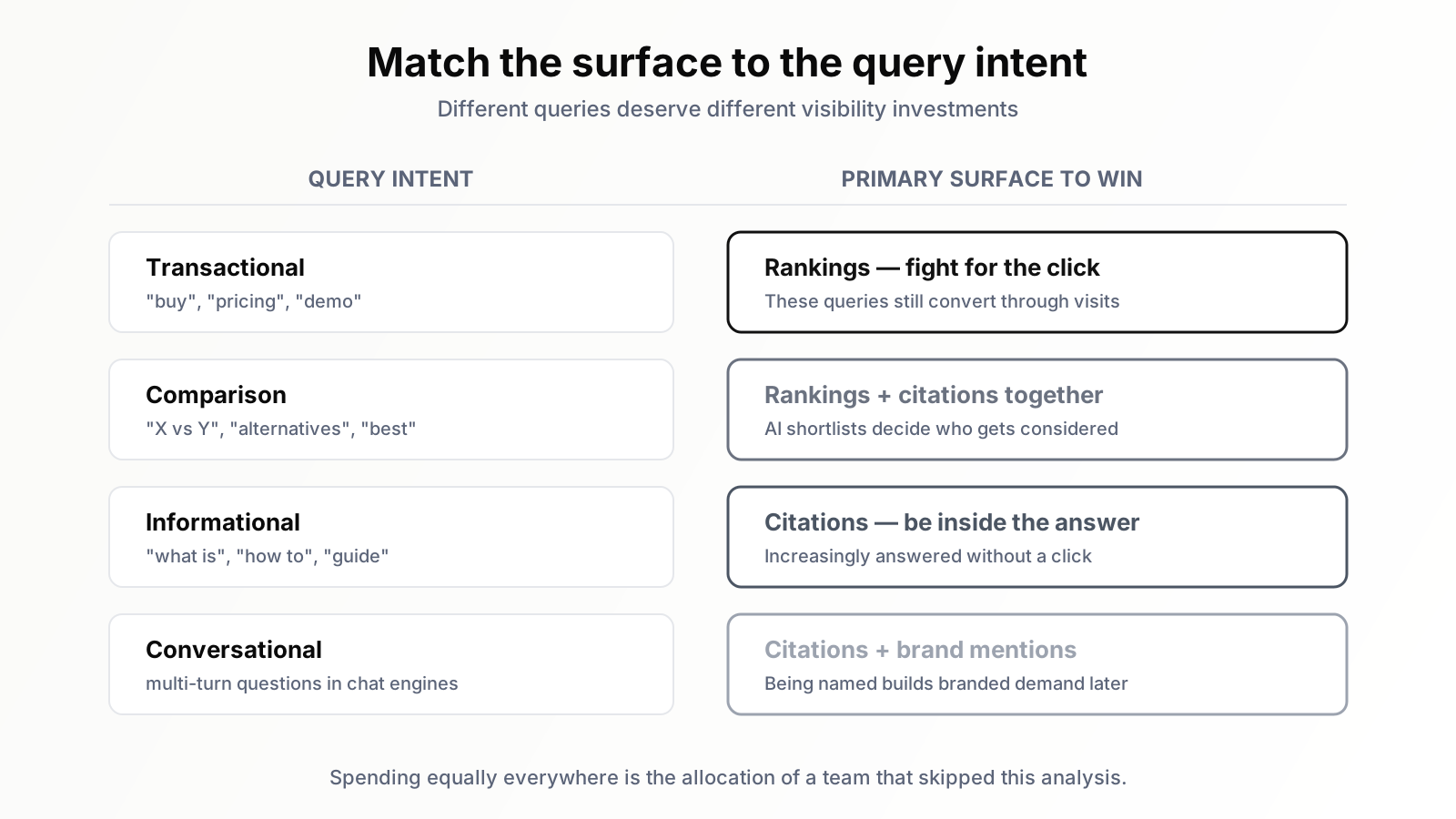
Rankings still matter — they drive the clicks that remain, and they feed the retrieval systems that select citation sources. Citations are the new second surface: being quoted and linked inside AI Overviews, ChatGPT answers, and Perplexity responses. Citation selection is not identical to ranking — engines favour extractable, well-attributed, answer-shaped passages, and they cite from positions classic CTR curves would call invisible — which is why it deserves its own optimisation effort, the discipline we mapped in the GEO playbook. Brand presence is the third surface, and the least appreciated: when an AI engine repeatedly mentions your product as an option for a category of problems, users go and search your name directly. Brand search volume has quietly become one of the truest KPIs of AI-era visibility, precisely because it captures the value of answers that never sent a click.
The strategic implication is allocation: different queries deserve different surface priorities. Transactional and comparison queries still convert through clicks — fight for rankings there. Broad informational queries are increasingly answered in place — fight for the citation and the brand mention. Spending equally everywhere is the allocation of a team that has not done the analysis.
Layer 5 — Measurement and operations: see citations, run the loop
The top layer is the one most teams are missing entirely. If your reporting stack only counts sessions and rankings, you are managing the AI era with pre-AI instruments, and you will systematically underinvest in everything this framework recommends because its returns are invisible to you.
A 2026 measurement stack tracks four families of numbers. Classic organic: rankings, clicks, conversions — still the backbone. AI referrals: sessions arriving from chatgpt.com, perplexity.ai, copilot.microsoft.com and friends, isolated in GA4 with a custom channel group, the setup we documented step by step in measuring AI search traffic in GA4. Citation share: a recurring audit of which sources the major engines actually cite for your priority queries — measurable today with nothing more than a fixed query basket, a monthly cadence, and a spreadsheet. Brand demand: branded search impressions and direct traffic as the downstream echo of answer-borne visibility. Read together, these four replace the single number — organic sessions — that used to summarise SEO performance, and they explain patterns that otherwise cause panic, like impressions rising while clicks stay flat.
Operations is the other half of this layer. The AI-era workload — continuous audits, citation tracking across engines, content refreshes, schema maintenance, answer-format rewrites — is larger and more repetitive than the classic workload, which is why the teams running it well increasingly delegate the repetitive parts to AI agents and spend their human hours on judgment: what to publish, what to claim, what the data means. The economics of that division of labour were the subject of our piece on closing the loop between dashboards and decisions.
Running the framework: a quarterly operating rhythm
A framework is only useful if it turns into a calendar. Here is the rhythm we recommend, scaled for a small team.
Quarterly: revisit the strategy itself. Re-run the query-intent analysis from Layer 4 — which of your priority queries now trigger AI Overviews, which engines your audience uses, where citation share moved. Reallocate the content roadmap accordingly. Audit one full layer per quarter on rotation, so the whole stack gets inspected annually without ever consuming a whole quarter.
Monthly: run the citation audit across your fixed query basket on Google AI Overviews, ChatGPT Search, and Perplexity. Review the four metric families together in one report. Pick the two or three pages where an answer-first rewrite or a trust upgrade would most plausibly move citation share, and ship those rewrites.
Weekly: normal content production — but every brief now includes the question the piece answers, the 40-to-60-word answer paragraph, the cluster it belongs to, the internal links it must carry, and the author whose expertise backs it. Weekly is also where automation earns its keep: rank and citation monitoring, technical checks, and refresh candidates surfacing automatically rather than through manual archaeology.
The rhythm matters more than the intensity. AI search visibility compounds: trust signals accumulate, clusters deepen, citation share builds engine by engine. A team that executes this rhythm at moderate intensity for a year will beat a team that sprints for a quarter and stops.
Adapting the framework to your situation
The five layers are universal; the weighting is not. Three common situations deserve explicit guidance, because the right starting point differs sharply between them.
If you are early-stage with little existing authority, resist the temptation to start at Layer 4. A site with thirty pages and no track record will not win citation share on competitive queries no matter how beautifully extractable its paragraphs are, because retrieval systems have no reason to surface it yet. Spend your first two quarters almost entirely on Layers 1 through 3: a technically clean site, real named authors from day one, and one deep topic cluster rather than thin coverage of five. Early-stage teams have one structural advantage — no legacy content to refactor and no internal politics about bylines — so they can build answer-first, trust-legible content natively instead of retrofitting it. The citation wins come later, but they come faster than for incumbents who must first undo years of anonymous, answer-buried content.
If you are an established site with strong classic SEO, your foundation and authority are assets; your formats and measurement are liabilities. The highest-return move is usually a systematic rewrite program: take your fifty most-trafficked informational pages, restructure each one answer-first, attach real authors with credentials, and tighten the cluster links between them. You are not creating value from nothing — you are converting authority you already own into a shape modern engines can lift. Pair the rewrite program with the Layer 5 measurement stack immediately, because the rewards will show up in citations and brand demand before they show up in sessions, and you need instruments that can see them.
If you operate in a regulated or YMYL-adjacent niche — finance, health, legal, anything where wrong answers hurt people — weight Layer 2 above everything. Engines are at their most conservative exactly where the cost of error is highest, and the citation pool for such queries skews hard toward sources whose expertise is independently verifiable. Credentials in schema, authors with third-party footprints, citations to primary sources inside your own content, and visible editorial review processes are not nice-to-haves in these niches; they are the entry ticket. The good news is the same conservatism protects you once you are in the pool: incumbent trusted sources in cautious niches are displaced slowly.
One more variable cuts across all three situations: language and market. Engines roll out AI features unevenly across languages, and citation pools in smaller-language markets are thinner — which means earlier movers in those markets capture disproportionate share. If you publish in a language where AI Overviews arrived recently, the window where the seats are still open is wider than the English-language discourse suggests. Treat that as the opportunity it is.
The five strategic mistakes to avoid
Mistake one: treating AI search as a separate project. Teams spin up a "GEO initiative" beside their SEO program and duplicate half the work. The framework above is one program. The same crawl that feeds Google feeds Perplexity; the same answer-shaped paragraph wins featured snippets and AI Overview citations; the same author page reassures human readers and retrieval systems.
Mistake two: optimising the top of the stack on a broken base. No quantity of answer-first formatting rescues a site whose content is invisible to crawlers, slow to load, or attributed to nobody. Audit upward from Layer 1.
Mistake three: measuring only clicks. A strategy whose returns include citations and brand demand, evaluated by an instrument that only counts sessions, will be cancelled by its own dashboard. Fix measurement before judging results — and before letting anyone else judge them.
Mistake four: chasing engine-specific hacks. Tactics that exploit one engine's current behaviour decay within months. The durable investments — retrievability, trust, extractable answers, topical depth — work across every engine because they serve what all engines are selected to do: give users accurate answers from credible sources.
Mistake five: waiting. Citation share, like link authority before it, has first-mover dynamics. Engines that have repeatedly retrieved and cited a source keep returning to it. Every quarter you delay is a quarter a competitor spends becoming the default source for your topics — and displacing an incumbent source is far harder than becoming one while the seats are still open.
A note on time horizons and risk
Every strategy document owes its reader an honest account of what could invalidate it. Two scenarios are worth naming. The first: AI engines could further reduce outbound linking, shrinking the click value of citations toward zero. If that happens, Layers 1 through 3 lose none of their value — brand presence in answers becomes the dominant return, and the measurement layer shifts its weight toward brand demand. The framework bends; it does not break. The second: regulation or licensing deals could reshape which content engines may use, potentially advantaging large publishers. Smaller sites hedge this the same way they hedge everything — by being the clearly attributed primary source for a specific niche, because licensing regimes and retrieval systems alike favour identifiable expertise over anonymous volume.
What will not happen, on any horizon worth planning for, is a return to the ten-blue-links world. The interaction model of asking a question and receiving a synthesised, cited answer is strictly better for users on most informational queries, and products that are better for users do not get rolled back. Plan accordingly: the framework above is not a bridge to wait out a trend. It is the new permanent shape of the discipline.
Where to go deeper
This framework is deliberately a map, not the territory. Each layer has a full playbook behind it in this series: the mechanics of ranking in AI Overviews, the GEO audit, citation tactics per engine, crawler policy, E-E-A-T implementation, the GA4 measurement setup, and the answer-first writing format. If you read one companion piece, make it the AI Overviews guide — Google is still where most of your audience asks most of its questions, and the habits that win there transfer everywhere else.
The honest summary of the AI search era is this: the game got bigger, not different. The craft of being genuinely useful, provably credible, and technically findable is the same craft it always was — there are simply more machines reading your work, more surfaces where it can appear, and more numbers to watch. Teams that internalise the five layers and run the rhythm will find the era less threatening than the headlines suggest. The operational load is real, which is why we built Orova to carry the repetitive parts — continuous audits, citation tracking, refresh detection — so the humans can spend their hours on the one thing no agent supplies: deciding what your company has to say.
Turning the Framework Into a Working Habit
Everything in this framework is doable by hand — reviewing what AI tools say about your brand, checking which pages get cited, adjusting content, and repeating the cycle every quarter. The honest catch is that this monitoring and adjusting work never really stops, and most business owners and marketing teams simply do not have the spare hours to track it consistently across every AI search surface, week after week.
This is exactly the gap Orova SEO is built to close. It automates the ongoing watching, checking, and reporting side of AI search visibility, so your team can spend its time on decisions instead of manual digging. If the framework above sounds right but you are wondering who will actually run it every quarter, it is worth taking a look at what Orova SEO can do for your business.
Let Orova SEO handle the repetitive part
Keyword research, drafting, refreshing old posts and rank tracking — running automatically on your own site.
Explore Orova SEO