
Blocking AI Crawlers With llms.txt: A Business Decision
Somebody on your team just asked whether you should block AI crawlers, and you didn't have a real answer. Maybe your agency quietly added it to a checklist. Maybe a competitor announced it like a badge of honor. So now you're staring at a robots.txt file — the small text file that tells bots what they can and can't read on your site — and a proposed llms.txt setup, trying to decide if blocking GPTBot makes you safer or just invisible to the exact tools your buyers now ask for recommendations.
Here's where it goes wrong: most businesses copy the decision instead of making it. They see a big publisher block AI crawlers and assume the same logic applies to them, without asking what that publisher is actually protecting — usually a subscription paywall or licensing revenue that a SaaS blog or a services site simply doesn't have. Nobody runs the numbers on what gets given up: being cited, being recommended, being findable inside the AI answers your prospects are now using instead of Google. That's not a small shift — SparkToro found that 68% of US Google searches in the first four months of 2026 ended without a click at all, up from 60% just two years earlier. The reflex to block feels like defense. Often it's just self-inflicted invisibility, dressed up as caution.
This piece walks you through the actual decision, not the mood. You'll see exactly which businesses have a real reason to block, which don't, and the four separate questions hiding inside that one "block or allow" checkbox that most teams never bother to separate. By the end, you'll be able to make this call for your own site — deliberately, with a reason you could defend out loud, instead of pasting a list you found on social media.
Where the reflex came from — and why it made sense for its inventors
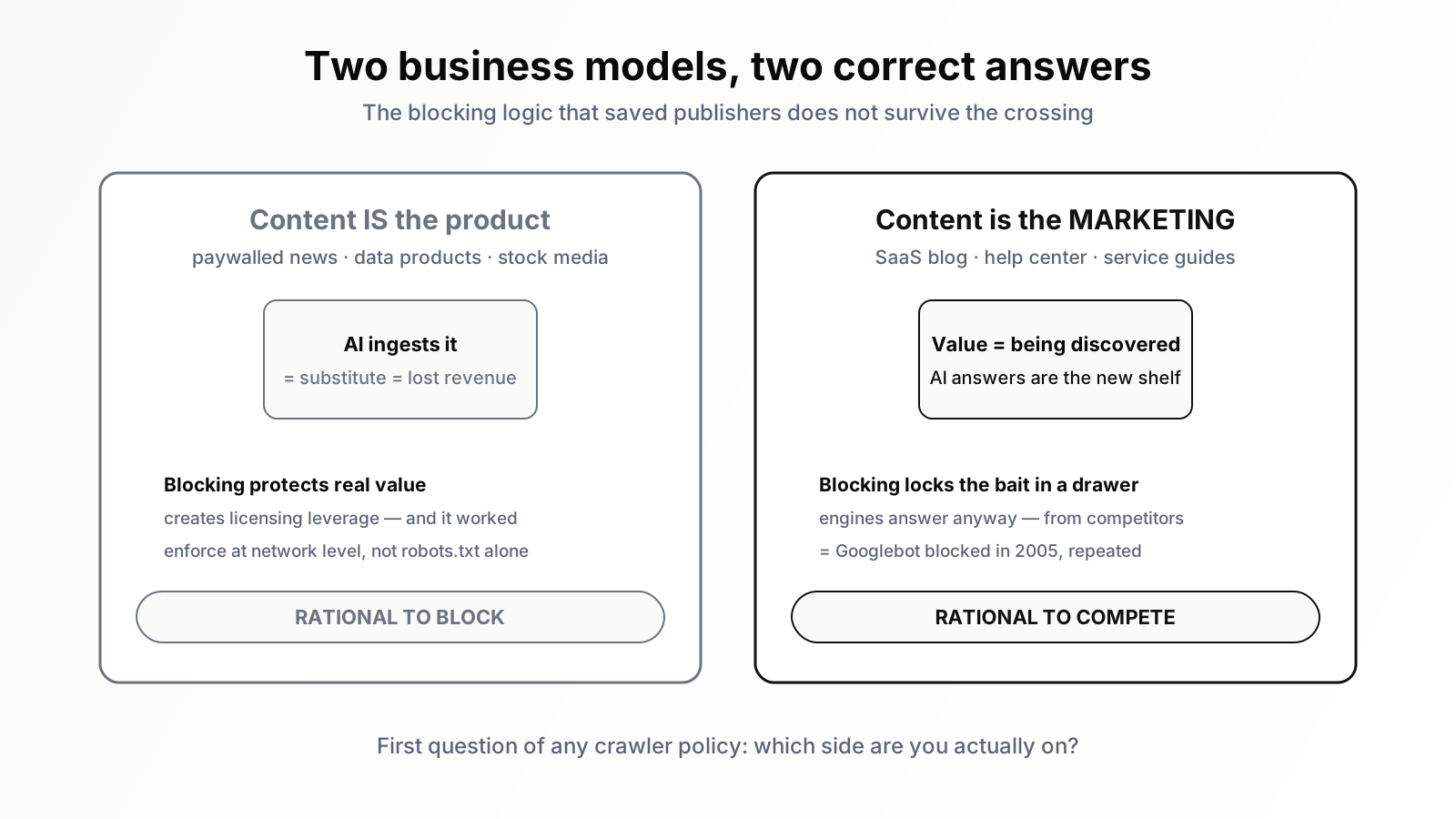
The blocking wave started with publishers, and for publishers the logic was and remains coherent. A news organization sells access to its journalism. Subscriptions, and the advertising attached to readership, are the revenue; the words are the product. When an AI system ingests that journalism and can reproduce its substance — answer questions from it, summarize it, satisfy the reader without the visit — the system is a substitute for the product. Substitution is revenue loss, full stop. Blocking the crawlers was simultaneously a defensive act and an opening move in a negotiation: you cannot sell licenses for content you give away, and within two years the strategy visibly worked, as a series of major publishers signed paid licensing deals with AI companies. For them, withholding created leverage, and leverage created revenue. Rational from the first move to the last.
The same logic extends to anyone whose moat is the content itself: stock media libraries, proprietary research and data products, premium courseware, marketplaces whose listings and reviews are the asset competitors would love to ingest. If a model absorbing your corpus diminishes what customers pay you for, blocking — real blocking, enforced at the network level, not just polite robots.txt requests — is sound strategy.
The trouble began when this posture jumped species. The reflex crossed from businesses whose content is the product to businesses whose content is the advertising — and nobody paused at the border to check whether the logic survived the crossing. It does not.
The category error at the heart of the reflex
Think about what a B2B blog, a SaaS help center, or a service company's guide library is actually for. Nobody pays to read it. It exists for exactly one reason: to be found by people with a problem, so that the brand behind it earns trust and, eventually, a customer. Its entire value is realized at the moment of discovery. The content is bait, in the honorable sense — the same sense in which every ad, every conference talk, every free sample is bait.
Now ask what "protecting" that content from AI systems means. The AI engines — ChatGPT Search, Perplexity, Google's AI surfaces, and the rest — are where a growing share of your buyers now ask the questions your content answers. Those engines retrieve, cite, and link sources. Visibility inside their answers is the new version of ranking, a shift we mapped in Citations Are the New Rankings. Blocking the crawlers that feed those engines does not protect your bait. It locks your bait in a drawer.
The category error becomes vivid the moment you translate it backward in time. A SaaS company blocking OAI-SearchBot in 2026 is a SaaS company blocking Googlebot in 2005 — refusing the index where its customers search, on principle, while its competitors stay in. Nobody would have called that prudence. The only reason it passes for prudence today is that AI referral volumes are still small, so the cost is invisible on this quarter's dashboard. But the cost compounds in the place dashboards do not show: every answer about your category that gets assembled without you is a buyer who met your competitors first.
And the asymmetry is brutal. What does the marketing-content business gain by blocking? Its blog posts are not licensable assets; no AI lab is coming to negotiate for your listicle archive. The content embodies expertise, but the expertise is not diminished by a model reading it — your product, your team, and your delivery remain yours. The realistic gain is a feeling of principle and a marginal reduction in server load. The realistic cost is absence from the surfaces where buying decisions increasingly start. Tiny gain, compounding cost: that is the trade the reflex makes, unexamined.
The reflex is not even one decision — it is four, smeared together
The deeper intellectual failure of copy-paste blocking is that it treats "AI bots" as one thing, when the bots in your logs are doing four different jobs with four different value propositions. We catalogued the full roster in our field guide to who's crawling you and why; here is what the smearing hides.
Blocking a training crawler like GPTBot or ClaudeBot is a decision about whether future models may learn from your content. It costs you no current visibility — but it also buys a small business almost nothing, because your individual blog's contribution to a trillion-token corpus is a rounding error, and withholding it gains you no leverage no one was going to pay you for anyway. It is the most defensible block and the least consequential one, in both directions.
Blocking a search-index crawler like OAI-SearchBot or PerplexityBot is a decision about whether AI search products can find and cite you. This is the de-listing decision, the Googlebot-in-2005 decision, and it is where blanket block lists do their real damage — often unintentionally, because the list was copied before the vendors split their training bots from their search bots, and nobody went back to reconcile.
Blocking a user-triggered fetcher like ChatGPT-User is a decision about whether a live human, mid-conversation, may have your page read to them by their assistant. Blocking it serves a prospect a refusal at the precise moment of their interest. There is no business model on earth this helps.
And the Google-Extended token is its own special case: it governs Gemini training, not AI Overviews, which are built from the same index as classic Search. There is no way to block your content out of AI Overviews while remaining in the ten blue links — the controls do not exist separately. Teams that believe their robots.txt has opted them out of Google's AI features while preserving their rankings are operating on a false map. If AI Overviews worry you, the available strategy is to compete inside them — our complete guide to AI Overviews covers how — not to pretend a token exempts you.
Four decisions, four different cost-benefit profiles. A forty-line copy-pasted block list answers all four with one reflex, which means at least some of them are answered wrong.
The arguments for blanket blocking, taken seriously
A critique owes the other side its strongest case, so let us take the common arguments at full strength rather than at straw strength.
"AI engines steal the click — they answer from your content and the user never visits." This is the best argument, and it is half right. Answer engines do resolve many queries without a click; zero-click dynamics are real and we have written frankly about them in Zero-Click Search Doesn't Mean Zero Value. But notice what blocking actually does about it: nothing good. The engine still answers the question — from your competitors, from forums, from secondhand summaries of your own ideas — and you lose both the click and the citation. The brand impression of being the cited source, the high-intent minority who do click through, the accuracy of what assistants say about your product: all forfeited. Blocking does not opt you out of the zero-click era. It opts you out of the compensation the era offers.
"Withhold now, license later — the publishers got paid." The publishers got paid because their corpora are large, unique, continuously refreshed, and brand-named — assets a lab can value and a lawyer can price. The licensing market that emerged confirms the strategy for them. It does not generalize downmarket: there is no emerging market for licensing mid-sized companies' marketing blogs, and holding your content hostage to a negotiation no one will ever initiate is not leverage, it is just absence.
"It's the principle — they should ask first." Sincerely held, and as a matter of how the AI industry behaved historically, not unfounded. But a principle enforced at the cost of your own discoverability, through a mechanism — robots.txt — that is voluntary for the compliant and invisible to the non-compliant, is a protest with all the costs borne by the protester. If consent and compensation norms for AI training matter to you, the effective venues are licensing collectives, legislation, and your vote as a customer of these tools. Your robots.txt is the weakest lever on that list and the only one that subtracts from your pipeline while you pull it.
"Crawl load is a real cost." True, and fully addressable without a philosophical position: rate limits, caching, CDN bot management, and crawl-delay rules manage server pressure while keeping you retrievable. Throttling is not blocking. Conflating them is how an infrastructure ticket becomes a strategy mistake.
The costs nobody invoices
Part of why the reflex survives is that its costs arrive without paperwork. Nothing in your analytics is labeled "deals lost because the assistant had never read your site." So it is worth making the invisible line items visible, because each one is real and each one compounds.
There is the narrative cost. When an assistant answers "what tools exist for X" or "how does Y compare to Z," it assembles a story about your category — who the players are, what each is good at, what the tradeoffs are. If your primary sources are unreadable to it, your chapter of that story gets written from whatever remains: old reviews, a competitor's comparison page, a forum thread from someone who churned in 2024. You have not vanished from the conversation; you have lost editorial control over your own part of it. Companies routinely discover assistants describing pricing they retired two years ago or features they never had, and the root cause is often their own robots.txt standing between the assistant and the correction.
There is the sales-cycle cost. B2B buyers in 2026 show up to demos having already asked an assistant to shortlist, compare, and critique. The conversation your sales team walks into was framed hours earlier by an AI answer. Being absent from that framing does not show up in attribution software — the buyer who never shortlisted you never enters your funnel at all — but it is the difference between defending your position in a conversation and never being in the room.
There is the compounding cost of starting late. Citation patterns in answer engines are self-reinforcing: sources that get retrieved and cited accumulate the behavioral and corroboration signals that make them more likely to be retrieved again. Every quarter spent blocked is a quarter your competitors spend accruing that advantage. Unblocking in 2027 does not restore you to where you would have been; it restores you to the starting line of a race others have been running for two years.
And there is the organizational cost of a false sense of action. A team that has "handled AI" by pasting a block list feels finished with the topic. The strategy conversation — how do we get cited, what do assistants say about us, where do our buyers actually ask — never happens, because the checkbox is already ticked. The reflex does not just cost visibility; it costs the discussion that would have built some.
A field test you can run this week
If any of this argument lands, do not take the argument's word for it — run the test on your own business. It takes an afternoon.
First, interrogate the engines. Ask ChatGPT (with search active), Perplexity, and Google's AI surfaces the five questions your best customers asked before they found you — category questions, comparison questions, "best tool for" questions. Record who gets named and cited, whether you appear at all, and what the answers claim about you. If you are blocked and absent, you are looking at the cost side of your policy, rendered in your buyers' actual interface.
Second, audit your own wall. Pull your robots.txt and its change history. For every AI-related rule, ask who added it, when, and what the stated reason was. In our experience the most common honest answer is "a list went around in 2023 and someone pasted it" — which means your current posture toward the fastest-growing discovery channel in your market was set by an anonymous gist, three years ago, before the bots it names even split into their current roles. Check especially whether you are blocking search-index bots and user fetchers that the original list's author was never thinking about.
Third, look at the revenue you may already be getting. Filter your analytics for referrals from chatgpt.com, perplexity.ai, gemini.google.com and their siblings, and look at conversion rates, not volumes. The consistent industry observation — ours included — is that this traffic is small and disproportionately high-intent, because it arrives pre-qualified by a conversation. Then weigh the trade in plain numbers: what you are protecting versus what those visitors are worth at five times the volume, which is roughly where the trend lines point.
If the test comes back saying your blocks are protecting real licensable value, keep them with confidence — now they are a decision. If it comes back saying you have been paying compounding costs for a feeling, you will know by Friday.
The decision, done properly
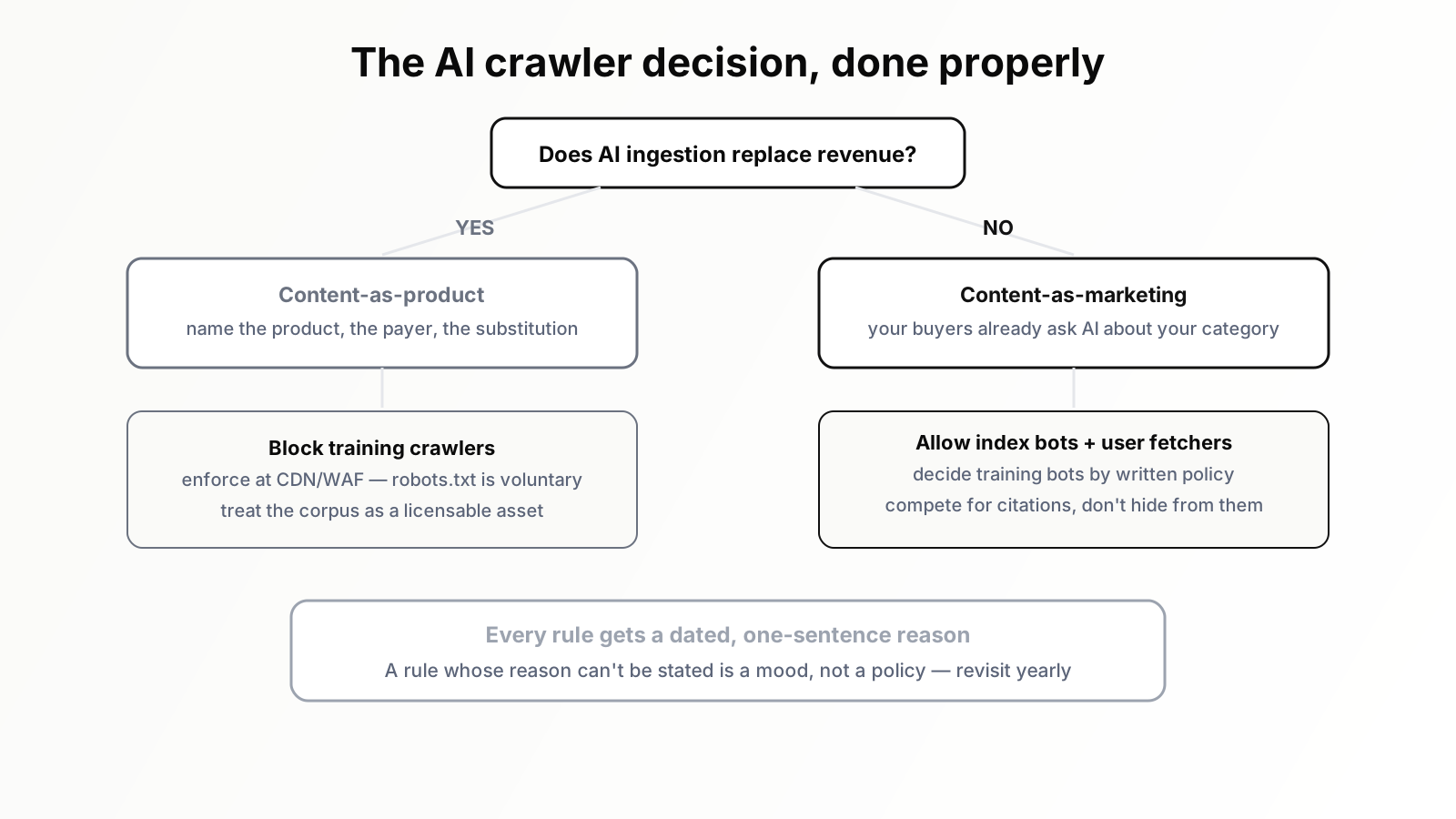
Strip the mood away and the actual decision is a short, answerable sequence. First: does AI ingestion of your content substitute for revenue? Trace the mechanism concretely — name the product, the payer, and the substitution path. If a model answering from your content means someone does not pay you, you are in the content-as-product camp: block the training crawlers, enforce it at the CDN where the dishonorable bots cannot ignore it, and treat your corpus as the licensable asset it is. Second, if there is no substitution path: which surfaces do your buyers consult? If they ask ChatGPT, Perplexity, or Google's AI anything adjacent to your category — and in 2026, they do — then the index crawlers and user fetchers stay open, and your energy goes to competing for presence in those answers rather than absence from them. That competition has its own playbook — retrievable structure, answer-first writing, corroborated claims — laid out in our GEO guide. Third, for the training bots specifically: decide on actual values or actual economics, write the reason down in a sentence next to the robots.txt rule, and revisit annually. A rule whose reason cannot be stated in a sentence is a mood, not a policy.
Note what this sequence produces for most companies: a split posture. Training crawlers maybe blocked, maybe allowed — defensible either way. Index crawlers allowed. User fetchers allowed. Enforcement matched to intent. It is rarely the forty-line wall, and rarely zero rules either. Real decisions produce mixed answers; reflexes produce uniform ones. You can audit your own robots.txt on exactly that test.
Treat it like the strategy it is
The robots.txt file used to be the most boring file on your server. It is now a strategic document that encodes your bet about where discovery happens next — and it deserves the same seriousness as your pricing page. Blocking AI crawlers is not hygiene, not principle-by-default, and not what serious companies do. It is a business decision with a real cost on each side, and the companies getting it right are the ones who can say, in one sentence, what they bought with it.
The hard part is that the decision is not one-and-done: bots split, rename, and multiply, engines change what they read, and the cost-benefit shifts under your feet. Keeping the policy connected to evidence — which engines actually cite you, what AI surfaces actually send you — is exactly the kind of continuous watching Orova was built for, so the next time someone forwards your team a forty-line block list, you can answer with your own data instead of someone else's mood.
Stop Guessing, Start Checking
Working through this properly takes real time: auditing your current robots.txt and llms.txt setup, figuring out which AI crawlers are even hitting your site, checking whether blocking one accidentally blocks the search and citation traffic you actually want, and then rewriting the rules without breaking anything else. Most teams either skip this and copy a block list, or spend hours cross-referencing user-agents by hand.
Orova SEO handles that groundwork automatically — scanning your site's current crawler rules, flagging what's blocked, and showing you where you're accidentally shutting the door on the traffic you want. If you'd rather see your own setup laid out clearly than guess at it, it's worth a look.
Let Orova SEO handle the repetitive part
Keyword research, drafting, refreshing old posts and rank tracking — running automatically on your own site.
Explore Orova SEO