
GEO vs SEO: What Ranking Means in the AI Answer Era
SEO is the work of getting a page to rank in a list of links. GEO — generative engine optimization — is the work of getting a passage quoted inside an AI-written answer. Same goal, visibility where buyers look; different unit. SEO optimises a page for position. GEO optimises a passage for selection into an answer that may never show a list at all.
The difference is no longer academic. You check your rankings dashboard and everything looks fine — you hold a top spot for the exact keywords your reports were built to track. But traffic is not matching that good news. More and more, customers ask their questions inside ChatGPT, Google's AI Overviews or Perplexity, get a direct answer and never click through to a website at all. You can be ranked #1 and still be invisible, because the page users are looking at is not a list of links anymore — it is a written answer that only quotes a few sources. When an AI Overview appears, the top-ranking page sees a 34.5% lower average click-through rate than similar queries without one (Ahrefs, across 300,000 keywords).
The old playbook — chase keywords, build links, climb the results page — was built for a world where search always meant a list you could scroll. That world has not disappeared, but it is no longer the whole picture. Keep pouring budget into classic ranking tactics without checking whether AI tools cite your content, and you are optimising for a shrinking part of how people find businesses like yours, while reporting success on a metric that no longer tells your board the full story.
This article breaks down, in plain terms, how AI engines pick which sources to quote versus how search engines rank pages — where GEO and SEO overlap, where they part company, and what that means for your budget and your team's goals. By the end you will know which parts of your current SEO work still carry over, which parts need to change, and how to set targets that account for both list-based and answer-based visibility instead of betting everything on one metric that is already going out of date.
GEO vs SEO: What Actually Separates Them
What SEO optimises. A search engine crawls the web, stores what it finds, and orders pages when someone searches. SEO is the work of doing well at all three, and the output is a rank — a position in an ordered list, held by a whole page, measurable every day for a keyword you chose in advance.
What GEO optimises. A generative engine retrieves candidate sources, then writes a single answer that synthesises them and attributes a handful. The output is a citation — inclusion in a written answer, earned by a passage rather than a page, and unstable in a way rankings are not: the same question asked twice can produce a different source mix.
Where the two agree. Both need your content to be found, crawled and understood. Both reward topical depth, factual accuracy and signals that the source is credible. Nothing about GEO makes technical health, useful writing or authority optional — a page an engine cannot retrieve cannot be cited either.
Where they diverge. Rankings are ordinal and page-level; citations are selective and passage-level. Ranking rewards being marginally better than the page below you. Citation rewards being the clearest, most self-contained statement of one specific point — often a single paragraph that makes sense lifted out of its article entirely. That is why a page can rank tenth and still get quoted, and why a page can rank first and get skipped.
The rest of this article works through those mechanics in detail, then turns them into measurement you can actually run and a scorecard that does not pretend one number covers both worlds.
How Search Engines Rank Pages, and What Just Changed
Take the SEO half first, because GEO is built on top of it rather than beside it.
What has always decided rankings: whether the page answers the query, whether the site is trusted enough to be believed, and whether the page is usable when it loads. Links from other sites are the main trust signal, which is why they matter so much.
What changed: search engines now answer many questions directly, using content from pages without sending anyone to them. Roughly two in three searches in the US now end without a click, according to SparkToro. Being ranked fifth on a page nobody scrolls is worth far less than it was.
Which shifts the goal. The thing worth optimising for is no longer only position — it is whether the engine quotes you inside its own answer, with your name attached. That is a different kind of work, and it is what the rest of this article covers.
The Unit of Visibility Is Changing
Every measurement regime depends on a unit. In print advertising it was circulation; in display it was the impression; in classic search it was the ranking position, later refined into the impression-weighted position that Google Search Console reports. The unit matters because everything downstream — forecasting, budgeting, attribution, even job descriptions — inherits its shape.
Ranking position worked as a unit because it had three properties. It was observable: anyone could run the query and see where a page sat. It was stable enough to trend: positions moved, but week-over-week tracking produced a meaningful curve. And it was economically legible: position correlated with click-through rate, CTR multiplied by search volume produced traffic, and traffic multiplied by conversion rate produced revenue. The whole chain could be modeled in a spreadsheet.
Presence in an AI answer has the first property only partially, the second weakly, and the third in a form we are still learning to compute. A citation in an AI Overview is observable if you run the query — but AI Overviews do not appear for every query, do not appear consistently for the same query, and can vary by user context. A citation in ChatGPT or Perplexity is observable per-session, but the answer is generated fresh each time, so "do we get cited for this query?" is a probability, not a binary. And the economics are different in kind: a citation produces some clicks, but it also produces something rankings never directly measured — your brand name and your claim, presented inside the answer itself, to a user who may never click anything.
This is why the analogy "citations are the new rankings" is useful but imprecise. Citations occupy the same strategic slot rankings did — the thing you compete for, the thing you measure, the thing that determines whether search produces business value — but they behave differently as a measurable object. Teams that copy their ranking dashboards over to citations, expecting the same stability and the same click economics, will conclude the channel is broken. It is not broken; it is a different instrument.
How Citation Selection Differs From Ranking — Mechanically
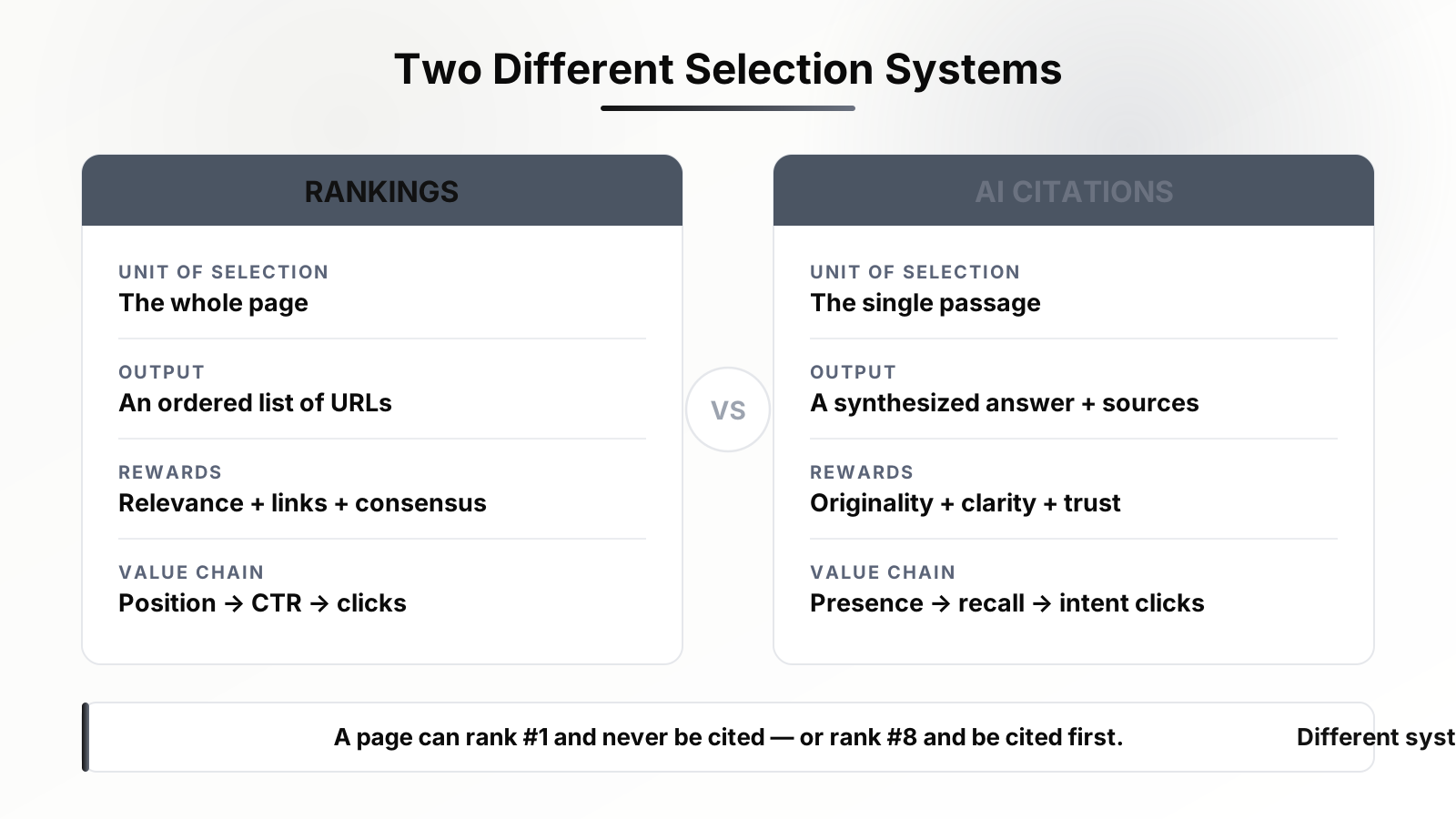
The most important analytical point in this entire discussion is that ranking and citation are two different selection systems, run by different machinery, optimizing for different objectives. They draw on overlapping inputs — both ultimately depend on crawled, indexed, trusted content — but the selection step itself diverges in at least four ways.
1. Page-level versus passage-level selection
Classic ranking evaluates and orders pages. The page is the atom: its overall relevance, its link profile, its engagement signals roll up to a single position for a single URL. Citation selection, by contrast, operates substantially at the passage level. An answer engine decomposes a question, retrieves candidate passages — sections, paragraphs, sometimes individual sentences — and synthesizes from the passages that most directly support the answer it is composing. A 4,000-word page with one superbly clear paragraph on the exact sub-question can win the citation over a more authoritative page whose treatment of that sub-question is diffuse.
The practical consequence is well documented in observed behavior: a page ranking #8 for a query can be cited first in the AI answer above it, and a page ranking #1 can be absent from the citations entirely. Rank is an input to the candidate pool in many systems — Google's AI Overviews draw heavily on pages that already perform in search — but it is not the deciding function. The deciding function is closer to "which passage most cleanly answers the sub-question I am writing right now."
2. Synthesis versus ordering
A ranked list is an ordering problem: ten slots, ten URLs, sorted by predicted satisfaction. An AI answer is a composition problem: the engine writes a response and attaches sources to the claims it makes. This means citation slots are not positional in the same way. There is no fixed inventory of "ten citations per answer." An answer might cite two sources or nine, might cite one source for three separate claims, might cite a source in a link card without quoting it. Competition is therefore not for a slot on a list but for a role in an argument — and the number of roles varies with the complexity of the question.
3. Redundancy is penalized differently
In a ranked list, five pages saying roughly the same thing can all rank #1 through #5; the list tolerates, even rewards, consensus. A synthesized answer needs each citation to do distinct work. Once the engine has a source for the consensus view, the marginal value of a sixth page repeating it is near zero. What earns the additional citation is original information: a number nobody else has published, a named framework, a documented test, a dissenting and well-supported position. This inverts a decade of content strategy in which matching the SERP consensus ("skyscraper" content) was the dominant play. In citation competition, being the fifth-best version of the same article is structurally worthless.
4. Clarity functions as a ranking factor
Ranking systems infer quality from behavior and links; they do not strictly require that a passage be quotable. Citation systems effectively do. A passage that states a claim directly — subject, verb, answer, in the first sentence, with the supporting detail after — is easier for a retrieval-and-synthesis pipeline to select and attribute than a passage that builds to its point across four paragraphs. Extractability, answer-first structure, self-contained sections with descriptive headings: these stop being style preferences and become selection criteria. The full tactical playbook for this is its own discussion — we cover it in our guide to how to get cited by ChatGPT, Gemini, and Perplexity — but the analytical point is that citation selection rewards a property (passage-level clarity) that ranking only weakly measured.
What Carries Over From Classic SEO — and What Doesn't
A common failure mode in industry transitions is the clean-slate fallacy: declaring everything old obsolete and rebuilding from zero. The reality of AI citations is messier and more interesting. A substantial portion of classic SEO is not just relevant but prerequisite; another portion is genuinely deprecated. Sorting one from the other is where strategy lives.
What carries over
Crawlability and indexation, fully. Every answer engine retrieves content before it can cite it. GPTBot and OAI-SearchBot (OpenAI), ClaudeBot (Anthropic), PerplexityBot, and Google-Extended are real crawlers with real user-agents hitting real servers, and a page they cannot fetch is a page that cannot be cited. Blocking these bots in robots.txt — a decision some publishers made reflexively in 2023–2024 — is now a visibility decision, not just a content-rights decision. Technical SEO's least glamorous work, making content fetchable and parseable, transfers at full value. (One caveat for the checklist-minded: llms.txt, the proposed standard for guiding language models to key content, remains a proposal without confirmed adoption by major engines. Treat it as cheap insurance, not as a lever.)
Authority and E-E-A-T, substantially. Answer engines have the same core problem search engines had — distinguishing trustworthy sources from confident-sounding noise — and they lean on similar signals: the entity behind the content, its track record, its citations from elsewhere, the demonstrated experience in the content itself. The framework Google formalized as E-E-A-T (what Google actually rewards) maps cleanly onto citation selection, because an engine attaching its credibility to your claim has every incentive to prefer sources it can defend. Brand mentions across the wider web appear to matter here too: a brand that is repeatedly associated with a topic in the training and retrieval corpus is a more probable citation than an equal-quality unknown.
Query and intent research, mostly. Understanding what people ask remains the foundation. What changes is granularity: instead of mapping keywords to pages, you map questions and sub-questions to passages. The research skill transfers; the unit of planning shrinks.
What doesn't carry over
Position obsession. The marginal effort spent moving a page from #3 to #2 — historically justified by CTR curves — has unclear value on queries where an AI Overview sits above the list and absorbs the majority of attention. The position still matters somewhat (it correlates with inclusion in the candidate pool), but the old precision of position economics is gone on answer-dominated queries.
Consensus content at scale. The publish-many-adequate-pages model, already weakened by Google's quality systems, is close to worthless in citation competition for the redundancy reasons above. Ten thin pages lose to one page with an original dataset.
CTR as the universal currency. Classic SEO's value chain ran entirely through the click. Citations produce value partly without clicks — a problem and an opportunity we will quantify next. Teams whose entire reporting stack assumes click-through as the only output will systematically undervalue citation visibility, in the same way early social media was undervalued by teams who only counted referral traffic. The broader version of this argument is laid out in our analysis of why zero-click search doesn't mean zero value.
The New Funnel Math
Here is where the analysis has to get honest about tradeoffs, because the funnel arithmetic of citations is genuinely different — partly worse, partly better — than the arithmetic of rankings.
The bad news is volume. An answer that satisfies the user reduces the need to click. Queries covered by AI Overviews tend to send fewer clicks downstream than the same queries did as classic results pages, and a chat answer in ChatGPT or Gemini may produce no click at all in the majority of sessions. If your model of search value is "sessions delivered," citations look like a degradation, full stop.
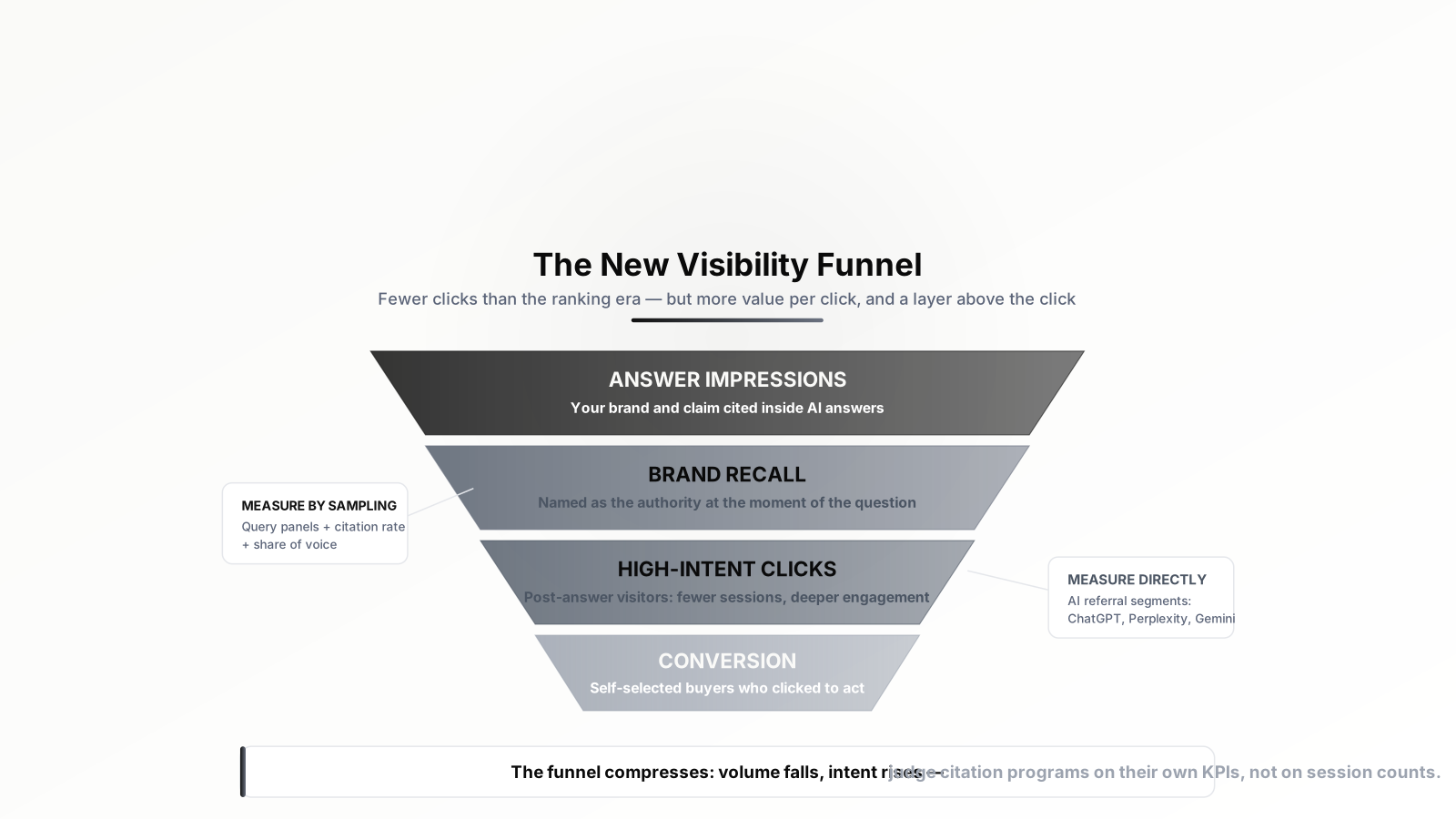
The first piece of good news is intent. The clicks that do come through a citation are post-answer clicks. The user has already read the synthesized response, already absorbed the consensus, and clicked anyway — to verify, to go deeper, to act. That is a self-selected, late-stage visitor. Teams tracking AI referral segments commonly observe stronger engagement and conversion behavior from these visitors than from generic organic sessions, which is exactly what selection effects predict: the answer filtered out the casually curious. Perplexity's referral traffic is the clearest illustration of this pattern — modest in volume, disproportionate in quality — which we examined in our look at Perplexity's real referral traffic.
The second piece of good news is the impression itself. When an AI answer says "according to [your company]'s analysis…" and links you, something happens that a blue link at #4 never accomplished: your brand is presented as an authority inside the trusted surface, attached to a specific claim, at the moment of the user's question. This is closer to earned media than to a search listing. It does not show up in your analytics, it is not clickable in the aggregate, and it is still real: it shapes which brands a buyer recalls when they move from research to shortlist. The honest difficulty is that we cannot yet measure brand-recall effects from AI answers with any rigor — the channel is too new and the surfaces too closed — so this value enters the model as a judgment call, not a number.
So the funnel compresses and re-shapes. Fewer total clicks; higher average intent per click; plus a layer of unmeasured in-answer brand impressions sitting above the click entirely. A defensible 2026 model looks like: (probability of citation per target query) × (answer impressions, estimated) feeding two outputs simultaneously — a smaller, hotter click stream you can measure, and a brand-presence layer you can only sample. Anyone who tells you they can compute exact ROI on the second layer today is ahead of the available instrumentation.
Measuring Citations Today — Methods and Limits
If citations are the new unit of visibility, the obvious next question is how to count them. The honest answer: imperfectly, with three complementary methods, each with known failure modes. Measurement maturity here resembles rank tracking circa 2003 — directionally useful, methodologically rough.
Method 1: Structured query sampling
Define a panel of 50–200 queries that matter commercially — the questions your buyers actually ask. Run them on a fixed cadence (weekly is a reasonable floor) across the surfaces that matter: Google with AI Overviews, ChatGPT Search, Perplexity, Gemini. Record three things per query per surface: whether an AI answer appeared, whether you were cited, and who was cited instead. The output is a citation rate — "we are cited in 23 of 100 panel queries on Perplexity, up from 17 last month" — plus a competitor map.
The limits are real. Answers are non-deterministic, so a single run per query is a coin-flip observation; serious panels run each query multiple times and report a citation frequency. Results vary by logged-in state, location, and history. And the panel is your hypothesis about what matters, which means it inherits your blind spots. Treat the numbers as a sampled estimate with error bars, never as a census.
Method 2: Referral segmentation
The click-through portion of citation value is directly measurable. Build an analytics segment for AI referrers — chatgpt.com, perplexity.ai, gemini.google.com, copilot.microsoft.com — and track sessions, engagement, and conversions for that segment as a distinct channel. This is the hardest number in the whole domain, and it understates reality systematically: it misses every no-click impression, and some AI-originated visits arrive with stripped or ambiguous referrer data. Use it as a floor, not a total.
Method 3: Share-of-voice tracking
The most strategic view borrows from brand tracking: across your query panel, what percentage of all citations go to you versus each competitor? Share of voice converts noisy per-query observations into a portfolio metric that trends meaningfully even when individual queries flip week to week. It also reframes the goal correctly — you are not trying to "rank" for a citation; you are trying to be a larger share of the source mix in your category's answers. Tooling for this is consolidating quickly; platforms with a generative engine optimization lens, Orova among them, now automate the query-panel sampling and share-of-voice computation that teams were running by hand in spreadsheets a year ago.
What you still cannot measure
Three gaps deserve explicit acknowledgment, because strategy built on pretending they don't exist will be fragile. First, true impression volume: no AI surface currently reports how many users saw an answer citing you, with the partial exception of Search Console folding AI Overview impressions into general search data without a clean breakout. Second, no-click influence: the brand-recall effect of being named in answers is unmeasured and may stay that way. Third, training-data presence: whether a model "knows" your brand from training, independent of live retrieval, affects unlinked mentions in ways nobody can audit from outside. Budget accordingly: measure what is measurable, sample what is sampleable, and hold a explicit line item of judgment for the rest.
What This Means for Content Strategy and KPI Design
If the analysis above is right, two operational systems need redesign: the content production model and the KPI stack.
Content strategy: from coverage to citability
The ranking era rewarded coverage — own every keyword in the cluster with an adequate page. The citation era rewards citability, which decomposes into three production disciplines. Original information density: every significant piece should contain something that exists nowhere else — proprietary data, a documented experiment, a named framework, a genuinely independent position — because original passages are the ones synthesis engines need rather than merely tolerate. Passage-level architecture: write so that each H2 or H3 section answers one question completely and quotably, with the direct answer in the first sentence; assume the engine reads sections, not pages. Verifiable authority: named authors with real credentials, claims with sources, dates on everything — the defensibility audit an engine implicitly runs before attaching your claim to its answer. None of this is exotic; all of it is the opposite of the content-velocity playbook that dominated 2019–2023.
It also changes prioritization. Not all queries deserve citation-optimized treatment. Informational and research queries — definitions, comparisons, how-it-works, best-practices — are where AI answers dominate and where citability investment pays. Transactional and navigational queries still resolve largely through classic results and product surfaces, where ranking work retains most of its old value. Mapping your query portfolio by answer-engine exposure, surface by surface — and the mechanics differ meaningfully between surfaces, as our complete guide to AI Overviews details for Google specifically — is the new first step of content planning.
KPI design: a two-layer scorecard
The reporting failure to avoid is forcing citation visibility into click-era KPIs, where it will always look like decline. A workable 2026 scorecard runs two layers in parallel. The classic layer keeps rankings, organic sessions, and organic conversions — still the majority of search-driven revenue for most businesses, still worth defending. The citation layer adds citation rate on the query panel, share of voice versus named competitors, AI-referral sessions and their conversion rate, and a qualitative competitor-citation review. Critically, the citation layer gets its own targets rather than being judged by the classic layer's yardsticks: a citation program judged on session volume will be cancelled in two quarters; the same program judged on share of voice and AI-referral conversion rate will show real, compounding progress.
The Honest Counterarguments
An analysis that only argues one side is a pitch. There are two serious objections to the citations-first thesis, and both deserve steelmanning.
Counterargument one: rankings still drive most of the revenue, today. This is simply true for most businesses in most categories. Classic organic results continue to deliver the bulk of search traffic; transactional queries — where the money concentrates — are the least answer-dominated segment; and a dollar moved from proven ranking work to speculative citation work has a measurable opportunity cost. The strong version of this objection says: citations are a leading indicator of a shift whose timeline is uncertain, and over-rotating early burns budget that compounds slower than ranking budget. A team that fired its ranking program in 2025 to go all-in on citations almost certainly lost money on the trade. The correct response is not to deny this but to size it: the question is portfolio weights, not direction.
Counterargument two: citations are volatile and engine-dependent. Also true. Citation behavior changes when models update, when retrieval pipelines change, when an engine renegotiates a content deal. A citation rate built on one surface's current behavior is a position held at the pleasure of someone else's product roadmap — a riskier asset than a ranking, which at least sits inside a system with two decades of observable change-management. The measurement layer is rough, the answers are non-deterministic, and a share-of-voice gain can evaporate in a model refresh. Anyone constructing precise citation forecasts is doing astrology with better fonts.
What the counterarguments do not support, however, is inaction. Both objections argue for weighting, not avoidance — because the underlying user behavior shift (reading answers instead of scanning lists) is directionally consistent across every surface, and because citability investments degrade gracefully: a page rebuilt for passage-level clarity and original information is also a better-ranking page in the classic system. The downside of early citation investment is mostly measurement frustration; the downside of late investment is absence from the answer layer while competitors accumulate the authority signals that make citation a compounding asset.
Synthesis: Track Both, Weight by Query Type
Pull the threads together and the strategic conclusion is unglamorous but robust: this is not a replacement event, it is a re-weighting event, and the weights vary by query type.
- Informational and research queries: answer engines increasingly own the interface. Weight toward citation work — original information, passage architecture, share-of-voice tracking. Accept lower click volume; harvest the higher-intent residue and the in-answer brand presence.
- Commercial-investigation queries ("best X for Y," comparisons): contested ground, often showing both AI answers and heavily-used classic results. Run both playbooks; this is where dual measurement matters most and where being cited and ranked compounds.
- Transactional and navigational queries: classic ranking and product surfaces still dominate. Keep the ranking machine running at full strength here; citation investment is mostly wasted on queries the engines route to listings anyway.
Operationally: keep the classic SEO program funded, add a citation measurement layer (query panel, referral segment, share of voice), shift net-new content investment toward citability on informational territory, and review the weights quarterly as answer-engine coverage expands. The teams that win this transition will not be the ones who called the shift loudest — they will be the ones who instrumented it earliest, with a scorecard that sees both lists and answers, and reallocated calmly while competitors argued about whether the change was real.
Rankings made search legible for two decades because they gave visibility a unit everyone could count. AI citations are the new unit — harder to count, differently valuable, and increasingly where the actual attention sits. The work now is building the discipline to measure them honestly: sampled, segmented, trended, with the limits stated. That is the discipline Orova was built to automate — tracking your AI citations and share of voice across answer engines alongside your classic rankings — so the re-weighting decision is made from data rather than from whichever conference talk was loudest. Position on a list mattered because users read lists. Users are starting to read answers. Be in them.
Stop Guessing Whether AI Tools Are Citing You
Everything in this piece is doable by hand — you can manually ask AI tools your top customer questions, note whether your site gets mentioned, compare that against your ranking reports, and rebuild your KPI sheet around both. The problem is doing it consistently, across dozens of queries, on a regular schedule, without it eating a full day of someone's week every month.
That's the gap Orova SEO is built to close — it automates the process of checking whether your content is actually being cited by AI answer engines, alongside your regular search visibility, so you get one clear picture instead of two disconnected reports. If tracking this by hand sounds like more busywork than your team has time for, it's worth taking a look at how Orova SEO handles it.
Related reading: AI Visibility Tracking: A Framework That Actually Works
Let Orova SEO handle the repetitive part
Keyword research, drafting, refreshing old posts and rank tracking — running automatically on your own site.
Explore Orova SEO