
Closing the Loop: AI Marketing Automation Tools That Act
You already have the dashboards. Analytics on every page, attribution on every campaign, screens on the wall — and still, when a number turns red, nothing actually happens for days. Someone has to notice it, someone has to decide what to do about it, and someone has to be free enough that week to do it. Most marketing teams don't have a reporting problem anymore; they have a "we saw the problem three weeks ago and still haven't fixed it" problem.
This is where most ai marketing automation tools quietly fall short. Alerts tell you something changed, but you still have to figure out what to do and who will do it. Rule-based automations can act, but only for the narrow, repetitive cases someone thought to program in advance — the moment a situation is even slightly new, the automation stalls and a human has to step in anyway. Either way, the gap between "we know" and "we did something" stays wide open, and that gap is where budget, traffic, and revenue quietly leak out — and the leak is only getting bigger now that 68% of US Google searches end without a click at all, up from 60% just two years ago (SparkToro).
This article looks at what it actually takes to close that gap — not with more dashboards, but with tools that can propose a specific fix, let a human sign off on it, and carry it out. By the end, you'll understand what separates a system that only reports from one that genuinely takes action, what to watch out for before trusting any tool with real decisions, and what changes in your day-to-day once that waiting period disappears.
The stack we built stops in the middle
Consider what a marketing decision actually consists of, end to end. Five stages, every time: data is collected; the data is interpreted into an insight ("conversion rate on this page fell"); the insight becomes a decision ("rewrite the form"); the decision becomes an action (someone actually rewrites the form); and the action's outcome feeds back into the data, completing the loop.
Now overlay the software industry onto those five stages. Stage one — collection — is saturated: tagging, pipelines, warehouses, connectors. Stage two — interpretation — is half-saturated: dashboards, anomaly alerts, attribution models, all competing to present the insight more vividly. Stages three, four and five — decision, action, feedback — are, in the overwhelming majority of marketing teams, performed entirely by hand or not at all. The stack was built left to right, and construction stopped in the middle.
Why did it stop there? Not because nobody noticed the gap. It stopped because the left half is a software problem and the right half was, until recently, a judgment problem. Displaying a number requires engineering. Deciding what the number means for this business, choosing among responses, and taking responsibility for the choice requires context, reasoning in natural language, and accountability — properties software did not have. So the industry optimised what it could optimise: ever-prettier renderings of the same undecided information. The dashboard is not the summit of marketing technology. It is the high-water mark of what was buildable before reasoning got cheap.
Decision latency: the metric nobody puts on the dashboard
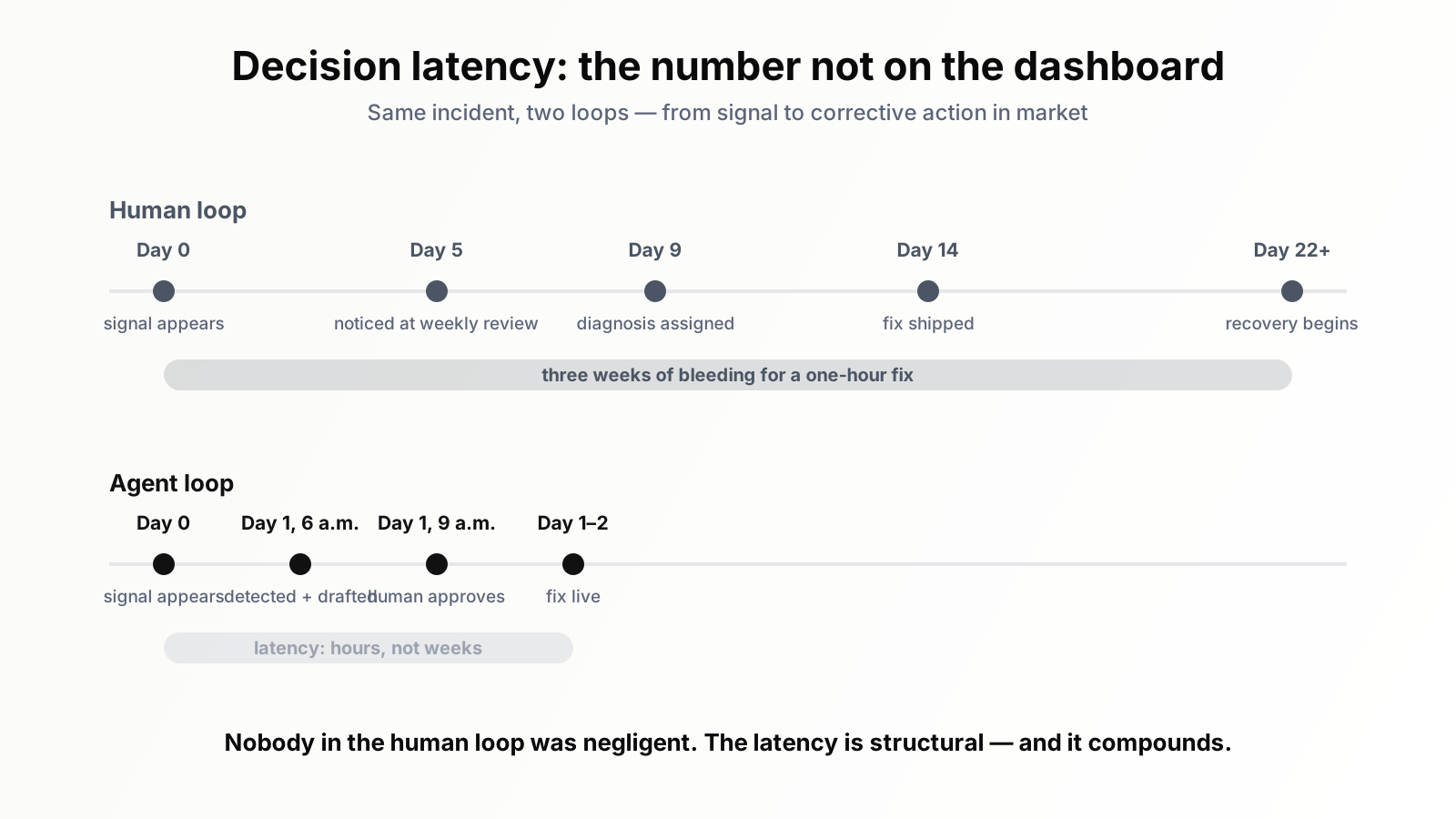
Let us give the gap a name and a unit. Decision latency: the time between a signal appearing in the data and a responsive action landing in the market. It is measured in days, and in most organisations nobody measures it at all — which is ironic, given how much of its cost compounds daily.
Walk through a typical incident honestly. A tracking-visible problem begins on day zero — say, a top page's click-through collapses after a competitor wins the snippet above it. The data records it immediately; dashboards are honest. But detection waits for a human to look at the right chart with the right comparison, which realistically happens at the weekly review: day five. Diagnosis gets assigned, lands in someone's queue behind the campaign launch: day nine. The fix — a rewritten title, a refreshed intro — is drafted, reviewed, and shipped: day fourteen. Search engines re-crawl and the recovery begins: day twenty-something. Three weeks of bleeding for a one-hour fix, and at no point did anyone behave negligently. Every individual acted reasonably within a system whose latency is structural, not personal.
Now multiply. A site has hundreds of pages and dozens of campaigns; signals worth acting on appear continuously, not occasionally. A team whose loop takes three weeks is not running one three-week delay — it is running a rolling backlog of decaying opportunities, of which it will ever address the loudest few. The quiet majority — the mid-tail pages losing ground, the ad sets drifting into inefficiency, the queries rising with no page to land on — simply never reach the threshold of human attention. This is the real cost of the open loop, and it never appears on any report, because the report would have to measure the actions not taken.
Alerts and automations: two half-answers that prove the point
The industry has produced two partial responses to decision latency, and analysing why each falls short clarifies what an actual answer requires.
The first is the alert. Threshold crossed, email sent: detection latency drops to near zero. But an alert merely relocates the human bottleneck from "noticing" to "responding." The insight still arrives undecided — no diagnosis, no proposed action, no draft — so the expensive stages remain exactly where they were, in a person's queue. Worse, alerts scale terribly: tighten the thresholds and the inbox becomes noise that trains the team to ignore it; loosen them and you are back to weekly-review latency. Most mature teams' relationship with their alerting is quiet, guilty muting.
The second is the rule-based automation: if cost per result exceeds X for three days, then pause the ad set. Rules genuinely close the loop — but only for decisions so mechanical that they could be specified in advance, by a human, covering every contingency. The moment a situation needs interpretation — is this spike a tracking glitch, a seasonal pattern, or a real collapse? does this page need a new title or a new paragraph? — the rule has nothing to say. Rules automate the bottom decile of decisions and leave the rest untouched. They are vending machines, not colleagues.
Put the two failures side by side and the requirement becomes visible. Closing the loop needs a system that can interpret an undecided signal (which alerts cannot), compose a context-appropriate response rather than select from a preset menu (which rules cannot), and still keep a human's judgment and accountability attached to consequential changes (which full autonomy must not discard). That three-part requirement is, more or less, the definition of an agent.
What an agent adds: the three missing layers
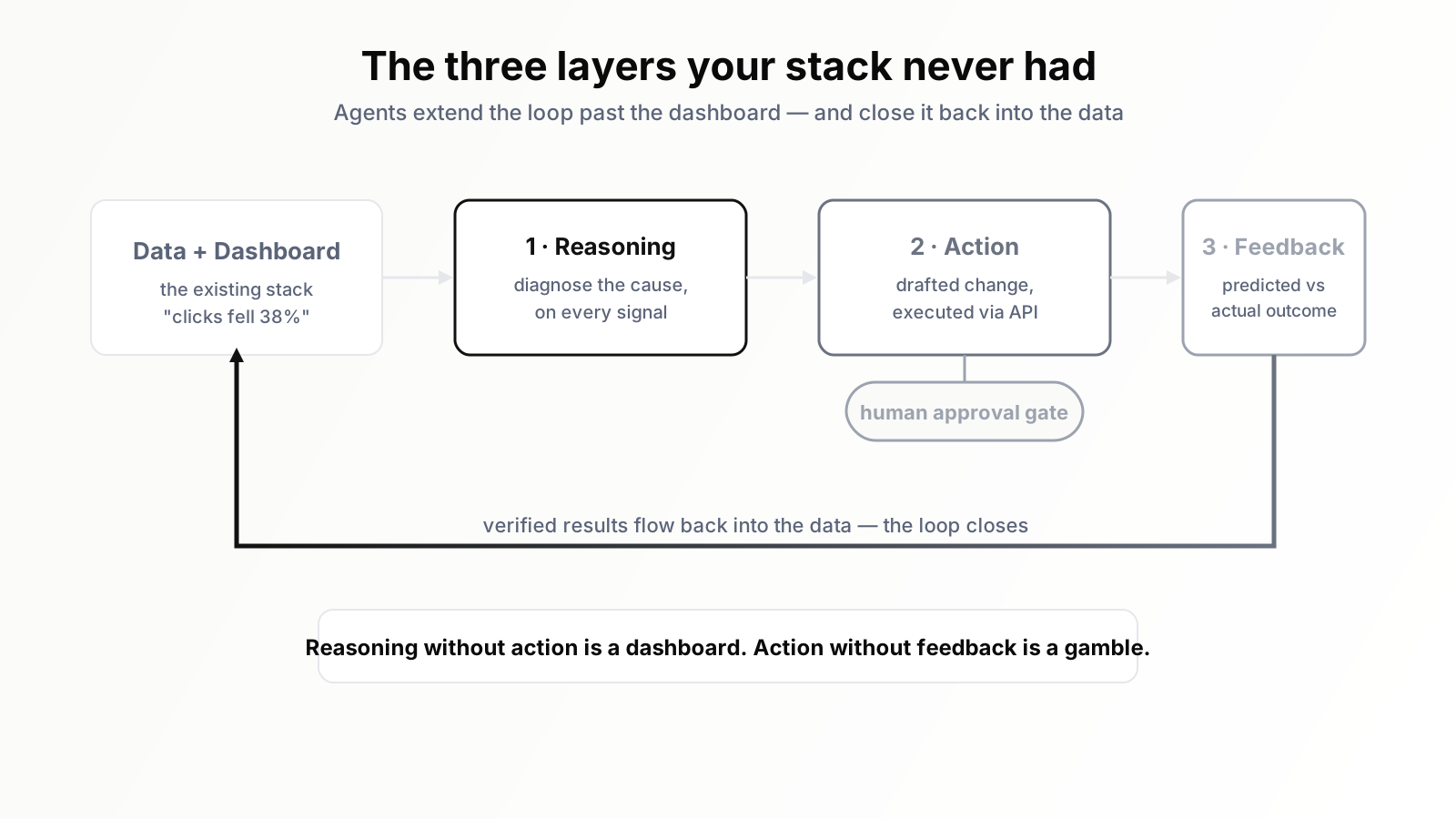
Strip away the branding and an AI agent contributes exactly three layers on top of the existing analytics stack — the three the stack always lacked.
First, a reasoning layer. Where the dashboard says "clicks fell 38 per cent," the agent continues the sentence: this page lost position on these queries; the cause pattern matches a competitor change rather than a sitewide problem; the page's title underperforms its ranking, suggesting a snippet-level fix. This is interpretation — the work an analyst would do, performed on every signal rather than the escalated few. We walked through what this looks like hour by hour in our anatomy of an agent's working day.
Second, an action layer. The reasoning terminates in a fully drafted, executable change — the rewritten title itself, the specific budget adjustment with old and new values — applied through official platform APIs once approved. This is the layer that converts insight into market-facing change without a handoff into somebody's backlog, and it is what separates agents from every generation of analytics before them. The flavour differs by domain — content and technical fixes on the SEO side, as covered in what an SEO AI agent is; budgets, bids and creative rotation on the paid side, as covered in what an AI ads agent does — but the architecture is identical.
Third, and least discussed, a feedback layer. Every action carries a predicted effect, and the agent checks predictions against outcomes on a schedule. This is the loop's final arc, the one human teams almost never complete because revisiting old decisions is nobody's job. Its absence is why so much marketing "knowledge" is folklore — beliefs about what works, unaudited for years. A closed feedback layer slowly replaces folklore with a verified, account-specific record of which interventions actually move which metrics. In our assessment this layer, not the automation, is where the durable competitive value sits: execution speed can be copied; an accumulated archive of verified cause-and-effect on your own properties cannot.
The governance question, treated as architecture
The standard objection arrives on cue: "I am not letting software spend my budget unsupervised." Correct instinct — wrong conclusion if it ends the analysis, because supervision is not the opposite of agency. It is a parameter of it.
The architectural insight is that deciding and approving are separable stages, and they always were. In a human team, the junior strategist proposes and the director approves; nobody calls the director a bottleneck, because review of a fully drafted proposal is fast, while the research and drafting behind it are slow. Agents inherit the same division: the agent performs the slow part — reading everything, diagnosing, drafting — and the human performs the fast part, judgment over a finished proposal. A day's worth of agent output gets reviewed in minutes precisely because it arrives decided-but-not-executed. The loop's latency collapses from weeks to roughly the interval between queue reviews, while a named human remains attached to every consequential change. This review-then-act pattern is how Orova ships its own SEO and Ads agents across Google, Meta and TikTok — proposals queue with their reasoning and predicted effects, and nothing consequential moves without a human click — which is less a safety compromise than the reason real teams adopt it at all.
Permission tiers complete the picture. Action types differ by blast radius, so mature deployments tier them: trivially reversible changes may earn autonomy within guardrails; budget-touching changes always queue; anything novel queues by default. The tiers are set by the team and widened with evidence from the feedback layer — autonomy as a budget that is earned, not a switch that is flipped. Analysed this way, the governance question stops being "agents: yes or no?" and becomes the much more tractable "which action types, at which thresholds, with whose sign-off?" — a question marketing managers are already qualified to answer.
What changes structurally when the loop closes
Suppose a team deploys this and it works. What actually changes? Three things, in ascending order of importance.
First, the obvious one: coverage. The long tail of signals that never previously cleared the attention threshold — the mid-tail pages, the modest campaigns, the slow drifts — starts receiving the same daily inspection as the headline assets. Compounding small corrections across hundreds of assets is unglamorous, and it is where a surprising share of agent value accrues, because it is the work that was never going to be done otherwise.
Second, the meeting changes. When detection, diagnosis and drafting happen continuously, the weekly review stops being a discovery session ("what happened?") and becomes a judgment session ("here is what happened, here is what was done, here is what awaits approval, here is what the verification log says about last month's changes"). Teams report this shift as the moment the agent stopped feeling like a tool and started feeling like a colleague who pre-reads the data. The human conversation moves up a level — from retrieving facts to setting direction — which is where human conversation was always supposed to live.
Third, and slowest: the knowledge asset. Month over month, the feedback layer accumulates something no dashboard ever produced — a verified causal history of the account. Which title patterns lift click-through on this site, by how much. Which budget moves held their efficiency and which decayed. Which content refreshes recovered rankings and which were wasted effort. Strategy formation starts drawing on this archive instead of on memory and conference wisdom. The organisation, for the first time, learns at the same speed it acts.
The failure modes, because an analysis owes you those
Closing the loop badly is worse than not closing it, and the failure modes are predictable. Garbage in, executed fast: an agent pointed at broken conversion tracking optimises toward the lie with mechanical diligence — instrumentation quality becomes more critical after deployment, not less. Metric myopia: a loop closed around a single KPI will sacrifice everything off-dashboard to feed it, which is why objectives need constraints, not just targets, and why zero-click-era measurement subtleties — the kind we explored in our piece on zero-click value — must be encoded, not assumed. Rubber-stamping: an approval queue reviewed carelessly converges on full autonomy without anyone deciding that; the mitigation is cultural, not technical — rejection with reasons must stay a normal, expected act. And thrash: an over-eager loop that edits campaigns hourly fights the platforms' own learning periods; good agents act on platform-appropriate rhythms, which sometimes means the correct daily action is none.
None of these is exotic. They are the same failures any powerful delegation invites, and the same management disciplines answer them: clean inputs, well-specified objectives, genuine review, sensible cadence.
A short exercise in latency arithmetic
Because "weeks of latency" is abstract, it is worth running the arithmetic on a generic but realistic case. Take a content site earning 100,000 organic sessions a month across 400 pages, converting at a blended 1.5 per cent into leads worth, say, a modest sum each. Performance signals worth acting on — a snippet lost, a page decaying, a rising query with no landing page, a campaign drifting — arrive at perhaps ten per week across a property that size, most of them small. Suppose the median one, addressed promptly, protects or adds half a per cent of monthly traffic, and that a three-week open loop means the median signal is either addressed late or never.
Run that for a quarter. Ten signals a week is roughly 130 a quarter; a human team operating by escalation realistically actions the top fifteen or twenty. The remaining hundred-plus decay or expire unaddressed — not because anyone decided they were unimportant, but because the loop's throughput is capped by human attention. Even if you assume the unaddressed signals were each worth only a fraction of the addressed ones, the aggregate forgone value runs to a meaningful percentage of total organic performance, every quarter, indefinitely. The point of the exercise is not the precise numbers — yours will differ — but the shape: open-loop cost is a throughput problem multiplied by time, which is exactly the kind of cost that compounds quietly and never triggers an incident review.
Now price the closed-loop alternative against it. The agent's marginal cost per additional signal handled is near zero; the human cost is a few minutes of queue review per day. The crossover point — where an agent loop beats a purely human loop on handled-signal economics — arrives at a property size far smaller than most managers assume. This is why the earliest enthusiastic adopters have not been enterprises but lean teams running more assets than headcount: agencies with many small clients, solo operators with large sites, in-house teams of two doing the job of six.
Questions that separate a closed loop from a chat box
If this analysis persuades you to evaluate the category, take the five-stage loop with you as an interrogation framework, because the market label "AI agent" is currently applied to everything from genuine closed loops to dashboards that added a chat box. Four questions do most of the filtering. Where does the system's data come from, and does it validate those inputs daily? Show me a drafted action: does it contain the specific change, the reasoning, and a predicted effect, or just advice? What exactly happens between draft and execution — whose approval, recorded where, reversible how? And who checks the predictions afterwards — is there a verification log I can read?
A system with good answers to all four is operating on the right-hand side of the dashboard, where the unclaimed value sits. A system that answers only the first is the old stack in a new costume — interpretation without action, insight without consequence, the same open loop with better conversation.
The dashboard was a waypoint, not a destination
For fifteen years, "data-driven marketing" meant building an ever-better left half of the loop and staffing the right half with tired humans. That was not a philosophy; it was a constraint — reasoning and acting were not things software could do, so we displayed, and we decided by hand, and we called the gap between them a meeting.
The constraint has lifted. The analytical question for any team now is not whether the loop can close — it demonstrably can — but how much decision latency your particular operation is paying, and what that costs you against a competitor who has stopped paying it. Audit one month of your own incidents: when did each signal appear in the data, and when did the responsive action ship? If the median gap is measured in weeks, you have found the most expensive number in your stack, and it has never once appeared on the dashboard.
And that, in the end, is the cleanest way to think about this category. Agents are not a new way to see your marketing — you can already see everything. They are the first credible answer to the question the dashboard has been silently asking for fifteen years: you can see it — so when, exactly, were you planning to do something about it? The teams that answer "within the day, with a human's signature on every change" will spend the next few years quietly collecting the value the rest of the industry leaves decaying between the chart and the meeting.
The part worth handing off
Doing this by hand means someone on your team has to watch the numbers every day, notice the moment something slips, decide what the fix should be, and then go make the change across however many platforms you use. That's not a one-time task — it's an ongoing job that eats hours every single week, and it's the reason so many good insights sit in a dashboard unactioned.
Orova SEO is built to take on exactly that part: watching for the changes that matter, drafting a specific action, and letting you approve it before anything goes live. If the idea of closing that gap without adding headcount sounds useful, it's worth taking a look and seeing how it fits into what you already run.
Read next: Automated Rules vs AI Agents: When to Use Each · Google Ads Optimization: 200+ Actions an AI Agent Can Do · What Is an AI Ads Agent? Autonomous Ad Management Explained · AI Ads Agent Setup: What to Do in Your First Week
Let Orova SEO handle the repetitive part
Keyword research, drafting, refreshing old posts and rank tracking — running automatically on your own site.
Explore Orova SEO