
How to Build Topical Authority for SEO in One Quarter
You have a new section on your site, or an old one that never took off, and you know it needs a real content plan — not just a list of blog titles pulled from a keyword tool. So you sit down to build topical clusters for SEO, and within an hour you are staring at forty possible subtopics with no idea which ten actually matter, or whether you are supposed to cover the whole market before Google will take you seriously.
The usual advice tells you to "cover the topic comprehensively" and "build authority over time," which is true and completely unusable on a Monday morning. So most businesses either try to cover everything at once and spread their few writing hours across too many pages, none of which rank, or they publish at random and hope volume eventually looks like authority. Both waste a quarter's worth of work for the same result: no rankings, no clicks, no proof it was worth doing — and the margin for error is shrinking, since 68% of US Google searches in the first four months of 2026 ended without a click at all, up from 60% in 2024 (SparkToro).
This article is the plan we actually ran, week by week, starting from zero — including the narrow slice of the topic we chose first, what we published and when, what flopped, and how we knew it was working before the traffic numbers caught up. Read it and you will know exactly how to pick your starting territory, what to publish in your first weeks versus your last, and how to tell real progress from vanity metrics.
The decision that did most of the work: shrinking the territory
The original brief was broad — "let's own [our category] content." That brief fails before it starts. Topical authority is not a measure of how much you publish; it is, as far as anyone can observe from the outside, a measure of how completely you cover a coherent territory relative to everyone else. Against incumbents with eight years and three thousand URLs of head start, a broad territory means competing at 2% coverage versus their 60%. You cannot out-comprehensive an incumbent on their own map. You can only redraw the map.
So the first two weeks involved no writing at all. We took the broad category and kept subdividing it until we found a sub-territory that passed four tests: real search demand (a few thousand monthly searches across all its queries, not millions); weak incumbency (the current page-one results were generic chapters of broad sites, not dedicated specialists); genuine product adjacency (people searching this would plausibly become our users — authority that attracts the wrong audience is a vanity project); and finite scope (we could enumerate the territory's questions, and the list had an end).
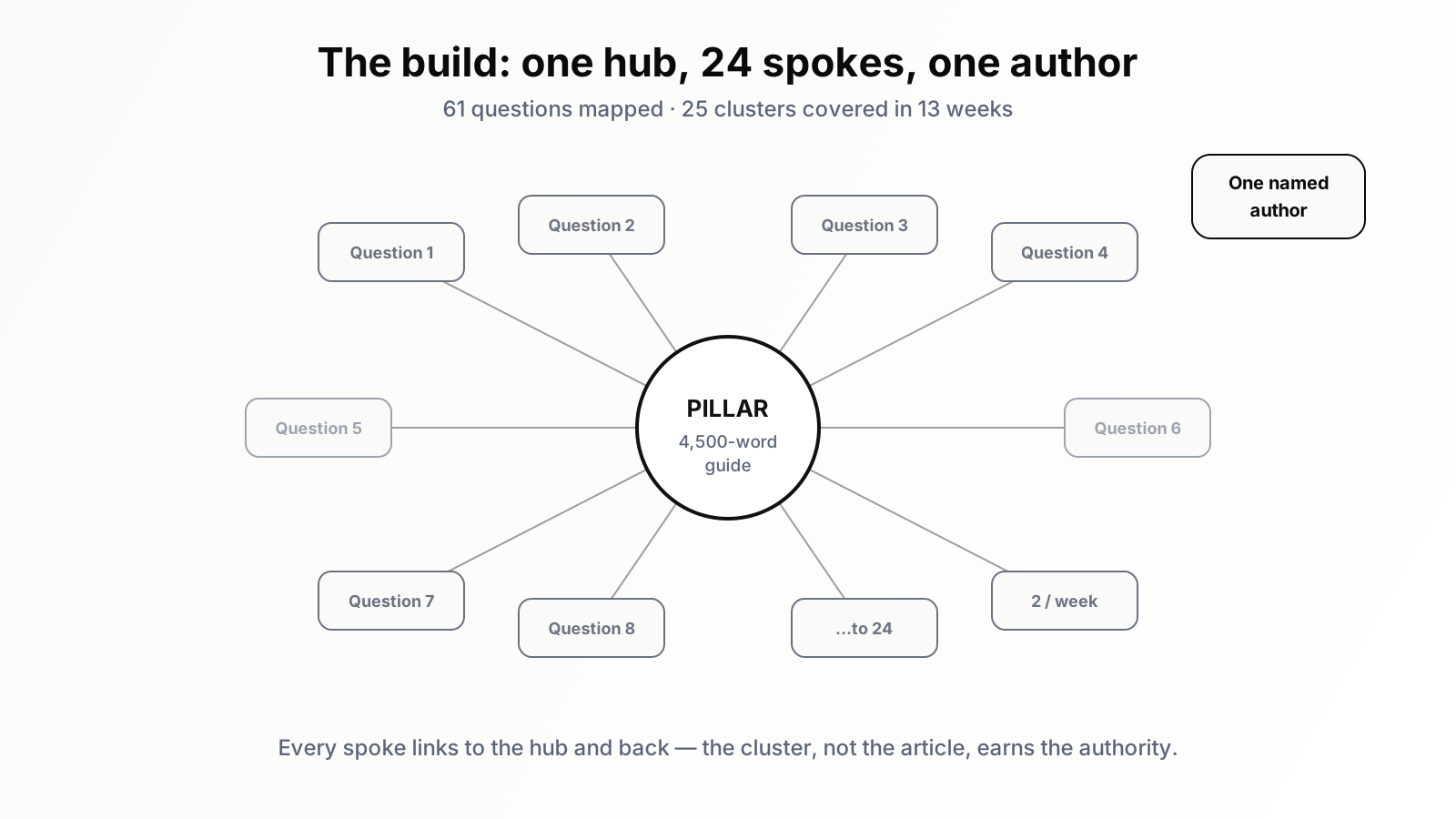
That last test deserves expansion, because it became our actual definition of the project. We mined every question source we could: autocomplete, People Also Ask chains, Reddit and community threads, support tickets, sales-call notes, and the query data from our own existing Search Console for anything tangentially related — the method from our piece on mining question keywords, applied with obsessive completeness. Then we deduplicated and clustered. The result was a spreadsheet of 61 distinct questions that, together, constituted essentially everything a person in this sub-territory wants to know. Sixty-one is the magic kind of number: large enough to matter, small enough that one quarter of disciplined publishing could cover most of it. When your territory's question list is finite and you can see the bottom, "comprehensive" stops being a slogan and becomes a checklist.
The architecture: hub, spokes, and one human
Structure came before any article was drafted, and we kept it deliberately textbook. One pillar page sits at the centre — the long, definitive guide to the whole sub-territory, the page we would want to rank for the head term eventually. Around it, supporting articles each own one question cluster from the spreadsheet: typically one primary question plus three to five sibling phrasings that belong on the same page. Every supporting article links up to the pillar with descriptive anchors; the pillar links down to every spoke; spokes cross-link where the subject matter genuinely connects. Nothing exotic — it is the hub-and-spoke model executed without improvisation, for the reasons laid out in our case that topic clusters beat standalone posts: the cluster, not the article, is the unit that machines learn topical association from.
The one structural decision I will defend hardest is this: every article carried the same byline, and we built that author's profile before publishing anything. Real bio with real history in the field, links out to LinkedIn and two past conference appearances, Person schema with sameAs, the works — the full standard from our E-E-A-T breakdown. From zero, a site has no topical track record; a credible named human is the only E-E-A-T asset you can deploy on day one. Sixty articles by "Team" is content. Sixty articles by one consistent, verifiable specialist is the visible formation of an expert — and machines doing authorship resolution can see the difference as clearly as readers can.
Cadence: two articles per week, every week, plus the pillar shipped in week three. We chose two-per-week over a big-bang launch deliberately — partly for quality control with a team of effectively 1.5 people, partly because we wanted a continuous publishing signal rather than a spike followed by silence. Each article had a floor of genuine usefulness: answer the question directly in the first hundred words, then go deeper than anything currently ranking, with first-hand specifics — our own screenshots, our own test data, actual numbers — in every single piece. That floor was non-negotiable, and it is the unsexy half of why this worked.
What the quarter actually looked like, week by week
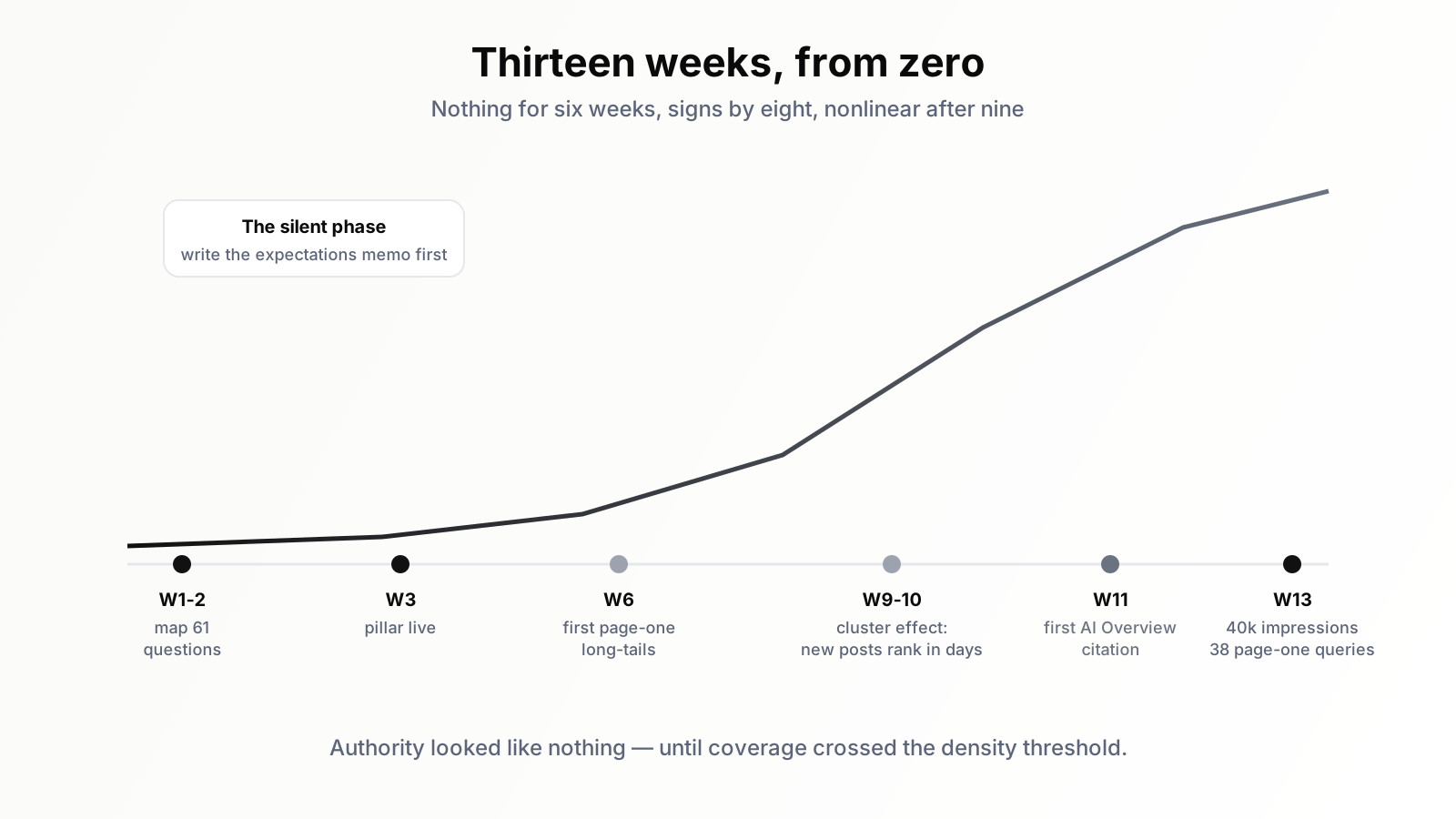
Weeks 1–2: zero publishing. Territory selection, the 61-question spreadsheet, cluster mapping, author profile build, templates for article structure and schema. It felt like stalling. It was the highest-leverage fortnight of the quarter.
Weeks 3–5: foundation. Pillar live in week three (about 4,500 words, honestly the hardest deliverable of the project), six spokes around it. Indexing was prompt but rankings were nowhere — impressions in the low hundreds per week, average position floating in the 40s–60s. This is the phase where content programs usually lose their executive sponsor, so we had set expectations in writing beforehand: nothing meaningful before week six. Write that memo before you start. You will need it.
Weeks 6–8: first signs. Around week six, a handful of long-tail spokes jumped from page four to the top of page two, and a couple of true long-tails — query phrasings with maybe 50 searches a month — hit page one. Impressions crossed 2,000 a week. More important than any ranking: Search Console began showing us the queries we were almost visible for, which became the steering wheel for everything after. We started a weekly one-hour ritual — pull queries with impressions but poor position, find the spoke that should own each, improve that spoke or note a gap in the spreadsheet. Several of our best-performing sections were never in the original plan; the data told us to write them.
Weeks 9–11: the cluster effect. This is where something nonlinear happened, and I want to describe it carefully because it is the observable substance behind the phrase "topical authority." New articles started ranking in days rather than weeks, and entering at position 15–25 rather than 50. Older spokes moved up without us touching them. The pillar — which had loitered on page three for a month — climbed to position 8 for the head term. Nothing about our process changed in those weeks; what changed, as far as we can tell, is that coverage crossed some threshold of density at which the site stopped being judged article-by-article and started being treated as a known specialist in the territory. Week eleven delivered the screenshot: one of our spokes cited in an AI Overview for a question-phrased query, traffic from which was modest but symbolically enormous — the selection dynamics from the AI Overviews playbook working in our favour for the first time.
Weeks 12–13: consolidation. Publishing slowed to one new piece a week; the reclaimed time went into refreshing the six oldest spokes with what we had learned, tightening internal anchors, and adding an FAQ block to the pillar built from PAA questions we still didn't own. End-of-quarter tally: 25 of the 61 clusters covered to our quality floor, roughly 40,000 monthly impressions, about 1,100 monthly clicks, 38 queries on page one, one AI Overview citation, and — the number I care most about — a question spreadsheet that now steered itself from real data instead of guesswork.
What didn't work, because those lessons cost the most
Three failures, recorded against my own future enthusiasm.
The launch-week link push. We spent real effort in weeks three and four pitching the pillar for links — outreach emails, a couple of communities, one newsletter placement. Almost nothing landed. In hindsight the reason is obvious: we were asking strangers to endorse a guide with no track record from a site with no standing in the territory. The links that did eventually arrive — unprompted — came in weeks ten through thirteen, after rankings made us findable and the cluster made us look like the specialist. Lesson: from zero, links are a lagging output of authority, not an available input to it. Budget that effort into the back half.
Two "trophy" articles. Early on we wrote two pieces aimed at broad, prestigious head terms outside our shrunken territory, because they felt important. Both sank without trace and still rank nowhere. Every hour on them was an hour not spent on the spreadsheet. The territory boundary is the strategy; honour it.
Underestimating refresh value. We treated updating as a week-12 luxury. The first time we refreshed an old spoke with better data and tighter answers, it moved four positions in a fortnight — cheaper gains than any new article. Should have started the refresh ritual at week six, the moment Search Console had anything to say.
How we measured "authority" without fooling ourselves
Topical authority has no official metric, which makes it dangerously easy to declare victory by anecdote. We forced ourselves onto four proxies, reviewed in the same weekly hour, and I recommend all four because each one catches a different kind of self-deception.
Coverage ratio. Clusters covered to the quality floor, divided by total clusters in the territory — the spreadsheet made this a simple count, 25 of 61 by quarter's end. This is the input metric, the only one fully under your control, and tracking it keeps the team honest about whether slow results reflect a slow algorithm or simply unfinished work.
Entry behaviour of new articles. For every new spoke: days to first impression, and average position in its first full week. This turned out to be the most sensitive instrument we had. In weeks three through five, new articles took roughly two weeks to register and entered around position 50. By week ten, they registered within two or three days and entered in the teens and twenties. Nothing measures "the site is now trusted on this topic" more directly than how the system treats your next article before anyone has linked to it.
Share of question list with page-one presence. Crude, binary, motivating — 0 of 61 in January, 9 by week nine, 17 by quarter's end (38 page-one queries spread across those 17 clusters). It maps the coloured-in portion of the territory and shows stakeholders progress in a form that needs no explanation.
What the machines say when asked. Monthly, we asked ChatGPT, Gemini, and Perplexity the territory's ten most important questions and recorded whether we were cited, plus what each engine answered when asked who the good sources on the topic were. January: invisible, all engines. By April: cited by Perplexity on three of the ten questions, one ChatGPT Search citation, and that single AI Overview. Small absolute numbers — but the direction was unambiguous, and this log is the closest thing we have to watching an entity acquire a reputation in real time.
Questions I keep getting about this project
How big was the team, really? One writer-strategist at roughly 60% allocation — me — plus a subject-matter colleague for about four hours a week of interviews, reviews, and "actually, in practice it works like this" corrections, plus occasional design help for diagrams. Call it 1.5 people. The constraint shaped the strategy: two articles a week at a real quality floor was our ceiling, which is precisely why the territory had to be small enough for that cadence to achieve comprehensiveness within a quarter. A bigger team should widen the territory, not the weekly volume per territory.
Would this work in a brutally competitive niche? The method, yes; the timeline, no. Our four territory tests would simply fail on "weak incumbency" for most sub-territories of, say, personal finance — and the honest response is to keep subdividing until you find the seam where the tests pass, even if that seam looks uncomfortably narrow. There is almost always a seam. If genuinely every corner of your market is saturated by specialists, a quarter of content will not fix that, and pretending otherwise is how budgets get burned.
Could AI have written the 25 articles? It drafted parts of several — outlines, restructuring, tightening — and that genuinely helped the cadence. But the load-bearing element of every article that worked was the part no model could supply: our screenshots, our test numbers, the practitioner corrections from those weekly interviews. Strip those and we would have shipped 25 competent summaries of the existing page one — which is exactly the content that answer engines now generate themselves, and exactly what they have no reason to cite. The leverage was never the prose. It was the evidence.
What happens to the section now? The remaining 36 clusters get covered at a relaxed one-per-week, refreshes run on a standing rotation, and the author keeps accumulating external footprint — a guest piece and a podcast already booked off the back of the quarter's visibility. Authority from zero was a thirteen-week project; staying the territory's reference is a permanent, cheaper one.
Why this worked: the honest mechanics
Strip the narrative and I think five factors carried the result, in this order of importance. First, territory selection — picking a fight we could win made every later hour count double; this was 50% of the outcome and it happened before any content existed. Second, finite comprehensiveness — covering 40% of a small map beats covering 2% of a big one, because machines measuring coverage density can actually detect the former. Third, structural discipline — the hub-and-spoke wiring meant every article reinforced every other instead of floating alone. Fourth, one verifiable human — the consistent byline gave all 25 pieces a shared credibility account to deposit into. Fifth, data-steered iteration — from week six, Search Console chose our priorities better than our instincts had, and the willingness to be steered was worth more than any individual article.
Notice what is absent from that list: publishing volume for its own sake, link buying, any clever trick. The quarter contained no secret. It contained a small map, a checklist, a calendar, and the refusal to deviate — which, I have come to believe, is what "building topical authority" has meant all along. The phrase sounds like alchemy and operates like bricklaying.
The two things I would do differently
Every retrospective owes its reader the regrets, so here are mine, ranked. First: start the Search Console ritual at week four, not week six, and the refresh work at week six, not week twelve. We left easy gains on the table for a month because "publish new things" felt like progress and "improve old things" felt like housekeeping; the data said housekeeping paid better per hour from the moment it had anything to work with. Second: record the baseline more obsessively. We captured rankings and impressions at week zero, but I wish we had archived full screenshots of what the AI engines said about the territory and about us before we began — the before-and-after would now be the most persuasive artefact the project produced, and we reconstructed it only partially from memory and one lucky export. Authority-building is slow enough that the evidence of change becomes a deliverable in itself; collect it like one from day zero.
If you are starting from zero on Monday
The transferable plan, compressed: spend two silent weeks shrinking your territory until its question list is finite and its incumbents are generalists. Build the author before the articles. Ship the pillar early, then two genuinely useful spokes a week, each answering its question in the first hundred words with first-hand evidence somewhere in the body. Wire every link in the cluster deliberately. From week six, hold a weekly hour with Search Console and let the data reorder your backlog. Do not chase links, trophies, or adjacent territories until the map is mostly coloured in. Expect nothing for six weeks, signs by eight, and — if your territory selection was honest — the nonlinear part somewhere after week nine.
The ongoing version of that weekly hour is the part we have since automated: Orova watches the query data, flags the spokes losing ground, surfaces the questions we still don't own, and turns the steering ritual into a standing report — the bricklaying continues, just with fewer meetings.
Doing This by Hand Is Where the Quarter Disappears
If you try to run this yourself, the strategy part — picking the narrow territory, mapping hub and spokes — takes an afternoon. What eats the quarter is everything after: researching each subtopic properly, keeping the internal links consistent as the section grows, checking what is ranking versus stalling, and doing it all again next month without losing track of what you already covered.
That is the part Orova SEO is built to take off your plate — it handles the repetitive research, structuring, and tracking work behind a topical cluster so you can spend your time on decisions, not spreadsheets. If this kind of quarter sounds like something your business needs but not something you have the hours for, it is worth a look.
Let Orova SEO handle the repetitive part
Keyword research, drafting, refreshing old posts and rank tracking — running automatically on your own site.
Explore Orova SEO