
Structured Data: How to Win Rich Results Without a Developer
Search results used to be a stack of blue links. They are not any more. Open Google for almost any practical query and you will see star ratings, recipe cards with cook times, FAQ accordions, event dates, product prices, breadcrumb trails, and answer panels. These enriched listings — Google calls them rich results — take up more space, draw more attention, and quietly push the plain ten blue links further down the page. If your listing is one of the plain ones, you are competing for clicks against listings that are visually louder than yours.
The mechanism that produces rich results is called structured data. And here is the part most teams get wrong: they assume structured data is a developer project — something that requires engineering tickets, a sprint, and a backlog negotiation. It does not. Structured data is a vocabulary and a format. Once you understand both, you can add it to your pages, validate it, and earn rich results without writing a single line of application code or waiting on anyone. This article shows you how.
What structured data actually is
Structured data is a standardised way of describing the content of a page to a machine. A human reading your page sees a recipe and instantly understands "this is a recipe, it serves four, it takes forty minutes, here are the ingredients." A search engine reading the same raw HTML sees text, headings, and images — it can guess, but it cannot be certain. Structured data removes the guessing. It is a small block of labelled facts, attached to the page, that says explicitly: this is a Recipe; its name is X; its cook time is Y; its rating is Z.
The vocabulary almost everyone uses is Schema.org — a shared dictionary of types (Article, Product, Recipe, Event, FAQPage, Organization, BreadcrumbList, and hundreds more) and properties for each type. Schema.org is not owned by Google; it is a collaboration between Google, Microsoft, Yahoo, and Yandex. That matters because it means structured data is a stable, multi-engine standard, not a single vendor's whim.
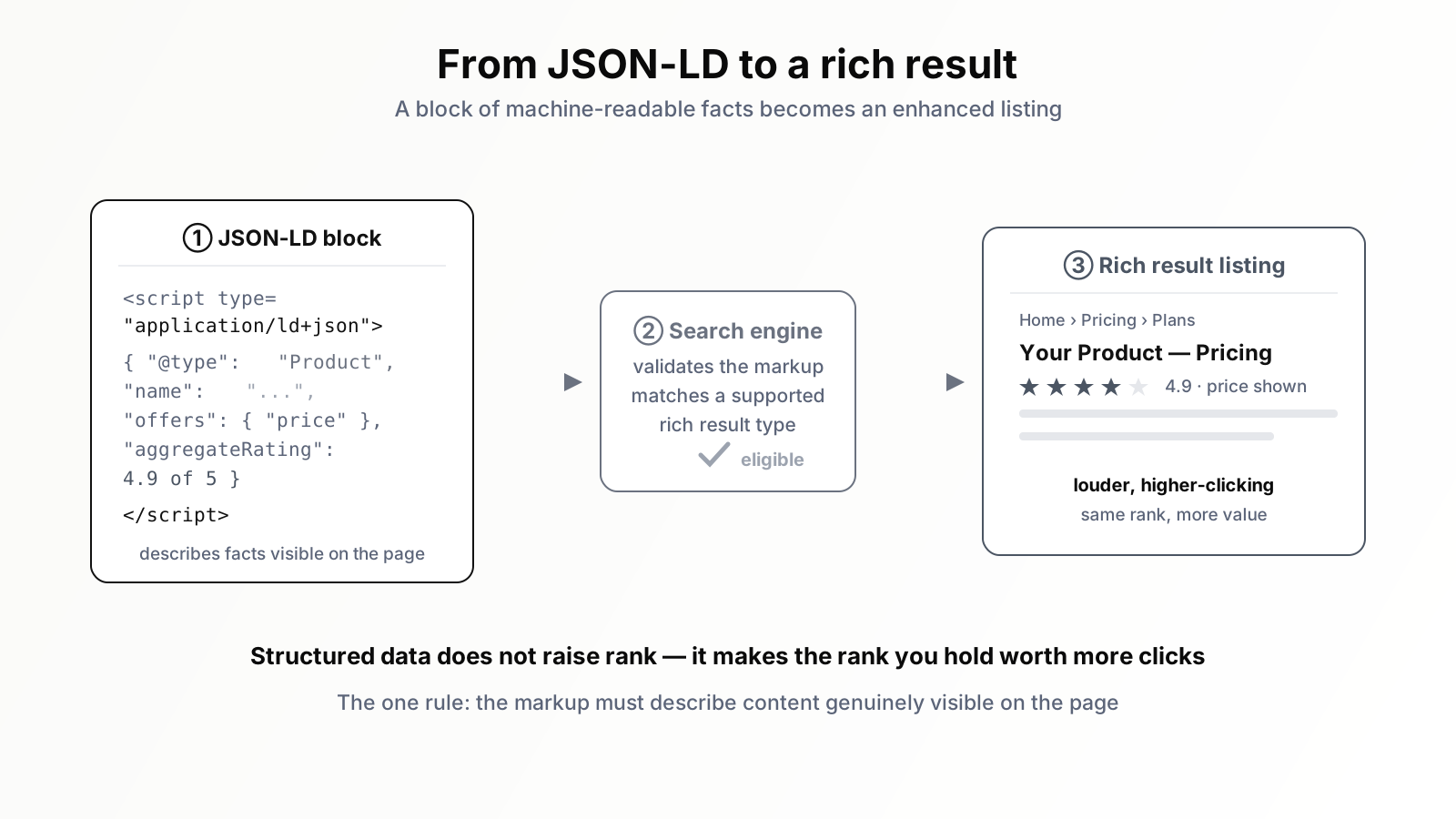
The format you should use is JSON-LD — JavaScript Object Notation for Linked Data. It is a block of structured text you place inside a <script> tag in the page. Crucially, JSON-LD is separate from the visible HTML. You do not have to weave attributes through your existing markup the way older formats (Microdata, RDFa) required. You write one self-contained block, drop it into the page, and you are done. Google has explicitly stated JSON-LD is its preferred format. This separation is also why structured data is not really a developer task: you are adding a description block, not modifying how the page is built.
What structured data does and does not do
Before you invest effort, be honest about what you are buying — because structured data is widely oversold and quietly under-explained.
Structured data does make your page eligible for rich results. Eligible. Adding valid Recipe markup does not guarantee a recipe card; it makes the card possible, and Google decides per query whether to show it. Structured data also helps search engines understand your content with more confidence, which can support how your page is interpreted and surfaced. And it increasingly matters for AI-driven answer surfaces, which lean on explicit, machine-readable facts when assembling responses.
Structured data does not directly raise your ranking. There is no "structured data boost" that lifts position four to position one. What it does is change how your listing appears once you rank — and a richer, more prominent listing tends to earn a higher share of clicks at the same position. So the honest value proposition is this: structured data does not move you up the page, but it can make your existing spot on the page work much harder. That is still a real and worthwhile gain — just not the one the breathless guides promise.
Structured data does not change where you rank. It changes how much your rank is worth.
The structured data types worth your time
Schema.org has hundreds of types. You need a handful. Here are the ones that earn real rich results for most sites.
Article — for blog posts and news content. It tells search engines the headline, author, publish date, and image, and it underpins how your content can appear in news and discovery surfaces. If you publish a blog, mark up your articles. It is the baseline.
BreadcrumbList — describes the hierarchical path to a page (Home › Category › Article). It lets Google show a breadcrumb trail in your listing instead of a raw URL, which looks cleaner and communicates site structure. It is low effort and applies site-wide.
Product — for e-commerce and SaaS pricing pages. It carries price, availability, and review ratings, and it powers the star ratings and price snippets that make shopping listings stand out. If you sell something on a page, this type earns its keep.
FAQPage — marks up a list of questions and answers. Treat this one with care: Google has significantly narrowed where FAQ rich results appear, so the visible accordion is far less common than it once was. Still, valid FAQ markup gives search engines and AI answer surfaces clean question-answer pairs, which has independent value. Just do not add FAQ schema expecting the accordion as a guarantee.
Organization — describes the entity behind the site: name, logo, official social profiles, contact points. It feeds the knowledge panel and helps search engines connect your brand as a coherent entity. Add it once, in your site-wide template.
HowTo, Recipe, Event, VideoObject, LocalBusiness — these are situational. Use HowTo for genuine step-by-step guides, Recipe for recipes, Event for events, VideoObject for pages built around a video, LocalBusiness if you have a physical location. Add the ones that genuinely match your content. Do not add a type because it sounds impressive.
How to add structured data without a developer
Here is the practical sequence. None of it requires engineering support.
Step one: identify the page type. Look at the page and name what it is. A blog post is an Article. A pricing page is a Product or an Offer. A guide with numbered steps is a HowTo. This single decision determines which Schema.org type you will use. Get it right — marking a blog post as a Product to chase star ratings is a misrepresentation, and search engines penalise mismatched markup by ignoring it or, worse, flagging the site.
Step two: gather the facts. For an Article you need headline, author name, publish date, modified date, and a featured image URL. For a Product you need name, description, price, currency, availability, and any review data. Write these down. They must match what is actually visible on the page — structured data is a description of the page, not an embellishment of it.
Step three: generate the JSON-LD. You do not write JSON-LD from scratch. Use a structured data generator — Google's own markup helper, or any reputable schema generator tool — and fill in the facts you gathered. It outputs a clean JSON-LD block. If your site runs on a CMS, the easier path is often a plugin: most major SEO plugins generate Article, Breadcrumb, and Organization schema automatically once configured, so you may already have a baseline without realising it.
Step four: place the block in the page. The JSON-LD goes inside a <script type="application/ld+json"> tag. It can sit in the <head> or the <body> — Google reads it in either place. In a CMS, this usually means pasting the block into a "custom code" or "header scripts" field, or letting the plugin inject it. No application code is touched.
Step five: validate before you trust it. This step is not optional. Run the page through Google's Rich Results Test and the Schema.org validator. They will tell you whether the markup is valid, whether it is eligible for a rich result, and exactly which property is missing or malformed if it is not. Invalid structured data is worse than none — it wastes the effort and can erode trust signals — so never publish markup you have not validated.
The single most important rule: markup must match the page
If you remember one thing from this article, remember this. Structured data must accurately describe content that is actually visible to a human on the page. This is not a soft guideline; it is the line that separates structured data that helps from structured data that hurts.
Marking up a five-star rating that does not appear anywhere on the page is a violation. Adding FAQ schema with questions and answers that are not in the visible content is a violation. Claiming a price in markup that differs from the price on the page is a violation. Google's structured data guidelines are explicit about this, and the consequence is real: at best your markup is ignored, at worst the site receives a manual action for spammy structured data, which is a far deeper problem than simply not having rich results.
The mental model that keeps you safe: structured data is a translation of your visible page into a machine-readable form. A translation must be faithful. It does not get to add facts the original never contained. If a fact is not visible on the page, it does not belong in the markup. If you want it in the markup, put it on the page first.
Why rich results are worth the effort
Step back and look at the search results page as a competitive battlefield. Ten organic listings compete for a finite pool of clicks. All ten are technically "on page one," but they are not equal — a listing with star ratings, a price, and a breadcrumb trail occupies more vertical space, carries more visual signal, and communicates more before the user has clicked. A plain listing next to it is, in attention terms, outgunned.
This is why structured data matters even though it does not change your ranking. Two pages can sit at positions three and four. The page at position four with a rich result can plausibly out-click the plain page at position three. You have not moved up the page — you have made your spot on the page more valuable. Across an entire site, with structured data on every eligible template, that compounds into a meaningful traffic difference from rankings you already hold.
There is also a forward-looking reason. AI-driven answer surfaces — the answer panels, the generative summaries, the assistant responses — are increasingly the layer between a searcher and your page. Those systems lean heavily on explicit, structured, machine-readable facts when deciding what to cite and how to summarise. Structured data is, in effect, you handing those systems a clean, unambiguous brief about your content instead of making them infer it from raw HTML. As that layer grows, the value of explicit structured data grows with it.
A realistic structured data rollout
Do not try to mark up everything at once. Sequence it.
First, the site-wide baseline: Organization schema in your global template, BreadcrumbList on every page, and Article on every blog post. This is high-coverage, low-effort, and most SEO plugins handle it once configured. Getting this right covers the majority of your pages with the foundational types.
Second, the commercial pages: Product or Offer schema on pricing and product pages, with accurate review data where you genuinely have it. These are your highest-value pages, so a richer listing here has the most direct business impact.
Third, the situational types: HowTo on genuine step-by-step guides, VideoObject on video pages, Event on event pages, LocalBusiness if you have a location. Add these where the content honestly matches the type.
Then validate everything, and re-validate periodically — Schema.org evolves, Google changes which types earn rich results, and a type that produced a card last year may not this year. Treat structured data as a living layer of the site, not a one-time task you tick off and forget.
Where an SEO AI agent fits
Everything described here is doable by hand, and for a small site you should simply do it. But structured data has two properties that make it quietly painful at scale: it is repetitive, and it is fragile. Every page needs the correct type, every block of facts must match the visible content, and every block must stay valid as the page changes and as the standard itself shifts. Across hundreds of pages, that is a maintenance burden teams start with enthusiasm and abandon by page forty.
This is structured, rule-based, repetitive work checked against a living standard — exactly the shape of task an SEO AI agent handles well. Orova can scan a site, identify the correct Schema.org type for each page, generate accurate JSON-LD from the content that is genuinely on the page, validate it against Google's requirements, and flag markup that has drifted out of sync with the page or out of date with the standard. The judgement in this article — choosing types, keeping markup honest — still belongs to you. The agent removes the repetition and the silent decay that otherwise make a structured data program fade after the first burst of effort.
Rich results are not a developer privilege. Structured data is a vocabulary and a format, both learnable in an afternoon. Identify your page types, gather honest facts, generate valid JSON-LD, validate it, and keep the markup faithful to the page. Do that, and your listings stop being plain blue links in a results page that has moved on without them. For more on the foundations this builds upon, see our guide on what an SEO AI agent does.
Run your business with AI Agents
Orova is the always-on Biz AI Agent — it plans, runs, and optimizes the work for you. Save time, unlock productivity.
Try it free