
Alternatives Pages: How to Write One That Actually Ranks
Somewhere in the growth playbook that every SaaS company apparently downloaded from the same place, there is a chapter titled "Alternatives Pages". The recipe: find your biggest competitor, publish a page called "10 Best Alternatives to [Competitor]", rank your own product first, repeat for every rival in the category. The logic is seductive and the case studies are real — companies have built meaningful pipeline from pages that intercept a competitor's unhappy customers at the exact moment they go looking for the exit.
And so the internet now contains tens of thousands of these pages, most of them interchangeable, many of them quietly dishonest, and a growing number of them worthless — penalised, ignored, or ranking just well enough to damage the brand that published them. The alternatives page has become a case study in what happens when a clever tactic gets industrialised without anyone asking why it worked in the first place. This is a critique of that industrialisation: what the lazy version gets wrong, why the failures are getting more expensive, and what the page has to be in order to deserve the money it prints.
"Alternatives to X" pages target buyers actively looking to leave a competitor — among the highest-intent queries that exist — but the mass-produced version fails: a templated listicle with your product implausibly ranked first, stale competitor claims, and no answer to why the searcher is leaving. The pages that earn durable rankings diagnose the switcher's reason and answer it honestly.
What an Alternatives Page Is and Why Most Fail
An alternatives page targets searches like "alternatives to [competitor]". People searching that are already unhappy with a product and actively looking to switch — about as close to buying as search intent gets.
Why most fail. They list the competitor, then five options, and put themselves first with a glowing description. Readers see through it in seconds and leave, because the page never intended to help them choose.
What a page that works does differently. It genuinely explains why people leave that competitor, in their words — pricing, a missing feature, support. It lists real alternatives including ones that beat you at something. It says plainly when a competitor is the better choice. And it explains what you are actually best at.
Why honesty ranks better: Google is measuring whether people found what they needed. A page that helps someone choose correctly, even against you, keeps them reading and earns links from people who found it useful.
What to avoid: naming a competitor in a way that misrepresents them. That is a legal problem, not just an SEO one.
The rest of this article covers structure and the research to write one.
Why the tactic works — when it works
Credit where due: the underlying insight is genuinely good. Consider who types "alternatives to X" into a search engine. Not a curious browser, not a student writing a report — overwhelmingly, it is a current or near-customer of X who has hit a wall. The price went up. A feature they assumed existed does not. The product got slower, the support got worse, the company got acquired and the roadmap went quiet. The searcher has already done the hardest part of any sales process — deciding their current solution is not good enough — entirely on their own. They are not asking whether to consider other products. They are asking which ones.
For the vendor, this query class has three properties that justify the gold rush. The competition for it is structurally weak: the competitor named in the query will obviously never rank for their own "alternatives" term, so the SERP is contested only by affiliates and rivals. The intent is bottom-of-funnel in the strictest sense — these visitors convert at rates that make normal content marketing look decorative. And the demand is perennial: as long as the competitor exists and occasionally disappoints, the query regenerates its own search volume every billing cycle and every pricing announcement.
All of that is true. None of it survives the way most teams execute it.
The lazy version: a field guide
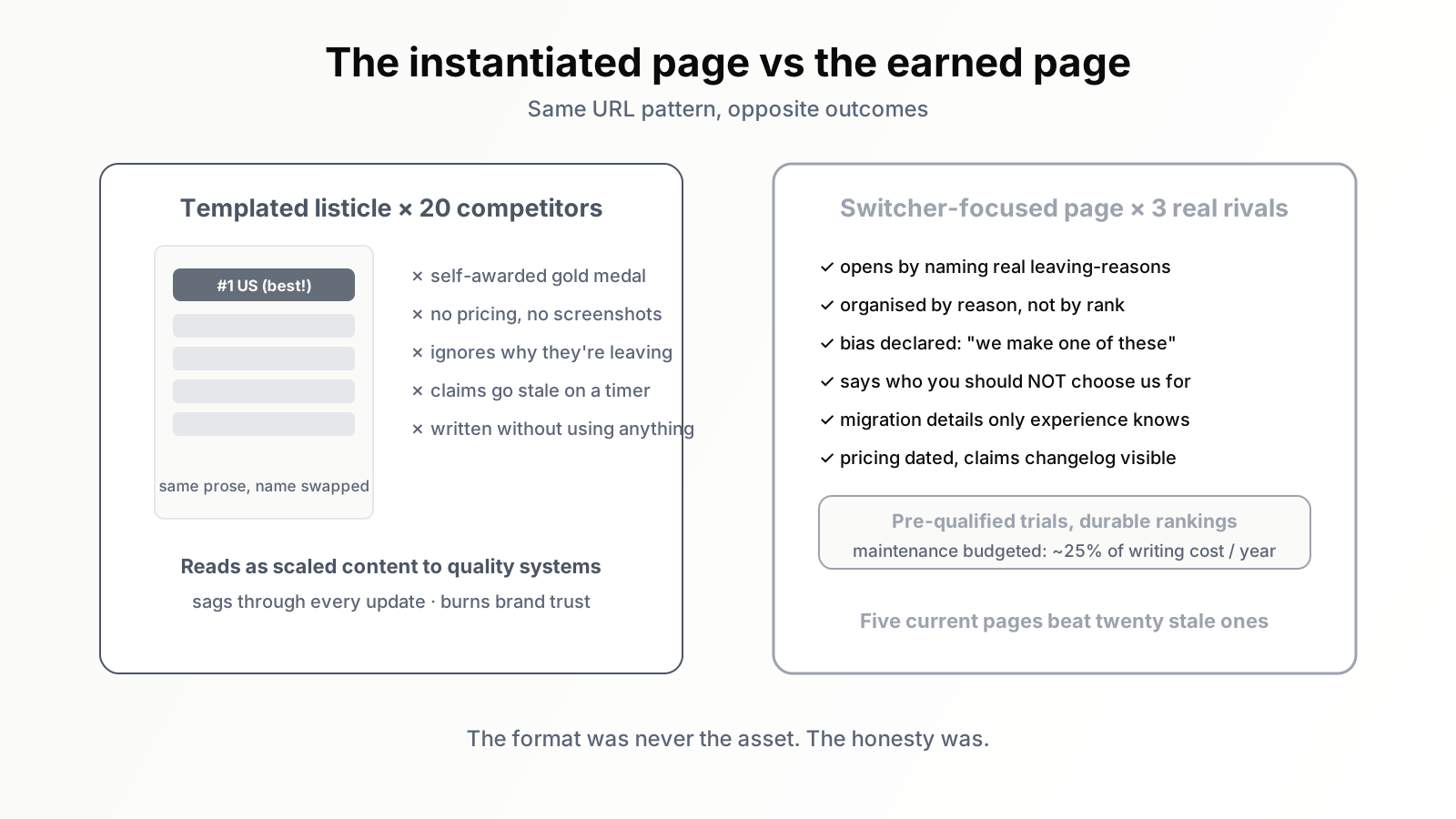
You have seen the page. Everyone has seen the page, which is part of the problem. It opens with three paragraphs of throat-clearing about how X is "a popular tool, but not right for everyone". Then comes the list: ten products, each with a logo, a recycled two-sentence description, a pros-and-cons block that reads like it was generated from the products' own homepages — because it was — and, sitting at number one with a "Best Overall" badge, the publishing vendor itself. Pricing information is vague or absent. Screenshots, if any, are marketing renders. The competitor being "replaced" is described in terms subtly outdated by two product cycles. And at the bottom, a call to action inviting you to start a free trial of the product that just awarded itself the gold medal.
Multiply by twenty: the same vendor publishes "Alternatives to [Competitor B]" through "[Competitor U]", same template, same ten products reshuffled, same self-coronation, often with paragraphs copied verbatim between pages with only the competitor name swapped. The pages are not written; they are instantiated.
Let us be precise about why this fails, because the failure is overdetermined — it fails on at least four independent axes, and fixing one without the others fixes nothing.
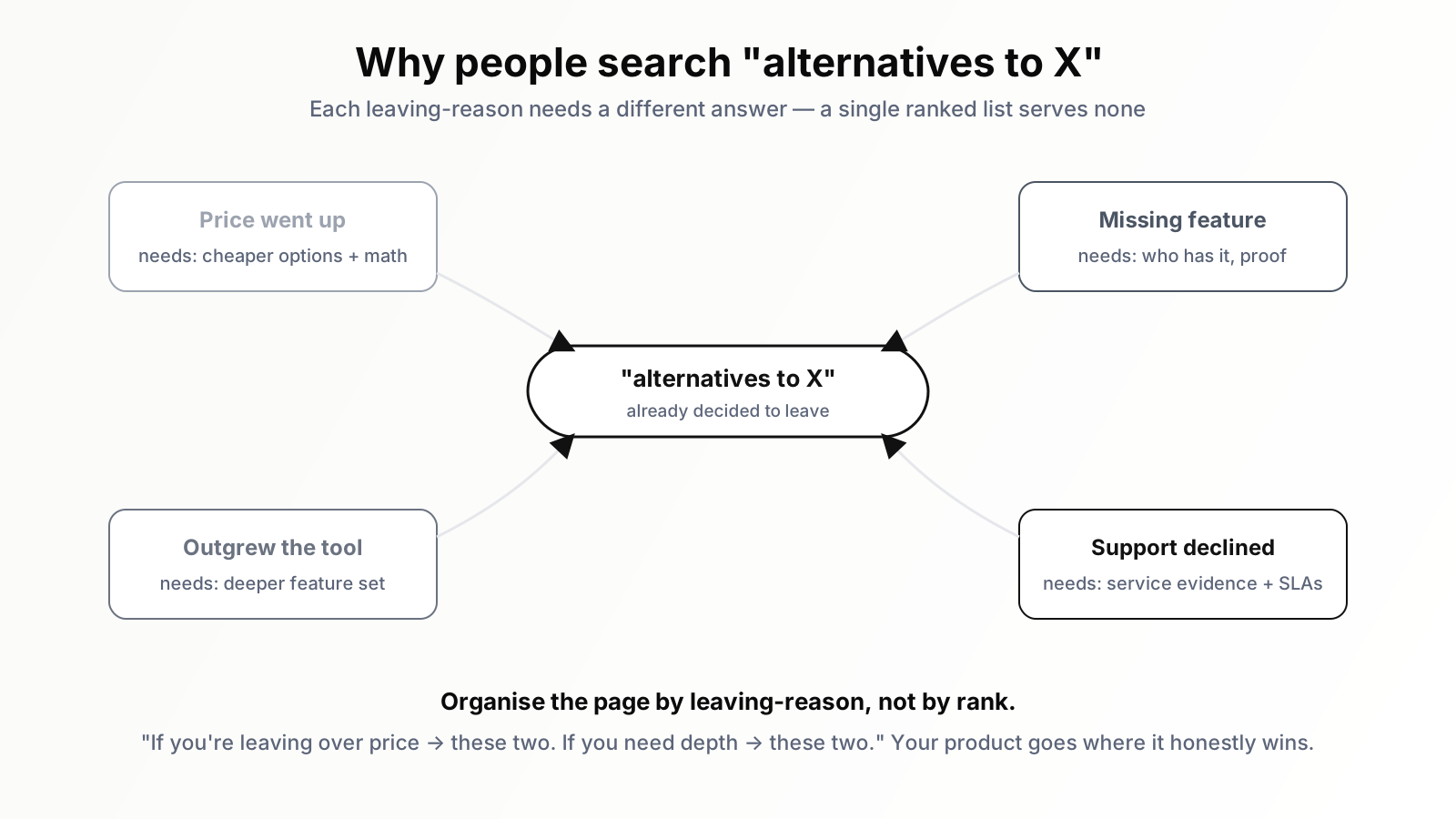
It fails the reader's actual question. The searcher is leaving X for a reason, and the page never asks what it is. Someone leaving because of price needs cheaper options; someone leaving because they outgrew the feature set needs deeper ones — those are opposite directions, and a single ranked list cannot point both ways at once. A list that ranks "best overall" answers a question nobody asked. The information the switcher actually needs — will this fix my specific problem, what does migration cost, what will I lose — is precisely the information the template omits.
It fails the credibility test instantly. The self-award at position one is read by every visitor for exactly what it is. There is no faster way to tell a skeptical, already-burned buyer "this page is an ad" than to rank yourself first in your own roundup. The deeper irony: vendors do this because they fear ranking themselves lower looks weak, when the evidence runs the other way — the rare page that says "we are one option; here is who we suit and who we do not" is so unusual that it earns the trust the other twenty pages in the SERP have collectively destroyed.
It fails quality systems, increasingly. Google's reviews-system guidance has spent years converging on a specific demand: review and roundup content should demonstrate first-hand use, provide evidence, and exist for users rather than for rankings. Templated alternatives pages are close to a perfect negative of that description — unoriginal, evidence-free, generated at scale, with commercial motive worn on the outside. Sites running large libraries of these pages have watched them sag through successive quality updates, and the scaled-content policies announced in 2024 made the at-scale, low-originality version an explicit target. The tactic's golden age coincided with an algorithm that could not tell these pages apart from real reviews. That algorithm is gone.
It fails the brand, which is the expensive part. Rankings can recover; the impression left on a buyer cannot. The switcher who lands on a dishonest alternatives page does not think "weak content" — they think "dishonest company", and they were one click from becoming your customer. Worse, the claims about competitors go stale on a timer: the rival ships the missing feature, drops the price, fixes the complaint, and your page now states falsehoods under your logo, indexed and discoverable, to the most commercially valuable audience you have. An unmaintained alternatives page is reputational short-selling.
The deeper mistake: confusing the query with the keyword
Underneath the surface failures sits a conceptual one worth naming, because it explains why smart teams keep producing these pages. The lazy version treats "alternatives to X" as a keyword — a string with volume to capture, a slot to fill in the content calendar between "vs" pages and listicles. The effective version treats it as a situation: a specific person, mid-frustration, with a diagnosable problem and a migration ahead of them.
The difference shows up in every section of the resulting page. A keyword-page asks "what should this page contain to rank?" and arrives at the template. A situation-page asks "what does someone leaving X need to know?" and arrives somewhere entirely different: a breakdown of the most common reasons people leave X (you know them — your sales team hears them weekly), an honest map of which alternative fits which reason, a frank section on what X still does better, migration specifics — what exports cleanly, what does not, how long the switch takes — and pricing stated in real numbers next to X's real numbers, dated. The keyword-page can be written by someone who has never used any of the products. The situation-page cannot, and that is exactly why it wins: the inimitable input is experience, the same currency that Google's quality framework has been trying to price into rankings for years.
This is also why the situation-page composes naturally with the rest of a commercial content system. It links to the detailed head-to-head comparison pages for buyers who narrow to a finalist, to the product pages built to rank and convert in their own right for the segment you genuinely serve, and to migration documentation for the buyer ready to move. The keyword-page links to a trial CTA and hopes.
What the defensible version looks like
To be concrete rather than merely critical, here is the structure that survives both quality updates and buyer skepticism — the version of the page that has earned the money the tactic promises.
Open with the diagnosis, not the list. Two or three paragraphs naming the real reasons people search this query, drawn from actual switcher conversations: "Most teams looking past X mention one of three things — the per-seat pricing that compounds painfully past twenty users, the reporting ceiling, or the support response times since the acquisition." A reader who sees their own complaint named in the first paragraph extends the page a credit of trust that no badge can buy.
Organise by leaving-reason, not by rank. "If you're leaving over price → these two options, here's the math. If you need deeper reporting → these two, here's what they add. If you want simpler → this one, here's what you give up." The structure itself demonstrates that the page understands the situation, and it dissolves the self-ranking problem: your product appears where it honestly belongs, recommended for the segments where it honestly wins.
Include yourself with declared bias and visible limits. "We make one of the options below, and we'll tell you exactly when not to choose us" — then actually do it. Naming the customers you are wrong for is the single highest-leverage sentence on the page; it converts the conflict of interest from a hidden defect into displayed confidence, and it pre-qualifies your trials besides.
Show evidence of use. Real screenshots with real data, observations specific enough to be checkable, migration details that only someone who has run the migration would know. Every unverifiable adjective you delete makes the verifiable claims that remain stronger.
Date it, and mean the date. Pricing verified as of a stated month, a visible changelog when claims are updated. This is maintenance commitment worn publicly — and it is the honest version of the freshness signal that the lazy pages fake by auto-updating the year in the title tag.
The portfolio question: how many of these pages should exist?
The industrialised playbook says: one per competitor, mass-produced. The critique writes itself by now, but the portfolio logic deserves a number. Each alternatives page is a promise of currency — competitor claims verified, pricing checked, screenshots current — and that promise costs a maintenance cycle every quarter, forever. A team that can genuinely sustain five pages should build five, chosen by where switcher demand actually flows: the competitors whose customers most often appear in your win column, the queries where Search Console already shows your brand surfacing, the rivals whose pricing changes or acquisitions are actively generating refugees this year. Twenty pages maintained by nobody are not an asset portfolio; they are twenty separate venues for a prospect to catch you being wrong.
The selection heuristic that works in practice: open your win-loss data and list the three competitors you most often displace. Those are the pages to build, because the content writes itself from interviews you have already conducted and the conversion thesis is already proven by your own sales history. Competitors you rarely win from make poor alternatives-page subjects regardless of their search volume — if the product truth does not favour you, no amount of page craft should, and the honest version of the page would conclude by recommending someone else. That is a page worth not writing.
And the pages do not stand alone. The same switcher emits adjacent queries — "migrate from X", "X export data", "X price increase" — that are smaller, more specific, and almost always uncontested. A focused cluster around one competitor (alternatives page, migration guide, head-to-head comparison) built on the architecture that makes topic clusters outperform standalone pages will beat a thin page each on twenty competitors, on every metric including the only one that matters, which is signed customers who used to pay someone else.
The objections from inside the building
The honest version of this page has to survive an internal gauntlet that the lazy version, oddly, never faces — nobody objects to propaganda for the home team. Three objections recur, and they deserve answers because each contains a half-truth.
"Sales will revolt if we recommend a competitor." The half-truth: sales does care what the website says about rivals. The miss: sales is also the team that loses deals when a prospect arrives quoting your own dishonest page back at you, and the team that wastes demos on switchers your product cannot help. A page that pre-qualifies — that routes the price-driven leaver to the cheap option and the depth-driven leaver to you — sends sales fewer leads and better ones. Put the win-rate of alternatives-page leads next to the win-rate of webinar leads and the revolt usually ends there.
"Legal will never approve naming competitors' weaknesses." The half-truth: legal will absolutely reject unverifiable disparagement, and should. But the honest page is built from verifiable statements — published pricing, documented feature absences, dated screenshots — which is exactly the evidentiary standard legal teams approve every day in sales decks and battle cards. The page that cannot pass legal review is the template page, with its vague recycled cons; the situation-page, paradoxically, is the compliant one. Truth with receipts is both the ranking strategy and the legal strategy.
"If we admit weaknesses, competitors will quote us." They might. They are already telling prospects about your weaknesses in every competitive deal, with less accuracy and less charity than you would. The only question is whether the canonical description of your trade-offs is written by you, in context, next to your strengths — or assembled from third-party complaints by someone with a commission. Owning your weaknesses in print is not a leak; it is message control of the only kind that survives contact with an informed buyer.
Measuring whether the page deserves its keep
Because alternatives pages are maintenance liabilities as well as assets, each one should periodically justify its existence with numbers, and the numbers worth checking are specific.
Query coverage: in Search Console, the page should be accumulating impressions not just for "alternatives to X" but for the long tail around it — "X alternative for small teams", "cheaper than X", "X competitors". A page stuck on the head term alone is usually a page whose content is too thin to match the variants, which is the first symptom of template syndrome.
Position durability across updates: plot the page's average position against the dates of Google's quality updates. The honest page typically holds or gains through them; the templated page saws downward in steps. One bad update is noise; two consecutive declines on a commercial page is a verdict, and the response should be a rewrite toward evidence, not a round of keyword tweaks.
Entrance-to-pipeline conversion: these visitors should convert at a multiple of your blog baseline — trial signups, demo requests, pricing-page progression. If an alternatives page draws traffic that behaves like blog traffic, the rankings are landing on the wrong searchers or the page is failing the ones it gets; either way the high-intent thesis is not being cashed.
Claim freshness: the operational metric — days since each competitor claim was last verified. Anything past a quarter is exposure. This is the audit that never appears on dashboards and decides whether the page is compounding trust or quietly spending it; pair it with the analytics layer you already run — the GA4 events that tie organic entrances to revenue — and the page's profit-and-loss becomes a routine read instead of an annual argument.
Run that review quarterly and the portfolio prunes itself: pages that earn their maintenance stay, pages that do not get merged into the comparison cluster or retired with a redirect. The discipline sounds bureaucratic; it is the opposite. It is what lets a small team run a small library that outperforms a large one.
What this tactic's lifecycle teaches
Step back and the alternatives page is a parable about growth tactics generally. A practice works because it serves an underserved searcher; early adopters profit; the playbook propagates; the practice is industrialised by teams who copy the format while discarding the service; quality systems and users learn to discount the format; and the tactic is declared dead — at which point it quietly keeps working for the small number of teams who were doing the original thing all along. "Alternatives pages print money" and "alternatives pages are penalised spam" are both true statements about different executions of the same URL pattern. The format was never the asset. The honesty was.
So: write them. Write them for the competitors whose customers you genuinely win, organised around the reasons those customers actually leave, with your bias declared, your evidence shown, and your maintenance budgeted. Decline to write the other eighteen. The searcher typing "alternatives to X" is the best lead your content will ever touch — treat the page they land on as the first promise your company makes to them, because it is.
The unglamorous half of that promise is vigilance — knowing when a competitor's pricing change has invalidated your table, when a page is slipping for its core query, when new switcher demand is emerging in your search data. That standing watch is what Orova is built to keep: continuous keyword and page monitoring across your commercial cluster, flagging the staleness before your prospects find it for you.
Related reading: SEO Keyword Analysis: The 4 Checks and What to Cut
Let Orova SEO handle the repetitive part
Keyword research, drafting, refreshing old posts and rank tracking — running automatically on your own site.
Explore Orova SEO