
Comparison Pages: The Highest-Intent Content in SEO

Pull up the search data for any software category and sort the queries by what they reveal about the searcher. "What is a CRM" is curiosity. "Best CRM for small business" is a shortlist forming. But "HubSpot vs Pipedrive" — that is a person with a spreadsheet open, a budget approved, and a decision due by Friday. They have done the education. They have narrowed to finalists. They are typing the names of specific products into a search box and asking which one to give money to.
Now look at who answers them. In category after category, the page that ranks for "X vs Y" belongs to an affiliate site, a review aggregator, or a content farm — almost never to either of the two vendors being compared. The two companies with the deepest knowledge of the products, the strongest incentive to win the buyer, and the most to lose from a bad framing have both ceded the conversation to a third party whose loyalty goes to whoever pays the higher commission. This is, when you stop to look at it directly, a strange equilibrium. This piece is an analysis of why it persists, what the data says about comparison-query value, and what the teams who break the pattern do differently.
Comparison pages target "X vs Y" and "best X for Y" queries — the highest-intent searches in any category — yet most vendors never build them, leaving affiliates to control the narrative. A credible comparison page names real trade-offs, admits where competitors win, uses honest feature tables, and converts at multiples of blog content because the reader arrives mid-decision.
The intent pyramid, and where the money sits
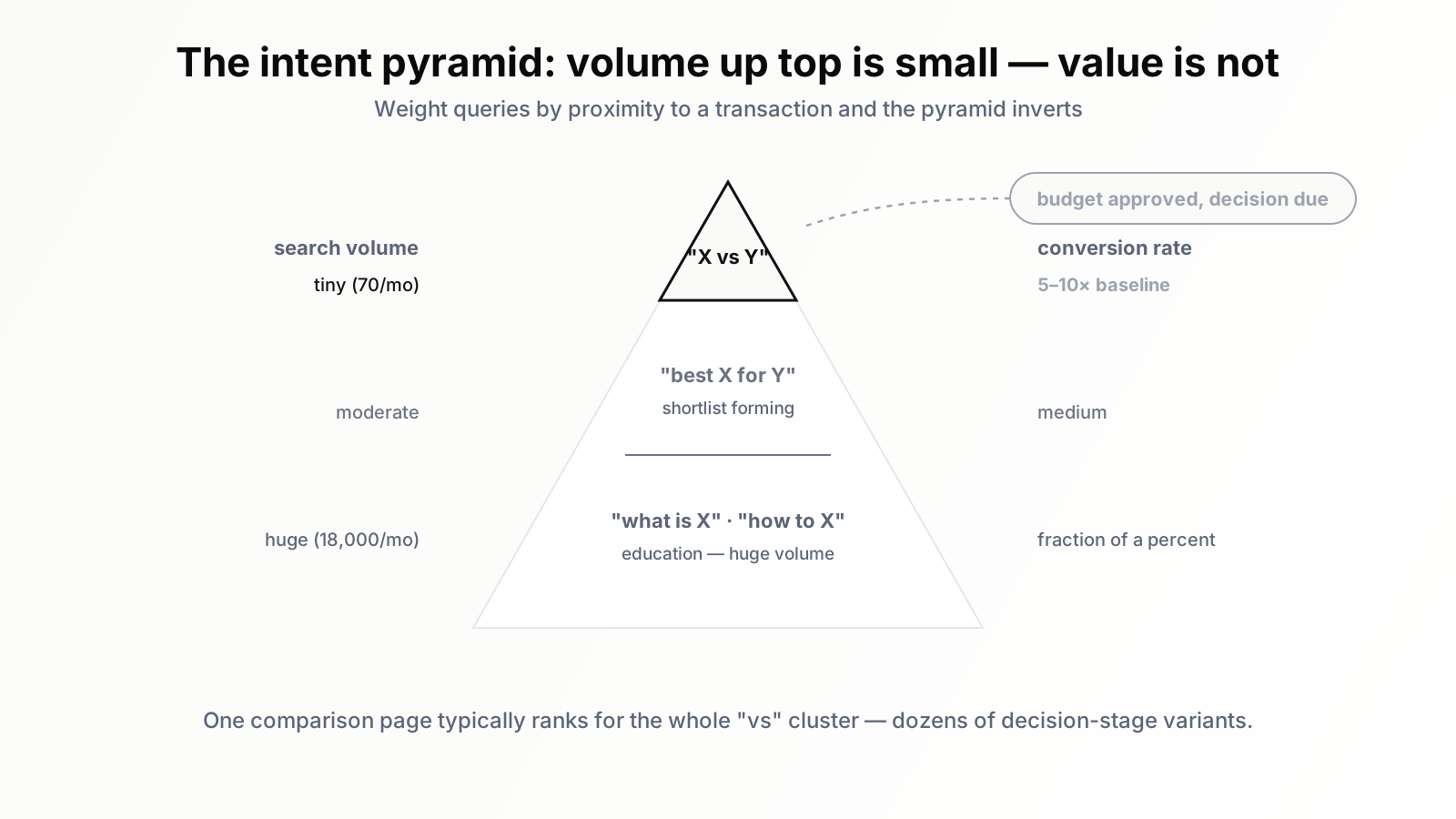
Search demand in any commercial category forms a pyramid. At the base: enormous volumes of informational queries — definitions, how-tos, problem descriptions. In the middle: category and list queries, where buyers assemble candidates. At the tip: a thin layer of comparison and decision queries — "X vs Y", "X alternative", "is X worth it", "X review" — with volumes so small they look like rounding errors next to the head terms. A typical "vs" query might register seventy searches a month against the category term's eighteen thousand.
Volume is the wrong lens. Weight the pyramid by proximity to a transaction and it inverts. The informational searcher converts at a fraction of a percent, eventually, after many touches. The comparison searcher is performing the final act of a buying process: studies of B2B buying consistently describe buyers completing the majority of their research before ever contacting a vendor, and the comparison search is what the end of that self-directed research looks like in a query log. When practitioners measure conversion by landing-page intent class, bottom-funnel comparison content converting at five to ten times the rate of informational content is a normal finding, not an outlier. Seventy visits a month at those rates, for a product with four-figure annual contract value, is not a rounding error. It is a pipeline line-item.
And the tip of the pyramid is wider than it looks, because comparison demand fragments across dozens of phrasings: "X vs Y", "Y vs X", "X or Y", "X vs Y pricing", "X vs Y for agencies", "difference between X and Y". Each variant is tiny; the cluster is substantial; and one well-built page typically ranks for the entire cluster. The economics of one page capturing forty adjacent decision-stage queries are unlike anything else in content marketing.
Why vendors don't write them: an anatomy of the hesitation
If the value is this legible, the absence demands explanation. Having watched this conversation happen inside many marketing teams, the resistance comes in four recognisable forms — each containing a real concern, each leading to the wrong conclusion.
"We don't want to give competitors airtime." The theory: publishing a comparison introduces your prospects to a rival they might not have known. This misunderstands the query. The person searching "X vs Y" already knows both products — that is what the query is. The only question is whose framing they read. Declining to publish does not hide your competitor; it hides you, and hands the framing to an affiliate. The airtime is being broadcast either way; the only choice is whether your voice is in it.
"Legal won't let us name competitors." A real constraint in some industries, but mostly overstated. Nominative use of a competitor's trademark — naming them to compare truthfully — is generally lawful in most jurisdictions, which is why entire affiliate industries exist doing exactly that. What legal teams correctly prohibit is falsehood: misstating a competitor's pricing, claiming features they lack, fabricating reviews. The compliant path is the same as the effective path — verifiable claims, dated screenshots, sourced pricing — which is convenient, because honesty is also the ranking strategy.
"It feels desperate." A brand-team instinct: confident market leaders supposedly do not acknowledge rivals. The behavioural evidence points the other way — the most aggressive comparison publishers in SaaS are successful category leaders and well-funded challengers, who maintain entire libraries of "vs" pages. Buyers do not read a fair comparison as desperation; they read it as transparency, and the willingness to put your weaknesses in a table next to a competitor's strengths is one of the costlier — and therefore more credible — trust signals a vendor can send.
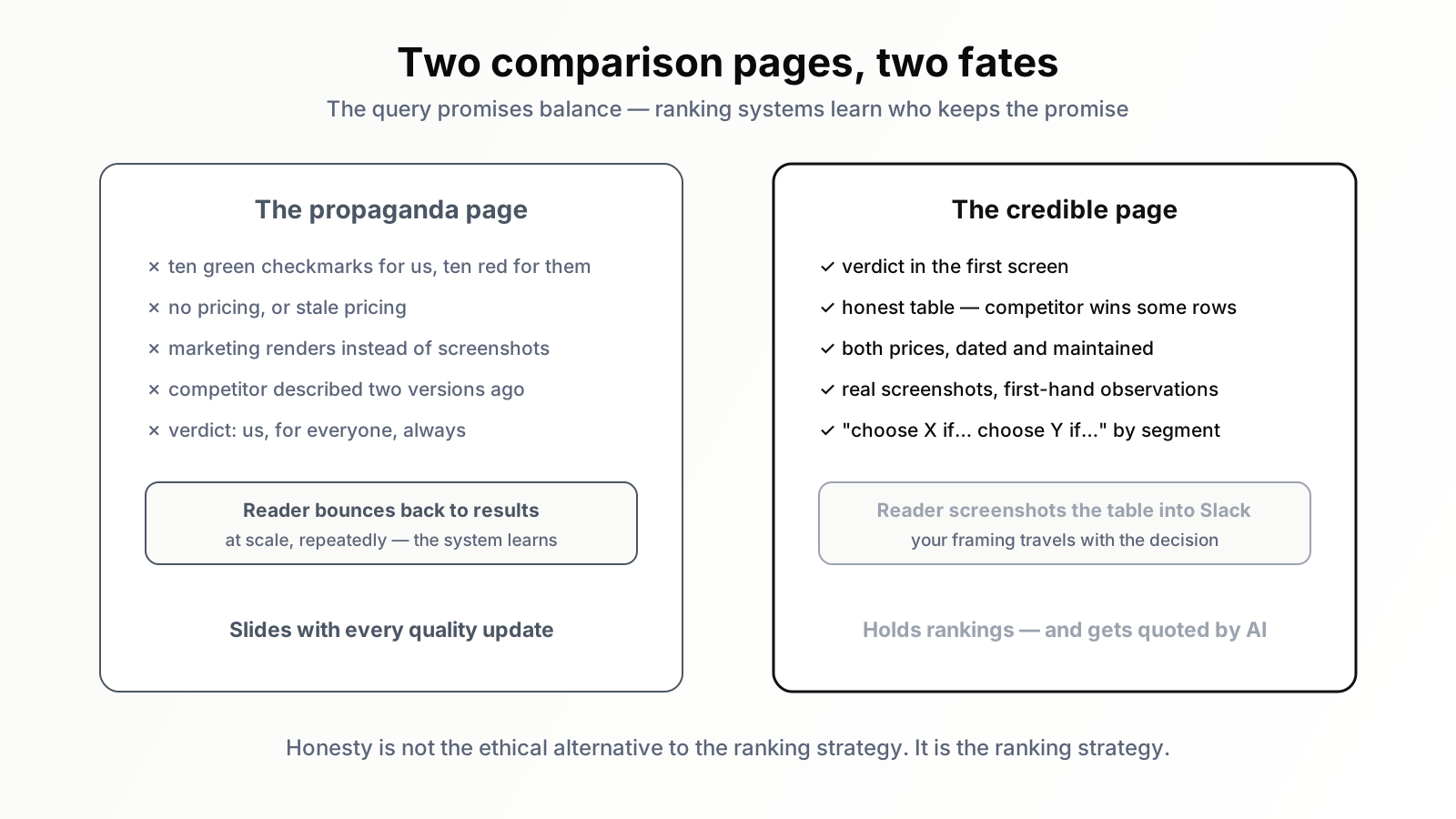
"We tried one and it didn't rank." Usually true, and usually because the page was a press release wearing a comparison page's clothes: ten green checkmarks in our column, ten red crosses in theirs, no pricing, no screenshots, no admission that the competitor does anything well. Pages like that fail for a structural reason worth dwelling on: the query "X vs Y" carries an implicit promise of balance, and ranking systems trained on user satisfaction learn whether a page keeps that promise. A buyer who lands on naked propaganda bounces back to the results — and does so at scale, repeatedly, teaching the system exactly what the page is.
What actually ranks: the credibility mechanics
Study the comparison pages that hold top positions in competitive categories — vendor-owned and affiliate alike — and the shared anatomy is consistent enough to read as a specification.
A verdict, early. The strongest pages answer in the first screen: "X suits teams that need depth and can absorb a learning curve; Y suits teams that want speed and simplicity." Burying the verdict beneath two thousand words of preamble misreads the visitor — they came for a judgment, and the judgment up front is also the extractable block that snippets and summaries lift. The same answer-first construction that earns featured snippets works here at the page level.
A real feature table. Honest rows, including rows where the competitor wins, in actual HTML table markup rather than an image. The table is what buyers screenshot into Slack and paste into decision documents — which means the table travels beyond the page, carrying your framing with it. A table with a competitor's genuine advantages visibly present earns the credibility that makes its other rows believable.
Current pricing, dated. Pricing is the highest-stakes element: buyers check it first and trust dies fastest when it is wrong. The pages that win state both products' pricing plainly, note the date verified, and update on a schedule. Stale pricing is the most common decay mode of comparison content and the most common reason a once-ranking page slides.
Evidence of first-hand use. Real screenshots, workflow specifics, observations no one could make without using both products ("Y's import handles duplicates automatically; X makes you resolve them row by row"). This is the experience dimension of what Google's quality systems reward applied to commercial content, and it is the hardest element for content-farm competitors to fake — which makes it precisely where a vendor's structural advantage lies. You have unlimited access to your own product and every incentive to genuinely trial the rival's.
Segmented recommendations. "Choose X if… choose Y if…" — by team size, use case, budget, technical appetite. Segmentation resolves the tension between honesty and advocacy: you can recommend the competitor for segments you serve poorly and your product for the segments you actually want, and both recommendations gain force from the presence of the other.
Notice what this anatomy amounts to: the page that ranks is the page a fair-minded analyst would write. That alignment between credibility and performance is not a coincidence of current algorithms; it is the system working as designed, however imperfectly, toward satisfying the searcher.
The vendor's dilemma — and the affiliate's hidden weakness
A vendor writing about itself carries declared bias, and readers discount accordingly. The affiliate carries hidden bias — rankings quietly ordered by commission rates — that readers discount less because it is less visible. Analysed as a contest of trust, this looks like the affiliate's game.
But the affiliate has a structural weakness the vendor does not: shallowness at scale. The affiliate covering two hundred products in a category has used few of them beyond a trial signup; their comparison is assembled from feature lists and other people's reviews. The vendor has depth — real usage, real customer migration stories, real support-ticket knowledge of where each product breaks. The vendor who chooses transparency (bias declared in the first paragraph: "We make X; here is our honest read") and pairs it with depth the affiliate cannot fake is playing a different game than the vendor who hides the bias and pads the page. The first earns durable rankings; the second earns the bounce-back pattern described above. The choice between those two postures, not the choice of whether to publish, is the real strategic decision.
There is also a second-order effect now in play: comparison pages are disproportionately retrieved when buyers ask AI assistants which product to choose, because a balanced "X vs Y" page is the ideal source document for a generated recommendation. A fair, well-structured comparison gets quoted; a propaganda page gets skipped. The trust mechanics that win the classic SERP and the ones that win the AI answer are converging on the same page.
The comparison library: portfolio logic
One comparison page is a test; a library is a strategy. The portfolio construction follows directly from the demand analysis.
Direct rival pages — you vs each competitor buyers actually shortlist against you. Sales calls tell you the list; so does Search Console, where "yourbrand vs X" impressions reveal which match-ups buyers are already researching. Build these first; they defend deals already in motion.
Third-party pages — competitor vs competitor, with you absent from the title. "X vs Y" where you sell a third option is an underused play: the searcher comparing two rivals is a buyer in motion whose criteria are still forming, and an honest adjudication of the two — with a measured "a third option worth knowing about" section — reaches them at the moment of maximum openness. These pages also rank more easily, because neither X nor Y will write a fair version of it.
Category roundups — "best X for Y" pages, the hardest for a vendor to do credibly and the ones where the honesty bar is highest. They work only when the segmentation is real and your product is not implausibly ranked first in every segment.
Structurally, the library should interlink like any content cluster — comparison pages linking to each other, to the relevant product pages built to rank in their own right, and to the deeper assets like alternatives pages and pricing pages that catch adjacent decision queries. The same cluster mechanics that make topic clusters outperform standalone posts apply with extra force here, because decision-stage pages reinforce each other's relevance for an entire family of commercial queries.
One operational warning from the failure cases: comparison libraries built from a template, where twenty pages share identical structure and ninety percent identical prose with only the competitor name swapped, read as doorway pages — to users and to quality systems. Every page in the library needs to be genuinely about its match-up: different trade-offs, different verdict, different evidence. The template can be shared; the analysis cannot.
The research workflow behind a credible page
Since first-hand evidence is the vendor's structural advantage, the production process matters as much as the page template. The teams whose comparison pages hold rankings run a recognisable workflow before a writer touches a draft.
First, actually use the competitor's product. Sign up for the trial under a real workflow: import data, build the thing your buyers build, hit the limits. Two or three hours of genuine use produces the texture — onboarding friction, naming conventions, where the export button hides — that separates a lived comparison from an assembled one. Capture screenshots as you go, because retaking them later means redoing the work.
Second, mine the migration stories you already have. Every vendor's CRM contains customers who switched from each major rival. Their onboarding notes and win-loss interviews answer the exact question the comparison searcher is asking: what was better, what was worse, what surprised you. Three sentences of paraphrased migration experience ("teams coming from X most often mention the reporting gap") carry more persuasive weight than any feature table row, and no affiliate can reproduce them.
Third, read the public review corpus for both products — not to copy quotes, but to calibrate. If every third review of your competitor praises their mobile app and your page is silent about mobile, the omission reads as evasion to any buyer who has done the same reading. The page must engage with the known strengths and known complaints of both products, because the buyer arrives having seen them.
Fourth, route the draft past sales and support before publishing. The people who lose deals to this competitor know which claims will be tested in the next demo call, and the people who onboard its refugees know which promises the competitor breaks. Ten minutes of their review catches the errors that would otherwise surface in a prospect's objection.
Beyond "vs": the adjacent decision queries
The "vs" family is the core, but the same buyer emits several adjacent query types on the way to a decision, and a comparison program should decide deliberately which to claim. "Is X worth it" and "X review" queries reward a different framing of the same research — verdict-led, criteria-explicit, experience-heavy. "X pricing" queries are often winnable by a third party when the vendor's own pricing page is thin, which is both an opportunity against competitors and a warning about your own exposure — treating the pricing page itself as a search asset closes that gap from the defensive side. And "switching from X" or "X migration" queries, tiny and almost always uncontested, catch the highest-intent slice of all: the buyer who has already decided to leave and only needs a destination. A comparison library that claims the "vs" cluster but ignores the switching cluster has built the storefront and skipped the door.
Maintenance: the part that separates compounding assets from decaying ones
Comparison pages decay faster than any other content type, because they make claims about a moving target. Competitors ship features, change pricing, redesign interfaces; every change silently converts one of your true statements into a false one. The analysis here is blunt: an unmaintained comparison page is a liability on a timer. The buyer who catches your page claiming a competitor lacks a feature they visibly shipped last quarter does not just discount that row — they discount your product, on the reasonable inference that a company careless with facts is careless elsewhere.
The teams that run comparison libraries well treat them as living documents: a quarterly review pass per page, pricing verified against the competitor's live page, screenshots refreshed on a cadence, and a visible "last updated" date that doubles as a freshness signal to readers and crawlers alike. Budget this before you build the library — a realistic rule is that maintaining a comparison page costs a quarter of writing it, every year, forever. If that budget is unavailable, build fewer pages. Five current comparisons outperform twenty stale ones on every metric that matters.
Measurement: judging the tip of the pyramid fairly
Comparison pages will embarrass themselves on every traffic dashboard and vindicate themselves on every revenue one, so the measurement design matters. Sessions are the wrong KPI for a page targeting seventy-search-a-month queries. The right ones: query-cluster impressions and average position in Search Console (is the page winning its "vs" family?), conversion rate of organic entrances against the site's informational baseline (expect a multiple, not a percentage-point gain), and — where your attribution allows — presence of the page in converting paths. Pipeline influenced per thousand visits is the statistic that reframes the conversation with whoever funds the content program; on that metric, decision-stage pages are routinely the best-performing content on the domain despite being the least visited. The instrumentation lives in standard GA4 reporting; the analytical discipline is refusing to let traffic-weighted averages hide what these pages do.
The conversation is happening either way
The conclusion of the analysis is uncomfortable in a useful way: your prospects are reading comparisons of your product right now, today, written by parties with no stake in their success and no deep knowledge of the products. The only open question is whether the most informed party in the category — you — participates. Done lazily, comparison content is propaganda that fails twice, once with the algorithm and once with the buyer. Done honestly, it is the highest-converting organic asset a commercial site can own: a page that meets buyers at the final fork of their decision and earns trust by telling them the truth about both paths.
The operational load — knowing which "vs" queries are surfacing, which pages are slipping as competitors update, which match-ups buyers search that you have not built — is the part teams underestimate, and it is the part Orova carries: continuous rank and query monitoring across your commercial keyword clusters, so your comparison library stays current with the market instead of with your last content sprint.
Let Orova SEO handle the repetitive part
Keyword research, drafting, refreshing old posts and rank tracking — running automatically on your own site.
Explore Orova SEO