
Generative Engine Optimization (GEO): The 2026 Playbook
Sometime over the past two years, a meaningful share of your potential audience stopped clicking through to websites and started reading answers instead. They ask Google a question and get an AI Overview stitched together from a handful of sources. They ask ChatGPT to compare tools in your category and get a confident three-paragraph verdict with a few citations at the end. They ask Perplexity for a recommendation and get a synthesized answer with footnotes. In every one of those moments, a machine decided which sources were worth retrieving, which were worth quoting, and which would simply never be seen — and traditional rank-tracking told you nothing about any of it.
Generative Engine Optimization is the discipline that grew up around that shift. It is not a replacement for SEO, and anyone selling it as one is overreaching. It is an extension of SEO into a new surface: instead of optimizing only for a ranked list of blue links, you optimize for being retrieved, understood, and cited by systems that compose answers. The fundamentals overlap heavily with good search optimization, which is the good news. The bad news is that the differences are specific, technical, and easy to get wrong if you rely on folklore — and right now the folklore around GEO is thick.
This is the playbook we wish existed when we started doing this work: what GEO actually is, how generative engines actually decide what to cite, the six layers of work that influence those decisions, and a realistic 90-day rollout. No miracle tactics, no invented statistics, and honest labels on the parts that are still unproven.
Generative Engine Optimization (GEO) is the practice of making your content more likely to be retrieved, quoted, and cited by AI systems that generate answers — Google AI Overviews and AI Mode, ChatGPT Search, Perplexity, and Copilot. It extends traditional SEO from ranking in link lists to earning visibility inside machine-synthesized answers.
Why GEO emerged: visibility stopped meaning rank
For twenty years, search visibility had a single, well-understood currency: position. You ranked third for a query, you got a predictable share of its clicks, and the entire industry — tools, reporting, job descriptions — was built on that model. Generative engines broke the model in two ways at once.
First, they changed the unit of competition. An AI Overview at the top of a Google results page does not present ten options and let the user choose. It presents one synthesized answer, assembled from a small set of sources, with links that a minority of readers will ever expand. Google's AI Mode goes further, turning the results page into a conversation where follow-up questions are answered in place. ChatGPT Search and Perplexity skip the link list entirely: the answer is the product, and the sources are footnotes. When the answer is the product, being one of the sources behind the answer is the new first page — and being absent from those sources is the new page ten.
Second, they changed who decides. A ranking algorithm orders documents; a generative engine selects passages. It retrieves a set of candidate documents, reads them, and chooses which specific claims and sentences to build the answer from. Two pages that rank similarly can have wildly different citation outcomes, because one of them contains a clean, self-contained, quotable explanation and the other buries its substance under preamble. That selection step is a new competitive layer that classic SEO never had to think about, and it is the layer GEO exists to address.
None of this means clicks are dead. Plenty of queries — transactional, navigational, local — still resolve to ordinary results, and even cited sources in AI answers receive referral traffic, often from unusually qualified visitors who arrive pre-informed. We have written separately about why zero-click visibility still carries real value; the short version is that being the source an engine quotes builds the brand familiarity that later shows up as direct and branded search demand. But the strategic point stands: a content program that measures itself only on rankings and organic sessions is now measuring a shrinking portion of its actual visibility.
Where the term came from — and what the research actually showed
The phrase "generative engine optimization" was popularized by academic research on generative engines — systems that answer queries by synthesizing text from retrieved sources. The researchers tested whether changing the content of a source page changed how visible that page was inside generated answers, and they found that it did. Tactics like adding relevant statistics, direct quotations, and clear citations to authoritative sources measurably increased how often and how prominently the modified content appeared; researchers reported visibility improvements of up to roughly 30-40% for some tactics in their test conditions.
Two caveats belong next to that finding, and most coverage omits both. The experiments were run against research configurations of generative engines, not against the production systems of Google or OpenAI, whose retrieval and synthesis pipelines are proprietary and constantly changing. And the effect sizes varied by query category — what helped in one domain did little in another. The honest reading is not "add statistics, gain 40% visibility." It is narrower and more useful: the way you write and structure content demonstrably influences whether generative systems select it, which means this is an optimizable surface, not a lottery. That is the entire premise of GEO, and it has held up in practice since.
How generative engines actually answer — and why retrieval is everything
To optimize for these systems you need a working model of how they produce an answer, because a persistent misconception sends teams down the wrong road entirely. The misconception is that AI assistants answer from their training data — that getting "into the model" is the goal, and that your content needs to be famous enough to be memorized. For the queries that matter commercially, that is mostly not how it works.
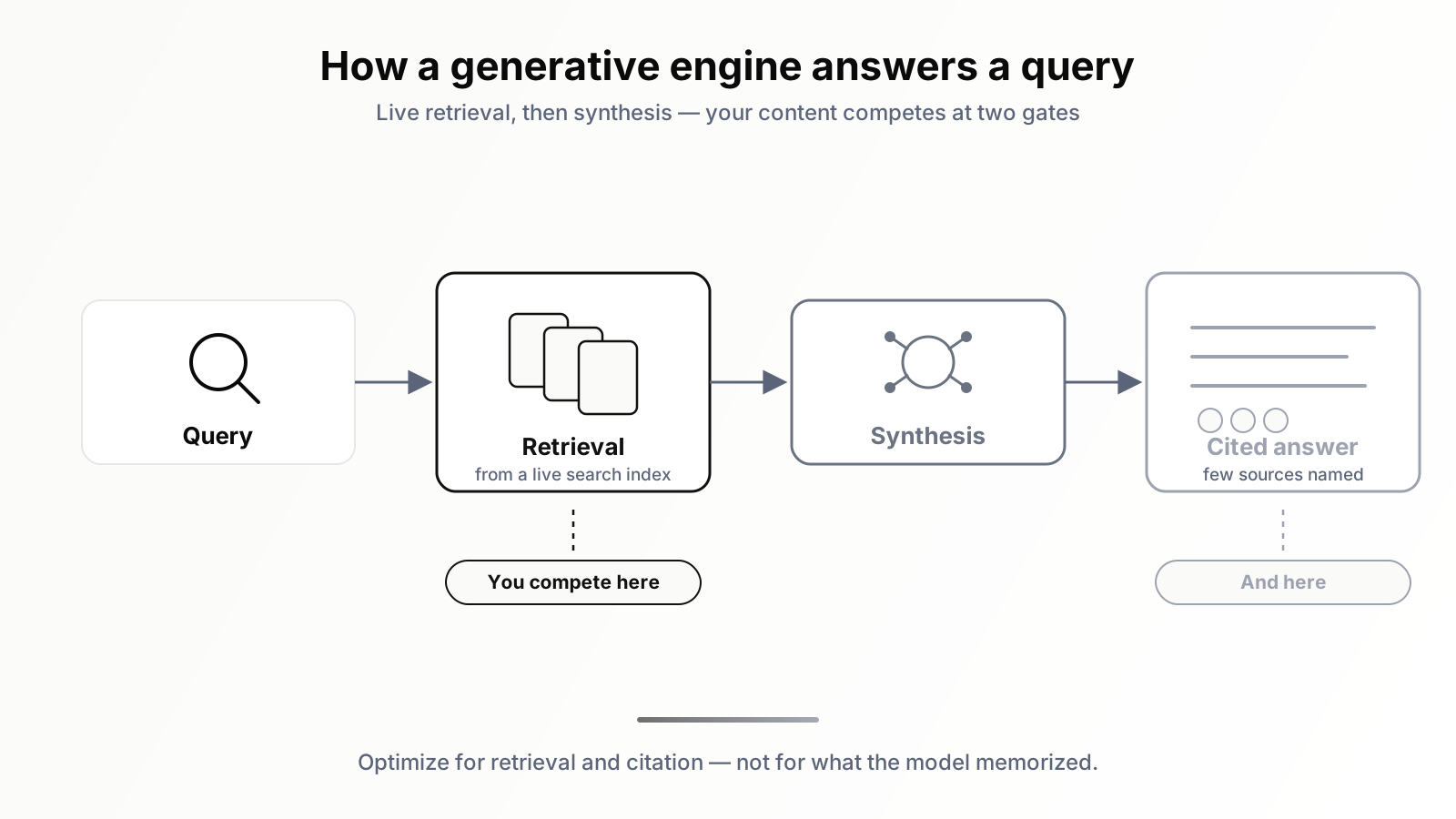
Modern answer engines are grounded. When a question benefits from current or specific information — and almost every commercial question does — the system does not rely on what the model absorbed during training. It runs a live retrieval step: the query (often rewritten into several sub-queries) is sent to a search index, candidate documents come back, relevant passages are extracted, and the language model synthesizes an answer from those passages, citing the sources it leaned on. Google AI Overviews and AI Mode ground against Google's own search index. ChatGPT Search retrieves from a web index at question time. Perplexity is built around retrieval from the ground up.
This distinction drives every practical decision in GEO. You are not optimizing for what a model memorized months ago in training — you have almost no leverage over that, and it goes stale anyway. You are optimizing for a live pipeline with three gates: can the engine retrieve your page (is it crawlable, indexed, and relevant to the rewritten queries), will it select your passages (are they clear, self-contained, and directly responsive), and will it cite you (does your content offer something attributable — a fact, a number, a definition — rather than restated common knowledge). Every layer of the playbook below maps to one of those gates.
It also explains why GEO and traditional SEO remain joined at the hip. If retrieval runs against a search index, then the things that earn you strong organic presence — crawlability, relevance, authority — are also what gets you into the candidate set for AI answers. Pages that rank well are disproportionately the pages that get cited. GEO does not replace that foundation; it adds the selection and citation layers on top. For a fuller comparison of what carries over and what changes, see GEO vs SEO: what actually changes.
The GEO playbook: six layers, in priority order
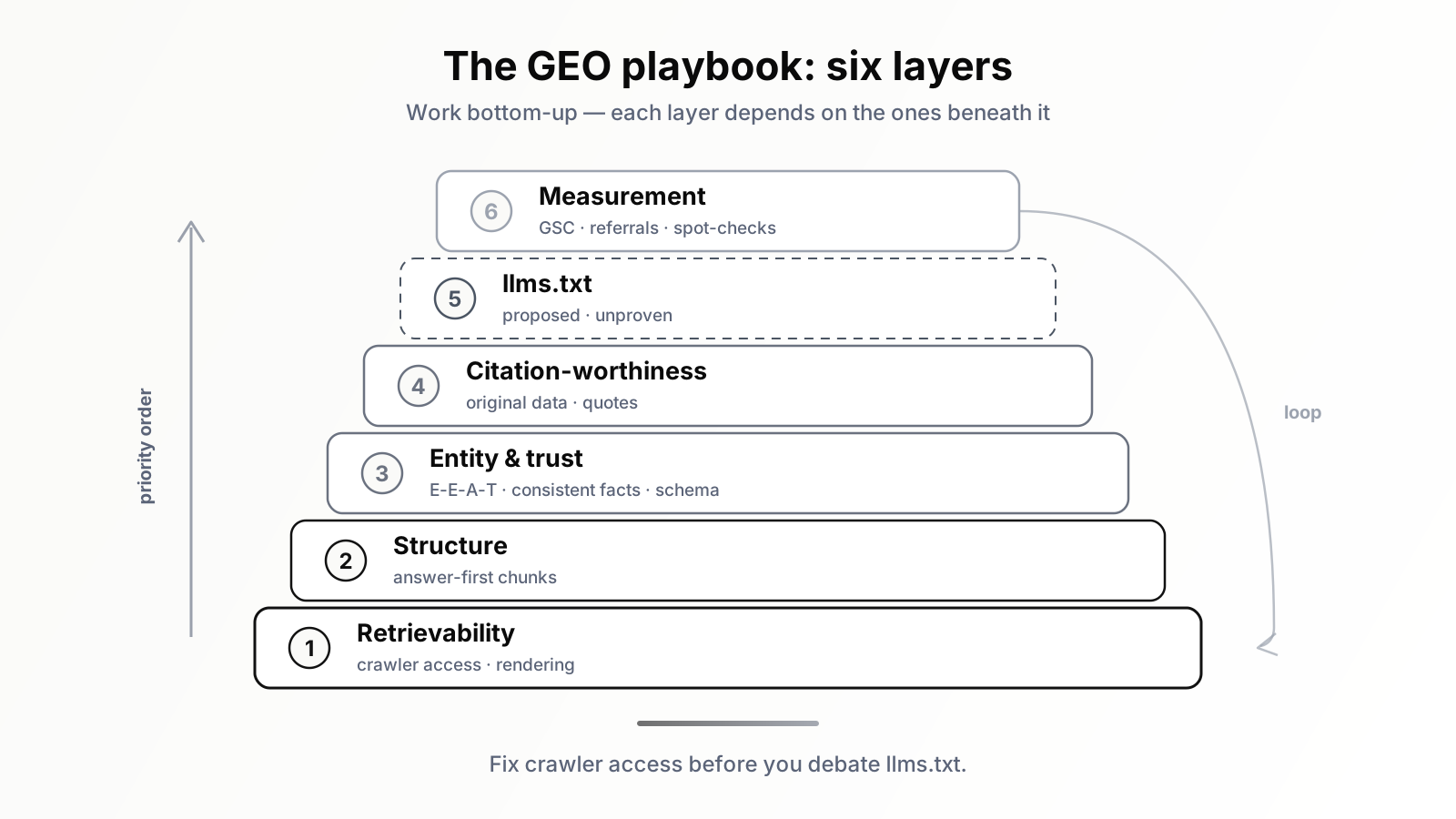
What follows is the work itself, organized as six layers. They are ordered deliberately: each layer depends on the ones before it, and the most common failure pattern we see is teams working layer five before layer one — debating llms.txt while their rendering setup quietly hides half their content from every AI crawler on the list. Work top down. If you want a condensed checklist version to run against your own site, we keep one in our 12-point GEO audit.
Layer 1 — Retrievability: let the engines in, and know which bot is which
Nothing else in this playbook matters if the engines cannot fetch and read your pages, so the first task is a crawler access audit — and this is where precision about user-agents pays off, because the bots have confusingly similar names and very different jobs.
Start with Google, because the most expensive mistake lives here. AI Overviews and AI Mode are built on Google's normal search index, crawled by ordinary Googlebot. The separate Google-Extended token does not control them — it governs whether your content is used for Gemini model training and for grounding outside of Search. Blocking Google-Extended in robots.txt does not remove you from AI Overviews; the only way to stay out of Google's AI answers is to restrict your presence in Google Search itself, which almost no business should do. Plenty of sites blocked Google-Extended in a defensive reflex believing they had opted out of AI Overviews. They had not — and conversely, if you want AI visibility, that block neither helps nor hurts it.
OpenAI splits its crawling the way Google should have: GPTBot collects content for model training, while OAI-SearchBot crawls for ChatGPT Search — the live retrieval that produces cited answers. The two are independent controls. A site can block GPTBot (declining to feed training) while allowing OAI-SearchBot (staying visible in ChatGPT's cited answers), and for most businesses that combination — or simply allowing both — is the sensible posture. Blocking OAI-SearchBot is what actually removes you from ChatGPT Search citations. Check your robots.txt now; a surprising number of sites block "anything with AI in the name" via rules added in 2023 and have been invisible to ChatGPT Search ever since.
PerplexityBot (Perplexity) and ClaudeBot (Anthropic) round out the list of user-agents worth explicit decisions. Audit your robots.txt, your CDN bot-management rules, and your firewall settings against all of them — CDN-level bot protection silently blocking AI crawlers while robots.txt looks permissive is one of the most common findings in these audits.
The second half of retrievability is rendering. Most AI crawlers handle client-side JavaScript poorly or not at all; content that only exists after a framework boots in the browser is, to many of these systems, content that does not exist. Test your key pages by fetching the raw HTML and checking whether the substance — the text you want cited — is present without script execution. If it is not, prioritize server-side rendering or prerendering for the pages that matter. This single fix has done more for AI visibility on JavaScript-heavy sites than every content tweak combined.
Layer 2 — Chunk-level structure: write passages that survive being lifted
Generative engines do not consume your page as a whole. Retrieval pipelines split documents into passages — chunks — and the engine selects individual chunks to ground its answer. The practical consequence: every important section of your page must make sense when read in isolation, because that is exactly how a machine will read it.
Four habits implement this. First, answer-first paragraphs: open each section with the direct answer in the first sentence or two, then elaborate. A paragraph that spends four sentences building context before reaching its point gives the retrieval system four sentences of nothing to match against. Second, question-shaped headings: H2s and H3s phrased the way people actually ask ("How long does GEO take to show results?") align your chunks with the rewritten queries engines generate, and the heading travels with the chunk, giving the passage its context. Third, self-contained passages: avoid sections whose meaning depends on pronouns and references pointing outside the chunk — "this approach," "as mentioned above," "the second option" all decay into noise when the passage is lifted. Name the thing each time it matters. Fourth, lists and tables for enumerable facts: steps, comparisons, specifications, and criteria expressed as structured lists are easier for engines to extract faithfully than the same information woven through prose.
If this sounds familiar, it should — it is the same craft that wins featured snippets and answer boxes, extended to the whole document. The overlap is no accident: answer engines and snippet extraction grew from the same root, and the discipline of writing for them, sometimes called answer engine optimization, is largely a subset of what we are describing here. We have covered the writing-level techniques in more depth in our piece on answer engine optimization; the chunk-level habits above are the part that generative engines reward most consistently.
One structural note specific to pillar content like the page you are reading: include a short, quotable definition of your core concept high on the page, in plain declarative language. When an engine needs to define a term, it overwhelmingly grabs a sentence that reads like a definition — subject, verb "is," predicate — rather than reconstructing one from scattered description. If you want to be the cited definition of something, write the sentence you want quoted.
Layer 3 — Entity and trust: be a known quantity with consistent facts
When a generative engine weighs candidate sources, it is not only matching text; it is assessing whether the source is a credible entity making claims within its competence. That assessment draws on the same signals Google has spent years formalizing as E-E-A-T — experience, expertise, authoritativeness, trust — and the work of strengthening them transfers directly. Clear authorship with real author pages and verifiable credentials, an organization that is described consistently across the web, visible editorial standards, and a track record of coverage in your subject area all raise the prior that your claims are safe to repeat. We maintain a full breakdown of what Google actually rewards under E-E-A-T, and every item on it earns double duty in GEO.
Two elements deserve special emphasis for generative engines. The first is fact consistency. Engines encounter your brand across many documents — your site, directories, social profiles, third-party reviews, press coverage. When the basic facts (what the product does, what it costs, who it is for, when the company was founded) agree everywhere, the entity is legible and claims about it are corroborated. When they conflict, the engine either hedges, picks a stale source, or omits you. Auditing and correcting your brand's facts across the web is unglamorous work with direct payoff in how AI systems describe you — and they are describing you, whether you participate or not.
The second is structured data. Schema markup — Organization, Person, Product, Article, FAQ — gives machines an unambiguous, parseable statement of who you are and what your content asserts. Be precise about the claim here: structured data helps machines parse and corroborate; no engine has promised that schema earns citations, and stuffing markup onto thin pages earns nothing. Treat it as disambiguation infrastructure, not a ranking trick. Our guide to structured data and rich results covers implementation; the same markup that wins rich results is the markup that makes your entity legible to answer engines.
Layer 4 — Citation-worthiness: give the engine a reason to name you
Retrievability gets you into the candidate set and structure makes you easy to quote — but engines still need a reason to cite you rather than any of the five other pages saying roughly the same thing. The reason is attributable substance: content that contains something which must be credited to a source because it does not exist anywhere else.
The research that named this field pointed in exactly this direction: the tactics that moved visibility were adding statistics, quotations, and citations — in other words, making content more evidentiary. Generic best-practice prose gives an engine nothing to attribute; it synthesizes the consensus and cites whoever happened to say it most clearly. Original evidence forces attribution. In practice, the assets that earn citations cluster into four types: original data — surveys you ran, aggregated anonymized metrics from your platform, benchmarks you measured, published with methodology; quotable definitions and frameworks — crisp namings of concepts that others adopt; expert quotation — attributed statements from named practitioners with real credentials, which engines treat as higher-grade evidence than anonymous copy; and specific numbers in context — concrete figures with stated sources, which both engines and the researchers' experiments favored over qualitative hand-waving.
This is the layer where content strategy has to change, not just content formatting. A program that publishes commodity explainers will get retrieved occasionally and cited rarely. A program that publishes one well-evidenced original-data piece per quarter, then references that data across its explainer content, builds a citation magnet that compounds. If your roadmap has no answer to the question "what do we publish that an engine could not get anywhere else?", that is the gap to close first. We go deeper on the mechanics of earning mentions in our guide to getting cited by ChatGPT, Gemini, and Perplexity.
Layer 5 — llms.txt: cheap to add, honest about the payoff
You will be asked about llms.txt, so here is the straight version. llms.txt is a proposed standard: a markdown file at your site's root that gives language models a curated map of your most important content — a table of contents written for machines, intended to help systems with limited context find the good parts of your site without crawling all of it.
The honest status report: it is a proposal, not a standard. Google has not committed to using it; OpenAI has not committed to using it; no major engine has announced that llms.txt influences retrieval or citation. Claims that adding the file produced visibility jumps are, as of this writing, anecdotes without controls. At the same time, the cost of adding it is close to zero — an hour to generate and a few minutes a month to keep current — and the exercise of writing one forces a useful editorial question: if a machine could only read twenty of your pages, which twenty? Our recommendation is to add it, keep it accurate, expect nothing, and re-evaluate if any major engine formally adopts it. What you should not do is let llms.txt displace any layer above it; it is the cherry, not the cake.
Layer 6 — Measurement: imperfect instruments, honestly read
GEO measurement is genuinely harder than rank tracking, and pretending otherwise leads to dashboards full of false precision. But "harder" is not "impossible" — it means triangulating four imperfect instruments instead of reading one accurate one.
First, Google Search Console. Impressions and clicks from AI Overviews are included in your GSC performance data — but they are not separable from ordinary web search; there is no AI Overviews filter. What you can read is the aggregate symptom: informational queries where impressions hold steady while clicks and average position behave strangely often indicate AI Overview presence. Treat GSC as a trend instrument here, not a citation counter, and pair it with the background on how Overviews behave from our complete guide to AI Overviews.
Second, referral traffic. Visits from ChatGPT and Perplexity arrive in your analytics with identifiable referrers — chatgpt.com and perplexity.ai. Build a GA4 segment or exploration that isolates these sources and watch the trend. The absolute numbers will look small next to organic search; watch growth rate and behavior instead. These visitors clicked through from an answer that already introduced you, and they tend to convert accordingly.
Third, citation spot-checks. Maintain a panel of the 20-40 queries that matter most to your business, run them monthly through AI Overviews, ChatGPT Search, and Perplexity, and record who gets cited. It is manual, the results vary between runs, and it is still the most direct evidence available of whether your visibility inside answers is improving. Score it in trends — share of queries where you appear — not single observations.
Fourth, brand-mention monitoring. Engines describe brands even when they do not link to them. Periodically ask the major assistants what they know about your brand and category and audit the answers for accuracy and currency. Wrong answers point you back to Layer 3: somewhere on the web, a stale or conflicting fact is winning.
A realistic 90-day rollout
Here is how we sequence this work for a site starting from a reasonable SEO baseline. Days 1-15: audit and unblock. Run the full retrievability audit — robots.txt, CDN bot rules, and a rendering check on your money pages against Googlebot, OAI-SearchBot, GPTBot, PerplexityBot, and ClaudeBot. Fix blocks immediately; these are the cheapest wins in the entire program. Stand up your measurement baseline in the same window: the GA4 referral segment, the query panel, the first citation spot-check. You cannot show progress later without a baseline now.
Days 16-45: restructure what already works. Take your twenty most valuable existing pages — the ones with rankings and traffic, because they are already retrievable — and rework them chunk by chunk: answer-first openings, question-shaped headings, self-contained passages, a quotable definition where the page owns a concept. Add or repair structured data as you go. Restructuring proven pages beats writing new ones at this stage; you are adding the selection layer to pages that have already passed the retrieval gate.
Days 46-75: build citation assets and tighten the entity. Ship one genuinely evidentiary piece — an original dataset, benchmark, or survey with published methodology — and cross-reference it from your restructured pages. In parallel, run the fact-consistency audit: correct your brand's description, pricing, and category facts everywhere they appear. Add llms.txt in an afternoon and move on.
Days 76-90: read the instruments and set the cycle. Re-run the citation panel, compare against baseline, review referral trends, and write down what changed. Then set the ongoing cadence: monthly spot-checks, quarterly evidentiary content, continuous chunk-level discipline on everything new.
Set expectations honestly. Crawler fixes can surface in retrieval within weeks; structural rewrites typically need one to three months to show in citation checks; entity and authority work compounds over quarters, not sprints. Anyone promising dominant AI visibility in thirty days is selling you the llms.txt layer with the foundation missing. What you can legitimately expect in ninety days is the foundation fixed, your best pages quotable, your first citation asset live, and instruments in place that tell you — for the first time — whether your visibility inside AI answers is rising.
The discipline, not the trend
Strip away the new vocabulary and GEO reduces to a sentence: make your content easy for machines to retrieve, easy to quote accurately, and worth attributing to you by name. That is not a trick, and very little of it is wasted if the AI landscape shifts again — retrievable, well-structured, well-evidenced content from a legible entity wins in classic search too. The teams that treat GEO as six layers of compounding discipline will spend the next several years being the answer; the teams that treat it as a checklist of hacks will spend them asking why the engines keep citing someone else.
The honest objection to all of this is volume: chunk-level rewrites across a content library, monthly citation panels across dozens of queries, fact audits across the open web — it is exactly the kind of structured, repetitive work that small teams cannot sustain by hand. That load is what an SEO AI agent exists to carry. Orova automates the repetitive layers of this playbook — auditing pages for answer-first structure and crawlability, tracking how your content performs as AI surfaces reshape search behavior, and turning the measurement loop from a manual monthly chore into a running system — so your team's time goes where machines cannot follow: the original evidence and expert judgment that make content worth citing in the first place. Fix the foundation, write things worth quoting, and let the instruments tell you the truth.
Run your business with AI Agents
Orova is the always-on Biz AI Agent — it plans, runs, and optimizes the work for you. Save time, unlock productivity.
Try it free