
People Also Ask Is a Free Content Strategy Consultant
Somewhere in your city there is a content strategy consultant charging four hundred dollars an hour to tell you what questions your audience asks. They have a slide deck, a discovery process, and a six-week timeline. Meanwhile, sitting in the middle of nearly every Google results page, there is a little box that does the same job in eleven seconds, for free, with data the consultant could never afford to buy — and most marketers scroll straight past it on their way to argue about title tags.
The box is called People Also Ask, and I want to make the case that it is the most undervalued strategy resource in SEO. Not because it is secret — everyone has seen it — but because almost everyone uses it wrong. The typical workflow is: glance at four questions, copy the two that look relevant, paste them at the bottom of a brief under "FAQs to include", feel strategic, move on. That is like hiring a world-class consultant and only asking them where the bathroom is.
Used properly, PAA is Google handing you its own internal map of how questions in your topic relate to each other — which question follows which, which phrasing is canonical, which anxieties cluster around which purchase. This article is the full extraction manual: how the box actually works, how to mine it systematically, how to turn the spoils into briefs and outlines, and — because every consultant has flaws — the specific ways PAA will confidently lie to you.
People Also Ask is a free window into Google's own model of which questions belong together in your topic. Expand questions recursively to map the question graph, mine the phrasings for headings, group the questions into content briefs, and verify against your own customer data — because PAA is occasionally stale, weird, or wrong.
Meet your consultant: what PAA actually is
People Also Ask is the accordion of related questions that appears in most Google results, usually after a few organic listings. Each entry is a question plus a snippet lifted from a page Google considers a good answer. Functionally, it is Google saying: people who searched what you just searched also wanted to know these things. That sentence deserves more respect than it gets. Google is the only entity on earth that knows what billions of people ask and what they ask next, and PAA is the one place it publishes a digest of that knowledge, openly, per query, for free.
The famous party trick is that the box grows. Expand a question and Google appends more related questions; expand those and it appends more. You can walk outward from a single seed query into dozens of connected questions — a guided tour through what is, in effect, Google's question graph for your topic. Each step of that walk is information: it tells you which questions Google's systems consider adjacent, which is to say, which questions your content should probably answer adjacently too.
Your consultant has impeccable credentials, then. Unlimited data, real user behaviour, always current-ish, no invoice. The catch — and we will get to it — is that the consultant also occasionally answers a question nobody asked, repeats themselves, or quotes a blog post from 2019 with total confidence. Free has its price.
The intake meeting: mining PAA systematically
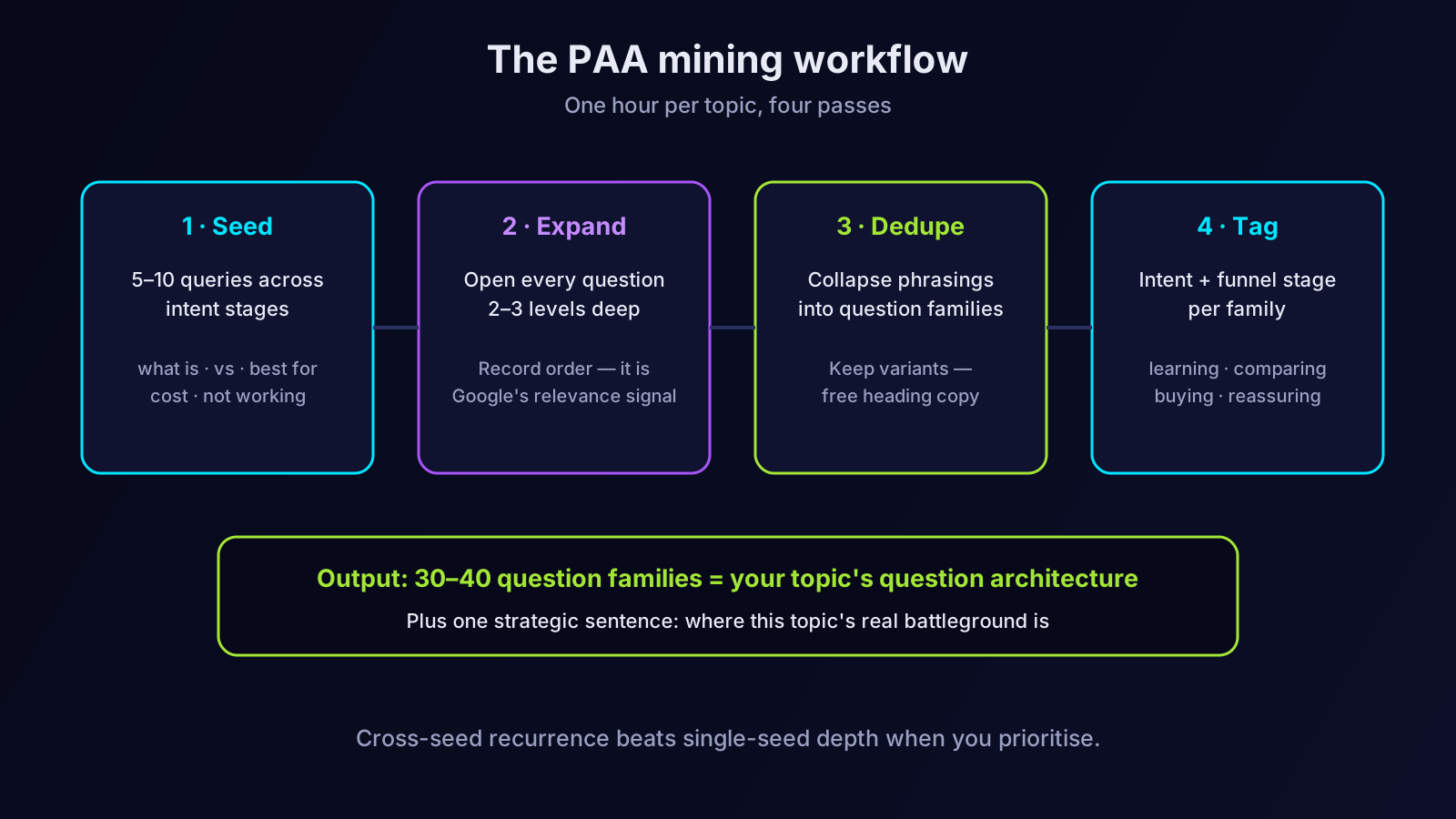
Random clicking produces random insight. Here is the structured version, which takes an hour per topic and replaces a deliverable agencies genuinely charge thousands for.
Step 1: Seed with the topic's natural entry points
Start with five to ten seed queries spanning intent stages: the definitional head ("what is X"), the comparison ("X vs Y"), the commercial ("best X for"), the troubleshooting ("X not working"), and your money terms. Each seed produces a different PAA neighbourhood, because Google's question graph is organised by intent, not just by topic. Seeding only with your head term is the classic error — you get the beginner neighbourhood and conclude, wrongly, that PAA is only good for definitional fluff.
Step 2: Expand recursively, and record everything
For each seed, expand every question two or three levels deep and capture the questions in order, noting which expansion revealed which. The order matters: questions that surface earlier and across multiple seeds are ones Google associates most strongly with your topic. Do it manually in an incognito window with a spreadsheet open, or use any of the SERP tools that extract PAA at scale. The manual version is slower and better for your first pass — reading two hundred questions in Google's own phrasing recalibrates your ear for how your audience actually talks, which is half the value. (The other half of that discipline — writing for natural phrasings — is covered in our guide to conversational queries.)
Step 3: Deduplicate into question families
PAA will hand you "How do I improve SEO?", "How can I make my SEO better?", and "What improves SEO ranking?" as three entries. Collapse them into one family, but — important — keep every phrasing on file. The variants are free heading copy, and the phrasing Google shows most often is its canonical form: a strong hint about which wording to use as your H2. A hundred-odd raw questions typically collapse into thirty or forty families. That set, ordered and grouped, is your topic's question architecture as Google understands it.
Step 4: Tag each family by intent and stage
Walk the families and tag each one: learning, comparing, buying, troubleshooting, reassuring. The tags expose the shape of your topic's demand. Some topics' PAA graphs are dominated by anxiety questions ("is X safe", "can X go wrong") — that is the consultant telling you trust content is your gap. Others skew toward cost and comparison — the buying conversation happens in public, and you had better be in it. This single tagging pass routinely reshuffles a quarter's content priorities, which is more than most paid discovery workshops achieve.
The strategy session: turning questions into a plan
Mining gives you raw material. The consulting value is in three decisions the material now lets you make properly.
Decision one: page or passage. For each question family, ask whether its best answer needs its own URL or a section inside a bigger page. The signals are in the box itself: a question that triggers its own rich PAA neighbourhood when searched directly has enough demand-depth to deserve a page; a question whose expansions immediately wander to other topics is a passage. Map the page-worthy families into your cluster structure — pillar for the head, clusters for the substantial families — exactly as a topic cluster architecture prescribes. PAA has effectively pre-drawn your cluster diagram; you are just tracing it.
Decision two: outline order. Within a page, sequence the question families the way the expansions unfolded — definition before mechanics, mechanics before cost, cost before alternatives. PAA expansion order approximates the natural follow-up sequence of a curious human, which means your outline can mirror an actual conversation instead of a keyword list. Readers experience this as the uncanny feeling that the article keeps answering the thing they were about to wonder. That feeling is retention, and it is manufactured directly from the box.
Decision three: the gap audit. For every high-value family, search the question and read the current snippet Google is using. You are looking for three exploitable conditions: the snippet answers a different question than the one asked (intent mismatch), the snippet is from a forum or a thin page (weak incumbent), or the snippet is outdated. Each condition is an opening. Write the genuinely better passage — direct answer first, 40 to 60 words, evidence after — and you have a realistic shot at taking the slot, because PAA snippets turn over far more readily than top-three organic rankings. Our question keywords goldmine guide covers the snippet-winning format in detail.
Why the consultant got a promotion in 2026
PAA mining has been a respectable tactic for years, but the AI search era quietly upgraded it from "nice tactic" to "core research input", for one structural reason: the systems that now write the top of the results page are built on the same question-expansion logic that PAA displays.
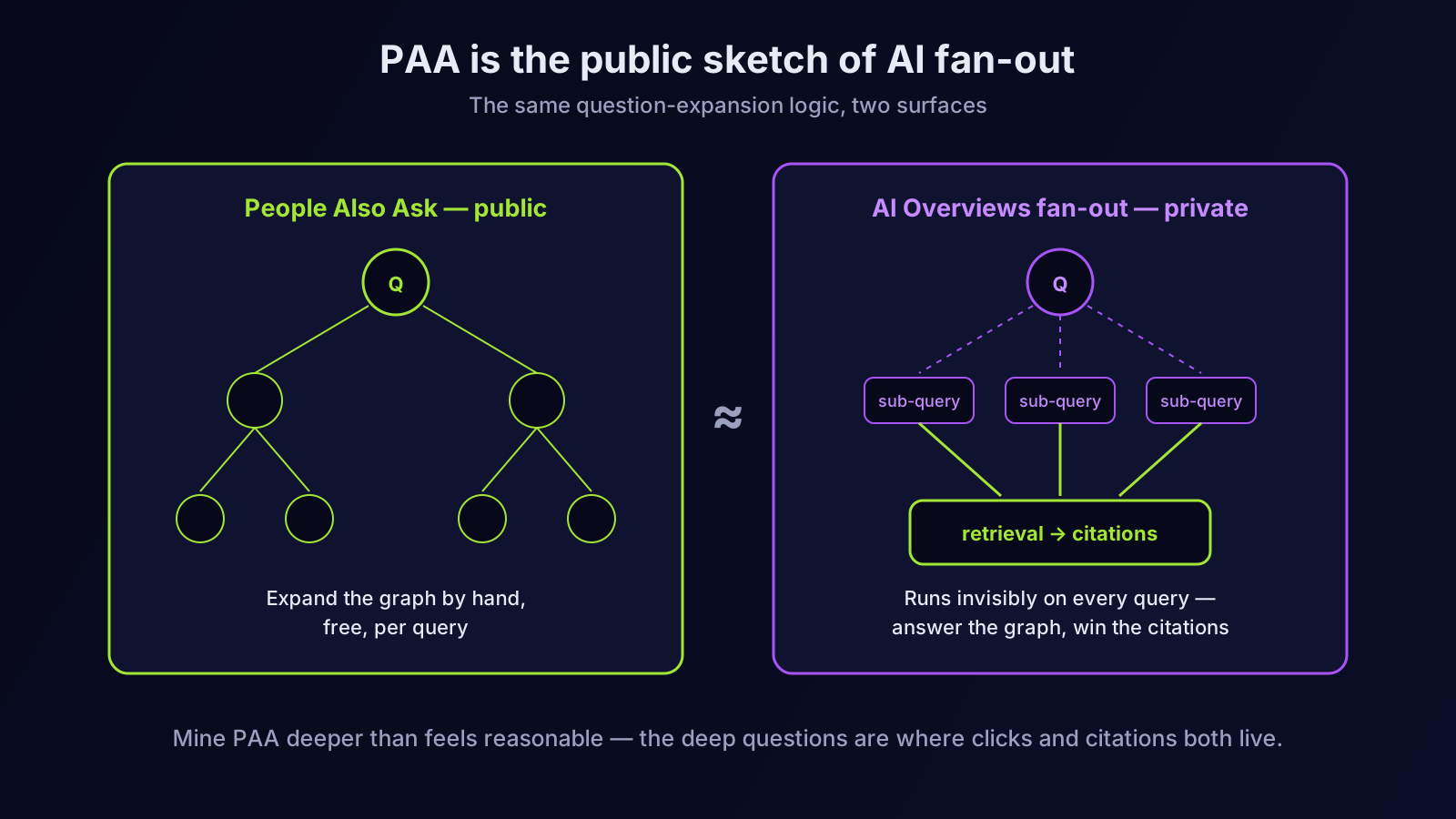
Google has described the query fan-out technique behind AI Mode and AI Overviews — a user's query gets expanded into related sub-queries, retrieved separately, and synthesised. Read that again next to the PAA box: related questions, generated by Google, around a seed query. PAA is the closest public artefact to the expansion layer that AI features run privately. When you build content that cleanly answers a PAA neighbourhood, you are not just chasing accordion placements — you are pre-answering the sub-queries an AI Overview is likely to fan out into, which is a large part of how pages get selected as citations. The full selection mechanics are in our complete guide to ranking in AI Overviews, but the practical takeaway fits in one line: the question graph you mine from PAA today is a sketch of the retrieval pattern AI answers will run on your topic tomorrow.
There is a defensive angle too. AI Overviews satisfy more generic questions on the results page itself, which means the click-throughs that survive skew toward the specific, situational, follow-up-shaped questions — precisely the inventory PAA exposes at depth two and three of the expansion walk. The shallow PAA questions are increasingly absorbed by AI answers; the deep ones are where the remaining traffic and the citations both live. Mine deeper than feels reasonable.
A worked hour with the consultant
To show the method earning its keep, here is a compressed transcript of one real mining hour, generic enough to share. Topic: project management software, from the perspective of a tool selling to small agencies. Seeds: "what is project management software", "project management software vs spreadsheets", "best project management tool for agencies", "project management software cost", and one troubleshooting seed, "why do project management tools fail".
The definitional seed produced the expected beginner neighbourhood — what does it do, do small teams need it, what is the easiest one. Useful mostly for phrasing. The comparison seed got interesting at depth two: the expansions kept returning to migration anxiety — "how do I move my projects out of spreadsheets", "will my team actually use a project management tool". Neither question appears in keyword tools with meaningful volume; both appeared across multiple seeds, which is the box's way of underlining something. The cost seed fanned into a pricing-model minefield: per-user versus flat pricing, what happens when you exceed user limits, hidden costs — an entire objection-handling page assembling itself in real time.
The troubleshooting seed was the revelation, as it usually is. "Why do project management tools fail" expanded into adoption questions — team resistance, half-empty boards, the tool becoming the manager's diary nobody else opens. Tag those by stage and you realise they are post-purchase anxieties surfacing pre-purchase: buyers ask "why do these fail" before choosing one, because they have lived the failure. The strategic readout, one hour in: this topic's real battleground is not features, it is adoption confidence. The content plan that fell out — a pillar on choosing, a cluster page on migration, an adoption-playbook page answering the failure questions, pricing-model explainers as sections — bears no resemblance to the feature-comparison roadmap the team had drafted from keyword volume alone. The four-hundred-dollar consultant might have reached the same conclusion. In week four.
Two process notes from that hour. First, the question families that recur across seeds outrank, in priority, families that run deep under one seed — cross-seed recurrence means the question shadows the whole topic, not one corner of it. Second, write the strategic readout sentence — "this topic's battleground is adoption confidence" — at the end of every mining hour while it is fresh. The spreadsheet is the deliverable, but the sentence is the strategy; spreadsheets get filed, sentences change roadmaps.
Keeping the consultant on retainer
One mining hour is a project; the durable advantage comes from making it a habit, because the box is not static. Questions enter and leave PAA as demand shifts — new competitor names appear, post-update anxieties spike, seasonal phrasings rotate through. A topic's question graph in January and its graph in June can disagree in ways that matter commercially, and almost nobody is watching the difference.
The retainer version costs thirty minutes a month per priority topic. Re-run your seeds, diff the question families against last month's list, and triage three buckets. New questions are early-warning demand — a question entering PAA today often precedes measurable search volume by months, which makes it the cheapest first-mover opportunity in content. Vanished questions tell you a section of an existing page may have stopped earning its slot, worth checking before traffic reports tell you the same thing more painfully. Changed incumbents — your snippet replaced by someone else's — are the competitive alarm; read the winning passage and learn, specifically, what beat you. It is almost always a more direct first sentence.
Track your own placements while you are there. For each priority family, log whether you hold the PAA snippet, who does if not, and whether an AI Overview now answers the question outright. That last column trends upward over time, and watching which kinds of questions migrate from PAA accordion to AI answer in your niche is its own strategic education: it shows you, months ahead of the averages, where your topic's zero-click line is moving — and therefore which question families to double down on for clicks versus citations. The wider playbook for that split is in our guide to answer engine optimization.
Where the consultant lies to you
Every consultant has failure modes, and PAA's are well documented by anyone who has mined it for long. Knowing them is the difference between using the box and being used by it.
It serves stale answers with fresh confidence. The questions are usually current; the snippet answers can be years old. Never treat a PAA snippet as ground truth about facts — treat it as ground truth about what Google currently considers an acceptable answer, which is exactly the bar you need to clear. Stale snippet, fresh opportunity.
It hallucinates relevance at the edges. Walk any expansion three levels out and the questions start drifting — your CRM topic slides into someone's tax question because the graph crossed an ambiguous phrase. The discipline: expansion order is signal, but final inclusion is your call. If a question would embarrass you in a customer meeting, it does not go in the brief, whatever the box says.
It shows the asked, not the unasked. PAA reflects questions people already ask Google. The questions your customers ask after the first answer — in tickets, on sales calls — mostly never reach a search box and therefore never reach the box. PAA is one consultant; your inbox is the other, and we have written about mining the follow-up goldmine separately. Hire both. Cross-reference their reports. Where PAA and your inbox agree, you have found a question that matters everywhere; where they disagree, you have found either a public question competitors will fight you for, or a private question nobody else can even see.
It repeats itself in different costumes. The same underlying question wearing four phrasings can convince an unwary strategist there are four pieces of demand. That is how sites end up with four cannibalising articles about one topic. The deduplication pass in step three is not optional housekeeping; it is the guard against building a content plan out of echoes.
It speaks Google's dialect, not necessarily yours. PAA phrasing reflects the average asker, and the average asker may not be your buyer. A developer-tools company mining its topic will see PAA dominated by hobbyist questions, because hobbyists outnumber CTOs a thousand to one in search. The questions are real; their weighting is wrong for your revenue. Correct for it deliberately: weight families by how often your sales pipeline echoes them, not just by how prominently the box displays them. The consultant reports population averages — you are selling to a segment.
None of these flaws is disqualifying; they are scoping notes. PAA is unbeatable at breadth, phrasing, and structure, and unreliable at facts, edges, and segment weighting. Use it for the former, audit it for the latter, and it remains the best price-to-value ratio in the entire research stack.
The invoice that never comes
A last bit of perspective. The deliverables described here — a question architecture for your topic, canonical phrasings for headings, an intent-tagged demand map, a gap audit of weak incumbent answers, and a sketch of the AI retrieval pattern — are, collectively, what a content strategy engagement is supposed to produce. The box produces them for the cost of an hour and a spreadsheet, and it never pads the scope or books a follow-up workshop. The only fee is discipline: mine systematically instead of glancing, deduplicate instead of hoarding, verify facts instead of trusting snippets, and cross-check against the questions your real customers ask in private.
And when the question list grows past what any team can hand-process — hundreds of families across dozens of topics, each needing a brief, a draft, and a refresh schedule — that is the point where the work becomes a pipeline problem, which is what an SEO AI agent like Orova is for: it watches your search data for emerging question patterns, drafts the answer-first sections, and keeps the cluster wired together while your humans make the judgment calls. The consultant in the box supplies the questions. Someone still has to ship the answers — and shipping faster than the next person reading the same free box is, in the end, the entire game.
Let an AI Agent handle your SEO
Orova plans, writes, optimizes, and tracks rankings on its own — you just read the results.
Try it free