
Question Keywords: Find PAA and Featured Snippet Questions
You write a blog post, check it a week later, and it is sitting on page two with barely any visitors. Meanwhile, a competitor with a thinner-looking article is showing up in that little answer box right at the top of Google, or inside the "People Also Ask" dropdown. You know the content matters, but you are not sure what they did differently to earn that spot.
The usual advice is to "add more keywords" or "write longer content," so you stuff in your main question keywords and hope for the best. But this misses the real pattern: those featured spots are almost always answers to a specific question, phrased the way a real customer would type it. If your article never actually asks and answers that question in plain words, Google has nothing clean to pull out and show, no matter how long or well-written the page is. This matters more than ever now that SparkToro found 68% of US Google searches in early 2026 ended without a click, meaning the answer box itself is often the only impression you get.
This article will show you where to find the exact questions your customers are already typing into Google, how to organize an article around them, and how to structure your answers so Google is more likely to feature you instead of a competitor. By the end, you will have a simple, repeatable process you can use for every new article, not just a one-time trick.
Two kinds of customer walking into your shop
Picture standing behind the counter. Two kinds of customer come in. The first drifts by, mutters "coffee", and moves on — you have no idea what they want, whether they'll buy or just browse. The second walks straight up and asks: "Which espresso machine under $150 can pull espresso for a family of four?" The second has practically pulled out their wallet — they've said exactly what they need, their budget, how many people. You just hand them the right thing and you've made a sale.
Google is the same. Some type a curt few words. But very many people type a whole question. And a question is that second customer — they declare their intent so clearly that you just answer correctly to win. Better still, Google reserves special boxes on the results page for good answers — and capturing those boxes means standing above even the #1 result.
This article digs into a goldmine of its own: question and long-tail keywords — why they're valuable, how to find them from free mines, how to structure articles so Google picks your answer, the answer-box formats, and why questions matter more in the AI era, not less.
What is a long-tail keyword? A long, specific search phrase — few people type it but it's clear in intent. "Shoes" is short-tail (many, vague); "running shoes for flat-footed 154-lb runners" is long-tail (few, but whoever searches is close to buying). Questions are almost always long-tail — because to ask is to be long and specific.
What is a question keyword? A keyword in the form of a question — starting with "how", "why", "what", "when", "where", "which", "how much"... Someone typing a question is stating their need outright, so it's the easiest kind of keyword to serve precisely.
Why questions are a goldmine
Three reasons question keywords are worth more than their "low volume" looks suggest:
- Crystal-clear intent. A question states what they want by itself. No mind-reading (see the Search Intent guide) — they've said it.
- Less competition. Specific questions usually have fewer pages targeting them, so a young site ranks far more easily than for short terms (see the Keyword Difficulty guide).
- They unlock "special boxes". Google reserves blocks like the quick answer box and "People Also Ask" for good answers — a way to stand above #1 without being #1.
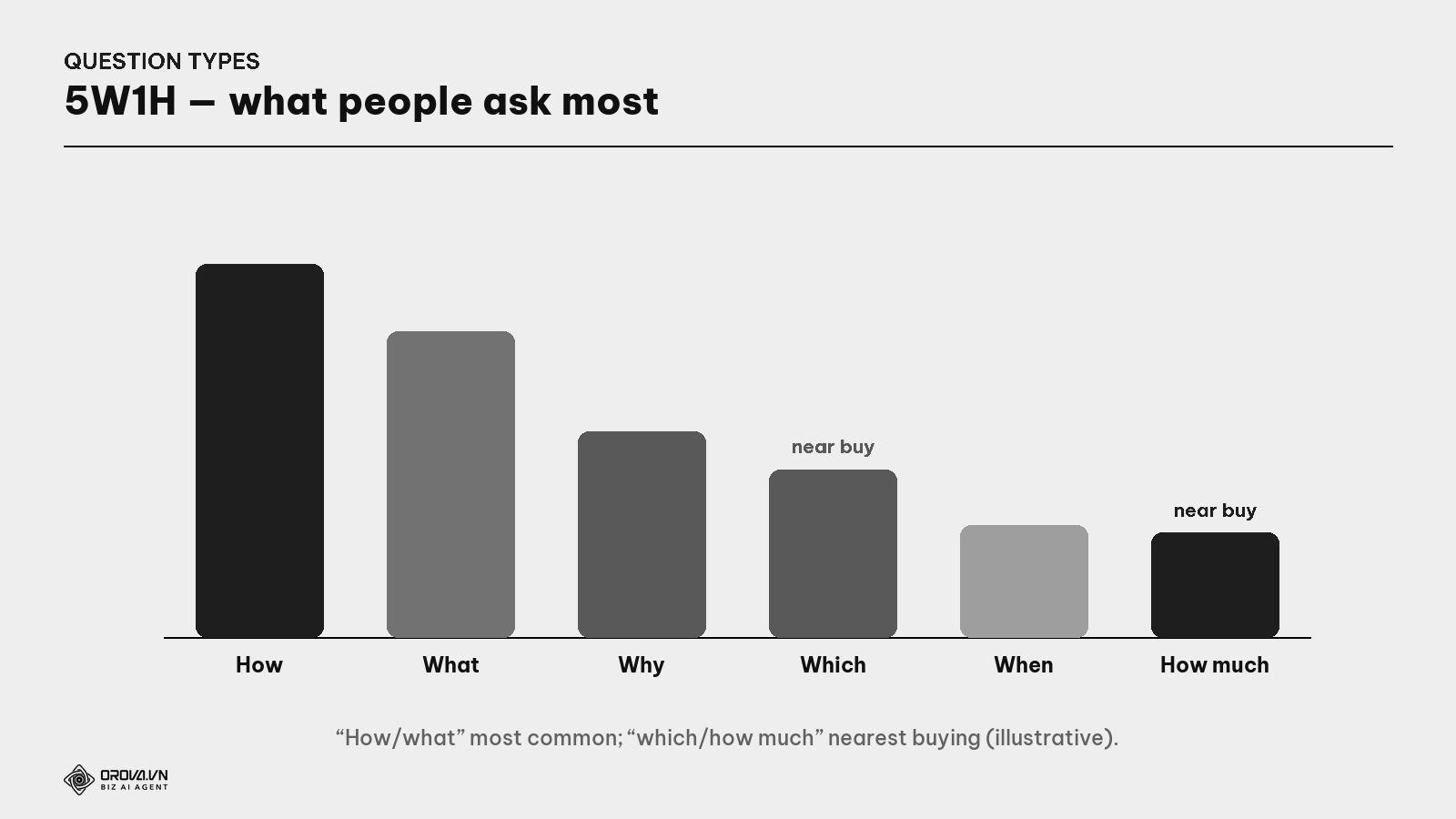
A strategic detail: not all questions are equal value. "What is X" leans toward learning (top of funnel); "which is best", "how much" lean toward near buying (bottom funnel, the money). When choosing questions to write, mix both — attract researchers and catch near-buyers.
The quick answer box & "People Also Ask": the reward for questions
This is why questions are especially valuable. Google rewards good answers with two prominent blocks.
What is a Featured Snippet? A block that quotes the answer straight from a page, shown at the very top of results — often called "position zero" because it sits above #1. Landing here = claiming the most prominent real estate, attracting many clicks (and authority) even if your "official" rank isn't #1.
What is People Also Ask? A block of related questions that unfolds on the results page; clicking each opens a short answer excerpted from a page. It's both an appearance opportunity (a good answer gets excerpted) and a huge idea mine (each question is a question keyword to write).
What is "position zero"? A playful name for the featured snippet — because it sits before result #1. Capturing it is the goal of question optimization.
Implication: if you structure an article correctly (see below), a page ranked 3rd–4th can still "leapfrog" to the answer box on top — one of the rare ways to beat a stronger rival without more backlinks.
How to find questions: three free mines
You don't need expensive tools. These three free mines yield hundreds of real questions.
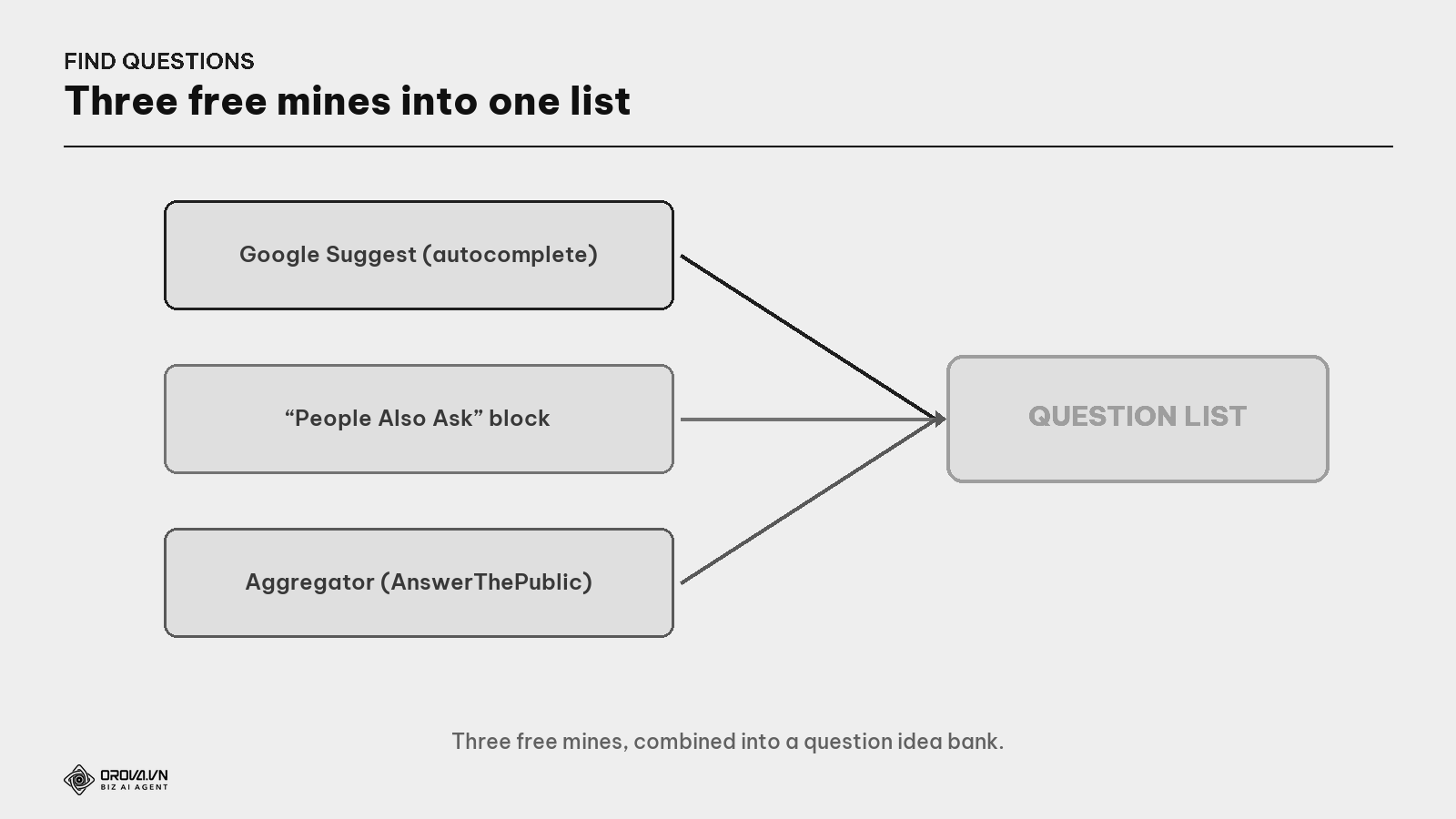
Mine 1 — Google autocomplete. Type a seed + a question word (e.g., "espresso machine how", "espresso machine which") and see Google's suggestions. Each suggestion is a real question many people type.
Mine 2 — The "People Also Ask" block. Type your main keyword, scroll to the PAA block, expand a few — Google spawns more related questions. A nearly endless mine.
Mine 3 — Question-aggregator tools. Tools like AnswerThePublic gather many questions around a topic into a map. The free version is limited but enough to start.
Quick how-to: take 3–5 main seeds, run them through all three mines, paste every question into a sheet. Cluster same-intent questions into groups — each group becomes a section (or article) to answer.
Long-tail question variations: six question words unlock them
A fast way to multiply your list: take a seed and combine it with the six basic question words.
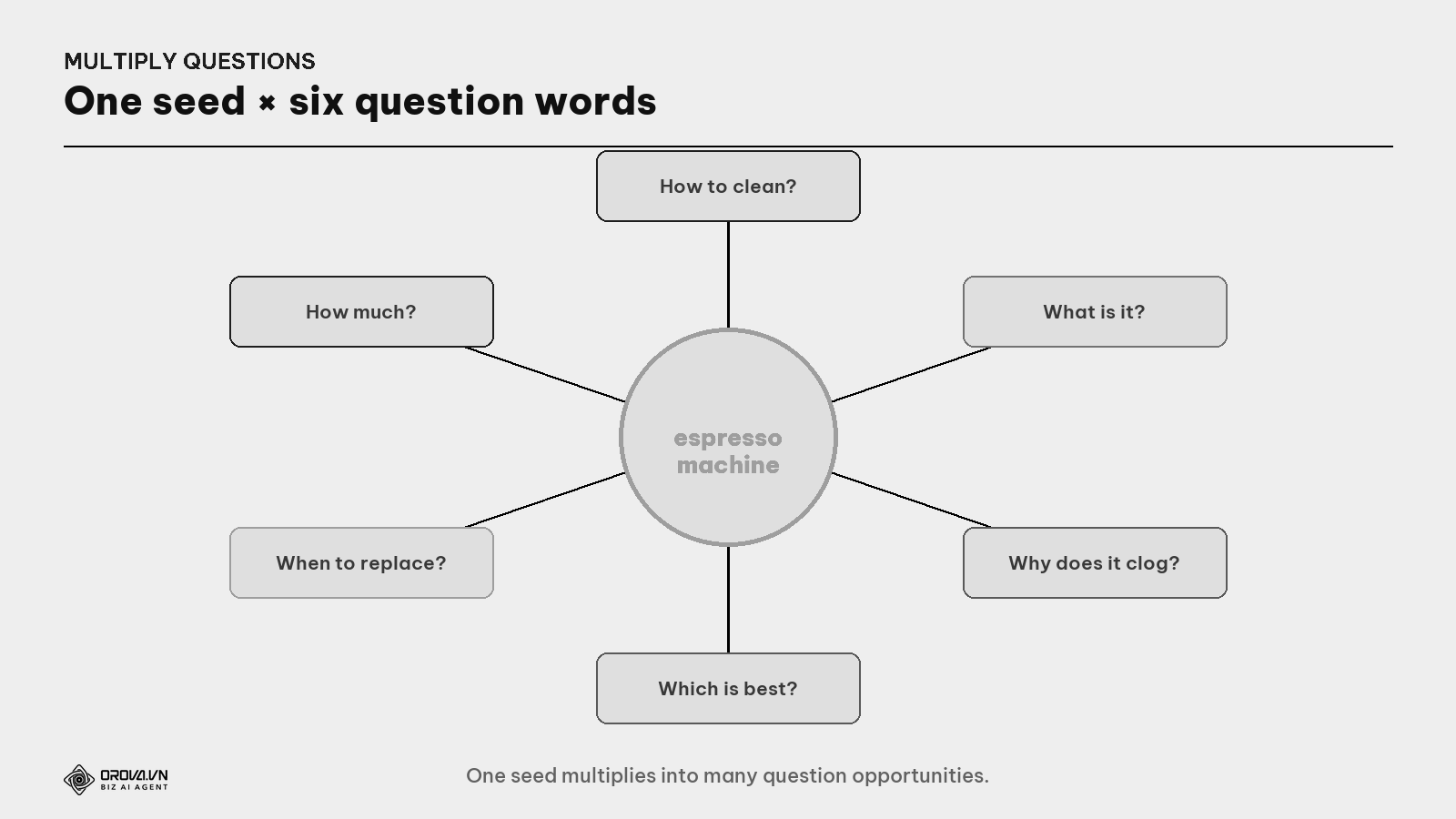
- How → "how to clean an espresso machine" (guide).
- What → "what is an espresso machine" (learn).
- Why → "why does an espresso machine clog" (troubleshoot).
- Which → "which espresso machine is best" (near buying).
- When → "when to replace an espresso machine" (consideration).
- How much → "how much does an espresso machine cost" (near buying).
The "which / how much" group is nearest money — prioritize it if you want orders fast.
How to structure an article so Google picks your answer
Finding questions is half the job. The other half: present so Google can easily excerpt into the answer box.
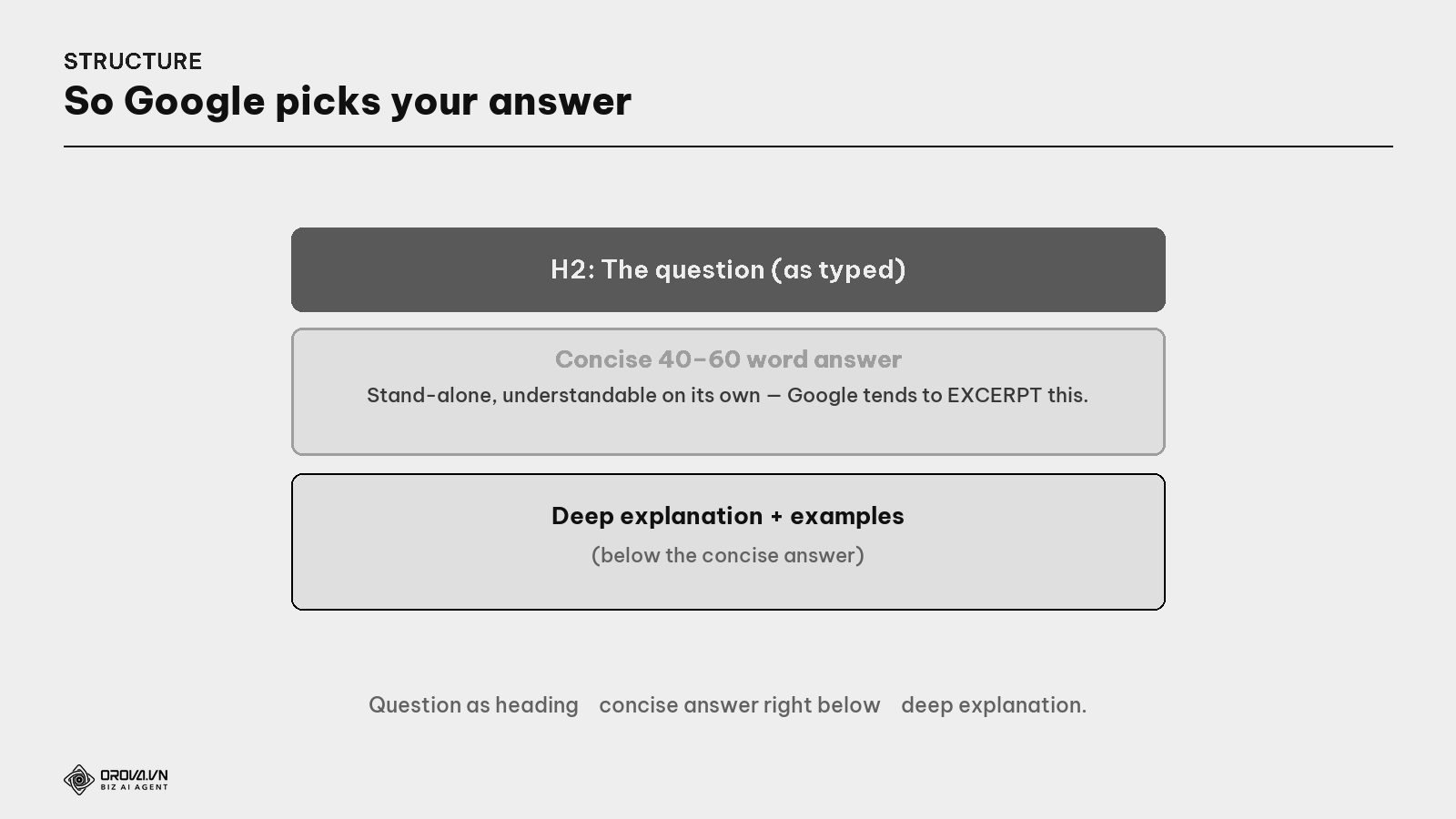
The golden rule:
- Put the question as the section heading (H2 or H3) — exactly as people type it.
- Answer concisely right below, about 40–60 words, standing alone (understandable on its own) — this is the block Google tends to excerpt.
- Then go deep below that concise answer.
- Use the right format the question type calls for (see below).
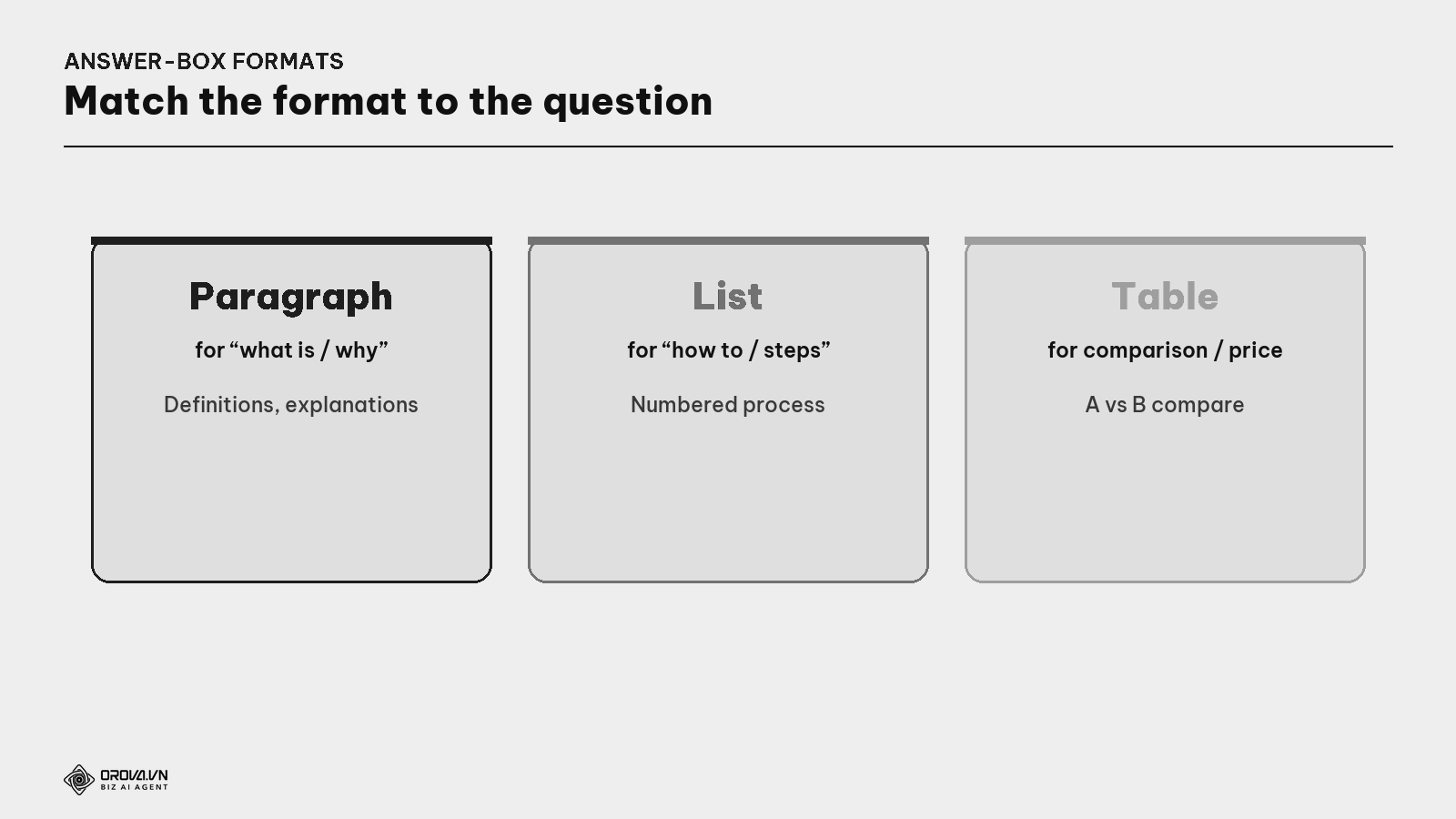
- Paragraph for definition/explanation questions ("what is X", "why").
- Numbered list for process questions ("how to", "steps").
- Table for comparison/price questions ("A vs B", "how much").
Matching the format to the question type makes selection into the answer box far more likely.
Questions in the AI era: why they matter even more
You might worry: "AI answers questions directly now, what's the point of writing questions?". Actually, the reverse.
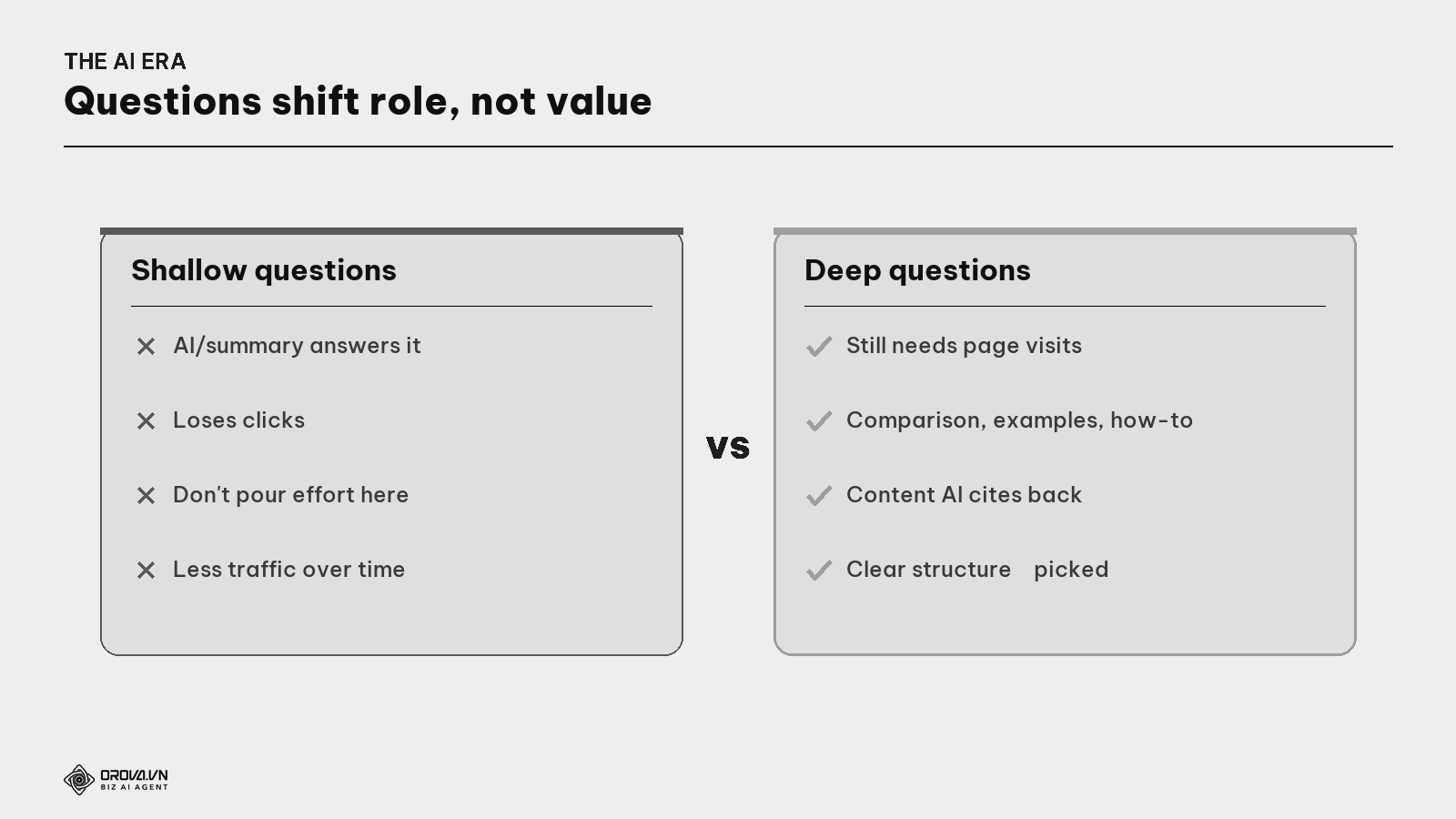
- Shallow questions (one-sentence definitions) are increasingly answered by AI/summary boxes → fewer clicks. Don't pour effort here.
- Deep questions (comparisons, detailed how-tos, real examples) still need a page visit — and clearly Q&A-structured content is exactly what AI tools tend to cite back. Good structure gets you picked in both places: Google's answer box and the AI's answer.
In other words, the "question-as-heading + concise answer" skill is more valuable in the AI era, not less.
The complete process & standard
- Collect questions from three mines (autocomplete + PAA + tool) for each seed.
- Cluster same-intent questions; classify by funnel (learn / near-buy).
- Choose questions worth writing — prioritize intent match + a gap on the SERP.
- Structure the article: question as heading → concise 40–60 word answer → deep explanation, right format.
- Fold related PAA questions into sub-sections of the same article (cover the topic fully).
- Track in Search Console which sections win the answer box / rank, to scale up.
"Pass" standard: the article covers a cluster of questions around a topic (not just one); each question is a section heading with a stand-alone concise answer right below; the format (paragraph/list/table) matches the question type; it mixes top-of-funnel and near-buy questions; and it's structured clearly enough for both Google and AI to excerpt. At this level, you don't just "rank" — you have a shot at position zero and being cited by AI.
Benefit: question keywords are one of the shortest paths for a young site to early results — less competition, clear intent, and unlocking prominent boxes that let you beat stronger rivals without more backlinks. A well-structured Q&A article also "spawns" traffic from dozens of related questions at once.
FAQ
How do question keywords differ from regular keywords? A regular keyword can be curt ("espresso machine"); a question keyword is a whole question ("which espresso machine is best for a small cafe"). Questions state intent more clearly, face less competition, and unlock special answer boxes.
How do I land "position zero" (the featured snippet)? Put the exact question as a section heading, answer concisely in 40–60 words right below (stand-alone), use the right format (paragraph/list/table). The page needn't be #1 — good structure can "leapfrog" from 3rd–4th into the answer box.
How do I use "People Also Ask" effectively? Two ways: (1) as an idea mine — each question is a question keyword to write; (2) fold related PAA questions into sub-sections of your article to cover the topic fully and increase your excerpt chances.
Are low-volume questions worth writing? Yes, for two reasons: intent is very clear (closer to a customer), and an article covering a cluster of questions sums traffic from many at once. Don't judge a question by its single-term volume.
If AI answers directly, what's the point of writing questions? Shallow questions lose clicks to AI; but deep/comparison/real-example questions still pull page visits, and clearly Q&A-structured content is what AI tends to cite. This skill is more valuable, not less.
How many questions should one article answer? A cluster of same-topic questions: one main question as the focus + many related ones as sub-sections. Don't do one article per question (dilutes, self-cannibalizes — see the Cannibalization guide); also don't cram unrelated questions together.
Do I need paid tools to find questions? No. Google autocomplete + the "People Also Ask" block + the free tier of a question aggregator are enough to find hundreds. Search Console also shows which questions you already appear for, to optimize further.
Back to the two kinds of customer
Remember the two kinds of customer at the start? The one muttering "coffee" and the one asking outright "which machine under $150 pulls espresso for four". For a lifetime of selling, you'll love the second kind — they tell you exactly what they need, and you just hand them the right thing.
Question keywords are how you invite that second kind of customer on Google. Instead of fighting over vague short terms everyone contests, go find the specific questions people are typing, then answer them clearly, concisely, in the right format. Do that, and you don't just rank — you claim the prominent answer box on top, and become the source both Google and AI choose to reply to the user's question. That's a position short keywords, however big their volume, rarely give you.
This article is part of Orova's complete SEO guide series. It's a deep-dive within the cluster — see "Keyword Research", "Search Intent", "Keyword Difficulty", and "Schema" for the full picture. Get started with Orova at orova.vn/en/seo.
Sources
Google Search Central (featured snippets, content structure, helpful content) · Google (the "People Also Ask" block & autocomplete) · Ahrefs, Semrush & AnswerThePublic (question keyword research) · research on featured-snippet formats.
Let the Questions Come to You Automatically
Doing all of this by hand takes real time: searching Google over and over, scrolling through "People Also Ask" boxes, copying questions into a spreadsheet, sorting them by the six question words, then rewriting your article structure around them. It is not hard work, just slow, repetitive work that is easy to keep putting off.
This is exactly the part Orova SEO is built to take off your plate, automatically pulling together the real questions customers are asking around your topic so you can skip the manual digging and go straight to writing answers worth featuring. If that sounds useful, it is worth taking a few minutes to try it out on one of your own topics.
Let Orova SEO handle the repetitive part
Keyword research, drafting, refreshing old posts and rank tracking — running automatically on your own site.
Explore Orova SEO