
Keyword Difficulty: How to Check Your Score the Right Way
You found a keyword, checked its keyword difficulty score, saw a nice low number, and went all in — new page, your best writer, weeks of work. Months later, you're nowhere near page one. Sound familiar? That low score lied to you, and you have no idea why.
Here's the problem: most keyword difficulty scores come from a formula that only looks at surface-level signals — things like how many links point to the top-ranking pages. It never actually looks at who those pages belong to, whether they're a good match for the search, or whether a site like yours could realistically compete with them. And even a "low difficulty" score doesn't account for how much of that traffic is even reachable anymore — AI Overviews now show up on more than 20% of Google searches, and when one appears, the top-ranking page sees a 34.5% lower average click-through rate than similar queries without one (Ahrefs). So you end up trusting a number that has nothing to do with your real chances.
This article shows you a better way. You'll learn how to look past the score and actually read the real battlefield — Google's results page itself — so you can tell in minutes whether a keyword is truly winnable for your site right now. By the end, you'll have a simple way to judge "can I actually win this" before you spend a single hour writing.
Sending elite troops into the wrong battle
A general gathers all his best troops and finest weapons and charges straight at the enemy's most fortified stronghold — thickest walls, most soldiers, strongest defense. His men are elite, but he picked the wrong battle. They fall in waves before an unbreakable wall. Meanwhile, a few miles away there's an open, almost unguarded gate — had he struck there, he'd have won cleanly.
SEO has exactly this tragedy. You can write the best article of your life, but pick the wrong "battle" and you still lose. A brand-new website charging at keywords held by major news sites and billion-dollar brands is like a new shop trying to out-price a supermarket. Lost before the first word is written. Meanwhile, countless "open gates" — keywords few contest, matched to your strength — go ignored.
The last article covered how to find keywords. This one answers the next life-or-death question: of all those keywords, which can I actually win? This is assessing keyword difficulty. And here's a truth few say plainly: the "difficulty" number tools give you often lies. Understanding why it lies — and how to read real difficulty — is the difference between pouring effort into pre-lost battles and only fighting ones you can win.
What is Keyword Difficulty (KD)? An estimate of how hard it is to rank for a keyword, usually scored 0–100. High KD = many strong rivals, hard to break in; low KD = easier. The problem is the word estimate — and that it omits many important things (we'll dissect that shortly).
Why picking the right battle beats fighting well
Beginners often believe "just write really well and you'll rank". Wrong. In SEO, picking the battle comes before fighting well:
- Your strength is limited. A young site can't beat a 10-year-old site with thousands of backlinks on big keywords — even with a better article. Accumulated authority is a real wall.
- Time is your most expensive resource. Three months on a hopeless keyword = three months you could've harvested from winnable ones.
- Small wins feed big wins. Each easy keyword you win raises your site's authority, gradually making you strong enough for bigger battles. Charge the big battle first and you never build that momentum.
In other words: assessing difficulty correctly is the skill that keeps you from wasting ammo. It turns "what should I write" into "what do I actually have a shot at".
How tools compute "difficulty" — and why it's often wrong
Tools (Ahrefs, Semrush, Moz...) give a tidy KD number. Convenient, but don't worship it as truth.
How is the KD score computed? Most tools compute KD mainly from the quantity and strength of backlinks of the pages currently on top: a top full of high-backlink pages → high KD. It's a useful hint, but it omits many factors that actually decide who wins.
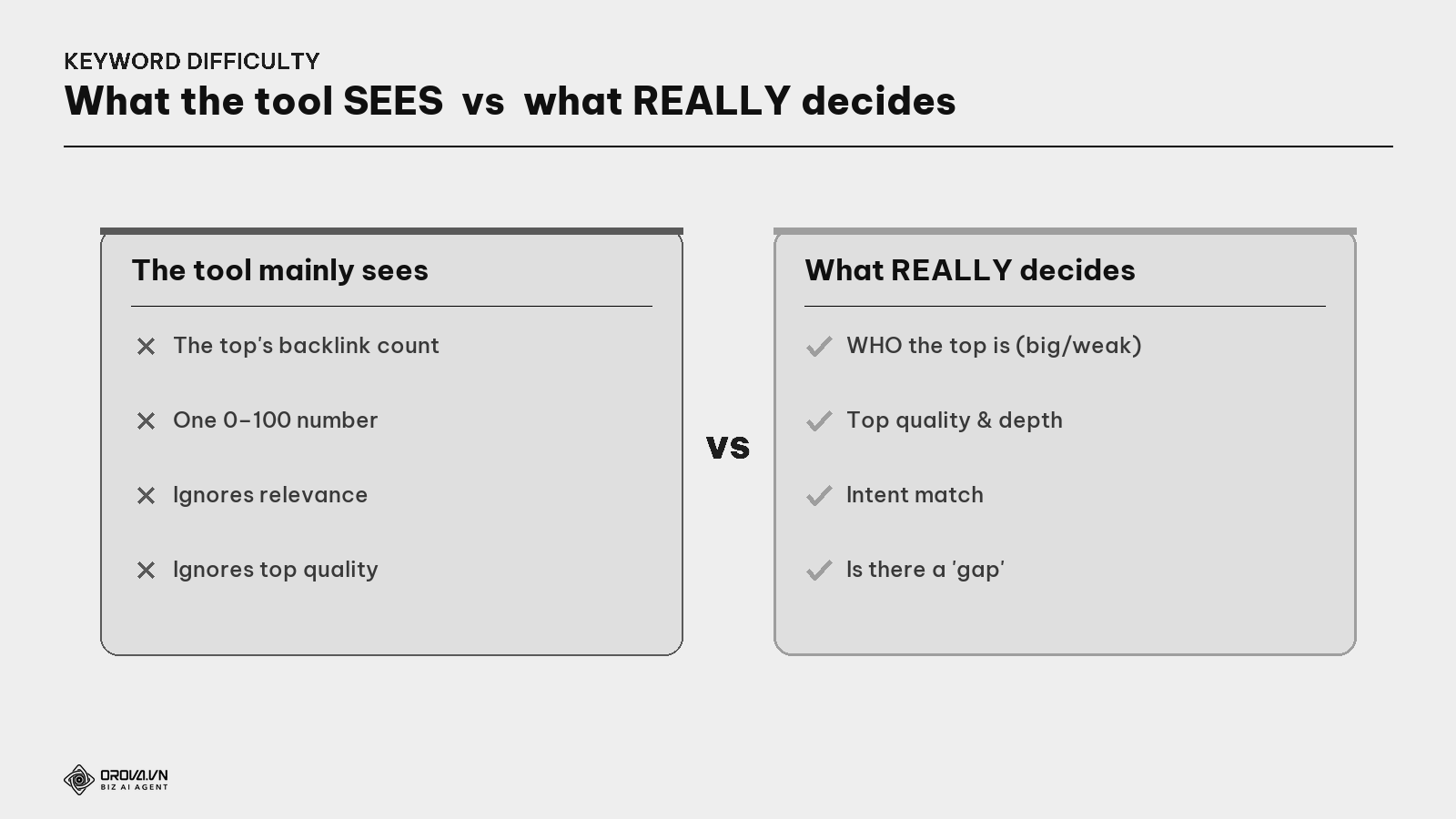
What the KD score usually omits:
- Topical relevance & depth. A site deeply specialized in a niche can beat a big but "generalist" site — KD doesn't see this.
- Intent match. If the top is off-intent (see the Search Intent guide), getting the intent right can break you in despite a high KD.
- Who is on top. A top full of major news sites = very hard. But a top full of forums, weak sites, old content = wide open — even with the same KD score.
- Quality of the top content. If the top articles are all shallow, old, poor — you have a big shot regardless of the KD number.
So: use the KD score for a quick filter, but base the final decision on inspecting the results page yourself.
What REALLY decides whether you can win
Before learning to read the SERP, know the real "forces" on the battlefield:
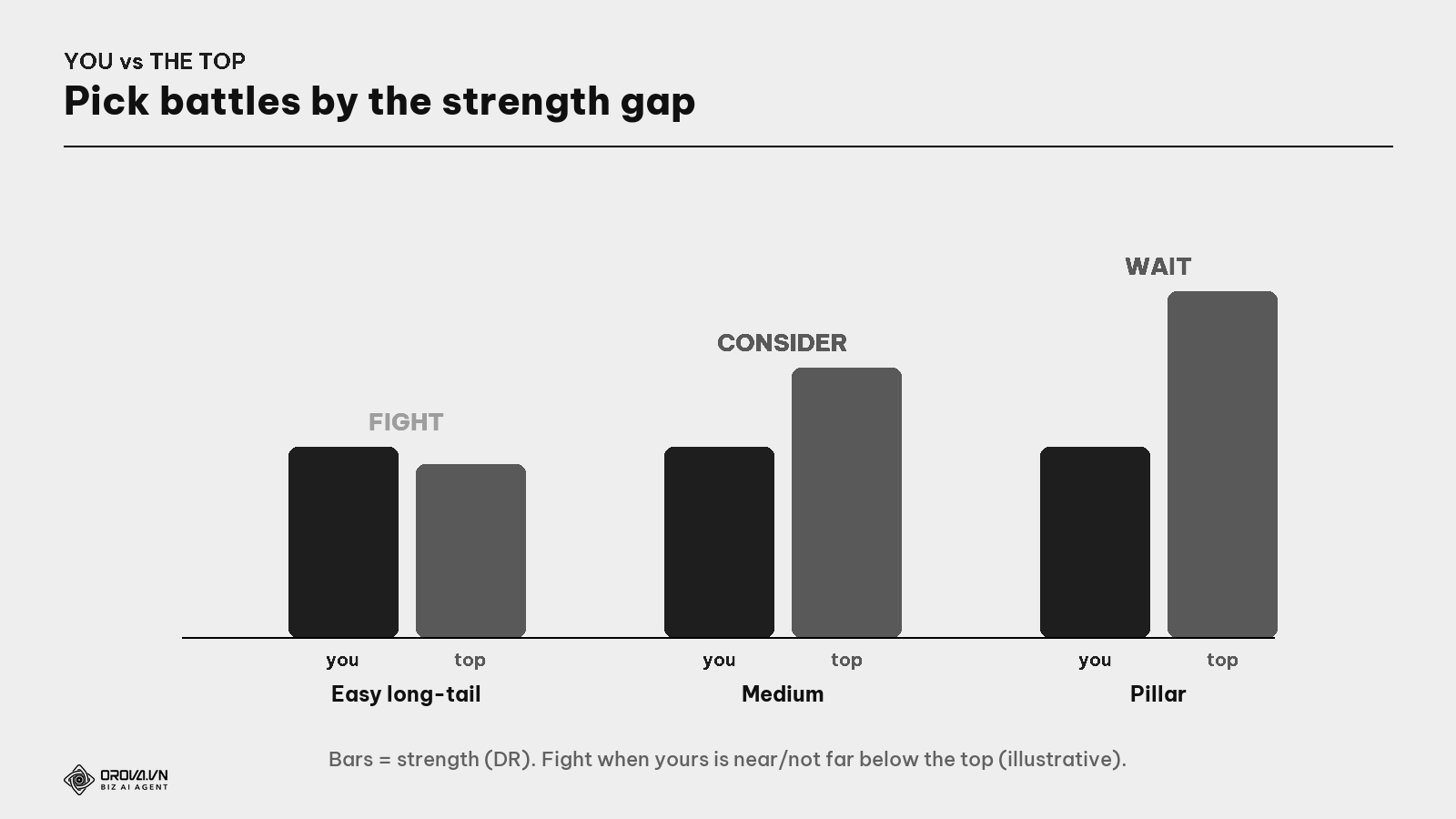
What are Domain Authority / Domain Rating? A score (Moz calls it DA, Ahrefs DR) estimating a website's overall strength, based heavily on its backlink profile. Use it to relatively compare your site's strength with the sites on top — it's not a Google metric. A top with DR far above yours = a hard battle.
What is Page Authority? Similar, but at the individual page level (not the whole site). A big site may still have a weak landing page for that keyword — that's a gap.
What is topical authority? How much Google regards you as an "expert" on a topic area (from deeply covering a topic cluster — see the Topic Cluster guide). A small but deeply specialized site can beat a big scattered one, even at a lower DR.
In sum, your chance of winning = (your site strength + relevance + content quality + intent match) versus (the strength & quality of the pages on top). The KD score only touches part of the latter.
The skill: read REAL difficulty right on Google's results page
This is the most valuable practical skill. Instead of trusting a number, look at the battlefield yourself.
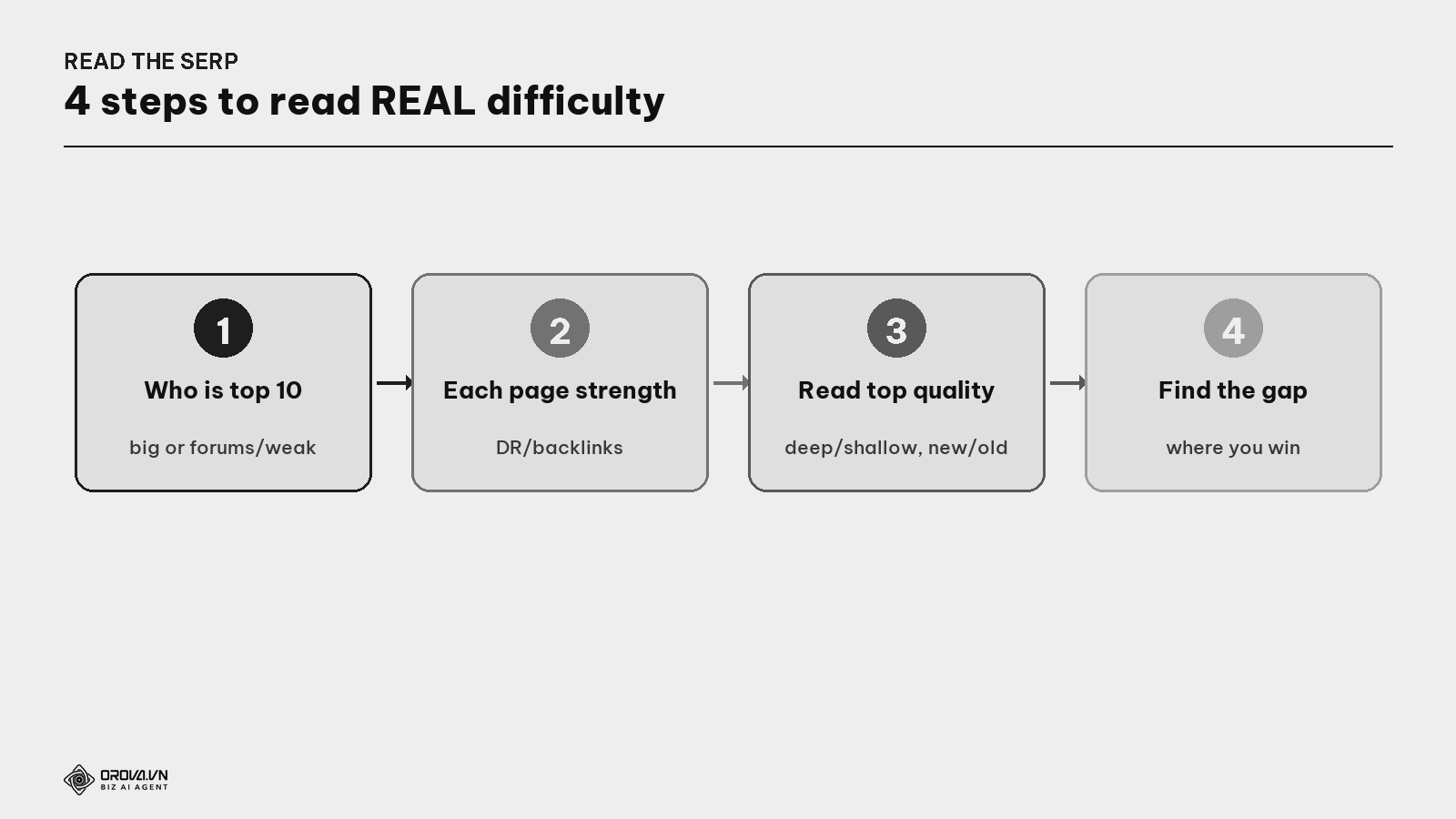
Step 1 — Who is the top 10? All major news, billion-dollar brands, Wikipedia → hard battle, avoid if young. Forums (Reddit, Quora), small sites, old content mixed in → there's a gap, worth fighting.
Step 2 — Each page's strength. Use an SEO toolbar (e.g., free Ahrefs/Moz) to see DR/backlinks of the top pages. If they're far above you and uniform → hard. If uneven (some weak pages) → there's room to break in.
Step 3 — Quality of the top content. Actually read 3–5 top articles: are they deep or shallow, new or old, intent-matched. Shallow/old/off-intent top = a big opportunity for you.
Step 4 — Find the "gap". What can you do better than them? Deeper, fresher, more on-intent, with real experience, better format? Finding the gap is finding your way to win.
Quick how-to: for each important keyword, spend 3 minutes inspecting the SERP via these 4 steps. The KD number only helps you quickly rule out clearly-too-hard keywords; the "fight or not" decision is far more trustworthy from 3 minutes of SERP inspection.
Signs of a SERP that's "easy to break into"
When inspecting, these are the "open gates" to watch for:
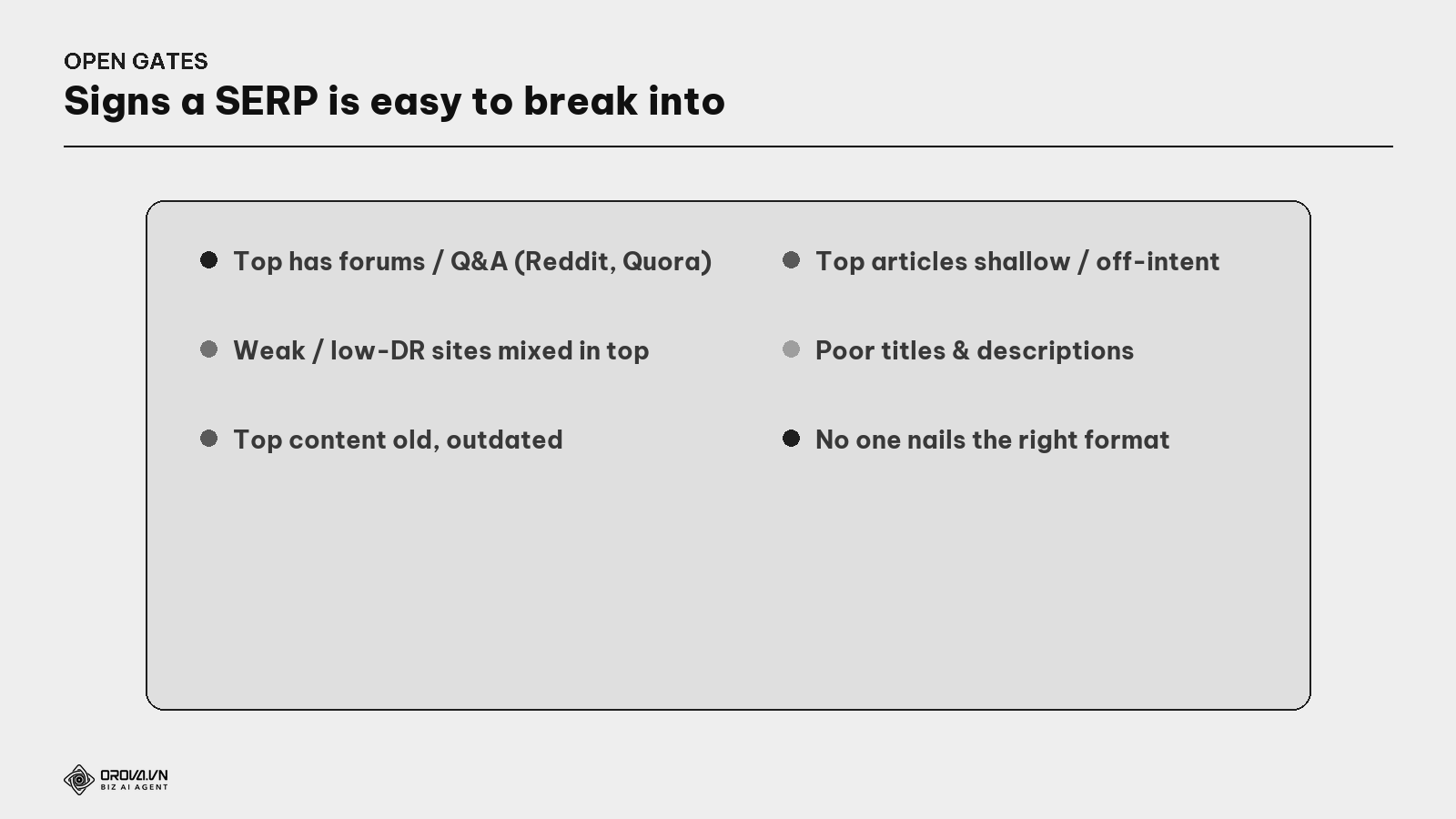
- Forums/Q&A in the top. Reddit, Quora ranking usually means Google "lacks" good deep content — a clear gap.
- Weak sites mixed in the top. If a low-DR page ranks, you have a shot too.
- Stale top content. Top articles from years ago with outdated data → make a fresh, deeper version and surpass.
- Shallow or off-intent top. Superficial top articles, or ones answering the wrong thing → a golden opportunity.
Conversely, if the top is all strong, fresh, deep, on-intent pages — that's a fortress; find another battle (or fight its long-tail variations).
A framework to score "winnability" by YOUR strength
Difficulty is relative — hard for one site may be easy for another. So don't ask "is this keyword hard" but "with my strength, can I win it". Use 5 questions:
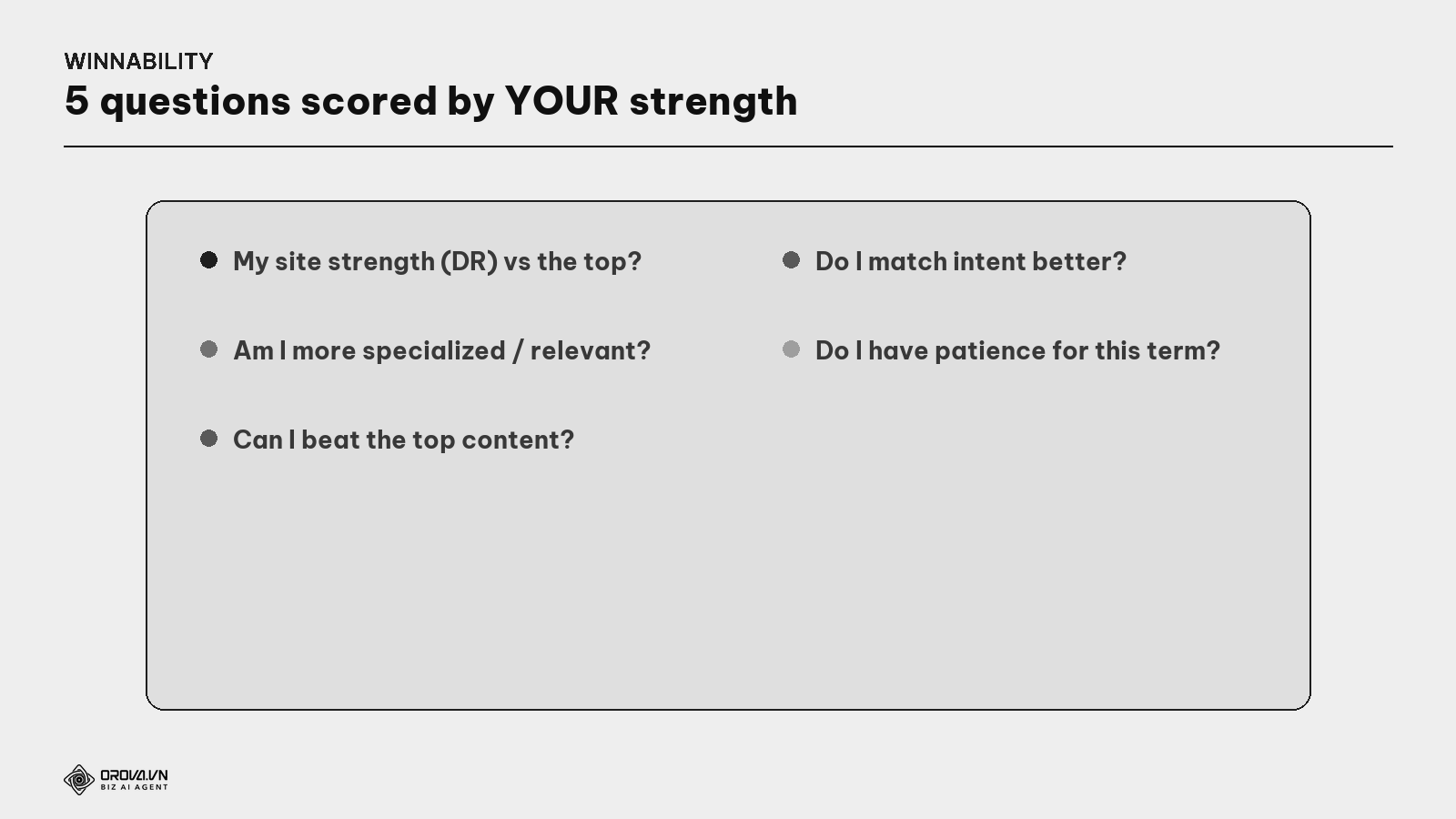
- My site strength vs the top? Your DR near or not too far below the top → a shot. Far below → hard.
- Am I more relevant/specialized? Right in your niche → an edge even at lower DR.
- Can I do better than the top content? Shallow/old top → opportunity.
- Do I match intent better? Off-intent top → you can break in.
- Do I have patience for this keyword? Big terms need months + backlinks — can you sustain it?
The more "yes" answers, the more worth fighting. This turns abstract "difficulty" into a concrete decision by your strength.
The escalation strategy: don't fight hard keywords from day one
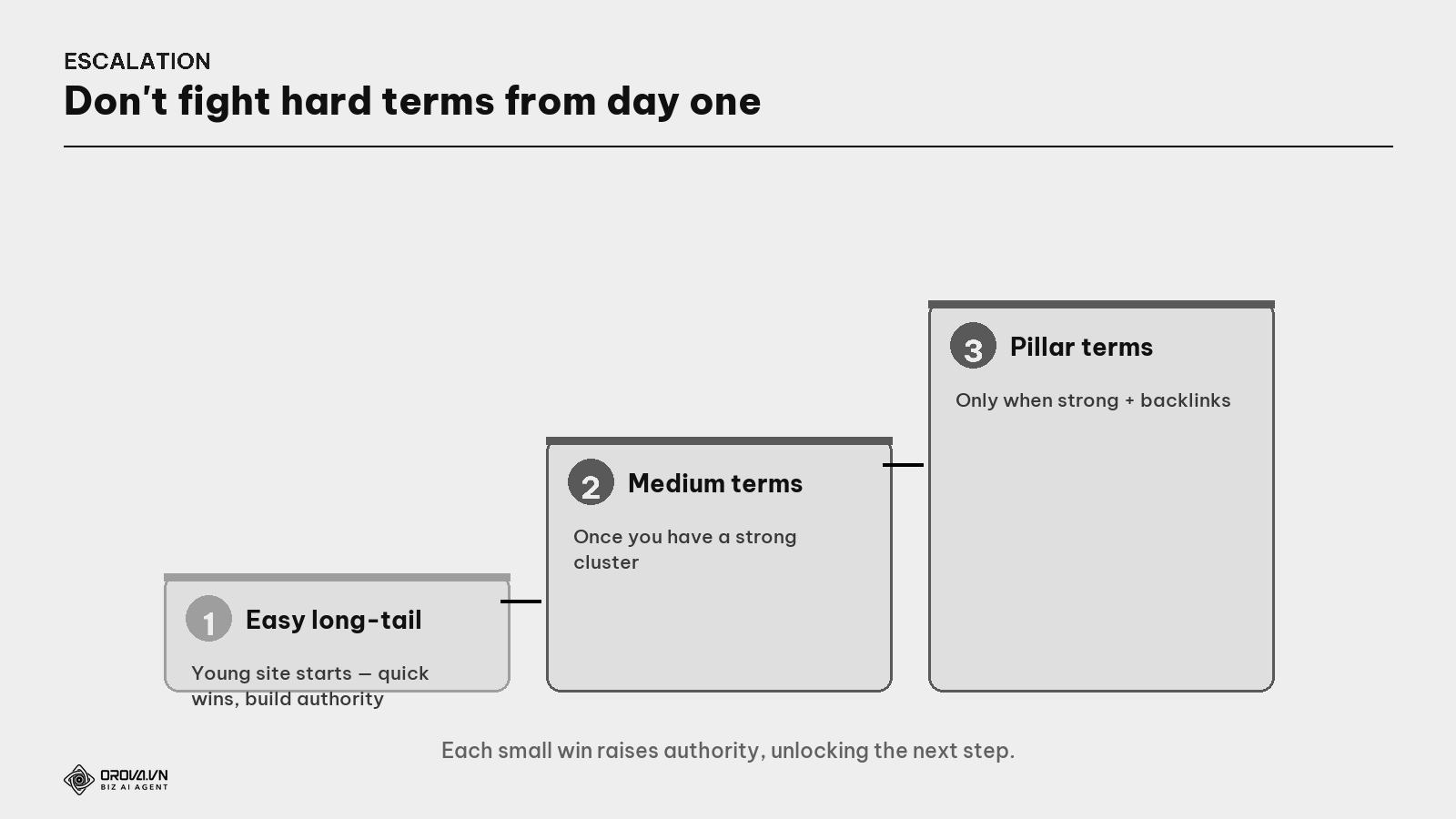
The right strategy for a young site:
- Step 1 — harvest easy long-tail. Start with specific, low-competition, intent-matched terms (see the Keyword Research guide). Quick wins, build authority.
- Step 2 — climb to medium terms. Once you have authority and a strong topic cluster, take on moderately hard terms.
- Step 3 — fight pillar terms. Only when strong enough (authority + cluster content + backlinks) do you charge the big head terms.
Each step's win raises your strength for the next. Jumping to the top = falling. Climbing step by step = surely reaching the top.
Process & standard
The process for choosing keywords by difficulty:
- Quick-filter with the KD score — drop terms clearly too hard for your strength.
- Inspect the SERP yourself (4 steps) for the rest — this is the real decision.
- Score winnability with the 5 questions (by your strength).
- Prioritize by the staircase — fight easy long-tail first, climb gradually.
- Find the "gap" for each term you'll fight — know in advance how you'll win.
"Pass" standard: you don't pick keywords by the KD number alone; you always inspect the SERP (who's on top, how strong, what content); you score winnability by your site's real strength; you prioritize easy long-tail while young then escalate; and for each term you fight, you can state how you'll win (deeper/fresher/more on-intent). At this level, you only go to battle when you already know you have a shot.
Benefit: assessing difficulty correctly is a shield against waste. It keeps you from spending months on unbreakable fortresses, and points you to open gates. A young site that does this well sees rankings rise early — because every battle is chosen to be won, not to try its luck.
FAQ
What KD score is "winnable"? No absolute threshold — it's relative to your site's strength. KD 30 may be easy for a strong site but hard for a brand-new one. Use KD to quick-filter, then let SERP inspection + the 5 questions decide; don't cling to a number.
Why do different tools give different KD scores? Each tool computes differently (mostly from the top's backlinks) and uses different data. Don't compare absolute scores across tools; only use it within one tool to compare keywords.
What KD should a brand-new site target? Start with low-difficulty long-tail terms + SERPs with gaps (forums, weak sites, old content). Harvest small wins to build authority, then escalate. Don't fight big head terms in the early months.
How do I beat a SERP full of strong sites? Hard, but two paths: (1) fight more specific long-tail variations of that term (less competition); (2) find a gap — be clearly deeper/fresher/more on-intent. If the top is too strong and already perfect, pick another battle.
Keyword difficulty or search volume — which matters more? Weigh both together with intent (see the priority matrix in the Keyword Research guide). A low-volume term that's easy + buying-intent is often more valuable than a high-volume but impossible one.
I have no paid tools — how do I assess difficulty? Entirely doable by inspecting the SERP yourself: search the term, see who's on top, content depth, freshness, intent match. This is actually the most trustworthy method, even with tools. A free SEO toolbar helps quickly see page DR.
How long until a winnable keyword reaches the top? Depends on difficulty & site strength, but a winnable long-tail term usually shows movement in weeks to months. Big terms need months + backlinks. Choosing the right difficulty helps you see results sooner instead of waiting in vain.
Back to the general
Remember the general charging his elite troops at the most fortified stronghold? His tragedy wasn't troop quality — it was picking the wrong battle. A good general isn't one who attacks anywhere recklessly, but one who knows which battles to fight and which to avoid, always finding the open gate before committing.
Assessing keyword difficulty is that generalship for SEO. Before pouring effort into a keyword, ask: "Is this a fortress or an open gate — and with my strength, how exactly do I win?" Answer that, and you only fight battles you win — and a chain of small, well-chosen wins takes you to the top more surely than any reckless charge.
This article is part of Orova's complete SEO guide series. It's a deep-dive within the cluster — see "Keyword Research", "Search Intent", "Topic Clusters", and "Link Building" for the full picture. Get started with Orova at orova.vn/en/seo.
Sources
Ahrefs, Semrush & Moz (how Keyword Difficulty is computed, Domain Rating/Authority, the limits of KD scores) · Google Search Central (content quality & relevance) · practical guides on SERP analysis & real-difficulty assessment.
Stop Guessing, Start Checking the Real Battlefield
Doing this by hand every time — opening the search results, checking who's ranking, judging their strength, comparing it to yours — works, but it eats hours you don't have, especially if you're evaluating many keywords for a content plan. It's the kind of task that's simple in theory but tedious enough that most business owners just skip it and hope for the best.
This is exactly the part Orova SEO can take off your plate. It's built to scan the real results page for you and give you a clear read on whether a keyword is actually winnable for your site, without you having to manually dig through every result yourself. If you'd rather spend your time writing content than analyzing search pages, it's worth a look.
Let Orova SEO handle the repetitive part
Keyword research, drafting, refreshing old posts and rank tracking — running automatically on your own site.
Explore Orova SEO