
Search Intent Meaning in SEO: The 4 Types Explained Simply
You write a blog post, rank it on page one, and then... nothing. No clicks turn into leads, no visitors stick around, and you're left wondering what went wrong. Meanwhile, a competitor with a shorter, less "impressive" article is quietly stealing your customers.
Here's the uncomfortable truth: most business owners write content based on what they want to say, not what the searcher actually wants when they type that word into Google. This is exactly what search intent meaning in seo is about — understanding the real reason behind a search, not just matching the keyword. Get this wrong, and you can have perfect grammar, solid research, and a fast website, yet still lose to a page that simply understood the searcher better. The stakes are only getting higher: according to SparkToro, 68% of US Google searches in the first four months of 2026 ended without a click at all, up from 60% in 2024, which means the few clicks that do happen matter more than ever.
This article breaks down search intent in plain language — no jargon, no fluff. By the end, you'll know the four basic types of intent, how to spot which one applies to any keyword just by glancing at Google's results, and which type of page you should build for each case. You'll walk away able to look at a keyword and immediately know what kind of content will actually satisfy the person searching for it.
Two people type the same word, but want completely different things
One morning, two people open Google and type the exact same word: "banh mi".
The first is a hungry tourist standing in the middle of Saigon, phone in hand. After typing "banh mi", what they want is: a great banh mi shop nearby, is it open, how do I get there. They don't want the history of Vietnamese banh mi — they want to eat now.
The second is a culinary student sitting in a library, writing an essay. After typing "banh mi", what they want is: how it originated, how many kinds there are, why it became a national dish. They don't care which shop is nearby — they need knowledge.
Same word. Two people. Two completely different "minds". And this is the central problem Google has to solve billions of times a day: "The person who just typed this — what do they actually want?" That "what they actually want" has a name in SEO — search intent. And if you remember only one thing from this entire guide, remember this: modern SEO is not a keyword-stuffing race, it's a race to read the searcher's mind.
This article dissects search intent to the core: what it is, how many types there are, how to read intent right on Google's results page, why a great article can still crash because it "missed the mind", and how intent is shifting now that people also ask AI. By the end, you'll look at every keyword with different eyes.
What is search intent? The real purpose behind a search — what someone is actually trying to achieve when they type a query, not the words themselves. The same keyword can carry different intent for different people; Google's number-one job is to guess that intent correctly and return the right thing. Your number-one job, therefore, is to make the right thing that intent needs.
Why search intent is the "hidden law" governing everything
Before 2013, Google was rather "naive": you typed "banh mi", it found pages containing the most instances of "banh mi" and ranked them. SEOs back then just stuffed keywords to rank. But from the Hummingbird (2013) update and then RankBrain (2015), Google learned to understand the meaning and purpose behind words, not just count them. It started asking "what does this person want" instead of "which page repeats this word most".
What is RankBrain? A part of Google's system that uses machine learning to understand the meaning of a query — even ones no one has ever typed. Thanks to it, Google guesses the searcher's "mind" rather than just matching words. This is why keyword stuffing is now useless (even harmful).
The result: search intent became the hidden law governing all of modern SEO:
- It decides what type of page you should make. For one topic, some intent needs a guide, some needs a product page, some needs a comparison. Wrong type = wrong from the root.
- It decides length and format. For someone wanting a quick answer, a short concise block beats a 3000-word article. For someone wanting deep research, the reverse.
- It's the first filter. Before judging whether your page is good or bad, Google checks whether it's the right type of thing people want. Miss the intent, and quality won't save you.
In other words: keyword research (see the "Keyword Research" guide) tells you what people type; search intent tells you why they type it — and the "why" is what decides what you must make.
The four types of search intent — and what to do with each
SEOs divide intent into four big groups. Understanding these four is understanding the "mind" behind nearly every query.
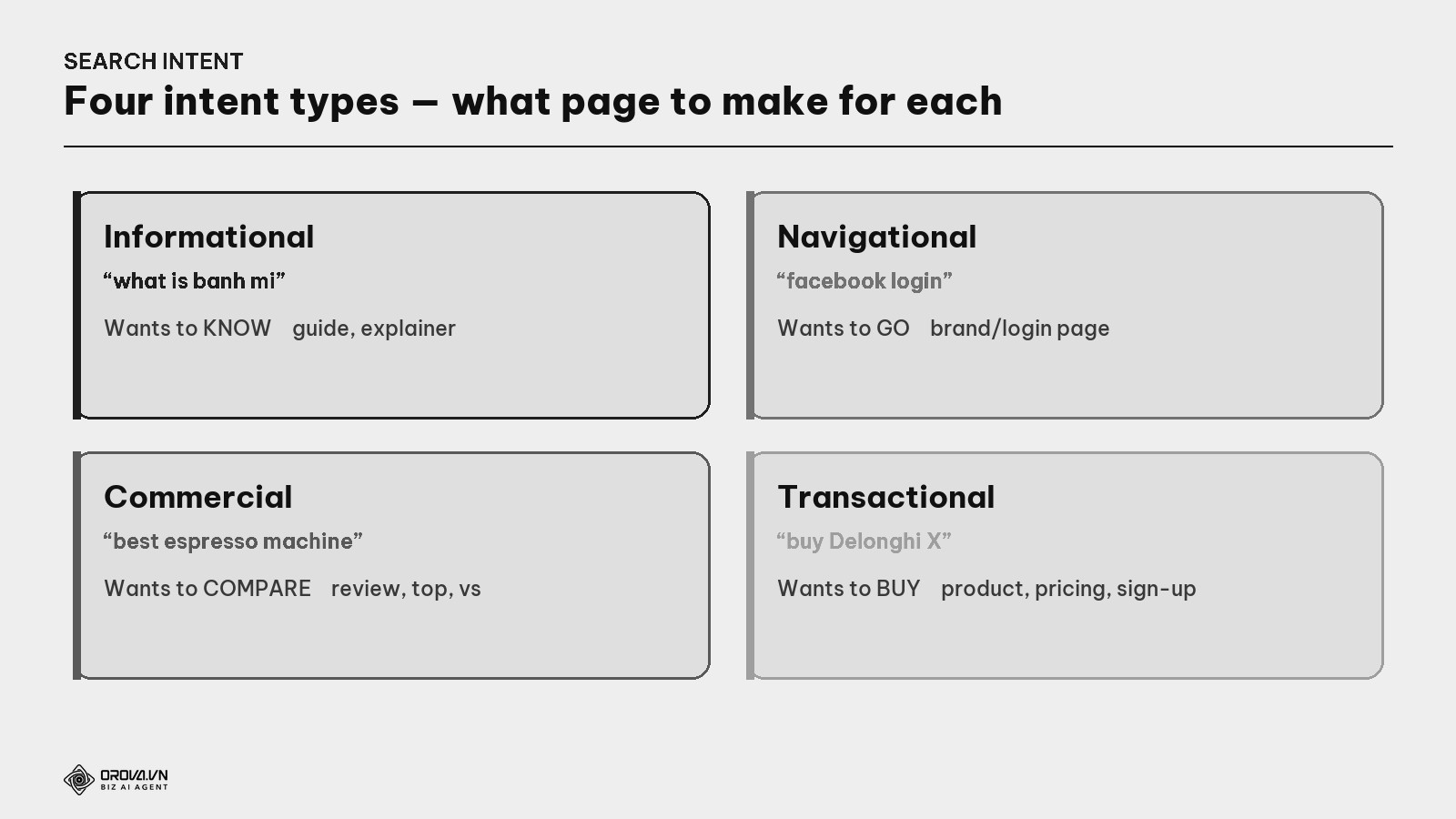
1. Informational intent — "I want to KNOW."
What is informational intent? When people search to learn, understand, know something — not to buy yet. E.g., "what is banh mi", "how to brew good coffee", "why does it rain". This is the largest group and usually sits at the start of the customer journey.
What to make: guides, explainers, "what is", "how to", lists. The goal isn't to sell now, but to deliver real value to build trust — then lead them onward (see the Tone of Voice & CTA guide).
2. Navigational intent — "I want to GO to a specific place."
What is navigational intent? When people use Google as a map to go straight to a page/brand they already know by name. E.g., "facebook login", "orova pricing", "vietcombank internet banking". They're not researching — they know where they want to go.
What to make: ensure your own brand page, login page, product page are easy to find when people type your name. For other brands' navigational keywords, don't try to compete — it's nearly hopeless and off-intent.
3. Commercial intent (pre-purchase investigation) — "I want to COMPARE before deciding."
What is commercial intent? When people are about to buy but still comparing and evaluating options. E.g., "best espresso machine 2026", "Delonghi vs Breville", "Orova review". They're past "learning", not yet at "buying".
What to make: comparisons, reviews, "best" lists, "top 5", comparison tables. This is an extremely valuable group because they're very close to a buying decision.
4. Transactional intent — "I want to DO/BUY now."
What is transactional intent? When people are ready to act: buy, sign up, download, book. E.g., "buy Delonghi X espresso", "sign up for Orova", "book Hanoi to Da Nang flight". This is the smallest group but the one that makes the most money.
What to make: product pages, pricing pages, sign-up pages, clear buy buttons. Don't make this group read a lecture — they want to get the job done.
Remember a simple phrase: Know → Go → Compare → Buy. The four intent types are the four rungs on the road from "knows nothing" to "becomes a customer".
The types aren't equal — and the mix is shifting
The four types aren't split evenly. In reality, informational and navigational intent make up most search volume, while commercial and transactional are fewer but closer to money.
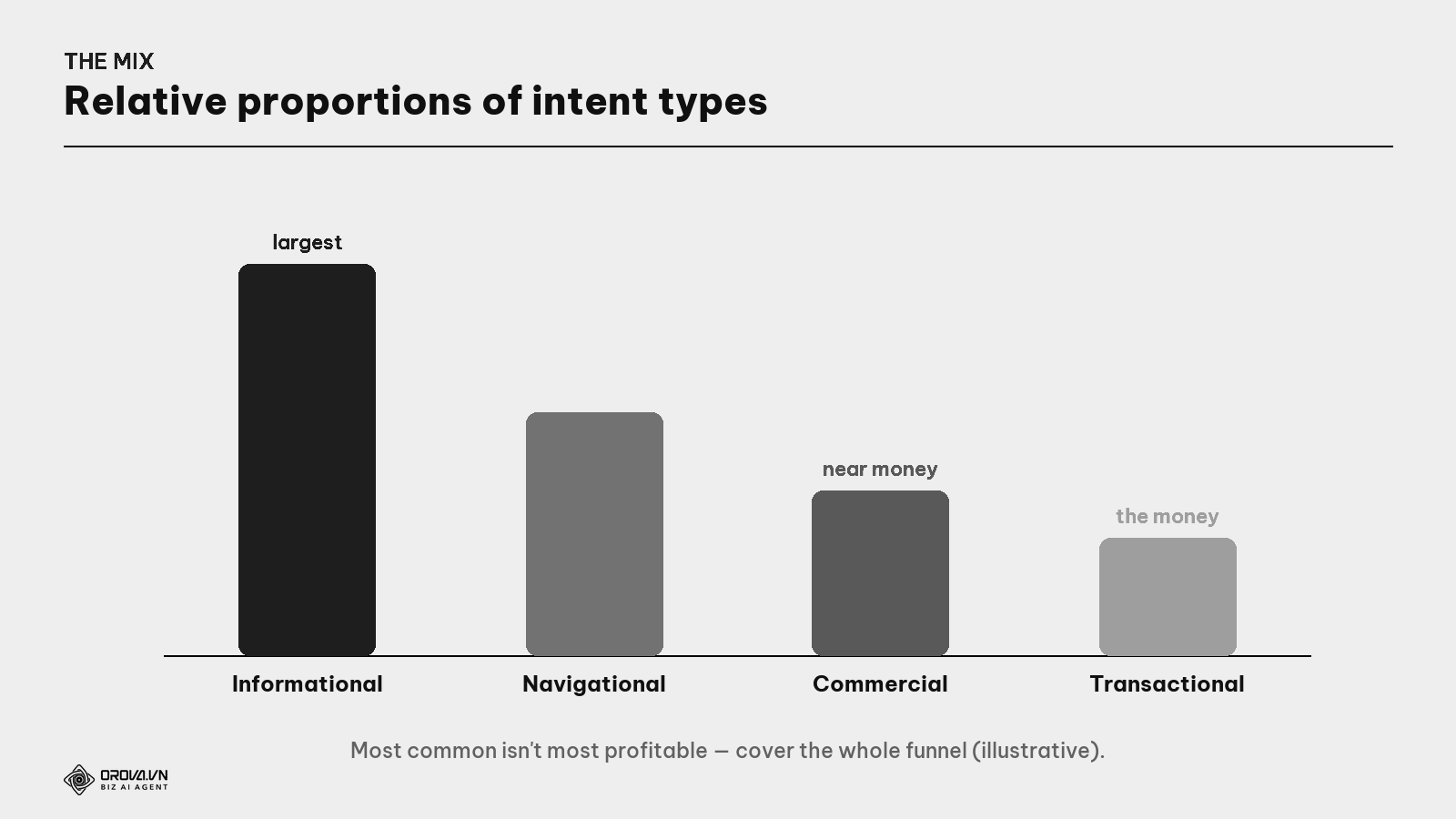
This has an important strategic implication: if you only write informational articles (because this group is large and easy to attract traffic), you'll get many readers but few buyers. Conversely, if you only build transactional pages, you miss a sea of people in the research stage — people who would buy later if you build trust early. A good content strategy (see the Content Strategy guide) covers all four types, each with a role in the funnel.
The "micro" of intent: even the same type can differ
The four big types are just the first layer. In practice, the same type still has small shades — called micro-intent — revealed through modifiers.
What is a modifier? Words added to the base keyword that reveal more specific intent. E.g., with "espresso machine": adding "what is" → wants to learn; adding "best" → comparing; adding "cheap" → price-sensitive, near buying; adding "where to buy" → ready to transact. Read the modifier, read the mind.
Some common modifier groups and the mind behind them:
- "what is", "how to", "why", "guide" → informational, wants to learn.
- "best", "top", "compare", "vs", "review" → commercial, choosing.
- "price", "cheap", "deal", "buy", "order" → transactional, near/at buying.
- "near me", "where", "[city name]" → local intent, usually near action.
Reading modifiers tells you not just "which type" but which rung of that type someone is on — so you make the right thing at the right moment.
The most important skill: read intent right on Google's results page
This is the part many skip, but it's the most valuable practical skill in the whole article. You don't have to guess intent by gut — Google has already told you the intent, right on the results page for that very keyword.
The reason: for each keyword, the pages currently ranking are the sample answers Google scored as "matching the searcher's mind". So instead of arguing with Google about intent, read it backwards from its own results.
What is a SERP? Short for Search Engine Results Page — the page that appears after you type a query and hit search. Look closely at a keyword's SERP and you can read what Google thinks its intent is.
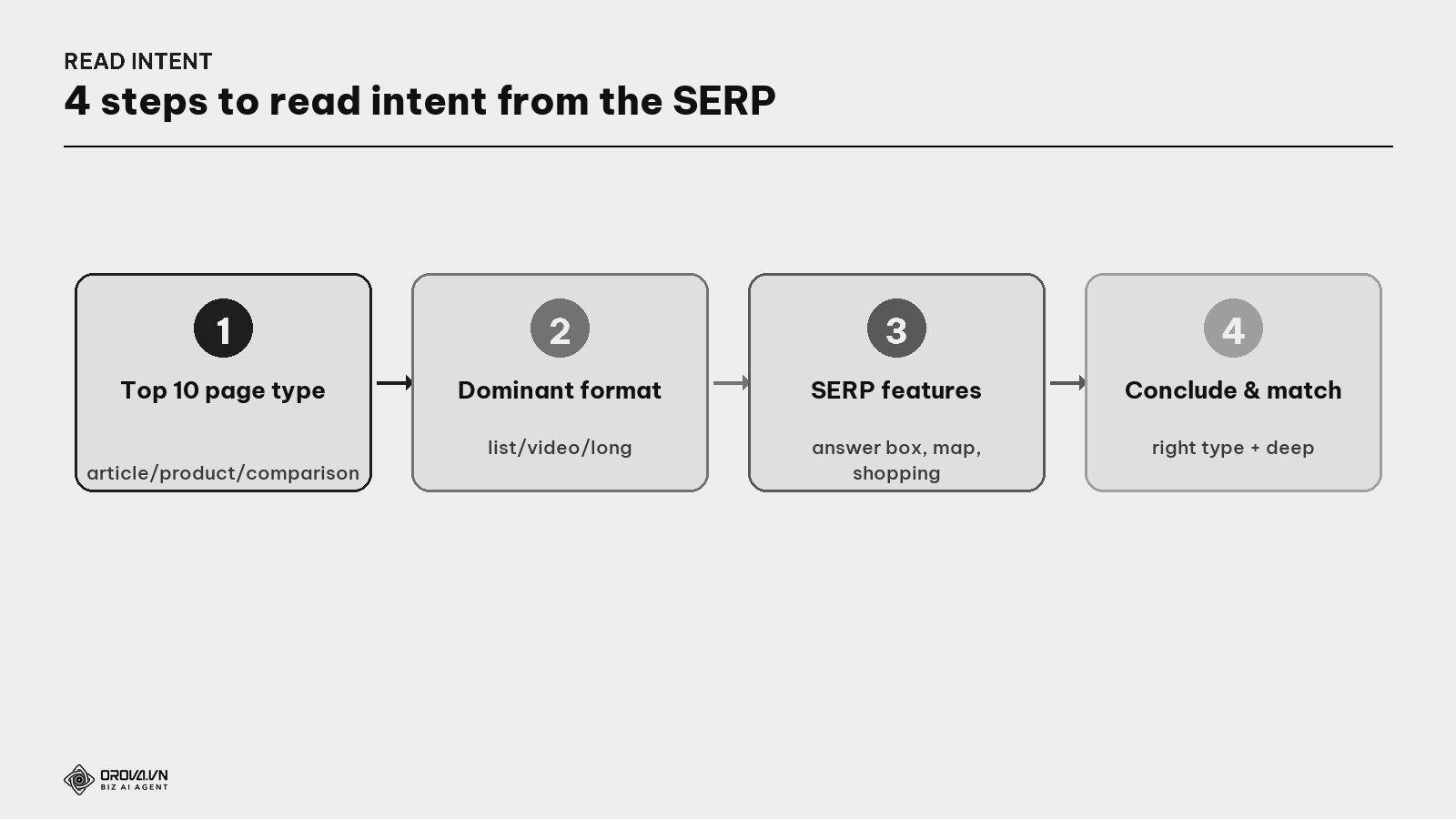
Step 1 — What type of page is the top 10? Search the keyword and look at the first 10 results. All guides? → informational. All product pages? → transactional. All "top/comparison"? → commercial. The winning page type is the type you must make.
Step 2 — What format dominates? Are the top results all list-style? All video? All long how-tos with step photos? Google is telling you the format searchers prefer for this keyword.
Step 3 — Any SERP features?
What is a SERP feature? Special blocks beyond the 10 blue links: the quick answer box (featured snippet), the "People Also Ask" block, the local map, the shopping block, the AI summary box... Each feature is an intent clue: a map → local intent; a shopping block → transactional; "People Also Ask" → people researching.
Step 4 — Conclude and make the right thing. Combine the three steps above and you get a clear portrait of the searcher's mind — then make the right type, right format, and go deeper than the pages on top.
Quick how-to: before writing any article, search the main keyword on Google and spend 2 minutes scanning the top 10 + SERP features. Those two minutes save you hours of writing the wrong type of article.
The golden table: which intent → which page
Rolled into a quick-reference table — pin it to the wall.
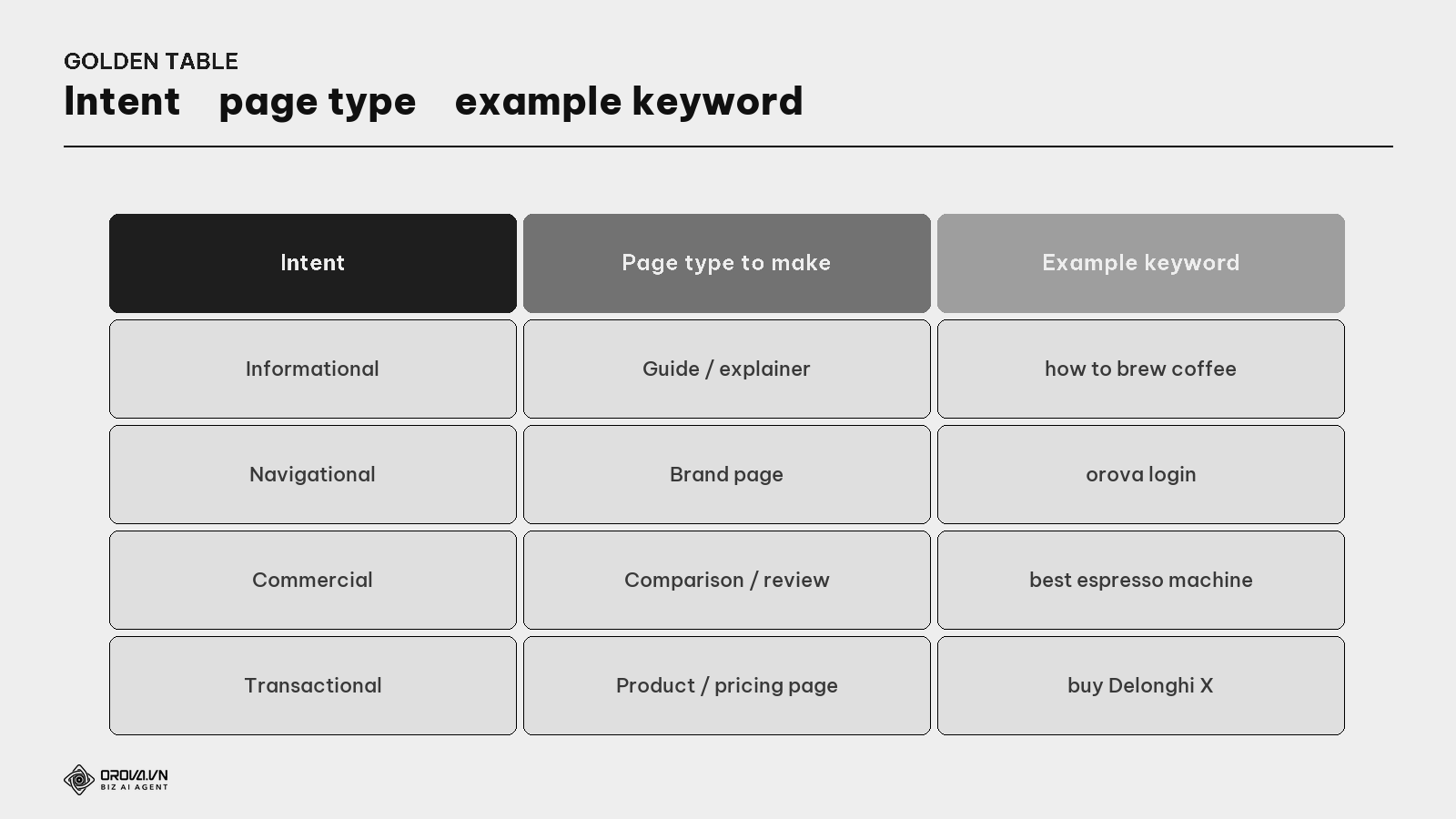
The unbreakable rule: the page format must match the intent type. Don't put a sales page on a "what is" keyword; don't write a long lecture for a "buy now" keyword. Matching intent is the necessary condition before any other effort means anything.
Why a great article still crashes: intent mismatch
This is the most expensive and common mistake related to intent.
What is intent mismatch? When your content is good but the wrong type compared to what searchers want. The classic example: you write a brilliant 3000-word "history and types of espresso machines" to target "best espresso machine" — but people who type that want a top-5 comparison table to choose what to buy, not a history lecture. However good your article is, it answers the wrong question, so Google won't rank it.
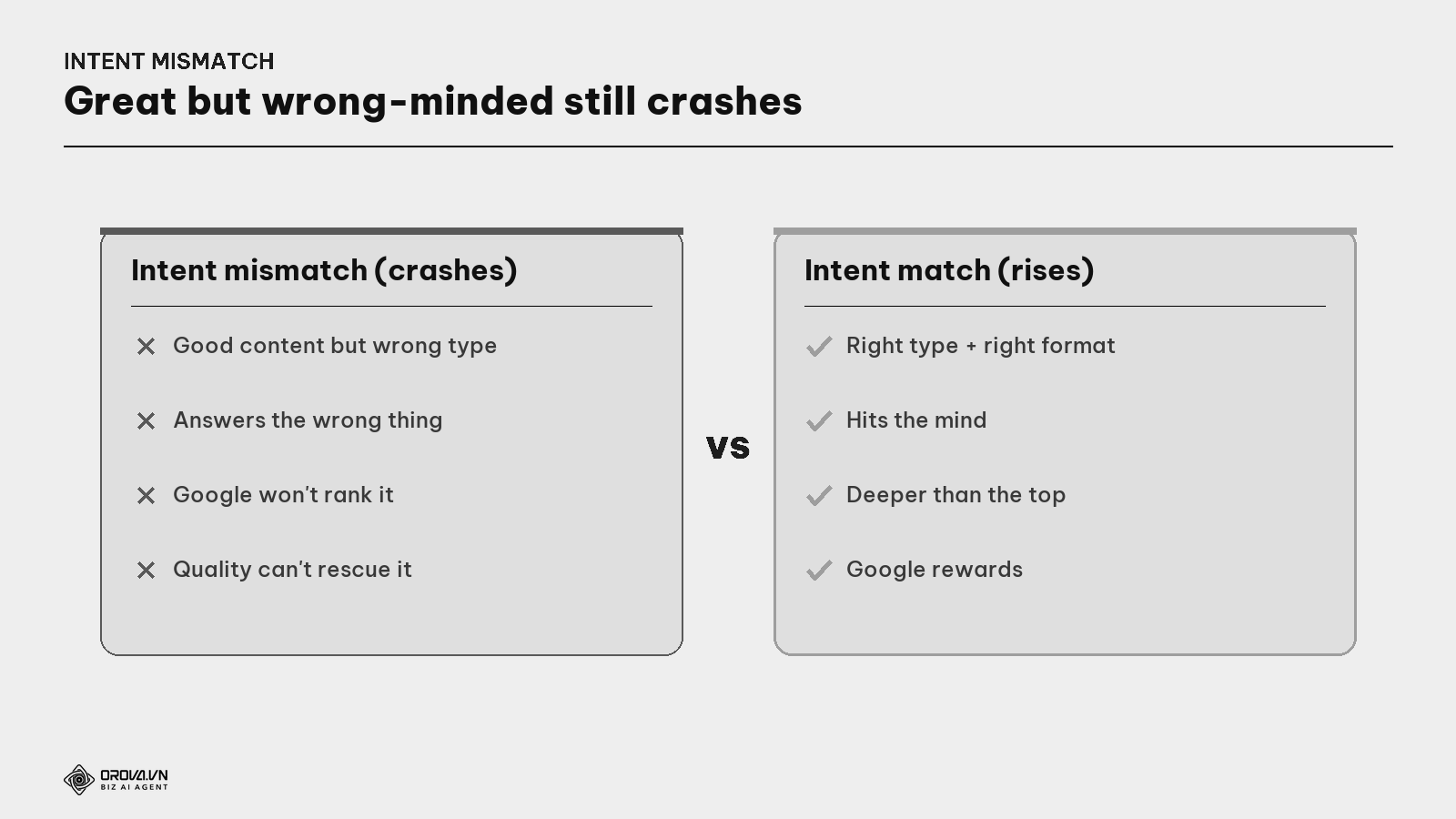
The hard lesson: quality can't rescue a mind-mismatch. Before asking "is my article good yet", ask "is my article the right type of thing people want". If an article is dropping despite good content, intent mismatch is suspect number one.
How to re-match intent if you've missed:
- Change the format to match the winning type on the SERP (e.g., turn a lecture into a comparison with a table).
- Change the angle to answer the question searchers really ask.
- Split the article if it's trying to serve two different intents (one page per intent — see the Cannibalization guide).
Dual intent and the journey: one keyword can have many layers
Life isn't always tidy. Some keywords carry multiple intents at once (mixed intent), and Google handles it by mixing several result types on the same SERP.
Example: "espresso machine" — the SERP may have some "what is/types" articles (informational), some "best of" articles (commercial), and a shopping block (transactional). Google is "sharing seats" among intents because it isn't sure which group you're in. For this kind of keyword, pick one intent to serve really well rather than trying to grab them all.
And more importantly: intent is tied to the customer journey. The same person, over time, passes through different intents for the same need — from "researching" (informational) → "comparing" (commercial) → "buying" (transactional). A smart content strategy meets them at each rung with the right type of content, walking them down the funnel (see the Content Strategy and Tone of Voice & CTA guides).
The 2026 turn: intent in the age of asking AI
There's a big shift happening that anyone doing SEO in 2026 must face head-on. Users increasingly take informational questions straight to AI tools (ChatGPT, Gemini...) and the AI summary box right on Google, instead of clicking each link.
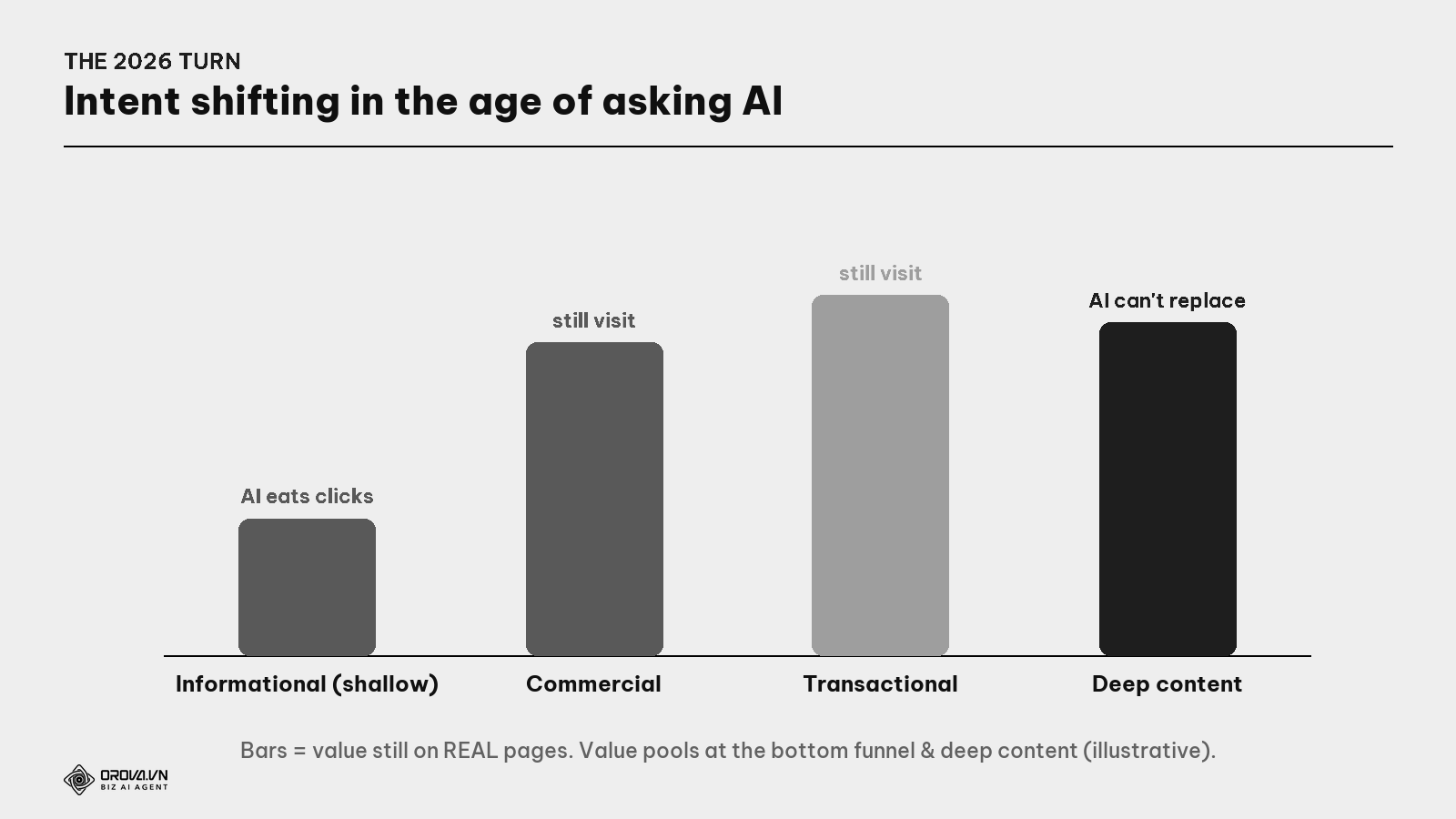
This does not kill search intent — it makes intent more important:
- Pure informational intent (short definitions, simple facts) increasingly loses the click to AI. Writing an article just to answer "what is X" in one sentence will get less and less traffic.
- Commercial & transactional intent still needs people to visit real pages — to compare carefully, read real reviews, and buy. This is where value pools.
- Intent needing depth, experience, perspective (things AI struggles to fabricate) stays very healthy — because people want what a mechanical summary can't give.
Strategic implication: in 2026, lean your effort toward content serving near-money intent (commercial, transactional) and deep content with real experience — instead of shallow informational articles that AI answers in a single line.
What is GEO / "getting cited by AI"? Optimizing so your content gets cited by AI tools when they answer. It's an extension of search-intent thinking into the AI era — and a topic Orova covers in depth in later articles.
The process to apply search intent to one article
Rolled into doable steps for each article you plan to write:
- Identify the keyword's main intent — informational / navigational / commercial / transactional (read the modifier to guess).
- Check the SERP to confirm — what page type the top 10 is, which format, which SERP features (don't skip this).
- Pick the right page type & format matching what the SERP is rewarding.
- Go deeper than the pages on top — cover the points they have, add depth/a new angle/real experience.
- One intent per page — don't let one article carry two intents (avoid mismatch & self-cannibalization).
- Re-check after publishing — if it drops despite good content, suspect intent mismatch first and re-check the SERP.
Benefit: when every article starts from intent, you stop "writing on a whim and hoping" and switch to "making what Google has proven people want". Your hit-rate to the top jumps, less effort is wasted, and every article has a clear place in the journey pulling customers toward a purchase.
"Pass" standard for handling intent
- Every article you write clearly identifies one main intent before writing.
- You've checked the SERP of the keyword to confirm the winning page type & format.
- Page type & format match the intent (no lecture on a "buy" keyword, no sales page on a "what is" keyword).
- One intent per page — no cramming, no self-cannibalization.
- You re-check when rankings drop, treating intent mismatch as the top suspect.
- The overall strategy covers all four types along the journey, not dumped into one group.
Meet these and you've laid the right foundation for everything else — because, as said, matching the searcher's mind is the necessary condition before good content, solid technicals, or strong backlinks can take effect.
FAQ
How do search intent and keywords differ? A keyword is what people type (the words); search intent is why they type it (the real purpose). One keyword can carry multiple intents. Keyword research gives you a list of words; intent analysis tells you what to make for each.
How do I know a keyword's intent for sure? The surest way isn't guessing but checking the SERP: search the term on Google, see what page type the top 10 is, which format, which SERP features. Google has already "scored" the intent through the very results it ranks.
Can one article target multiple intents at once? Best avoided. Each page serves one intent well. Trying to grab two usually mismatches both and risks self-cannibalization (see the Cannibalization guide). If a topic has multiple intents, split into multiple pages, one intent each.
My article's content is great but it still won't rank, why? Suspect number one is intent mismatch: good content but the wrong type of thing searchers want. Re-check that keyword's SERP — if the top is all a different page type than yours (e.g., all comparisons while you wrote a "what is"), that's the problem.
Does intent change over time? Yes. A keyword can shift intent when the market/context changes (e.g., an event moves people from "researching" to "buying"). Periodically re-check the SERP of important keywords to catch the shift.
Do AI and summary boxes make search intent irrelevant? The opposite — more relevant. AI eats clicks at shallow informational intent, so value pools at near-money intent (commercial, transactional) and deep content with real experience. Understanding intent helps you invest in the right place in the new landscape.
Should I try to rank for another brand's navigational keyword? Nearly hopeless and off-intent — someone typing "facebook login" wants Facebook, not your page. Focus on your own brand's navigational keywords, and the informational/commercial/transactional intents you genuinely serve.
Back to the two people who typed "banh mi"
Remember the two people at the start? The hungry tourist and the essay-writing student. If you run a banh mi shop doing SEO, you do not write a single article trying to please both. You make two different things: a tidy shop page with address, opening hours, a directions button — for the hungry person who wants to eat now (transactional + local); and a genuinely great blog post about the types of banh mi, origins, how to choose — for the student who wants to learn (informational). Each piece hits exactly one mind.
That's the whole spirit of search intent: don't ask "how much search volume does this keyword have", ask "what does the person typing this actually want — and am I making exactly that". Answer that for every keyword and you're ahead of most SEOs — the ones still counting words instead of reading minds.
This article is part of Orova's complete SEO guide series. It's a deep-dive within the cluster — see the overview "SEO in 2026", "Keyword Research", "Content Strategy", and "Writing SEO Content" for the full picture. Get started with Orova at orova.vn/en/seo.
Sources
Google Search Central (understanding user intent, creating helpful content, Hummingbird/RankBrain) · Google Search Quality Rater Guidelines (intent classification: Know/Do/Website/Visit-in-person) · Ahrefs, Moz & Semrush (the four search-intent types, reading intent from the SERP, intent mismatch) · research on AI Overviews & shifting search behavior 2024–2025.
Stop Guessing What Your Readers Want
Figuring out search intent by hand means opening Google, searching your keyword, scrolling through the top results, and trying to spot the pattern — is it a question, a comparison, a buying decision? Do this for every keyword on your list and it eats up hours you probably don't have, especially if you're managing content on top of running the actual business.
This is the kind of repetitive analysis Orova SEO is built to take off your plate — it looks at the search results for you and helps flag what type of intent a keyword is really showing, so you can skip the manual guesswork and go straight to writing the right kind of page. If that sounds like it would save you some headaches, it's worth taking a look.
Related reading: Keyword Search Intent: The 4 Types You Need to Know
Read next: What Is SEO? The Complete Beginner's Guide for 2026
Let Orova SEO handle the repetitive part
Keyword research, drafting, refreshing old posts and rank tracking — running automatically on your own site.
Explore Orova SEO