
SEO in 2026: The Complete Story of Getting Your Website to Google's Storefront
A tale of two coffee shops
Two coffee shops open on the same street, the same month, with equally good coffee. Shop A sits right on the main road. Shop B is tucked deep in an alley.
You already know how this ends. Six months later, Shop A is packed; Shop B is up for lease. The coffee wasn't worse — only the location was.
On the internet, that "main road" is called page one of Google. And that dark, empty alley nobody walks into? That's page two, page three — where almost no one ever looks.
Here's the interesting part: in real life, a storefront location costs a fortune in monthly rent. On Google, there's a way to "move your shop to the main road" that costs no rent at all — only the effort of doing it right.
That "doing it right" has a slightly intimidating three-letter name: SEO. It sounds technical, but the core is surprisingly simple. It answers one question: "How do I get Google to willingly put me on the main road, ahead of my competitors?"
We'll walk through the whole answer over the next 45 minutes. No jargon left behind, no prior knowledge required. Just remember these two coffee shops — we'll keep coming back to them.
So what exactly is "SEO"? Short for Search Engine Optimization. In human terms: everything you do to get Google to put you on the main road, in front of the right customers at the right time — without paying for ads. This whole guide unpacks what that "everything" includes.
One more thing before we move on. On Google there are two kinds of "storefront":
- Rented storefront (ads): pay and you're placed up top, usually with a small "Sponsored" label nearby. Stop paying and you vanish instantly — like renting; lease ends, you're out.
- Owned storefront (organic results): Google chooses these based on quality, and no one can buy the spot. This is SEO's playground — and once you've earned it, it lasts.
A word you'll see all over this guide: "organic." It simply means the results Google returns for free based on quality, as opposed to paid ads. "Organic traffic" = visitors who come from that not-paid section.
This entire guide is the map for building that "owned storefront." Let's begin.
"Free" is the most expensive word in marketing
You'll hear it everywhere: "SEO is free traffic."
Half true, half a trap.
True part: unlike ads — where every click costs you money — traffic from SEO costs nothing per visit. The trap: to earn that traffic, you pay in three other things everyone forgets to count.
One: time. SEO has no "switch it on" button. It's more like growing fruit trees than turning on a tap. 2025 industry data shows that after six months of investment, every dollar put in returns only about $0.80 — still a loss. But by month 12, that figure jumps to $2.60. The first half-year is the "spending with nothing to show" stretch — and that's exactly when 90% of people quit, right before the tree bears fruit.
Two: effort. Here's the part nobody expects. A proper SEO article isn't just "writing." Behind one article is an assembly line: figuring out what to write, building the outline, checking for overlap with old posts, making visuals, adding links, fixing technical details, publishing correctly, "telling" Google, then tracking and updating. A decent article eats a dozen separate jobs. (This is exactly why people built AI assistants to fold that whole line into one place — like Orova SEO.)
Three: content. And here's where many shoot themselves in the foot: bad content isn't just useless, it's harmful. Dumping piles of junk for "volume" can drag your entire website down (more on why later, in the algorithm history).
So why is SEO still worth it?
Because once the tree fruits, the economics get beautiful compared to ads:
| SEO (organic) | Ads (paid) | |
|---|---|---|
| Cost per lead | ~$31 | ~$181 |
| Leads per dollar | ~5.8× more | Baseline |
| When you stop paying | Visitors still come | Traffic hits 0 the next day |
(Source: First Page Sage, SEOProfy 2025.)
The difference fits in one sentence: ads are renting, SEO is buying. Renting gets you in immediately but you're out the moment you stop paying. Buying takes effort and money upfront, but afterward it's your asset — a good article can bring customers for years at no extra cost per visit. That compounding effect is what produces the number the industry loves to quote: an average 748% ROI (you get $7.48 back for every $1).
What's "ROI"? "Return on investment." A 748% ROI means $1 in returns $7.48 (a $6.48 profit). It's the final scoreboard for whether SEO is worth the money — not "what rank am I."
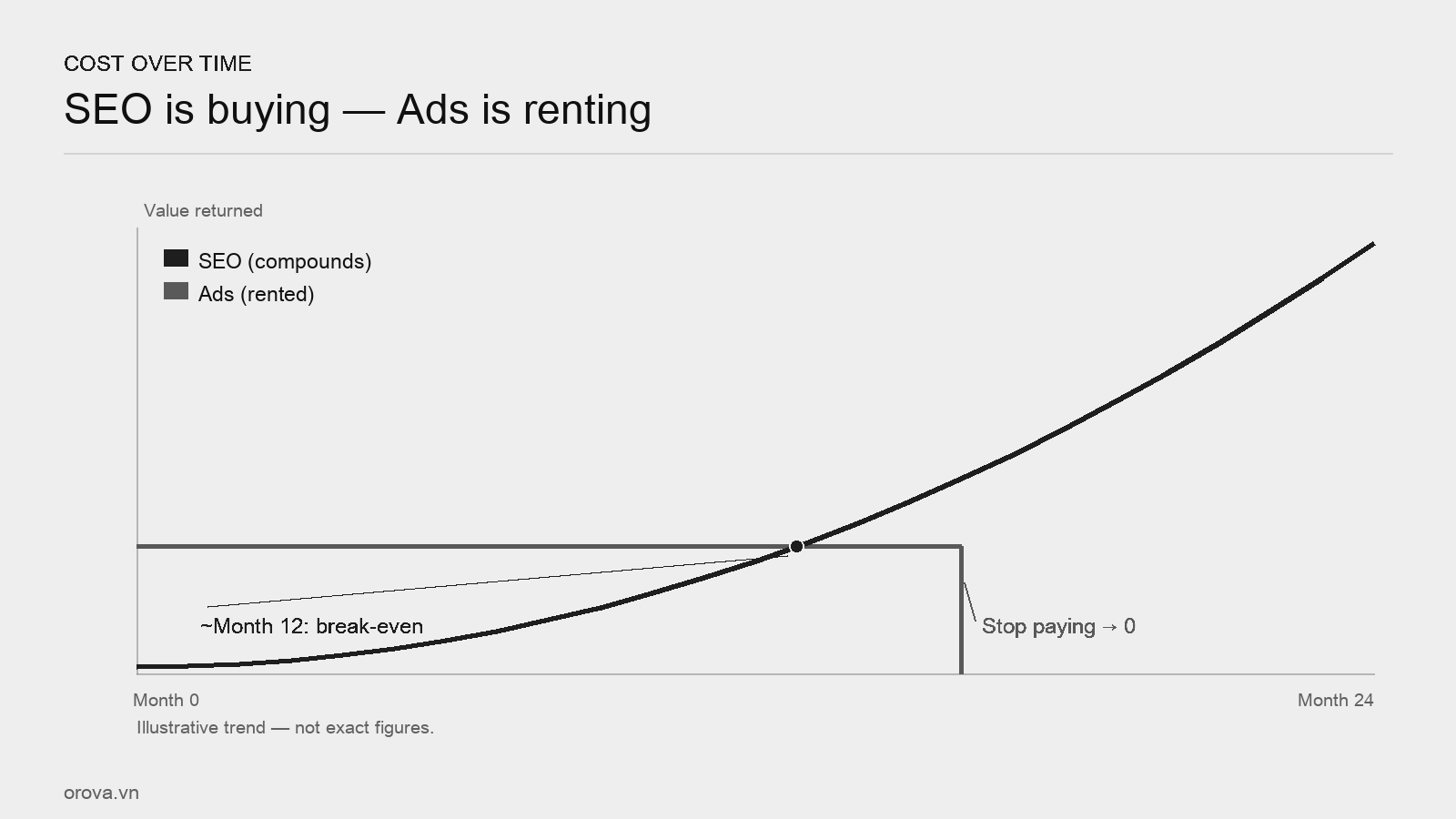
Bottom line: don't do SEO because it's "free." Do it because it's an asset — provided you're patient enough to survive the first 6–12 months. If you need customers this month, that's a job for ads, not SEO.
Google is really just a very diligent librarian
To get your shop on the main road, you first need to understand who decides location: Google. And Google, fancy as it sounds, works exactly like a librarian at the world's largest library.
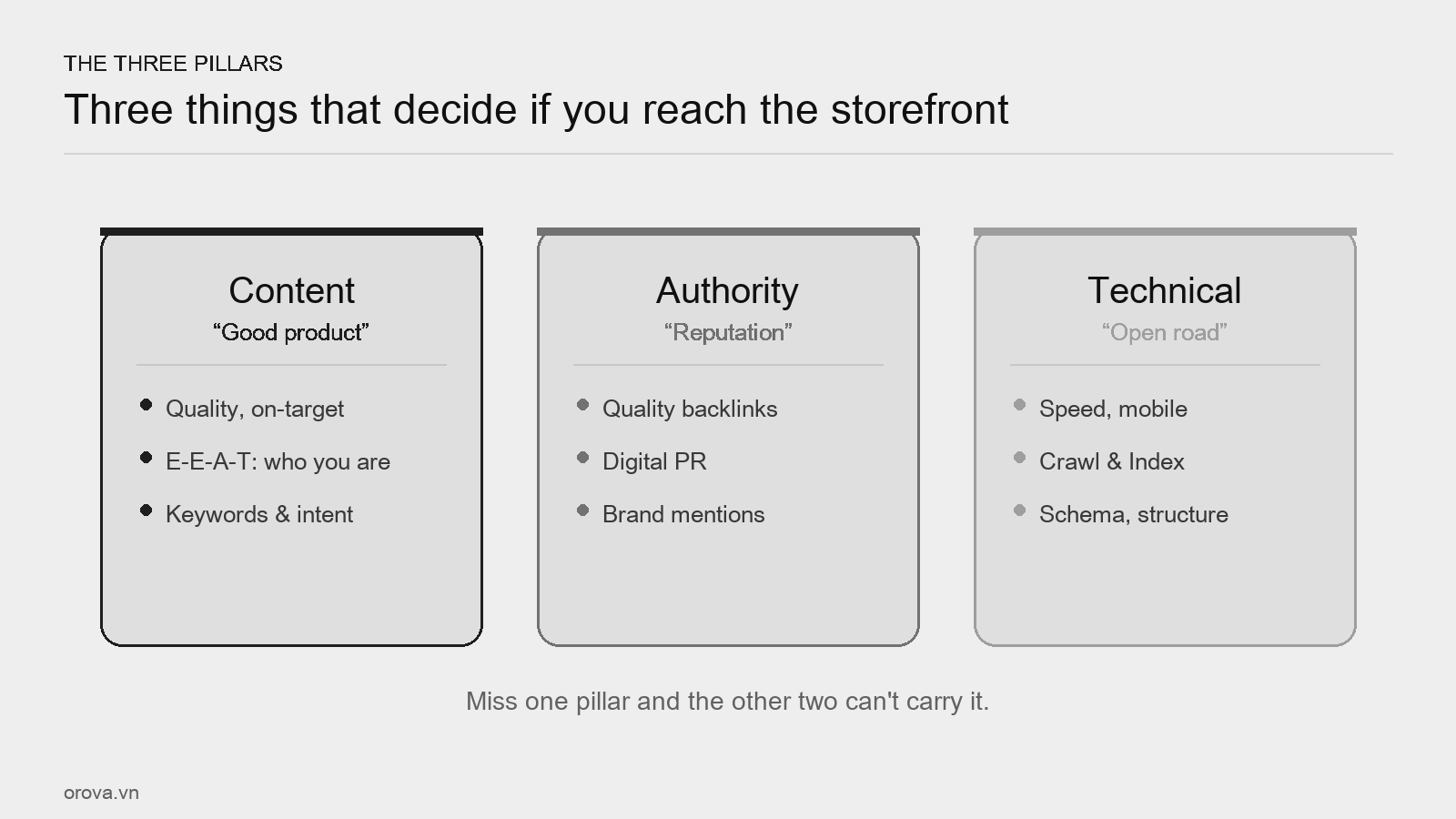
This library doesn't hold books — it holds every web page in existence. When you ask the librarian a question, they must instantly pull a few of the most relevant pages from billions. They can pull off that magic only because they quietly did three jobs beforehand:
Job 1 — Go gather the books. The librarian has "robots" that roam the internet, following links to read each page. Google's robot is called Googlebot, and its roaming-and-reading is called crawling.
What's "crawl"? It literally means to crawl/roam. It's the robot roaming the web to read pages. When someone asks "has Google crawled my page?", they mean "has the robot dropped by and read it?"
Job 2 — Shelve the books. After reading, the librarian doesn't keep everything. They sort and store the worthwhile pages in a giant warehouse called the index. Only pages in the warehouse can show up when someone searches.
What's "index"? The warehouse of pages Google has read and decided to keep. "My page is indexed" = it's in the warehouse, eligible to appear. "Not indexed" = Google knows it exists but hasn't shelved it → searchers won't find it.
Job 3 — Hand over books when asked. You type a question, the librarian pulls the most fitting pages and puts them in order. That ordering is called ranking — who gets the storefront.
What's "rank"? Your position in the results list. "Rank #1" = top. "Ranking up" = climbing higher. It's what every SEO talks about — but a later section shows why it isn't the real goal.
Why must you remember these three jobs? Because every "my page gets no traffic" pain traces to exactly one of them:
- The robot hasn't crawled your page (stuck at Job 1), or
- It crawled but didn't shelve it (stuck at Job 2), or
- It shelved it but ranks you on page 5 (a Job 3 problem).
Three different illnesses, three different cures. Diagnose right, then treat. And there's actually a fourth door — a brand-new one that's upending the whole industry. We meet it next.
Going deeper (for the curious): Job 1 most often breaks because of a file called
robots.txt— it tells the robot "where you may go, where you may not." One wrong line can accidentally ban Google from your whole site. Businesses have lost all their traffic because a developer forgot to remove that line when moving a site from staging to live. To check if your page is shelved, search Google forsite:yourdomain.com— it shows roughly how many of your pages Google is holding.
Google's results page in 2026 is no longer "ten blue links"
This is where old-school SEO breaks down. If in your mind "Google results" still means a list of ten links, that picture is out of date.
Let's actually open Google and type: "how to choose accounting software for a small business." Scrolling top to bottom, here's what you hit — before you even see the first link:
First, an AI-written answer. Right at the top, Google inserts a summary its own AI wrote, answering your question directly. This is called AI Overviews.
What are "AI Overviews"? Picture this: instead of handing you a list of books to read yourself, the librarian now reads a few for you and recites a summary right at the desk. That's AI Overviews — an answer written by Google's AI, placed on top, with a few small links to the sources it referenced. The chilling consequence for website owners: if the AI already answered, the visitor no longer needs to click your page. This is the single biggest change in SEO 2026 — the hard numbers are coming in the "Is AI killing SEO?" section.
Next, a quick-answer box. Google clips a passage verbatim from one specific page and frames it prominently. This is the Featured Snippet — and the page it picks effectively sits at "position zero," above #1.
How is that different from AI Overviews? AI Overviews are written by the AI (mixing many sources). A Featured Snippet is quoted directly from one page. Landing here means visibility and a link back — a goldmine. The trick to landing it: answer the question concisely and clearly (a 40–60 word passage, a list, or a table).
Then, a "People Also Ask" block. A set of related questions; click one and it expands a short answer (again clipped from a page). For website owners this isn't just a block — it's a treasure map: those are the real questions your customers wonder about, so write articles that answer them.
Then blocks of images, videos, news, maps, star ratings. Depending on the query, Google adds image strips, YouTube videos, fresh news, maps (for location searches), or results with star ratings (thanks to Schema, covered later).
Finally, beneath all of that, come the traditional "ten blue links" — the classic organic results SEO has always chased. The person at traditional "#1" now often has to be scrolled to.
See the problem? "Ranking high" no longer means "getting traffic." You can hold #1 and still starve, because an AI answered above you.
And it gets bigger — people are leaving Google altogether, asking AI assistants directly:
What are ChatGPT, Perplexity, Gemini? All conversational AI assistants: you ask in plain language like talking to a person, and they answer directly. ChatGPT is the most popular; Perplexity specializes in answers with clear citations; Gemini is Google's own. The common thread: they answer instead of you opening several websites. (The umbrella term is LLM — Large Language Model — AI trained on enormous amounts of text to understand and generate language.)
Because customers now hunt for answers across many doors, SEO in 2026 has to widen its ambition: not just "the main road on Google," but showing up everywhere people go to ask — including inside the AIs' mouths. That new craft has its own name, GEO, coming up.
The three pillars that decide whether you reach the storefront
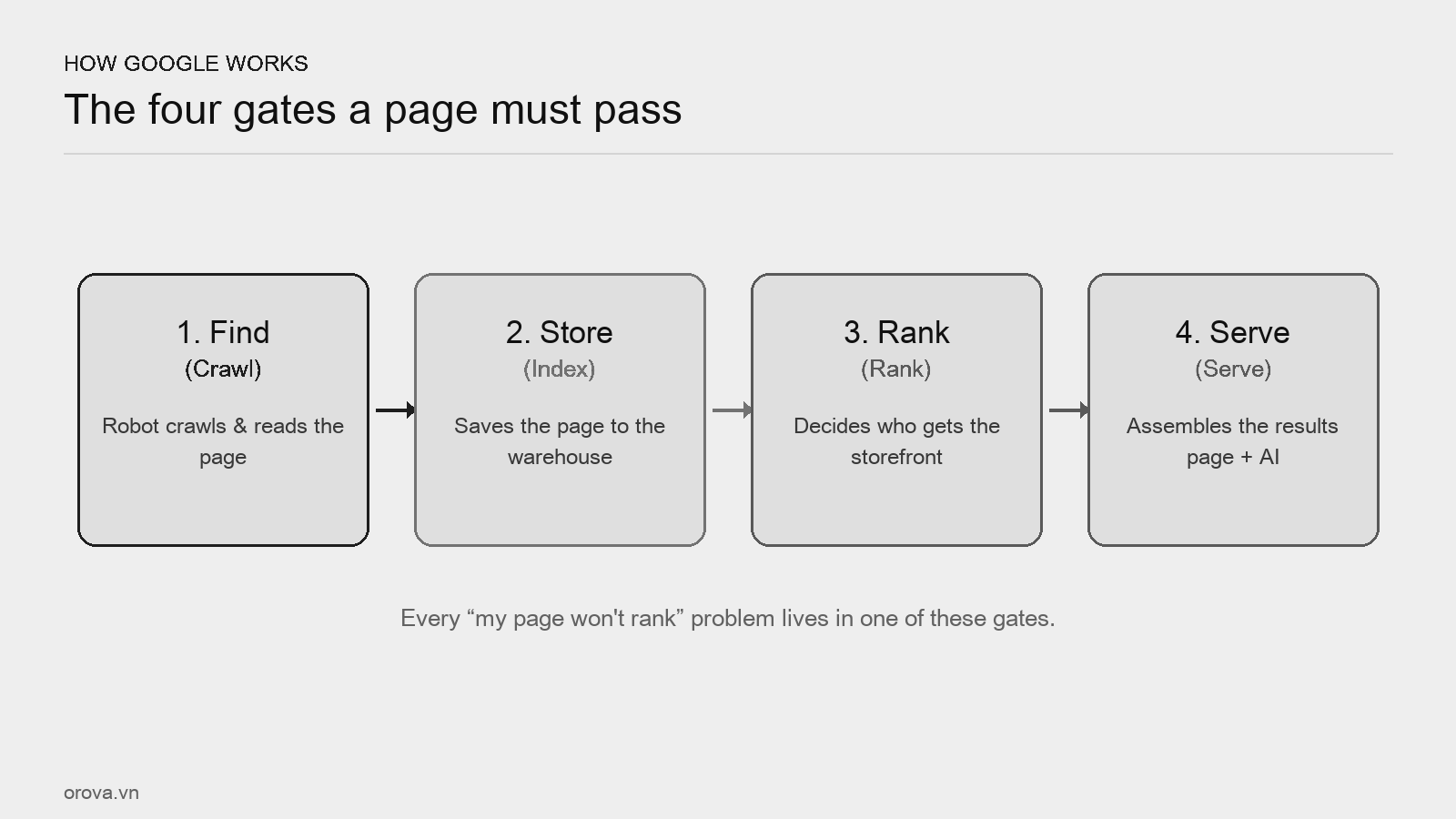
Back to the coffee shops. A busy shop needs three things: good product, an open road, and a reputation. A website is identical — and these are the three pillars of SEO. Get this map, and you'll never get lost among the hundreds of "SEO tips" online.
Pillar 1 — Good product (Content)
This is your coffee quality — and the most important pillar. Google doesn't rank "the most optimized page," it ranks the page that best answers the need. An 800-word piece by someone who truly knows the subject, getting straight to the point, can crush a rambling 3,000-word keyword-stuffed one.
Inside "good product" is a special ingredient Google increasingly values: who are you to talk about this?
What's "E-E-A-T"? It's Google's yardstick for trustworthiness, in four parts: Experience (have you actually done this yourself?), Expertise (do you have subject knowledge?), Authoritativeness (are you recognized in the field?), and Trust (is the site legit, transparent?). Easy example: a camera review by someone who actually used it, with their own photos, always beats one that just copies the spec sheet. In short, E-E-A-T answers Google's question: "Should I trust this person, on this site?"
Pillar 2 — Reputation (Off-page authority)
Your coffee may be great, but if no one talks about you, you grow slowly. Online, "reputation" is measured by whether other websites talk about you — specifically, whether they link to you.
What's a "backlink"? It's when another website places a link pointing to your page. Think of each backlink as a vote of confidence: when a major newspaper links to your article, Google reads it as "a credible source vouches for this → probably trustworthy." But remember: quality over quantity. One link from a big outlet beats a thousand from junk sites — and buying links in bulk is the fastest way to get penalized (story coming in the history section).
Pillar 3 — An open road (Technical)
Great coffee, big reputation — useless if the road is blocked and the door is jammed. A website's "road" is the technical layer: does the page load fast, work on phones, and can Google's robot crawl in to read it (remember the librarian?).
This pillar also has "hidden signposts" that help Google understand your page faster — for example schema, an invisible label that tells Google "this is an article / a product priced X / rated 4.8 stars," so your page can show up richer (with stars, prices) in results.
What's "schema" / structured data? An invisible snippet you add to a page to tip off Google: "this is an article, author X, published Y" or "this is a product, price Z, 4.8 stars." That lets Google display your page more prominently — with stars, price, images — called a rich result.
Putting the three together
- Technical is the road and the front door — block it and the best product won't matter.
- Content is the product — what actually keeps customers.
- Reputation is the fame — why people trust you and spread the word.
Miss one pillar and the other two can't carry it. Great SEO balances all three — in order: clear the road first, then make the product excellent, then build reputation over time.
In 15 years, Google has taught one lesson
You don't need to memorize Google's history. But there's a 15-year story worth hearing, because it reveals what Google will reward (or punish) next — and therefore where to place your bets.
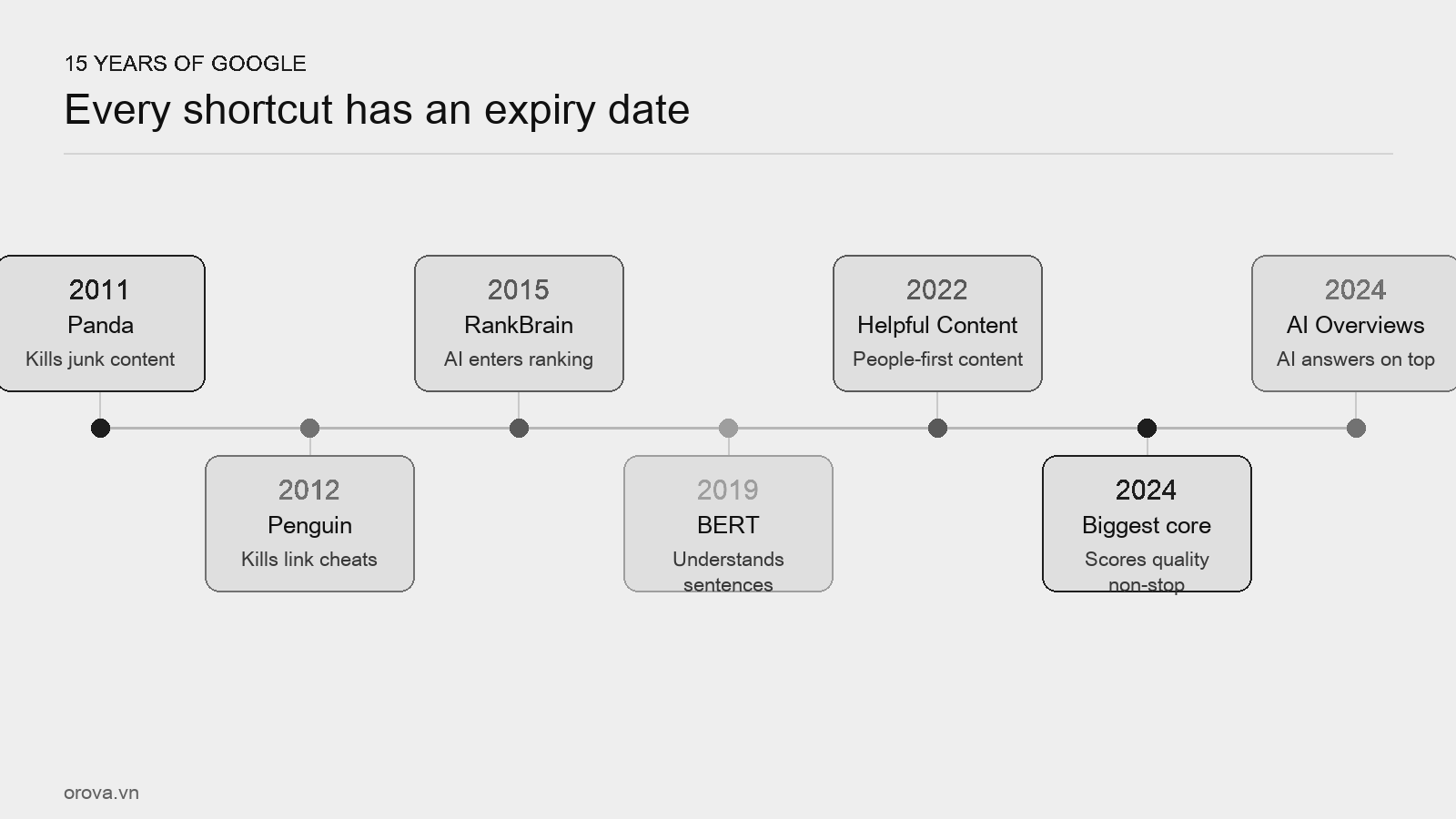
For 15 years, every few years Google has shipped a big "update" to its ranking rules. And every time, it aimed at the same thing: killing the shortcut-takers.
| Year | Update | Who it hit |
|---|---|---|
| 2011 | Panda | Thin, copied content; "content farms" mass-producing junk. |
| 2012 | Penguin | Backlink cheaters — bought links, spammed links everywhere. |
| 2015 | RankBrain | First time AI entered ranking. |
| 2019 | BERT | Started understanding whole sentences like a human. |
| 2022 | Helpful Content | Content "written for machines" instead of people. |
| 2024 | Largest update ever | Folded quality-scoring into the core, running continuously. |
(Source: Search Engine Journal, Search Engine Land.)
See the recurring pattern? Every shortcut has an expiry date. Keyword stuffing — dead in 2011. Buying links — dead in 2012. Mass-produced soulless AI articles — dying right now. Every few years a trick dies. The only thing that survives every update is genuinely useful content from a trustworthy source.
The 2024 mark matters most: previously Google scored quality in waves (like inspectors making periodic rounds — get caught, get penalized for a while). Since 2024, the scoring runs constantly, every day. The practical result: a site full of junk now gets dragged down continuously, no longer waiting for a "penalty round." That's why "just publish more for volume" is now suicidal.
The lesson, distilled: Don't optimize for "today's algorithm" — it changes constantly. Optimize for Google's never-changing goal: serve users better than your competitors. That's the only bet that never loses.
SEO, ads, and "getting named by AI": who does what?
Three concepts that often get confused. Tell them apart and you'll spend money in the right place.
- SEO — climb the organic storefront, no pay-per-visit. Slow but durable.
- Ads (a.k.a. SEM/PPC) — pay to be placed up top instantly. Fast but not durable: stop paying, it's gone.
- GEO — the new kid, and increasingly important.
What's "GEO"? Short for Generative Engine Optimization — roughly "optimizing to get cited by AIs." In short: SEO gets you onto Google; GEO gets you named by ChatGPT/Perplexity/Gemini and AI Overviews when they answer users.
Why is GEO no longer science fiction? A few 2025 numbers will straighten your posture:
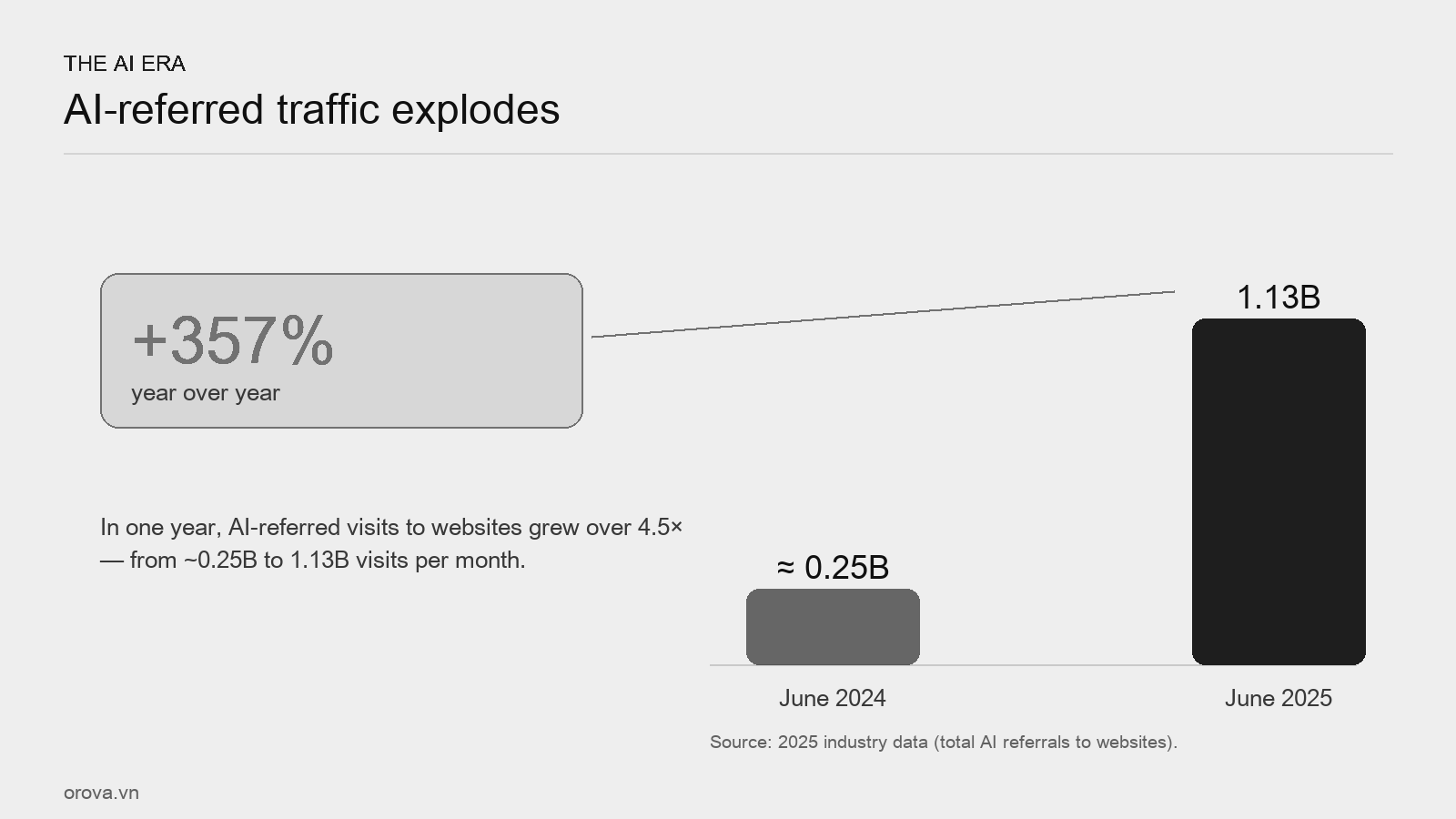
- AI platforms referred up to 1.13 billion visits to websites in June 2025 alone — up 357% year over year.
- ChatGPT has roughly 400 million weekly users, handling over 1 billion queries a day.
- The most shocking figure: the overlap between "top Google pages" and "sources cited by AI" has dropped from ~70% to under 20%. Translation: ranking on Google no longer automatically gets you named by AI. It's a separate game, played separately.
- A golden tip: 85% of content cited by AI Overviews was published within the last two years, 44% in 2025 alone. Fresh or freshly updated content gets cited 4.3× more than stale content. → Content freshness is now a real weapon.
So where do you spend? Need customers now → ads. Building a long-term asset → SEO. Protecting your name in the age of AI questions → GEO. In 2026 you need all three. The good news: all three share the same foundation — quality content + authority. Do SEO well and you automatically help GEO. They're not three separate wars, but three faces of one effort: becoming the best answer.
The sweet trap called "ranking #1"
This is the most common mindset mistake — even among veterans. They celebrate hitting #1 for a keyword, then stare blankly as revenue doesn't budge.
The hard truth: rank is a means, not an end. Three reasons "#1" can be meaningless:
1. Wrong keyword. Ranking #1 for a phrase nobody intends to buy on is just for show. Example: #1 for "what is accounting software" (people learning) is worlds apart from #1 for "where to buy accounting software" (people reaching for their wallet).
2. Searchers find the answer and... click no one. Remember the AI answer at the top? It intercepts the customer right at the desk.
What's "zero-click" search? A search where the user clicks no website — because the answer is already shown on Google itself (via AI Overviews, answer boxes, or pre-displayed info). Numbers: over 60% of U.S. searches end this way; on mobile it's up to 77%. You can be #1, but if an AI answered for you, you get no one.
3. #1 but the page doesn't "close" the customer. They come, they leave. Traffic that doesn't create customers is a cost, not an asset.
So what should you measure? Think in terms of a funnel: a customer moves from "sees you" → "clicks" → "stays and reads" → "leaves their info" → "buys." Wide at the mouth, narrow at the bottom (actual buyers). "Ranking #1" only affects the mouth. Good SEOs measure all the way to the bottom — to money — and optimize backward.
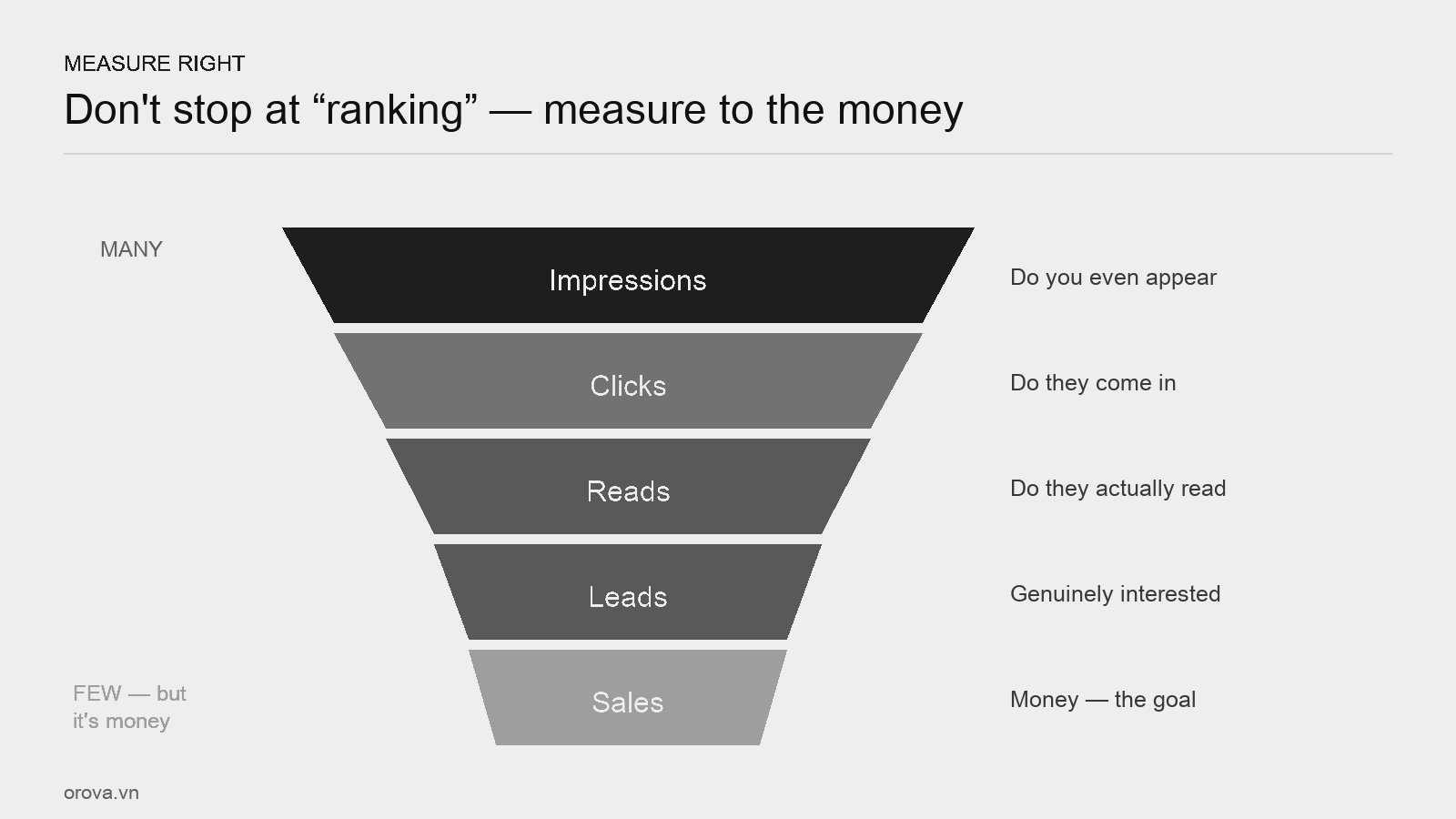
The right question to ask each month isn't "What's my rank?" but "How many customers and how much revenue did organic search bring this month, and at what cost?"
Is AI killing SEO? Look straight at the data
The hottest question of 2026. Short answer: not killing it, but changing it to the core. Set feelings aside; look at the numbers.
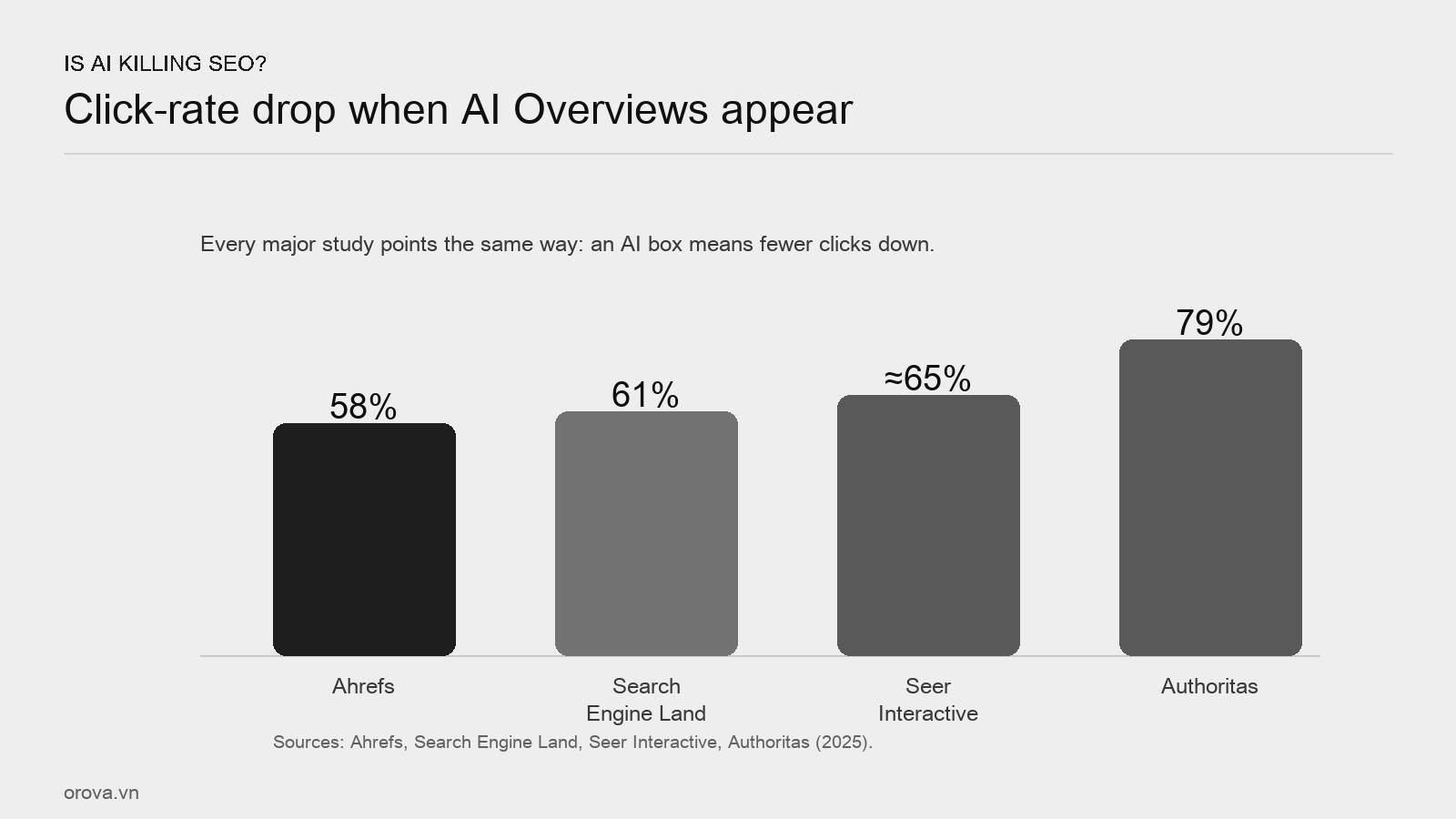
The brutal part first. When an AI Overview appears, clicks to organic results drop sharply — every major study agrees:
- Pew Research (Mar 2025): people who saw an AI summary clicked a traditional link only 8% of the time, versus 15% without AI. Clicks on links inside that AI summary? Just 1%.
- Ahrefs (Dec 2025): AI Overviews correlate with a top page's click rate being 58% lower.
- Authoritas: the #1 organic link loses about 79% of its clicks when an AI Overview is present.
Bluntly: if you live off articles answering simple "what is X" questions, AI is taking part of your meal. Accept it.
But here's the other half — the part few mention.
One, being cited in the AI box is a golden opportunity: per Seer Interactive, when AI Overviews name you, you get 35% more organic clicks. The game just shifts from "rank high" to "get chosen by AI" — which is what GEO handles.
Two, fewer clicks but higher quality. Once AI filters out the merely curious, whoever still clicks is someone ready to act. Some data shows ChatGPT-referred visitors convert 31% higher than ordinary organic visitors. Fewer-but-better often beats more-but-diluted.
Three, there are signs of recovery: click rates on AI-present queries nudged up from 1.3% (Dec 2025) to 2.4% (Feb 2026). Not the old world returning, but the floor has stopped dropping.
And the SEO job itself? Not replaced by AI — re-described by it. The repetitive, mechanical work (raw keyword research, outlining, rank tracking, reporting) → hand to AI. The work that needs a human (strategy, unique angle, real experience, relationship-building) → worth more than ever. This is exactly the idea of an "AI Agent for SEO": instead of one person wrestling 40 disconnected tools, one person directs an AI assistant that runs the whole line — carrying a team's worth of work. (The problem Orova was built to solve.)
The honest conclusion: Whoever only knows "writing keyword-stuffed articles" will be replaced. Whoever lets AI handle the mechanical part and pours human effort into real quality — will be stronger than ever.
Where do you start? A 90-day map
Enough theory. If you're starting from zero, here are the first 12 weeks — what to do, how, and crucially, in what order. The golden rule on the wall: don't rush to write. Diagnose and clear the road first. Writing before the foundation is ready is like arranging beautiful goods in a shop whose door is still locked.
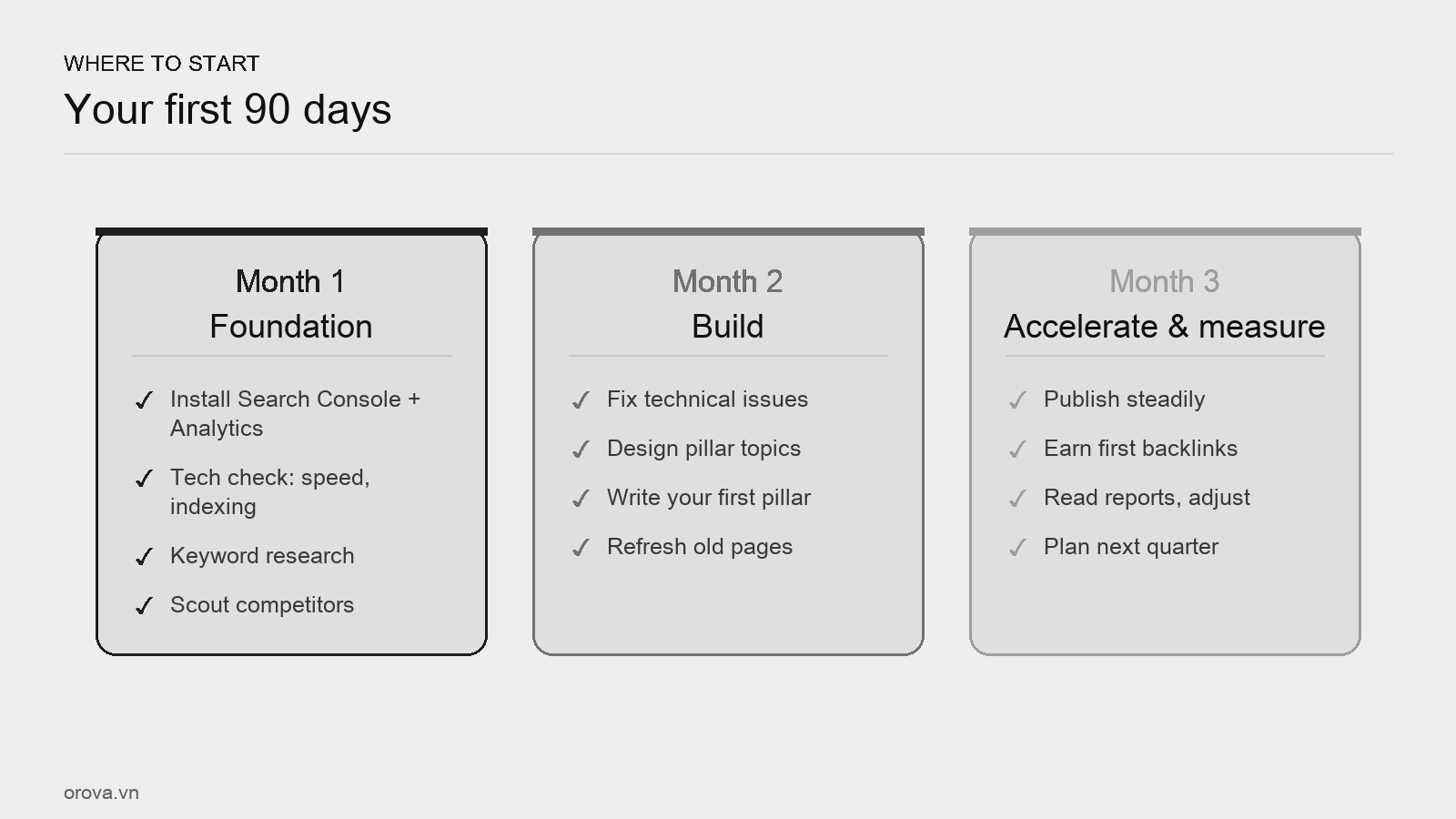
Month 1 — Foundation & diagnosis (don't write anything)
This month you write zero content. You play doctor: examine first, prescribe later.
Week 1 — Attach the "meters." Install two free Google tools:
- Google Search Console — shows how Google sees you: which keywords you appear for, what rank, how many see and click.
- Google Analytics — shows what visitors do after arriving: how long they stay, how many pages, whether they buy/sign up.
How: go to search.google.com/search-console, add your website, verify ownership (paste a snippet or via your domain), then submit a sitemap. Done when: after 2–3 days, data starts showing. Why it matters: without these two meters, everything afterward is guessing in the dark.
Week 2 — Examine the "road into the shop" (technical check). Check four things:
- Shelved by Google yet? Search
site:yourdomain.com— a reasonable page count is fine; zero is a red alert. - Fast enough? Paste your URL into Google's PageSpeed Insights; check the mobile score.
- Works on phones? Open the site on a real phone; is the text tiny, are buttons hard to tap?
- Accidentally blocked? Check
robots.txt(visit yourdomain.com/robots.txt) for a disastrousDisallow: /.
Done when: you have a list of fixes, ordered by severity.
Week 3 — Listen to customers (keyword research). List what customers actually type to find what you sell — not your internal jargon. How: type into Google and watch the autocomplete suggestions + the "People Also Ask" block; use a free tool like Google Keyword Planner. Sort by intent: who's learning ("what is X"), who's comparing ("X vs Y"), who's buying ("where to buy X"). Standard for a keyword worth targeting: real search demand + matches what you sell + you can realistically compete.
Week 4 — Scout competitors. Find 2–3 competitors on the main road; list the keywords they own that you've left empty. That's your prioritized opportunity list for next month.
Month 2 — Build the asset (now you write)
Foundation's clean; now build.
- Fix the technical issues from Week 2 — prioritize whatever blocks Google from reading the page.
- Design the content architecture: pick a few big pillar topics (like this very guide), with smaller posts orbiting and linking back. Benefit: Google sees you as an expert on the whole area, not a random writer.
- Write one proper pillar rather than ten shallow posts. Standard for a finished article: it fully answers the customer's question, has real examples/data, names the author, and the reader needn't open another tab afterward.
- Refresh existing pages (fix titles, headers, add internal links) — usually the fastest win, since old pages already carry some authority.
Month 3 — Accelerate & measure
- Publish steadily, each small post linking back to its pillar.
- Earn your first quality backlinks with content worth mentioning (a data piece, a free tool) — don't buy links.
- Read Search Console: any keyword climbing into the top 20–30, reinforce it (write deeper, add links); double down on what works. Plan next quarter from real numbers, not gut feeling.
An honest word on expectations: 90 days is for laying the foundation and seeing first signals (impressions ticking up, a few keywords entering the top 20–30) — not for an explosion. Real money usually arrives from month 6 onward. Anyone promising "#1 in a month" is either lying or using a shortcut you'll pay for later (remember Panda/Penguin?).
How do you know you're winning?
You can't improve what you don't measure. But measuring wrong is worse than not measuring — it drives wrong decisions. First, two mandatory "meters" (both free from Google):
The two foundational tools: • Google Search Console — "Google's view of you": which keywords you appear for, what rank, how many see and click. • Google Analytics — "the visitor's view": how long they stay, how many pages, whether they buy/sign up. One covers before the visit, one after. You need both.
What to measure? Remember the funnel, top to bottom: impressions (do you appear) → clicks (do they come in) → engagement (do they read) → and most important, conversions (do they leave info / buy). The bottom layer is the money.
Beware "vanity metrics": don't get hypnotized by impressive-but-moneyless numbers — total pageviews, "keywords tracked," total backlinks (ignoring quality). A good report is one your boss understands in 30 seconds and sees how much money organic is bringing.
A classic trap: a sudden traffic "drop" is usually not a Google penalty, but a measurement/technical error (reinstalled tracking, redesigned site, accidental block). Before panicking, check: is the data still flowing correctly?
Quick questions, quick answers
How long until SEO works? Usually 3 months for first signals (rising impressions, a few keywords in the top 20–30), 6–12 months for clear business results. Depends on competition, your site's age and authority, and investment.
Is SEO still worth it with ChatGPT and AI Overviews around? Yes, more than ever — "SEO" just widens to "be everywhere people go to ask" (including GEO). The foundation is still quality content + authority, which both Google and AI reward.
Should I do it myself, hire out, or use software? DIY builds deep understanding but costs time. An agency is fast but expensive and hard to quality-control. AI Agent software (like Orova) is the new path: automate the mechanical part so one person does a team's work.
Do backlinks still matter? Yes, but quality and relevance matter far more than quantity. Buying links is high-risk — Google has hunted that since 2012 and keeps getting better at catching it.
Will Google penalize AI-written content? Google doesn't penalize "using AI"; it penalizes low quality, human- or machine-written alike. Soulless AI content gets buried. AI content that's human-directed, fact-checked, with real angles and experience, is perfectly fine.
I'm not technical — where do I start? Follow the 90-day map above: in Month 1, have someone install Google Search Console + Analytics, then go step by step. You don't need to code to do SEO — you need the principles (this guide) and the discipline to keep at it.
Back to the two coffee shops
Remember Shop A and Shop B? The difference between them wasn't luck — it was location. And online, location isn't given by fate: you build it.
You build it with three pillars — good product, reputation, an open road. You keep it by always being genuinely useful, never taking shortcuts. And in 2026, you extend it to the new "storefronts" too — the AI boxes, the assistants like ChatGPT.
Sounds like a lot of work. It is. But here's the good news: everything in this guide boils down to one sentence worth tattooing on your wall — become the best answer for your customer. Do that, and Google (and the AIs) will willingly put you on the main road. The rest is just technique.
This article is part of Orova's complete SEO guide series. Each major topic (keyword research, content writing, technical, backlinks, measurement...) has its own deep-dive article. Start your SEO journey with Orova at orova.vn/en/seo.
Sources
Seer Interactive · Ahrefs · Authoritas · Search Engine Land · Pew Research Center · SparkToro · Bain & Company · Semrush · Google Search Central · Search Engine Journal · SEOProfy · First Page Sage · Brandlight (2024–2026).
Run your business with AI Agents
Orova is the always-on Biz AI Agent — it plans, runs, and optimizes the work for you. Save time, unlock productivity.
Try it free