
SEO Strategy Guide: How to Build One for SaaS in 2026

Your team is publishing blog posts every week, traffic is climbing on the graph, and yet demo requests barely move. Trials sign up, poke around for a few days, and vanish. Meanwhile support tickets pile up asking questions your onboarding emails were supposed to answer. Something is off, and it is not obvious from the analytics dashboard alone.
Most SaaS teams borrow their SEO strategy playbook from retail or local business blogs, chasing keyword volume and publishing generic "best tools" listicles. That approach fills the top of the funnel but ignores the fact that a software buyer needs proof, comparisons, and reassurance long after the first visit — and it does nothing for the customers you already have, who churn quietly while your content team keeps writing for strangers. The math is getting harder too: 68% of US Google searches in the first four months of 2026 ended without a click, up from 60% in 2024 (SparkToro), which means the traffic climbing on your graph may already be a shrinking slice of the demand that actually exists.
This guide walks you through building an SEO strategy made specifically for SaaS: what to measure instead of vanity traffic, how to organize content around the actual jobs your customers are trying to get done, and how product pages and retention content fit into the same plan instead of living in separate silos. By the end, you will have a clear framework to judge whether your current content is actually driving signups and renewals, not just clicks.
The bucket that fills while it leaks
Imagine you're pouring water into a bucket — but the bottom has a leak. The faster you pour, the fuller it gets; but if the leak is too big, no amount of pouring fills it. The wise person doesn't just pour faster — they patch the leak first, so every scoop poured in actually stays.
A SaaS business is that bucket. The "water poured in" is new sign-ups; the "leak" is customers canceling (churn). Unlike selling a product once and done, SaaS collects money every month — each customer is a recurring cash stream, more profitable the longer they stay. This changes how you do SEO: for SaaS, SEO isn't just about "pouring fast" (driving sign-ups) but about attracting the right people who'll stay, and serving them across their whole lifecycle — because a customer kept for 3 years is worth many times a trial-and-leave.
This guide shows SEO by the "SaaS rules": why SaaS SEO differs from retail, the MRR/churn/LTV/CAC concepts, topic clusters by "jobs-to-be-done", content covering the whole funnel from awareness to retention, product SEO (programmatic & feature pages), and measuring tied to recurring revenue.
What is SaaS? "Software as a Service" — software sold by subscription (monthly/yearly) rather than a one-time purchase. Because revenue is recurring, a customer's value lies in how long they stay, not just the first payment. Orova is one such SaaS.
Why SaaS SEO differs from retail
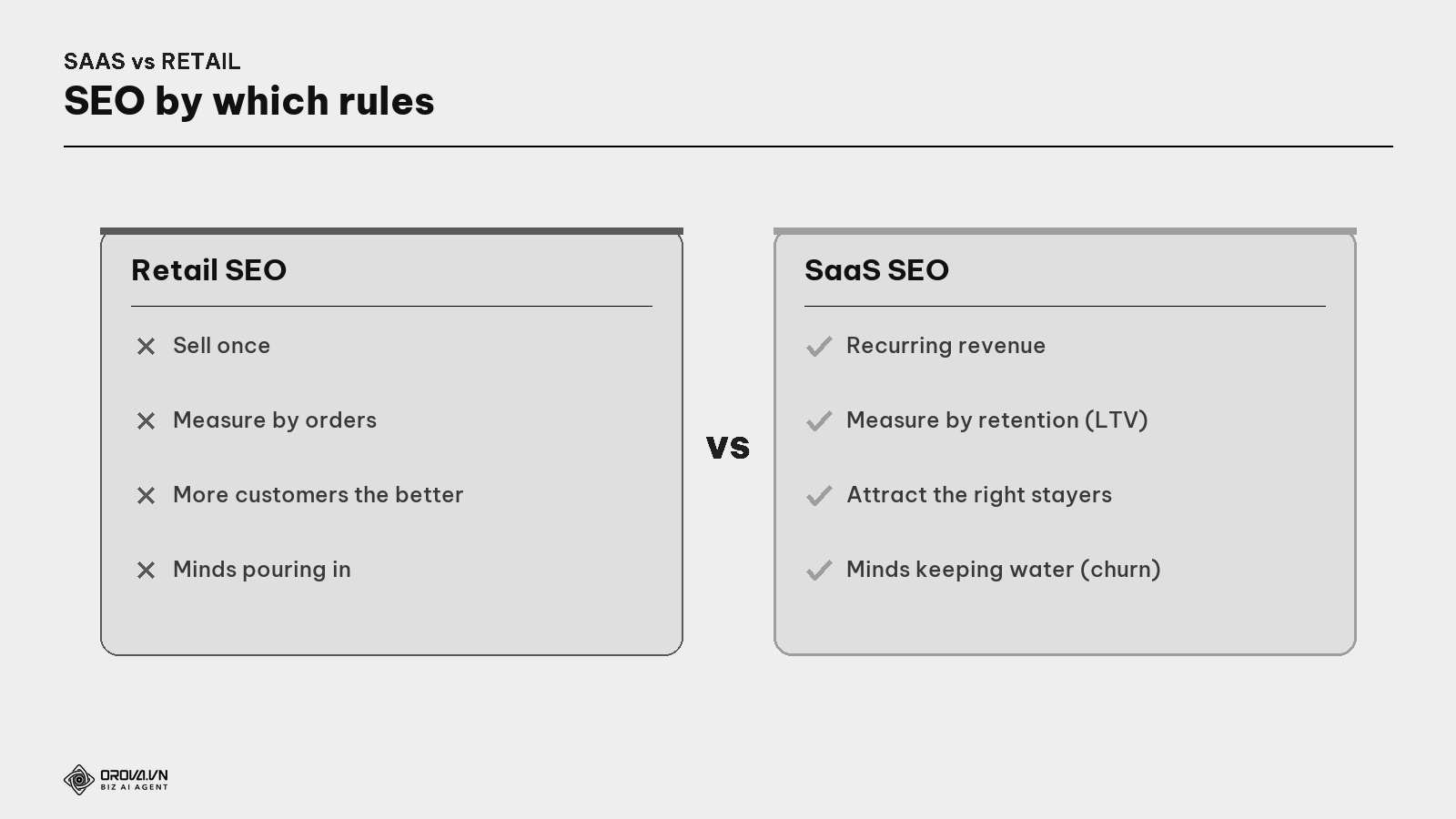
What are MRR & churn? MRR (Monthly Recurring Revenue) = recurring monthly revenue — total subscription money each month. Churn = the percentage of customers canceling each period — the bucket's "leak". SaaS lives and dies by MRR and churn: attracting new customers while churn is high is like pouring into a leaky bucket.
The implication for SEO: attracting the wrong people (those who trial and leave) actually hurts — they cost support then leave, pushing churn up. The goal of SaaS SEO isn't "maximum traffic" but attracting the right people with a problem your product solves, who'll stay and pay long-term.
The four vital numbers of SaaS
What are LTV & CAC? LTV (Lifetime Value) = total money a customer brings over their whole relationship (not just the first month). CAC (Customer Acquisition Cost) = the cost to acquire one customer. A healthy SaaS needs LTV several times larger than CAC (often targeting an LTV:CAC ratio ≥ 3:1). SEO appeals to SaaS because it lowers CAC over time — good articles keep attracting customers without ongoing cost like ads.
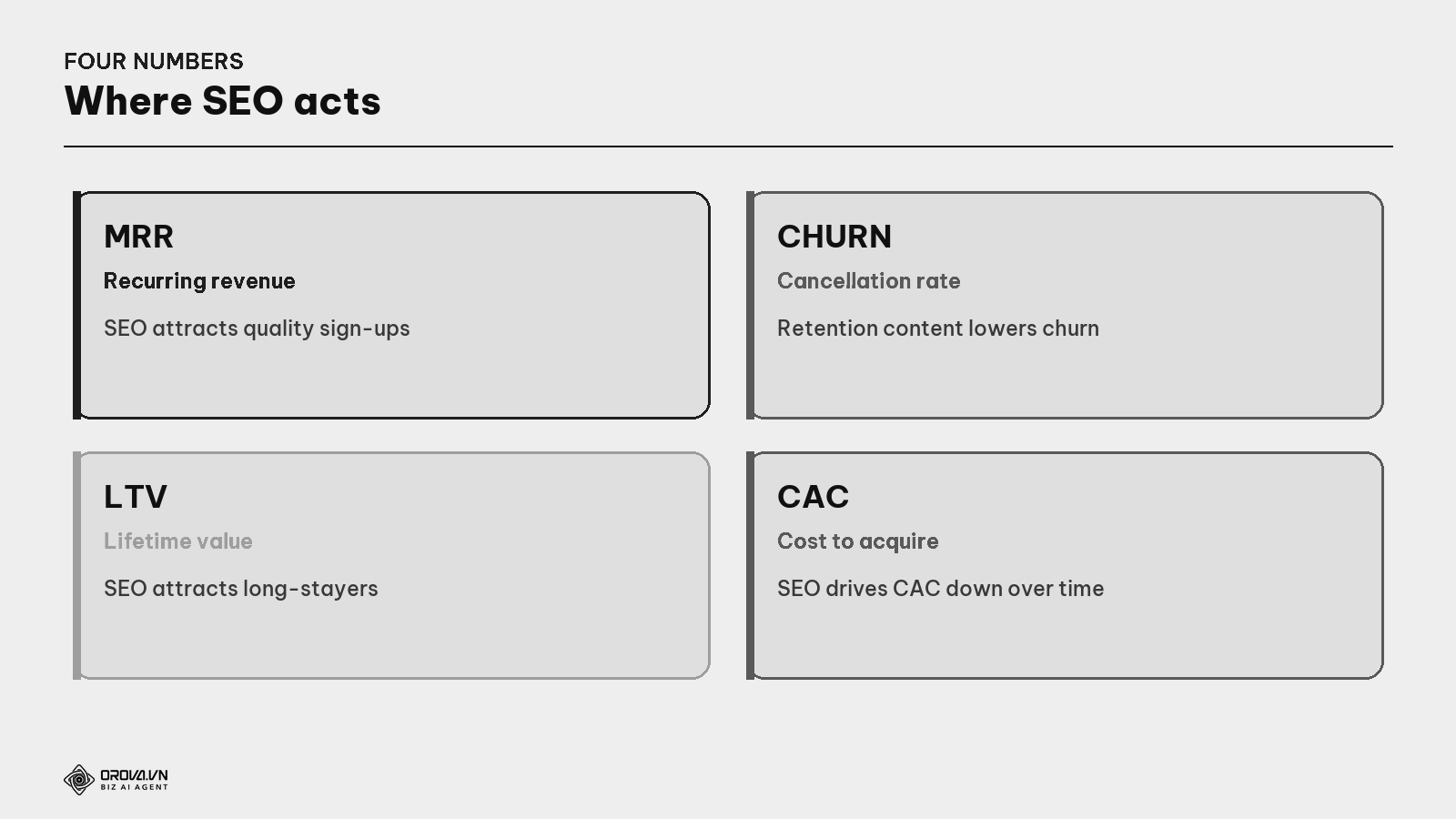
This is why SEO suits SaaS especially: an article's cost is fixed once, but it attracts customers continuously for years — so CAC from SEO falls over time, while ads stop bringing customers the moment you stop paying. For a recurring-revenue model, a low-CAC, durable channel like SEO is gold.
Topic clusters by "the job the customer needs done"
SaaS SEO is strongest when topic clusters hook onto the real problem the product solves, not just keywords.
What is jobs-to-be-done? A way of thinking: a customer "hires" a product to get a job done (e.g., "write SEO articles fast and properly"), not for features. SaaS clusters should revolve around those "jobs" — each job a content cluster leading the person-with-a-problem to the product as the solution.
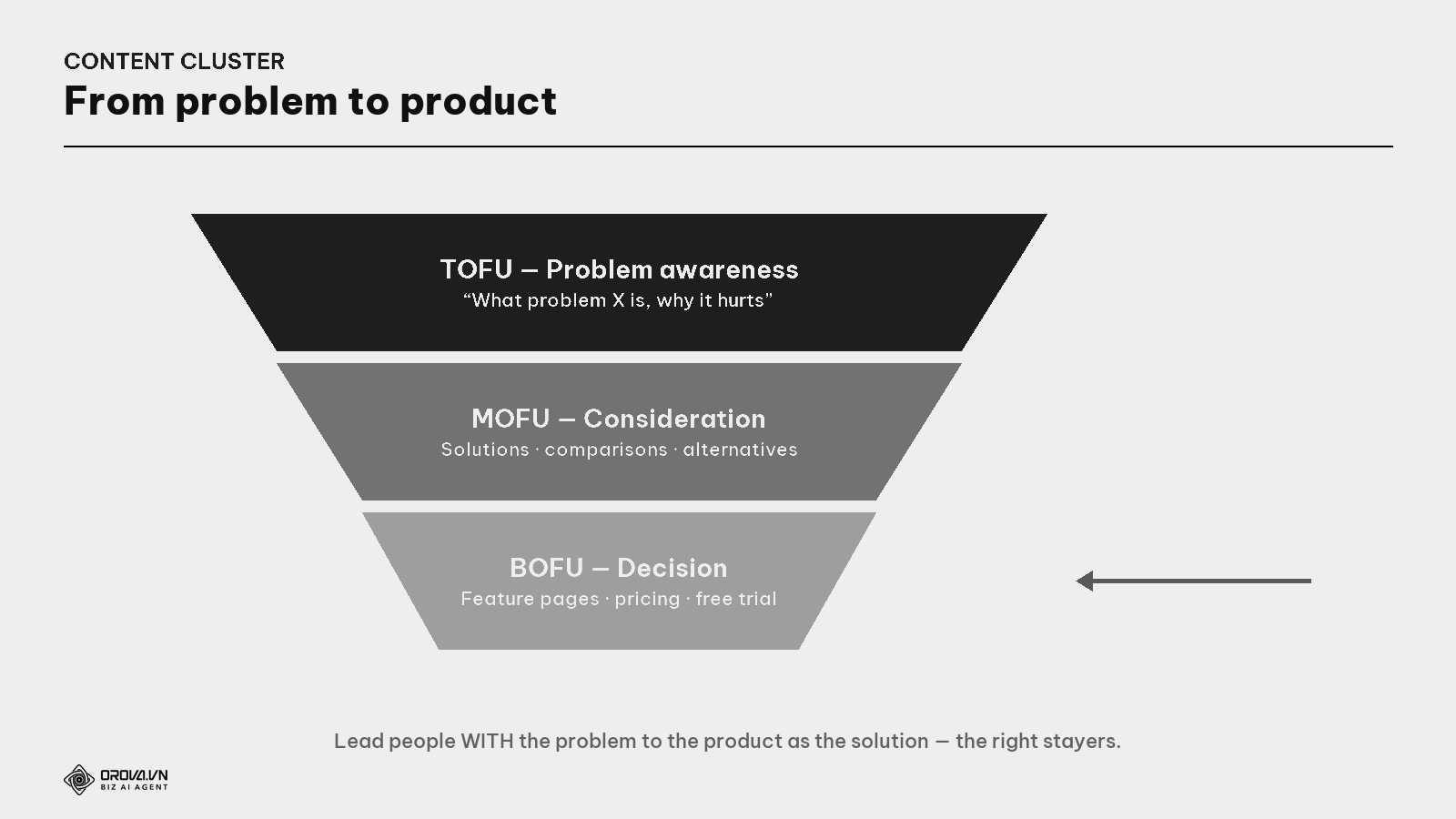
- TOFU — problem awareness: "what problem X is, why it's costly" — attract the right people hurting from the problem you solve.
- MOFU — consideration: "how to solve problem X", "tool comparisons", "[competitor] alternative" — people seeking solutions.
- BOFU — decision: feature pages, pricing, "free trial" — people ready.
This cluster builds topical authority (see the Topic Cluster guide) and leads people with a real problem to the product as the solution — exactly the kind who'll stay.
Product SEO: feature, comparison & programmatic pages
This is the "money" part unique to SaaS that many forget — they only write a blog and forget to optimize product pages.
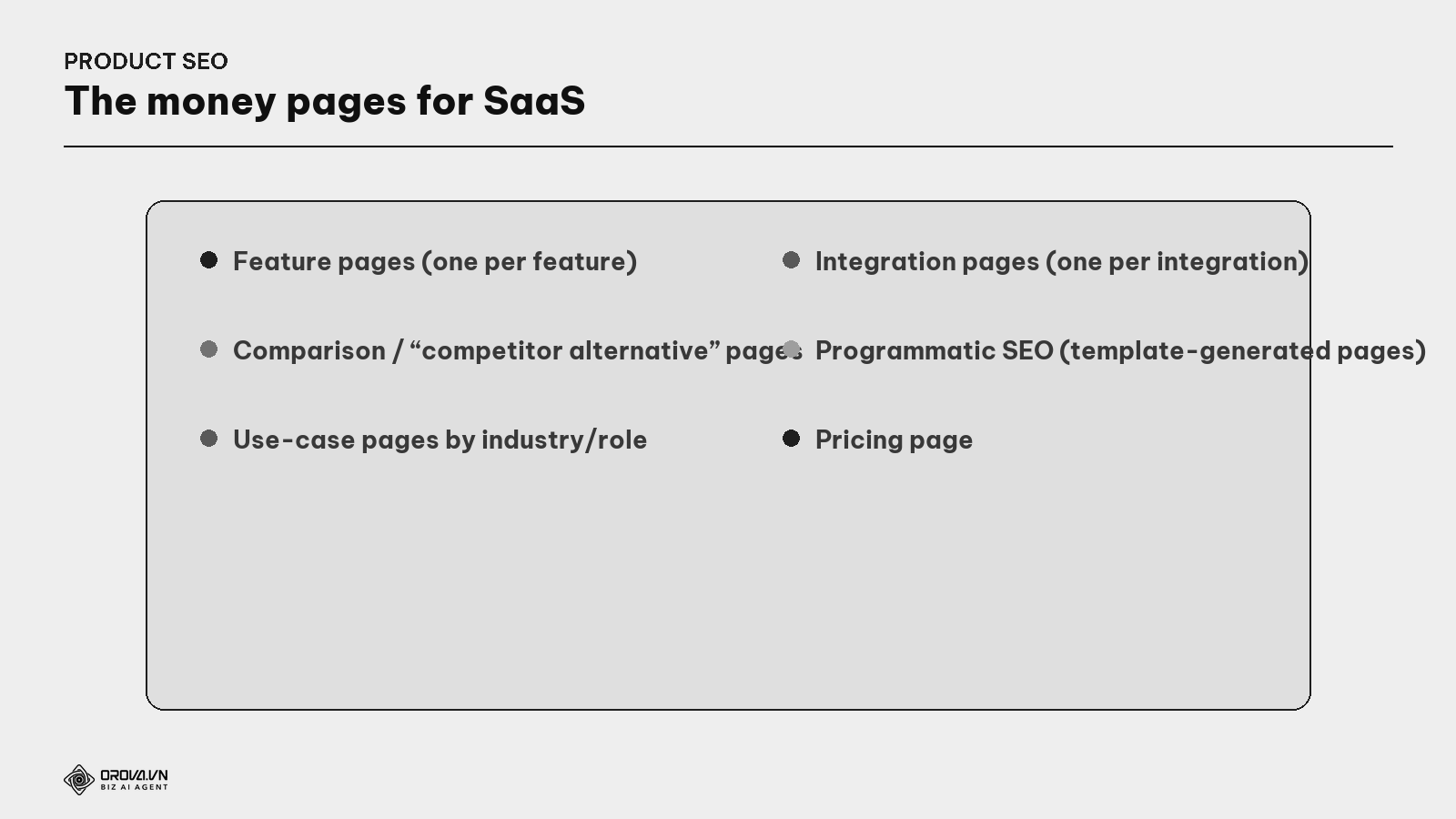
- Feature pages — one page per main feature, targeting the keyword for that feature.
- Comparison / "[competitor] alternative" pages — people using a competitor seek alternatives (very high buying intent).
- Use-case pages — by industry or role ("X for restaurants", "X for marketers").
- Integration pages — one page per integration for SEO (see how OMICALL does /tich-hop/).
What is programmatic SEO? Generating many pages from a template using data (e.g., one page per city/industry/integration). Powerful for SaaS with many variants, but dangerous if done sloppily — generated pages must be genuinely useful, not mass empty shells (which get flagged as spam — see the AI Content & Helpful Content guides).
Retention content: SEO doesn't stop at the sale
This is SaaS's most distinctive point — and the most often forgotten.
What is retention content? Content serving customers after they've bought — how-to guides, docs, advanced tips, answers. It reduces churn (helping customers succeed so they stay) and is often also searched (users Google how to use it), so it both retains and drives SEO.
For SaaS, "patching the leak" (reducing churn) matters as much as "pouring water" (attracting customers). Guide/doc content both helps customers use the product well (stay longer, higher LTV) and ranks for "how to use X" queries — one content serving both. This is the SEO part a sell-once company doesn't need, but SaaS must have.
Measurement & "pass" standard
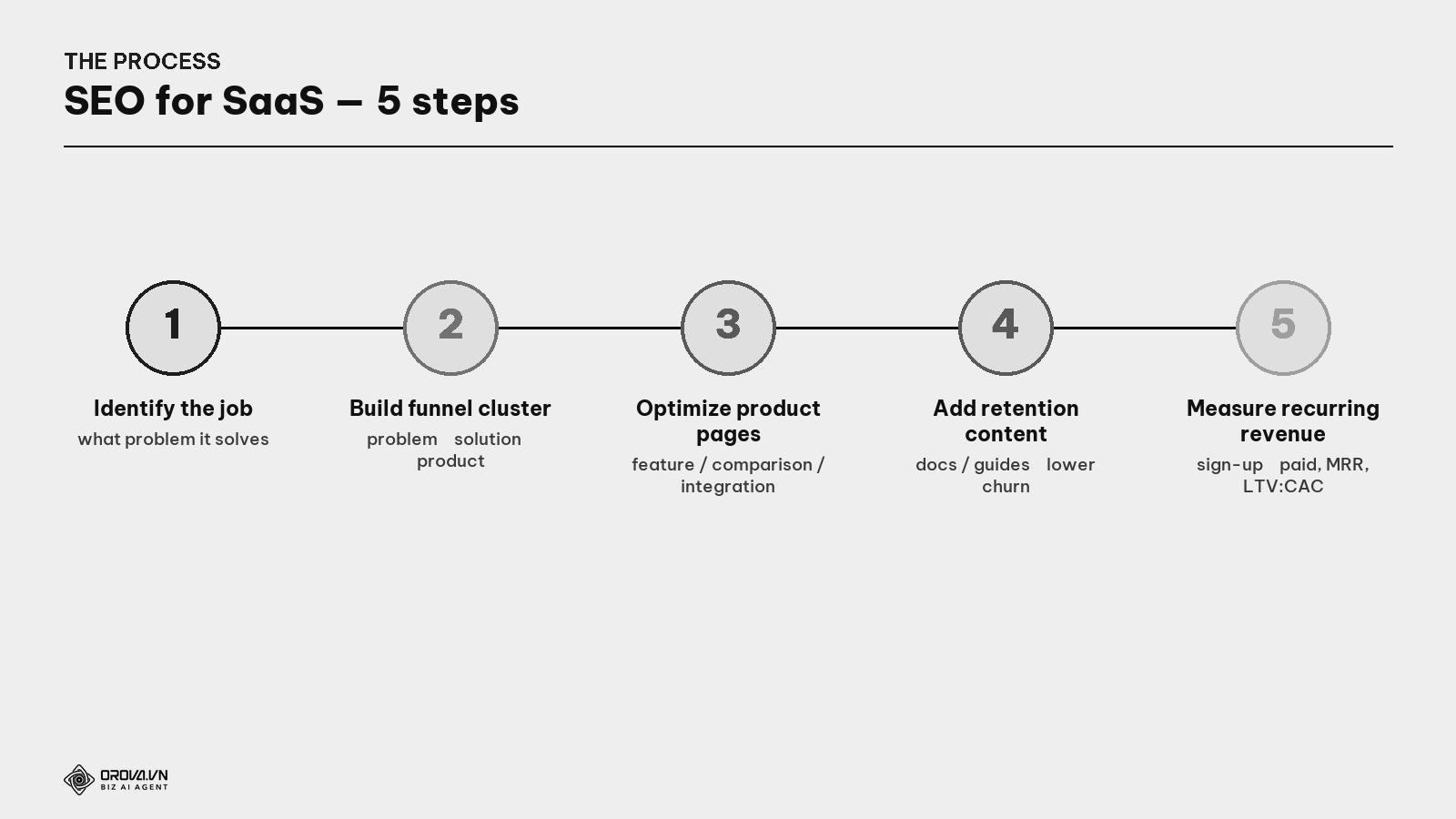
- Identify the "job to be done" the product solves — the foundation for every cluster.
- Build a funnel-covering cluster from problem to product (the right people who'll stay).
- Optimize product pages — feature, comparison, competitor-alternative, integration.
- Add retention content — docs, how-to guides (reduce churn).
- Measure by recurring revenue — not just traffic, but trial sign-ups → paid, MRR, churn, LTV:CAC (see the Measuring SEO & ROI guide).
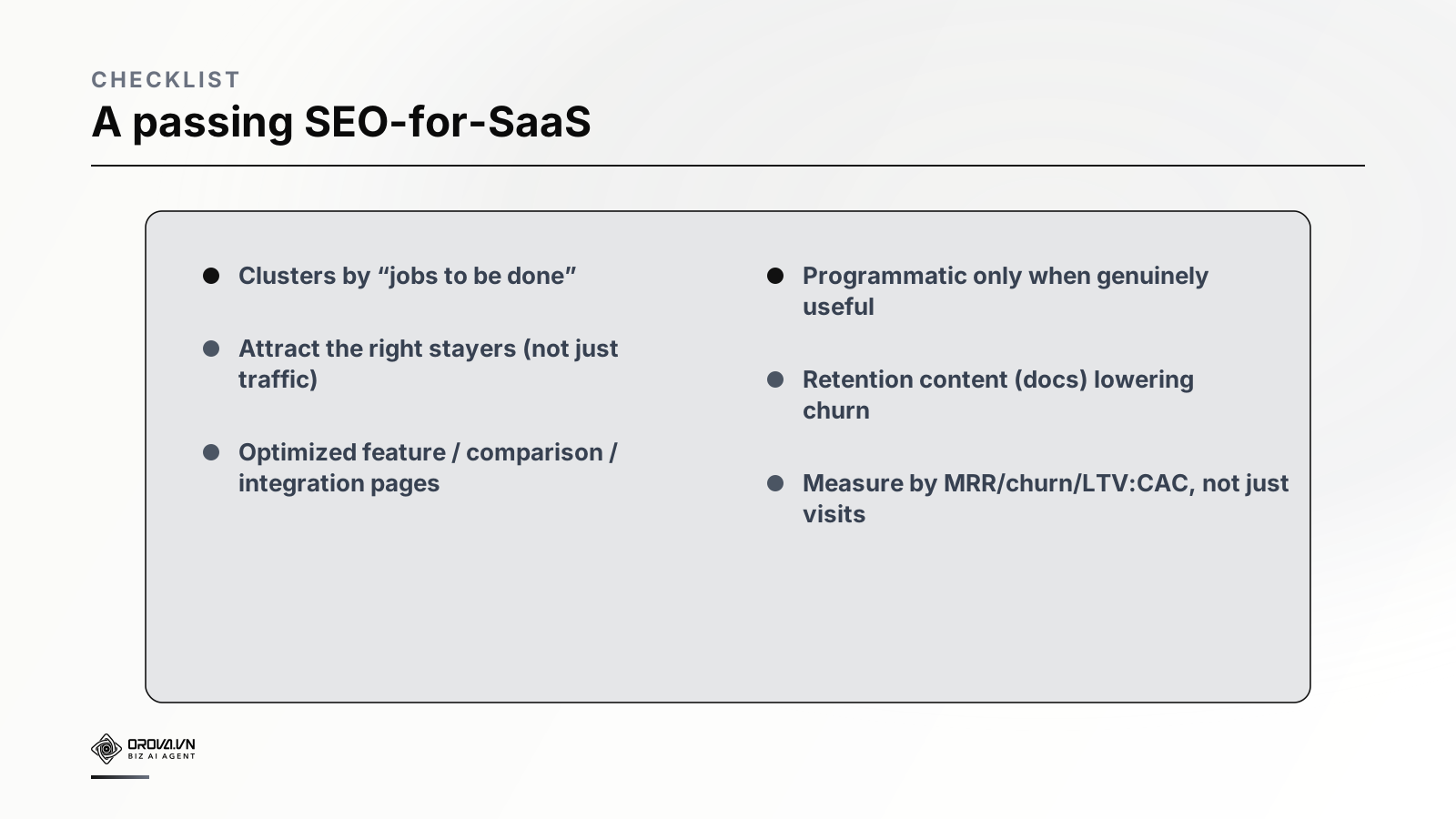
"Pass" standard: clusters hook onto "jobs to be done" and cover the whole funnel; SEO attracts the right people who'll stay rather than chasing empty traffic; feature/comparison/integration pages are optimized (the money part); if using programmatic, each page is genuinely useful; there's retention content (docs/guides) to reduce churn; and you measure by recurring revenue (sign-up→paid, MRR, churn, LTV:CAC), not just visits. At this level, your SEO both pours water fast and patches the leak — by the SaaS rules.
Benefit: SEO is one of the most durable, cheapest channels for SaaS, because it drives CAC down over time and serves customers across the lifecycle — exactly what a recurring-revenue model needs. A good content library both attracts the right paying people (raising MRR) and helps them succeed and stay (lowering churn), lifting LTV. While ads stop bringing customers when you stop paying, SEO done right for SaaS is like opening another tap while patching the bucket's bottom — and that's how recurring revenue grows sustainably.
FAQ
How does SaaS SEO differ from regular SEO? In goal: SaaS earns recurring revenue, so SEO must attract not just sign-ups but the right people who'll stay and pay long-term, and serve the whole lifecycle (even after purchase) to reduce churn. You also measure by recurring revenue (MRR, LTV:CAC), not just traffic.
Why does SEO especially suit SaaS? Because an article's cost is fixed once but it attracts customers continuously for years → CAC from SEO falls over time. For a recurring-revenue model (high LTV), a low-CAC, durable channel like SEO is extremely attractive versus ads (which stop when you stop paying).
Should I use programmatic SEO? Yes, if done with quality. It's powerful for SaaS with many variants (by industry, integration, city). But each generated page must be genuinely useful; mass empty shells get flagged as spam and hurt the whole site (see the AI Content guide).
Do "[competitor] alternative" comparison pages make sense? Very much, with high buying intent — someone using a competitor and seeking alternatives is a hot prospect. Compare honestly and fairly (no fabrication, no smearing) to build trust (E-E-A-T).
Does retention content (docs) count as SEO? Yes. Docs/guides both reduce churn (helping customers use it well so they stay) and rank for "how to use X" queries. This is the SEO part a sell-once company doesn't need, but SaaS must have — one content serving both goals.
What metrics measure SaaS SEO? By recurring revenue: organic trial sign-ups → conversion to paid → MRR contributed, and further LTV:CAC and churn of SEO-sourced customers. Traffic is just a stepping stone; the final number is customers who pay and stay.
Should I prioritize the blog or product pages first? Balance both, but don't forget product pages (feature/comparison/integration) — that's the money part near the funnel bottom that many blog-only SaaS miss. The blog attracts people with a problem at the top; product pages close them at the bottom.
Back to the leaky bucket
Remember the bucket that fills while it leaks? Someone who only pours faster exhausts themselves while the bucket stays empty; the wise one patches the leak first, so every new scoop actually stays and the bucket fills up. Pour and patch — both make a full bucket.
SEO for SaaS is doing both. "Pouring water" is attracting the right people who'll stay via problem-hooked clusters and optimized product pages; "patching the leak" is retention content helping customers succeed so they don't cancel. Don't do SEO retail-style — chasing traffic only to let trial users leave. Do it by the SaaS rules: attract the right people, serve the whole lifecycle, measure by recurring cash flow. Then each article brings not just a visit — but a cash stream month after month, and your MRR bucket fills up sustainably.
This article is part of Orova's complete SEO guide series — and the one closing the series. See the overview "SEO in 2026", and "Topic Clusters", "Search Intent", "Tone of Voice & CTA", and "Measuring SEO & ROI" for the full picture. Get started with Orova — a SaaS doing SEO with AI — at orova.vn/en/seo.
Sources
SaaS growth frameworks (MRR, churn, LTV, CAC, LTV:CAC) · Google Search Central (helpful content, mass-generated content) · Ahrefs & SaaS SEO studies (programmatic, comparison pages, retention content).
Stop Guessing, Start Compounding
Building this kind of SEO strategy by hand is not the hard part — sustaining it is. Mapping every customer job to a content cluster, keeping product and comparison pages updated as features change, and tracking whether retention content is actually reducing churn takes ongoing hours that most SaaS teams simply do not have between shipping features and answering support tickets.
Orova SEO was built to take that repetitive tracking and content upkeep off your plate, automating the parts of this process that eat the most time so your team can focus on strategy instead of spreadsheets. If juggling all of this manually sounds exhausting, it is worth taking a look at how Orova handles it.
Read next: What Is SEO? The Complete Beginner's Guide for 2026
Let Orova SEO handle the repetitive part
Keyword research, drafting, refreshing old posts and rank tracking — running automatically on your own site.
Explore Orova SEO