
EEAT SEO Explained: How to Build Trust for Your Site (2026)
Same advice, two people — who do you believe?
Imagine you're worried about chest pain. Two people tell you the exact same thing: "Probably just a strained muscle, but get it checked." The first is a cardiologist in a white coat at a hospital, with a name badge and diplomas on the wall. The second is an anonymous account online with a cat for a profile picture. Same words — who do you believe more? The doctor, obviously. Not because his sentence is better, but because he has a reason to be trusted.
Google does exactly what you do. Given two pages saying the same thing, it tries to guess who is more trustworthy to put first. Its way of guessing has a name: E-E-A-T. Understanding and building E-E-A-T is how you tell Google "I'm the one worth trusting" — and that's often the difference between a page that ranks and one that sinks despite near-identical content.
This article dissects it fully: what E-E-A-T is, each letter and how to show it on the page, why Trust is the root, the YMYL concept (topics judged far more strictly), the concrete signals to build E-E-A-T, how individuals/small sites can still build it, why E-E-A-T matters even more in the AI era, and the self-audit process.
What is E-E-A-T? Four letters: Experience, Expertise, Authoritativeness, Trust. A set of criteria in Google's quality-rating guidelines used to judge how trustworthy a page is. Note: E-E-A-T is not a direct ranking number — it's how Google thinks about quality, and the signals that build it do affect rankings for real.
Unpacking the four letters — and how to show each on the page
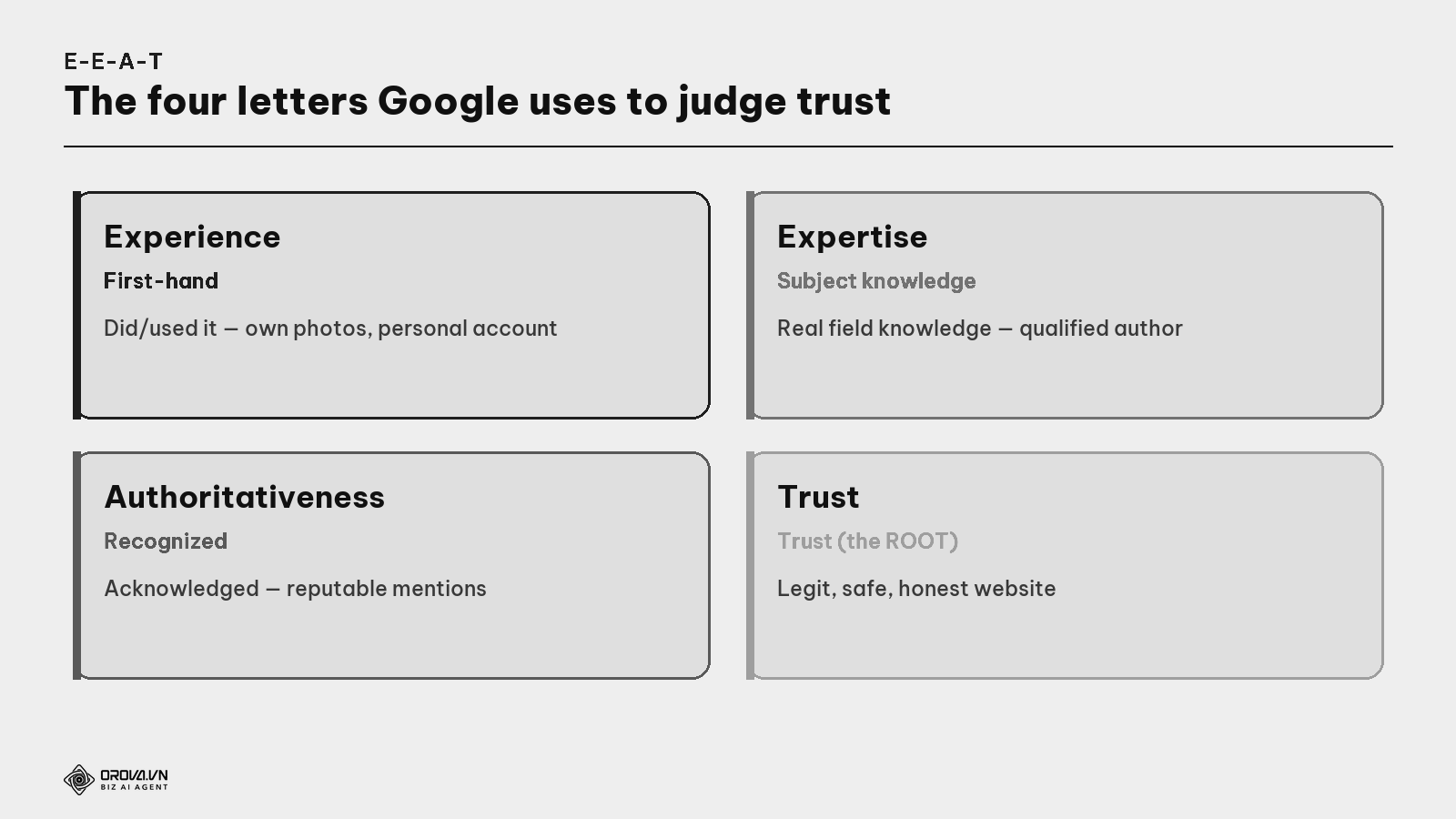
E — Experience. Did the writer actually live through what they describe? The most recently added letter, and the hardest for AI to fake. Show it: original photos/videos, insider-only details, a personal account ("I tried...").
E — Expertise. Does the writer have subject knowledge? A medical article by a doctor is trusted more than one by an outsider. Show it: author name + title, a professional bio, accurate and deep content.
A — Authoritativeness. Are you/your site recognized as a notable source in the field? Reputation beyond the page. Show it: mentions and links from reputable outlets (backlinks — see the Link Building guide); a brand people search by name.
T — Trust — the ROOT of all. Google explicitly says Trust is the center. Is the site legit, safe, honest? Show it: clear contact, an "About" page, policies, a security certificate (HTTPS), no scams, no empty promises.
Why is Trust the root? The other three feed Trust. A page with high expertise but no trust (anonymous, scammy) is still worthless to Google. When building E-E-A-T, start with Trust.
YMYL: why some topics are judged far more strictly
Not every page is scrutinized for E-E-A-T equally.
What is YMYL? Short for Your Money or Your Life. Topics where wrong information could cause real harm to health, finances, safety, or legal standing: medicine, investing, loans, drugs, safety... For YMYL, Google raises the E-E-A-T bar very high — because the consequences of bad content here are serious.
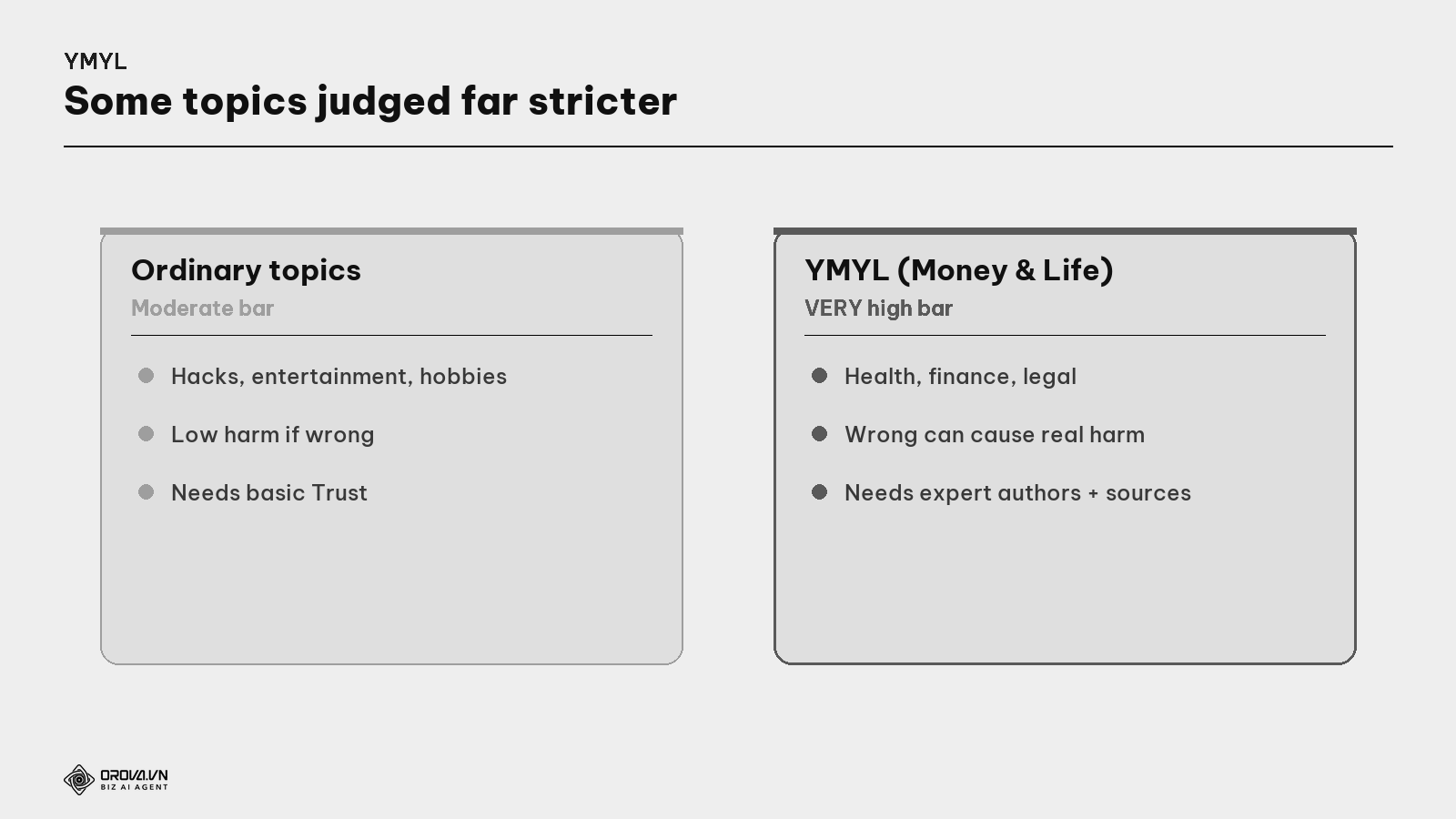
So: YMYL content must invest heavily in expertise and trust (real credentials, scientific sources, review). Light topics (recipes, hacks) have a gentler bar — but Trust is always needed.
How to build E-E-A-T on your website, in practice
E-E-A-T sounds abstract, but it's built from very concrete signals you add to the page.
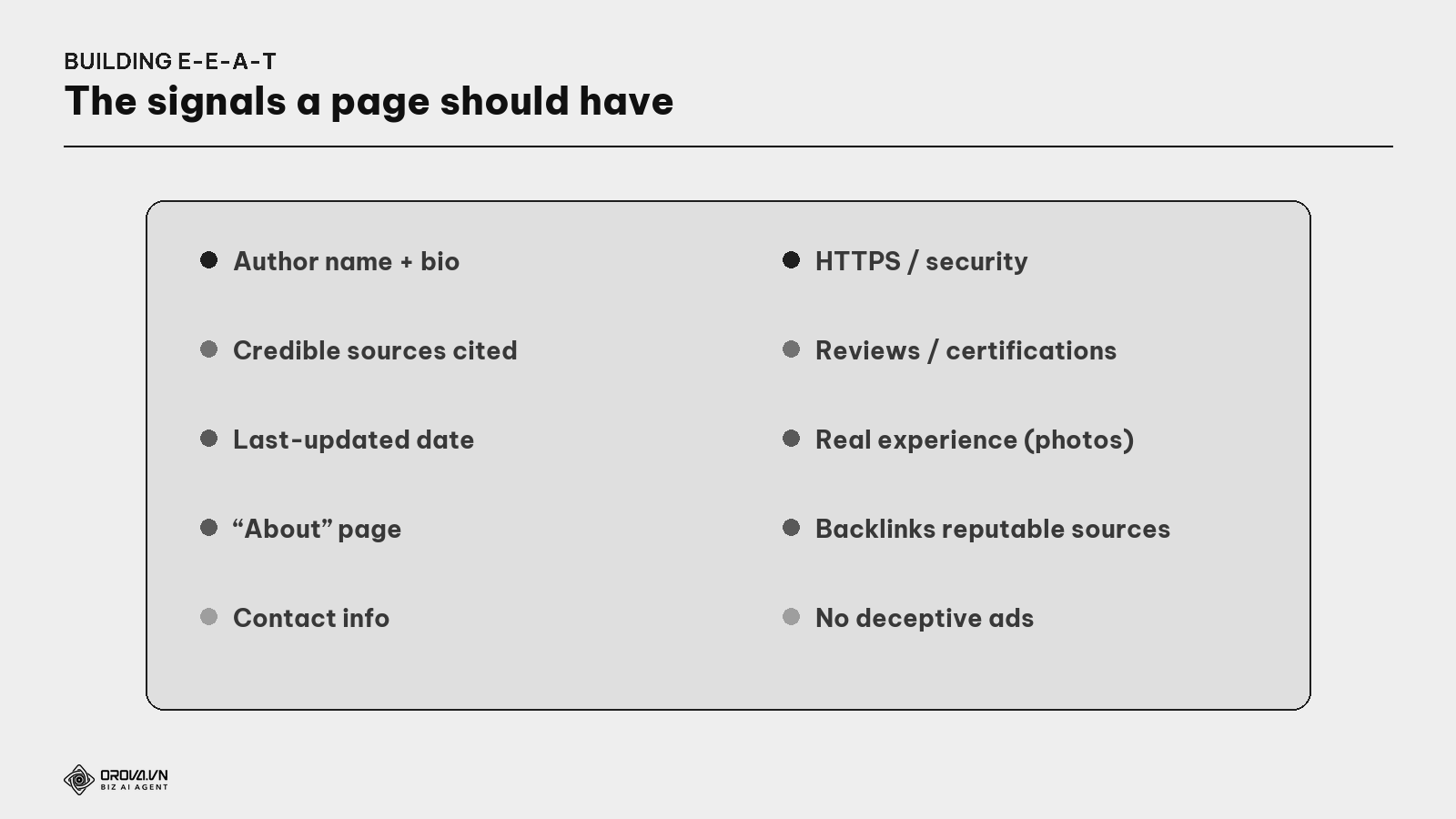
- Name the author + bio. Real name, title, a line on why they're qualified. Anonymous posts are hard to trust.
- Cite credible sources. Quote research, official data, link to the origin (and don't fabricate numbers — Google increasingly cross-checks).
- Show a last-updated date. Fresh content is trusted more, especially for fast-changing topics.
- An "About" page + clear contact. Tell who's behind the site.
- Basic security (HTTPS). A site without it is seen as less trustworthy.
- Real experience. Original photos, concrete examples, real results — proof you did it.
- External reputation. Mentions and links from reputable sources.
Individuals & small sites can still build E-E-A-T
Many think E-E-A-T is only for big brands. Wrong — you start with the two most controllable letters.
For individuals/small sites, start with Experience and Trust — the two letters you fully control: write from real experience, name the author, make a proper "About" page, enable HTTPS. Authoritativeness (A — backlinks, mentions) builds up over time; don't wait for A to start.
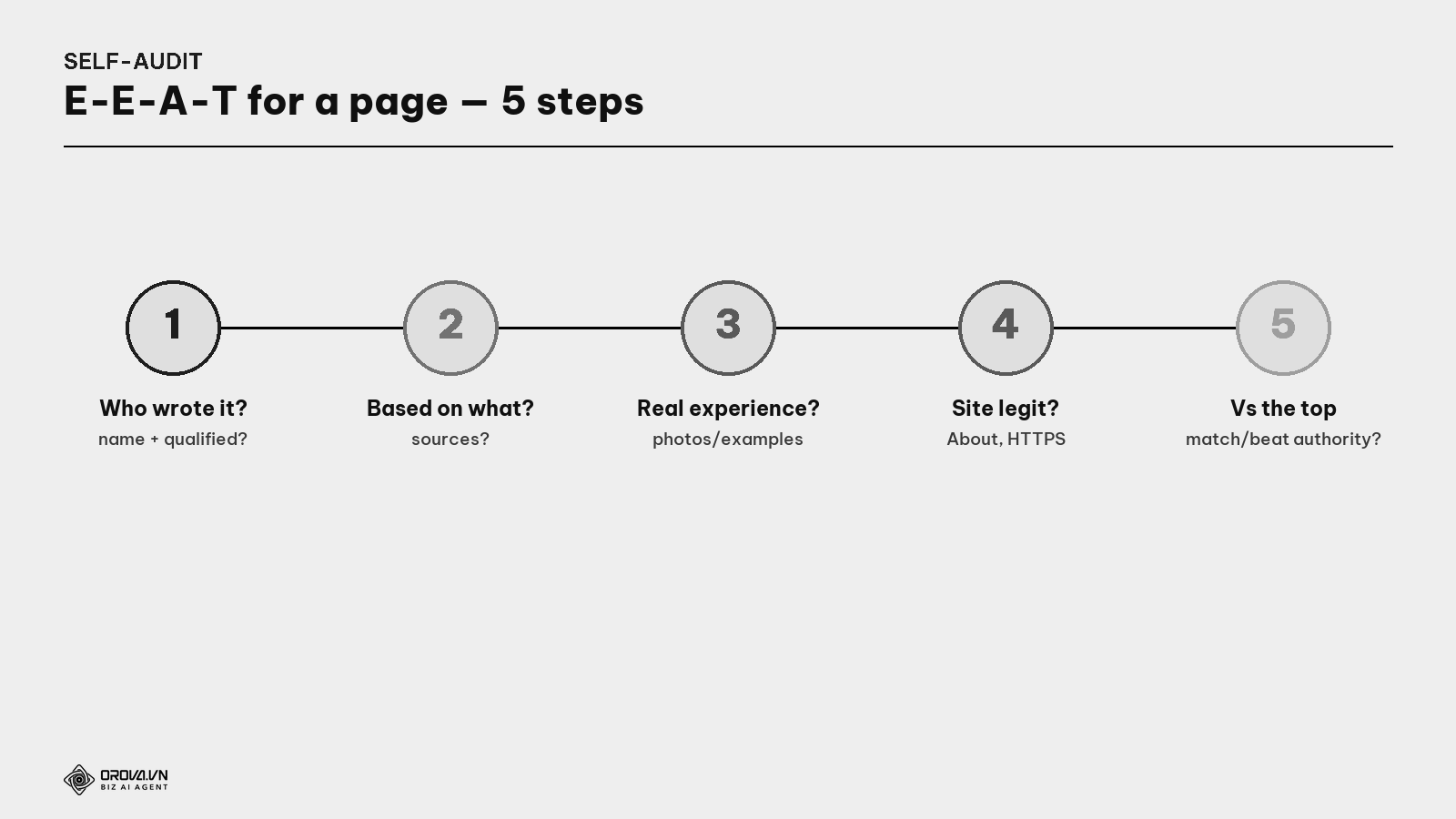
The self-audit for an important page (especially YMYL): (1) Who wrote it — name + qualifications? (2) Based on what — sources? (3) Any real experience, or just copied theory? (4) Is the site legit (About, contact, HTTPS, no empty promises)? (5) Versus the top page, do you show equal or greater authority?
E-E-A-T in the AI era: why it matters even more
When AI can churn out "enough words" en masse, what separates real content from machine-made content is E-E-A-T.
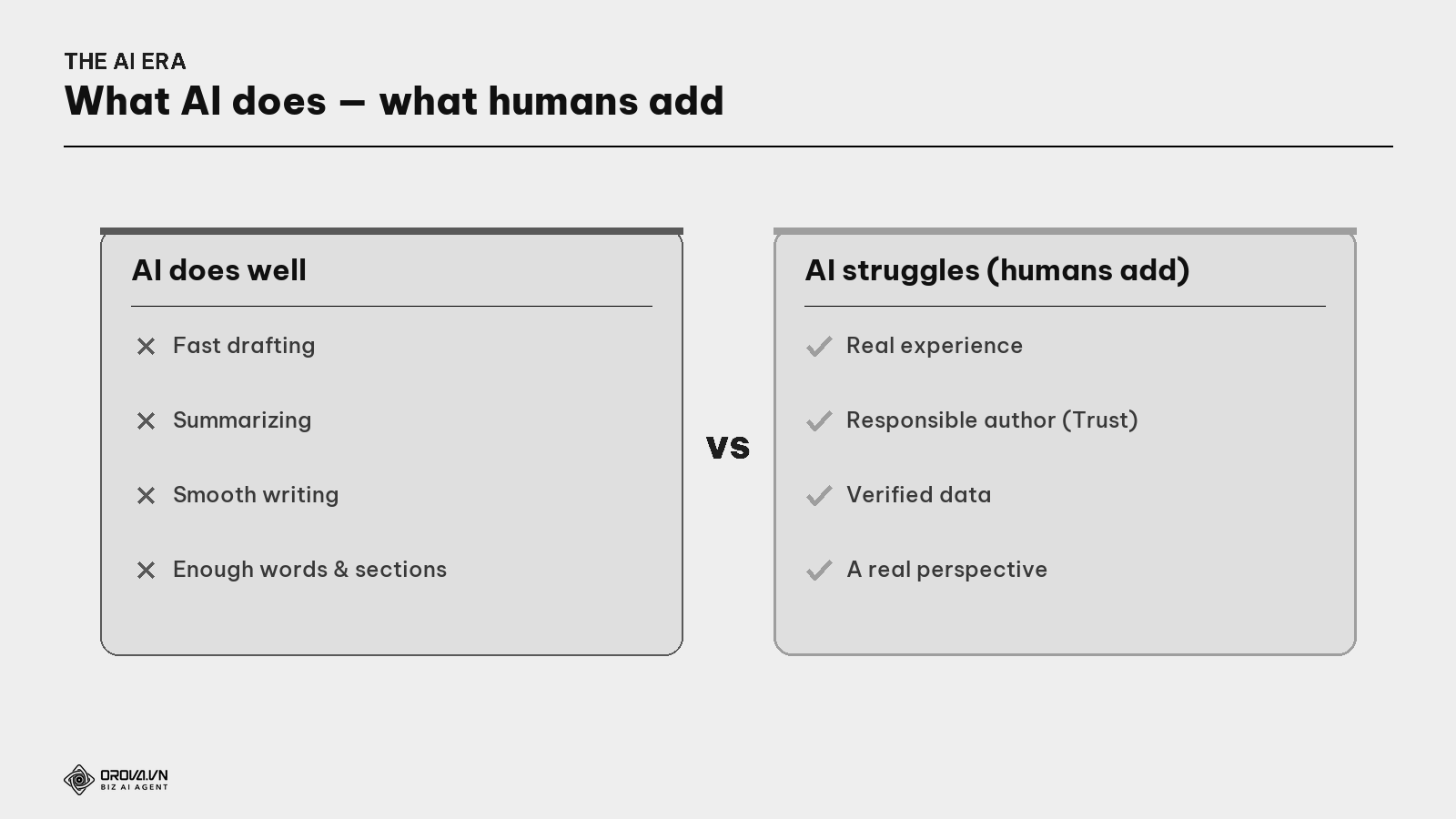
- AI struggles to create Experience (first-hand) and Trust (a truly responsible author) — exactly the two letters Google values most.
- AI content that wants E-E-A-T must be human-directed, fact-checked, given real experience, and a real named author (see the AI Content guide).
- So in a sea of bland AI content, a page with real E-E-A-T stands out more — Google and AI tools alike favor trustworthy sources.
"Pass" standard
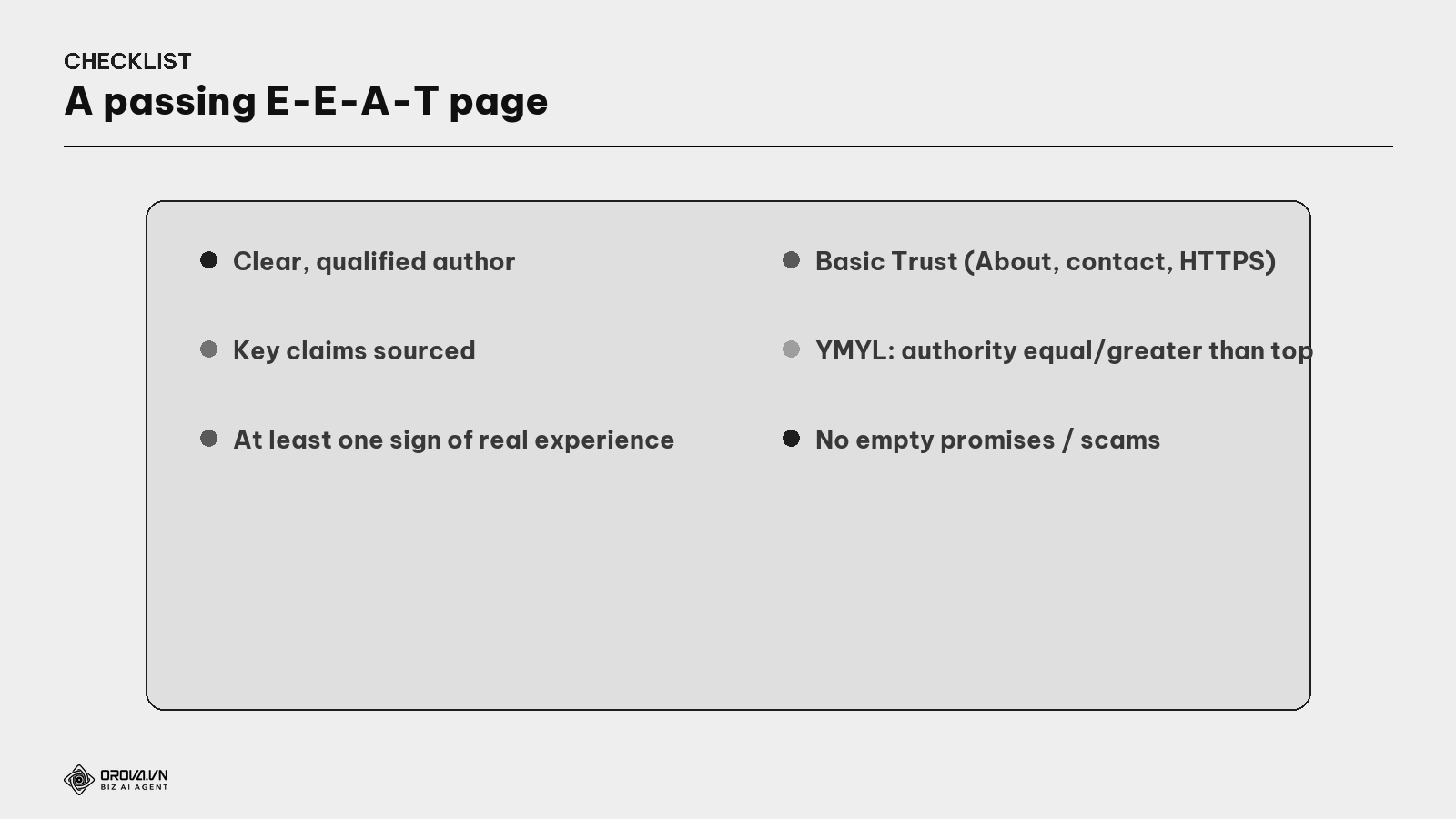
"Pass" standard: the article has a clear, qualified author; key claims are sourced; there's at least one sign of real experience; the site has basic Trust (about, contact, HTTPS); and for YMYL topics, your authority investment matches or beats the pages on top. At this level, with two equal articles, yours — with stronger E-E-A-T — almost always wins.
Benefit: E-E-A-T is accumulated "trust capital". Each small signal (author, sources, HTTPS, real experience) adds up to a clear message to Google: "this page, this person, is trustworthy." In an era of mass AI content, this is the hardest thing to copy and the most durable advantage — a competitor can copy your words, but not your credibility.
FAQ
Is E-E-A-T a direct ranking factor? Not quite. Google says E-E-A-T is how they think about quality, not an on/off number. But the signals that build it (author, sources, backlinks, trust) do affect rankings — so building E-E-A-T is the right move.
Does AI-written content affect E-E-A-T? Google doesn't penalize "using AI", but AI struggles to create "Experience" and "Trust". AI content needs human direction, fact-checking, real experience added, and a real named author to meet E-E-A-T.
I'm an individual / small business — how do I build Authoritativeness (A)? Start with Experience and Trust — the most controllable: write from real experience, name the author, make a proper "About" page, use HTTPS. Authoritativeness (backlinks, mentions) builds over time.
How long until E-E-A-T improves rankings? Not instant. It's accumulated capital: adding an author/sources helps a bit right away, but site-level authority and trust need months of good content + backlinks to show clearly.
Which of the four letters matters most? Trust — Google explicitly says it's the center. The other three (Experience, Expertise, Authoritativeness) all feed Trust. If you must pick where to start, start with Trust.
Do product/commercial pages need E-E-A-T? Yes, especially the Trust part (these are usually YMYL — money-related). Real reviews, clear policies, contact info, payment security are all important Trust signals for sales pages.
How do I show "experience" if I haven't used the product I'm writing about? Create real experience at small scale: try it yourself, take photos, record results/impressions. A little real experience (your own photos, insider details) beats a ton of copied description.
Back to the doctor and the anonymous account
Remember the two people advising you about chest pain? You trusted the white-coated doctor over the anonymous account — not because the words differed, but because one had reasons to be trusted: credentials, identity, a clear workplace.
Building E-E-A-T is giving your website those "reasons to be trusted". State who wrote it and why they're qualified; cite real sources; show real experience; make the site legit, safe, transparent. Do that, and you're no longer the "anonymous cat-avatar account" in Google's eyes — you're the white-coated doctor people (and Google) choose to believe. In a world flooded with machine-made content, trust is the hardest asset to copy that you can build.
This article is part of Orova's complete SEO guide series. It's a deep-dive within the cluster — see the overview "SEO in 2026", "Writing SEO Content", "Using AI to Write Content", and "Link Building" for the full picture. Get started with Orova at orova.vn/en/seo.
Sources
Google Search Quality Rater Guidelines (E-E-A-T definition & Trust at the center; the YMYL concept) · Google Search Central (creating helpful, trustworthy content) · Search Engine Land (E-E-A-T for SEO).
Related reading: SEO in 2026: The Complete Guide (From Zero, No Jargon)
Let Orova SEO handle the repetitive part
Keyword research, drafting, refreshing old posts and rank tracking — running automatically on your own site.
Explore Orova SEO