
Local SEO for SaaS and Service Businesses: Yes, You Still Need It
Somewhere in the last decade, a quiet consensus formed among software and B2B service companies: local SEO is for restaurants, dentists, and plumbers. We sell to the whole country — the whole world — so why would we care about ranking on a map? The consensus is wrong, and it is wrong in a way that costs real pipeline. Buyers still search with geography in their heads. They type "marketing agency in Da Nang," "payroll software for Singapore companies," "IT support near me," and when they do, Google does not serve them the same results page it serves everyone else. It serves a local one — a map, three highlighted businesses, and a set of organic results filtered through the lens of place.
If your company has an office, serves a defined region, sells anything where trust and proximity matter, or simply competes for searchers who add a city name to their queries, you have a local SEO surface whether you tend it or not. An untended surface does not stay neutral. It fills with whatever Google scrapes together — an unverified profile, an old address, a competitor's well-managed listing sitting above your absence. This guide covers what local SEO actually involves for a SaaS or service business in 2026, what is worth your limited hours, and what you can safely skip.
Do SaaS and service businesses still need local SEO in 2026? Yes — if any meaningful share of your buyers search with a location in mind. Local SEO means claiming and optimising your Google Business Profile, keeping name-address-phone data consistent, earning reviews, and building location-relevant pages. It wins you the local pack, Maps visibility, and the trust signals AI answers increasingly draw from.
Why "we're not a local business" is usually a half-truth
Start with an honest audit of your own search demand. Open your Search Console data and filter queries for city names, country names, "near me," and "in [region]." Most service businesses are surprised by what they find. A design agency in Ho Chi Minh City discovers that a third of its converting queries contain a geographic modifier. A SaaS company discovers that "best CRM for Australian small business" and similar market-scoped queries outrank its generic head terms in actual conversions, because geographic intent correlates with buying intent. Someone who types a city into a search is past the curiosity stage. They are shortlisting.
There is a second, newer reason the half-truth has become expensive. AI-generated answers — Google's AI Overviews, AI Mode, and the conversational assistants people increasingly ask for recommendations — lean heavily on structured, verifiable business data when the question has any local dimension. Ask an assistant for "a reliable IT services firm in Hanoi" and the answer is assembled substantially from Google Business Profile data, review corpora, and the entity information search engines have already validated. A business with a complete, active, well-reviewed profile is legible to those systems. A business without one is invisible to them, no matter how good its blog is. The work you do for local SEO is, increasingly, the work that makes you quotable to machines — the same logic that drives E-E-A-T and entity trust in classic organic results.
And there is a third reason that predates AI entirely: the local results block sits above most organic results. When a query triggers the local pack — the map plus three business listings — those three positions absorb a disproportionate share of clicks and calls before a single blue link gets seen. Ranking fourth organically below a local pack is, functionally, ranking eighth. If your competitors occupy that block and you do not, the contest is over before your content gets a chance to compete.
The three levers Google actually uses: relevance, distance, prominence
Google is unusually transparent about local ranking. It names three factors: relevance, distance, and prominence. Everything in local SEO is an attempt to move one of these three, so it is worth understanding what each means before touching any tactic.
Relevance is how well your business profile matches what the searcher asked for. It is determined mostly by the categories you choose, the services you list, the words in your business description, and the content of your reviews. A profile categorised as "Software company" will never appear for "marketing agency" searches no matter how prominent it is. Relevance is the lever you control most directly, and the one most businesses set once, badly, and never revisit.
Distance is how far your location is from the searcher, or from the place named in the query. You cannot fake this and should not try — fake addresses and virtual offices used to game proximity are suspension bait. What you can do is make sure every location you genuinely operate is represented, and that service-area businesses define their real coverage area instead of leaving it blank.
Prominence is how well-known and well-regarded Google believes your business to be. It is fed by review count and rating, by mentions of your business across the web, by links to your site, and by your overall organic SEO strength. This is the lever where classic SEO and local SEO converge: the authority you build with content and links lifts your local rankings, and the entity validation you earn locally feeds back into how search engines and AI systems trust the rest of your site.
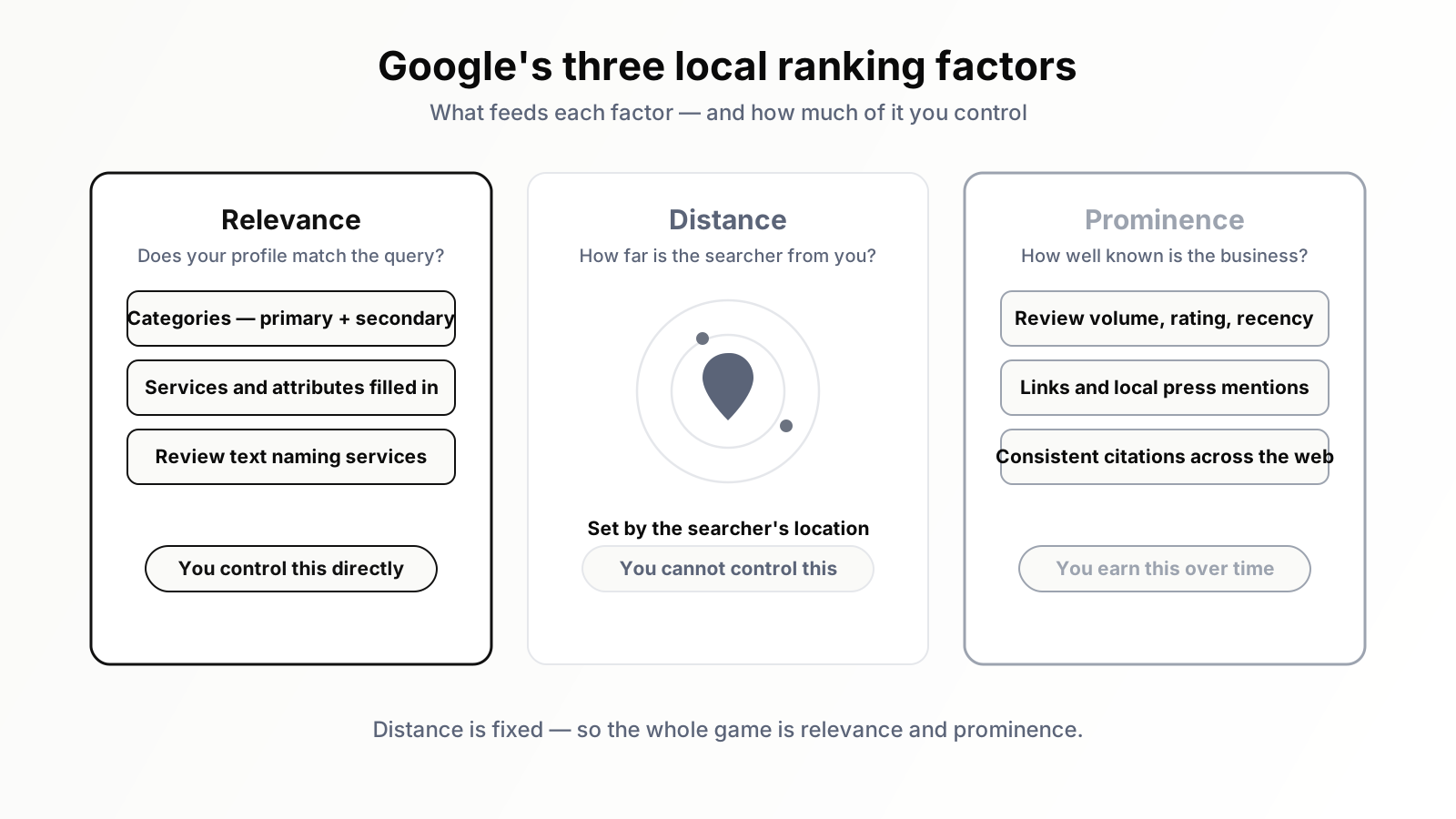
Hold these three in mind and the rest of this guide stops being a list of chores and becomes a set of deliberate moves. Categories and services move relevance. Honest location data respects distance. Reviews, citations, and links move prominence. If a tactic does not move one of the three, it is decoration.
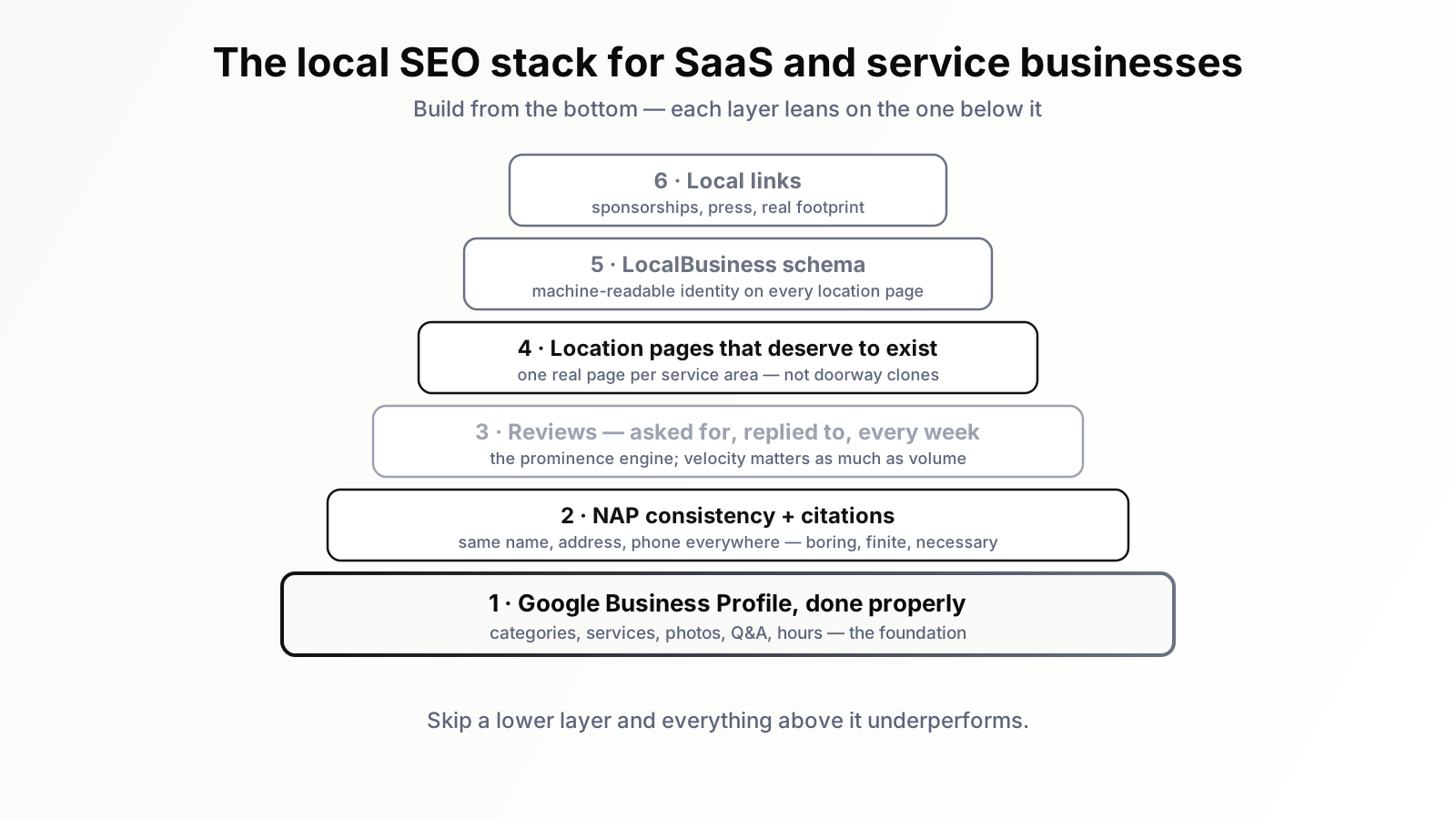
Google Business Profile: the foundation, done properly
Google Business Profile — the product formerly called Google My Business, renamed in 2021 — is the single highest-leverage asset in local search, and it is free. It powers your appearance in the local pack, in Google Maps, and in the knowledge panel that appears when someone searches your brand. For many service businesses it generates more calls and direction requests than the website does. Treat it as a second homepage, because for local searchers it effectively is one. It is also, as we argue at length in our companion piece on why most companies neglect their Business Profile, the asset most likely to be claimed once and abandoned.
Setting it up properly means getting a handful of decisions right:
Verification. Claim the profile and complete verification — increasingly done by video for service businesses, where you show your premises, signage, and proof of operation. Until you verify, you cannot control the listing, and anyone can suggest edits to it.
Primary category. This is the single most consequential field on the profile. Google offers thousands of categories; your primary category should be the most specific one that describes your core business, not the broadest. "Software company" is weaker than "E-commerce service" if e-commerce software is what you sell. Look at what categories the businesses currently ranking in your target local pack use — the data is visible in their profiles — and choose with that competitive picture in mind. Add secondary categories for genuine additional lines of business, but resist stuffing every plausible category in; dilution hurts relevance for your core terms.
Services and description. List your actual services with plain-language names that match how customers search, and write the business description for humans — what you do, for whom, and where. Keyword-stuffing the description does little; leaving it empty does less.
Hours, attributes, photos. Accurate hours matter more than they appear to — "closed now" labels suppress clicks and calls, and wrong hours generate the angriest reviews a business can earn. Attributes (online appointments, languages spoken, accessibility) feed filters and AI answers. Photos are not decoration: profiles with current, genuine photos of premises, team, and work earn measurably more engagement, and Google's vision systems read them as evidence the business is real and operating.
Q&A. The questions-and-answers section on your profile is public and anyone can answer — including people who do not work for you. Seed it yourself with the questions prospects actually ask (pricing model, onboarding, coverage area) and answer them as the business. This is allowed, useful, and almost nobody does it. The same logic that makes question keywords a goldmine for content applies to your profile: answer the question where it is asked.
NAP consistency and citations: boring, finite, necessary
NAP stands for name, address, phone — the core identity data of your business. Citations are the places that data appears across the web: directories, industry listings, app stores, social profiles, chamber-of-commerce pages, review platforms. Search engines cross-reference these mentions to validate that your business is real and that its details are correct. When the data agrees everywhere, confidence rises. When your address is written three different ways, your old phone number lingers on six directories, and your business name appears with and without the "Co., Ltd." suffix at random, confidence drops — and so, at the margin, does prominence.
Two honest caveats keep this work in proportion. First, citation building hit diminishing returns years ago. The era of "submit to 500 directories" is over; what matters is that the major platforms — Google, the big general directories in your country, the industry-specific ones your buyers actually use — are present, accurate, and consistent. Second, this is a finite project, not a program. Audit once, fix everything, then put a calendar reminder to re-check quarterly and whenever you move office or change numbers. A SaaS or service business should spend days on citations in total, not hours every week.
The one place NAP consistency is an ongoing discipline is your own website. Your contact page, footer, and location pages should state the identical name, address, and phone that your Business Profile uses, character for character where possible. This is also where structured data earns its keep — mark up your organisation and locations with LocalBusiness schema so the agreement between your site and your profile is machine-readable. If schema is new territory, our guide to winning rich results with structured data covers the implementation pattern; the LocalBusiness type is one of the most unambiguous wins in the whole schema vocabulary.
Reviews: the prominence engine
If you take one operational habit from this guide, make it a review system. Reviews are the strongest prominence signal a typical service business can influence, they dominate conversion inside the local pack (searchers compare ratings before they compare websites), and their text feeds relevance — when customers write "they migrated our data warehouse over a weekend," that sentence helps you match searches about data migration. Reviews are also the local signal with compounding behaviour: each review makes the next customer slightly more likely to choose you, which produces more customers who can review. We analyse that flywheel in depth in Reviews Are Local SEO's Compound Interest; here is the operational core.
Build asking into the workflow, not into someone's memory. The ask should happen at the moment of demonstrated satisfaction — project delivered, ticket resolved with a thank-you, renewal signed — and it should carry a direct link to your review form. Ask every customer, not just the happy ones: selectively soliciting reviews from satisfied customers while steering unhappy ones elsewhere is called review gating, and it violates Google's policies as well as, in several jurisdictions, consumer-protection law. The volume from asking everyone outweighs the occasional critical review, and a profile with nothing but five-star raves reads as curated anyway.
Reply to everything. Google states plainly that responding to reviews signals that you value customers and can improve your local presence; more practically, your replies are read by every future prospect who opens your profile. A calm, specific, non-defensive reply to a negative review is some of the highest-converting copy you will ever write. And never buy, fake, or incentivise reviews with rewards — review fraud is now an enforcement priority for regulators and a filtering priority for Google, and the downside ranges from deleted reviews to a suspended profile.
Location pages that deserve to exist
The website side of local SEO concentrates in one page type: the location page. For a single-office business this may simply be a properly built contact-and-visit page. For multi-location and service-area businesses it is a page per location or per primary service area — and this is where local SEO has historically produced its worst spam, so the standard matters.
A location page deserves to exist when it contains information that is true only of that location: the address and embedded map, the team, the services offered there if they differ, location-specific case studies or clients, parking and access details, opening hours, and the genuine ways that market differs. A location page does not deserve to exist when it is the same 400 words with the city name swapped — "doorway pages" in Google's vocabulary, and a pattern its spam systems have been demoting for a decade. The test is simple: would a local prospect learn anything from this page that the generic page would not tell them? If the answer is no for a given city, do not build the page. Ten honest location pages outperform a hundred templated ones, and the hundred can drag your whole site's quality assessment down.
Each location page should carry its own LocalBusiness schema, link to and from your Business Profile for that location, and serve as the landing page you set on the profile itself — sending profile clicks to a relevant local page rather than a generic homepage measurably improves both conversion and the coherence of your entity data.
Local links and real-world prominence
The link-building portion of local SEO is easier than general link building, because the bar is lower and the targets are obvious. Links from your city's business association, the university you run workshops with, the co-working space you sponsor, the local tech-meetup page that lists you as a host, the regional press that covered your funding round — these carry geographic relevance that a generic directory link never will. They are also, usefully, links your national competitors cannot easily replicate, because they require actually being somewhere.
The deeper point is that prominence is downstream of real-world activity. Sponsor the meetup, host the workshop, speak at the regional conference, and the citations, links, branded searches, and reviews follow as exhaust. Local SEO at its best is less a marketing channel than a measurement layer over genuine local presence. The businesses that find it easy are the ones that were already locally engaged and merely needed the digital record to reflect it.
What SaaS and service businesses can skip
An honest guide should also draw the line. You can skip the obsessive rank-tracking of dozens of keywords across grid points of your city — useful for a locksmith, noise for a B2B firm. You can skip mass citation submissions beyond the major and industry-relevant platforms. You can skip daily Google Posts; a steady monthly rhythm of genuinely useful updates outperforms a frantic stream of filler, and for B2B buyers Posts are a secondary signal at best. And if you are a fully remote company with no office, no service region, and no geographically modified queries in your Search Console data, you can skip most of this entirely — claim and complete your profile for brand-search purposes, mark up your organisation with schema, and invest the rest of your effort in topical authority. Local SEO is for businesses with a local surface; it is fine to conclude you do not have one, as long as the conclusion comes from your query data and not from your self-image.
Measuring whether any of this is working
Local SEO produces its own measurement exhaust, and most of it lives outside your normal analytics. The performance reports inside Google Business Profile show how many searches surfaced your profile, which queries they were, and how many calls, direction requests, and website clicks resulted — track these monthly, because profile interactions are conversions that never touch your site. On the website side, tag your profile's website link with UTM parameters so profile traffic is segmented in GA4, and watch the organic performance of your location pages separately from your blog. If you are setting that up, our walkthrough of what SEOs should track in GA4 covers the configuration. The numbers that matter in the end are calls, form fills, and booked meetings with a local origin — rankings in the pack are the means, not the metric.
Expect the timeline to be unglamorous. Profile completeness and category fixes can move visibility within weeks; reviews and prominence compound over quarters. The businesses that win local search are almost never the ones with a secret tactic. They are the ones for whom the boring fundamentals — accurate data, steady reviews, honest pages, real local presence — simply never stopped happening.
The quiet advantage of taking it seriously
Local SEO for SaaS and service businesses is unfashionable precisely because it looks beneath the ambitions of companies that think in markets rather than neighbourhoods. That is the opportunity. Your national competitors are not answering the Q&A on their profiles. Their hours are wrong in three cities. Their location pages are doorway templates. A modest, consistent local program — profile genuinely complete, reviews flowing weekly, a handful of location pages that tell the truth, schema agreeing with the profile — clears the bar in most B2B categories simply because the bar is lying on the ground.
The constraint, as always, is attention: local SEO is a dozen small recurring tasks, and small recurring tasks are what busy teams drop first. That is also exactly the shape of work an SEO platform should carry for you — Orova tracks your local landing pages' search performance alongside the rest of your content, flags the geographic queries already appearing in your data, and keeps the recurring optimisation work on a schedule instead of in someone's overloaded memory. Tend the surface, let the system remember the chores, and the map becomes one more channel you quietly win.
Run your business with AI Agents
Orova is the always-on Biz AI Agent — it plans, runs, and optimizes the work for you. Save time, unlock productivity.
Try it free