
Google Business Profile: The Free Ranking Asset Most Companies Neglect
Run this experiment. Pick ten companies in your industry — including, bravely, your own — and open their Google Business Profiles. Count how many have photos newer than two years old. Count how many have answered a single question in the Q&A section. Count how many replied to their last negative review with something other than silence. In most B2B and service categories you will find one profile that is actually managed, three that were claimed and abandoned, and six that are effectively unattended public records, slowly accumulating errors that nobody at the company has noticed.
This is strange behaviour from businesses that will happily pay five figures a month for advertising. Google Business Profile is the rare asset in search that is free, directly controllable, displayed above organic results for commercial queries, and — this is the part that should sting — visibly neglected by almost every competitor you have. The neglect is not a resourcing problem. The whole maintenance burden is perhaps half an hour a week. It is a perception problem: companies have decided the profile is a phone-book entry, when it has quietly become the most-viewed page they own.
Why does Google Business Profile matter so much? Because for local and brand searches it is shown before your website — in the local pack, in Maps, and in the knowledge panel — and its data feeds AI-generated answers. A complete, active, well-reviewed profile wins calls and clicks that an abandoned one silently hands to competitors.
The asset everyone claimed and nobody runs
The pattern is so consistent it deserves a name. Call it the claim-and-abandon lifecycle. Stage one: someone — usually whoever handled marketing five years ago — claims the profile, fills in the address, uploads a logo, and ticks the task complete. Stage two: nothing, for years. Stage three: a customer mentions that Google says you are closed on Fridays, or that your old office is still listed, or that someone asked a question on your profile fourteen months ago and a stranger answered it wrong. Stage four: a flurry of panicked corrections. Then stage two again.
The lifecycle persists because the profile sits in an organisational blind spot. It is not the website, so the web team does not own it. It is not a campaign, so the marketing calendar never includes it. It is not the product, so nobody reviews it. It generates no internal dashboard anyone looks at, even though Google provides performance reports showing exactly how many searches, calls, and direction requests the profile produced. The single most effective fix for most companies is not a tactic at all — it is writing a name next to the asset. Someone owns the profile, the way someone owns the homepage.
What makes the abandonment genuinely costly rather than merely untidy is what the profile now feeds. This is no longer just a Maps pin. Profile data — categories, attributes, hours, reviews, photos — flows into the local pack that sits above organic results, into the knowledge panel on your own brand searches, and increasingly into AI-generated answers when someone asks an assistant to recommend a provider. The general shift is the one we covered in answer engine optimization: machines assemble answers from structured, verified data, and your profile is among the most structured, most verified data about your business that exists. Neglecting it in 2026 means being misrepresented not just on a map but in every machine-written summary of your category.
An inventory of quiet rot
Let us be specific about what neglect looks like, because each item on this list is currently true of profiles in your industry.
Wrong hours, wrong data, nobody watching. Google lets users "suggest an edit" on any profile, and many suggested edits are applied with little or no notification to the owner. Profiles drift. Categories change, hours change, pins move. An unwatched profile is a wiki your competitors and least-informed customers help edit. If nobody at your company looks at the profile monthly, you do not actually know what Google is currently saying about you.
The unanswered Q&A. The questions-and-answers module on your profile is public, indexed, and answerable by anyone. When a prospect asks "do you work with international clients?" and the business says nothing, one of two things happens: the question sits there as a small monument to unresponsiveness, or a random user answers it — sometimes helpfully, sometimes wrongly, occasionally maliciously. Companies that would never let a sales email go unanswered for an hour let public pre-sales questions sit unanswered for years. Worse, almost nobody seeds the Q&A with the questions they answer on every sales call, which is permitted, useful, and free.
Review silence. Google has said for years that responding to reviews improves the signal your business sends; every local SEO study ever run finds managed profiles outperform silent ones. But forget ranking — review replies are read by prospects at the exact moment of vendor comparison. A profile where negative reviews sit unanswered tells every reader that this is what the company's post-sales attention looks like. The compounding economics of reviews are a subject we treat fully in Reviews Are Local SEO's Compound Interest; the short version is that silence does not just waste the signal, it slowly inverts it.
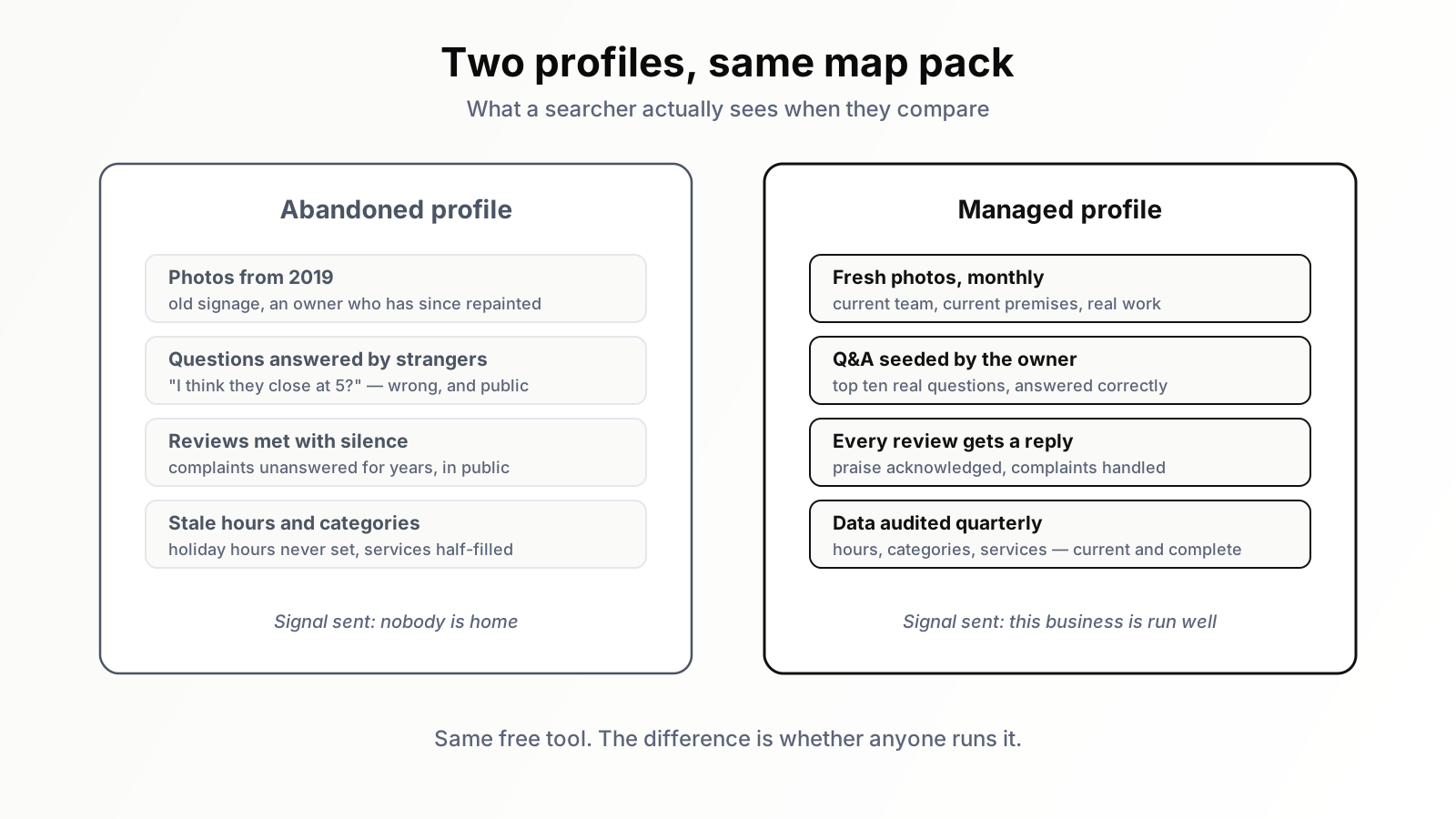
The photo graveyard. Photos from an office you left, a team that has 60 percent turned over, a logo two rebrands old. Profiles with current, real photography get more clicks and calls — Google has published as much — and image recency is one of the easiest authenticity signals to maintain. The neglected profile instead documents, in pictures, exactly how long ago the company stopped paying attention.
The default category from 2019. The primary category is the strongest relevance lever on the entire profile, and most companies set it once at claim time, often choosing whatever broad option seemed closest. Meanwhile Google adds and refines categories continuously. The firm listed as "Consultant" while competing for "cybersecurity service" searches has handicapped itself with a single dropdown, and will keep paying that tax until someone looks.
The brand-search blind spot
Most of the discussion so far assumes discovery searches — a buyer looking for a category, not a company. But the profile's quietest job may be the one it does on your own name. Search any established company's brand and the knowledge panel built from its Business Profile occupies the right-hand column on desktop and the top of the screen on mobile: the photos, the rating, the reviews, the hours, the questions. Every prospect who was referred to you, every candidate researching the interview, every journalist checking a fact — they all see the panel before they see the homepage you spent six figures redesigning.
Now replay the inventory of rot through that lens. The prospect your best salesperson spent three calls warming up googles the company the night before signing and finds a 3.6 rating, two angry reviews with no reply, and a question — "is this company still in business?" — answered eleven months ago by a stranger. No campaign dashboard will ever attribute the deal that quietly dies there. Companies monitor their press mentions and their social sentiment while ignoring the one branded surface Google assembles for them and shows to everyone. If you measure nothing else about your profile, search your own brand on a phone you are not logged into and read what a stranger reads. That five-minute exercise has launched more profile-remediation projects than any audit deck.
The blind spot extends to employees. Profiles of multi-office companies routinely show one office thriving and another — the one that actually serves the searcher — looking derelict, because the claimed asset was only ever the headquarters listing. Branch offices accrete unclaimed duplicate profiles, created automatically from web data or by well-meaning staff, and those duplicates split your reviews and confuse both users and ranking systems. Part of owning the asset is owning all of it: claim every location, merge or remove duplicates, and manage the estate from a single organisation account with proper access control rather than the personal Gmail of someone who left in 2022.
Posts, updates, and the difference between active and busy
One module deserves a more nuanced verdict than simple neglect-shaming: Google Posts, the updates feed on your profile. The neglected profile has never published one; the overcorrected profile publishes filler three times a week because a blog post somewhere said frequency matters. Both miss the point. Posts are not a ranking lever of any documented consequence — they are a conversion surface, a few square centimetres of pixels shown to a buyer at the moment of comparison. The question for any post is not "have we posted this week?" but "would a person deciding between us and two competitors find this useful?"
Useful, in practice, means: a new service or capability with concrete details, a price or availability change, a genuinely substantive piece of content the buyer segment cares about, an award or certification with verifiable substance, seasonal hours. A monthly rhythm of that quality outperforms a weekly rhythm of motivational filler, because the surface is small and every slot of it either builds the case for choosing you or dilutes it. The same editorial bar applies to the offers and product modules in categories where they appear: populated thoughtfully they pre-answer sales questions; populated mechanically they read as the digital equivalent of a window display nobody has changed since winter.
There is a useful diagnostic hiding in this distinction. A profile can be busy without being active — stuffed with automated posts while questions go unanswered — and active without being busy, quiet for weeks but with every review answered within a day. Buyers and, increasingly, ranking systems can tell the difference, because one pattern correlates with a functioning business and the other with a marketing automation left running. Optimise for the signals that require a human to have actually paid attention.
The neglect is rational — and that is the indictment
Here is the uncomfortable part of the critique: from inside each company, the neglect almost makes sense. The profile produces no alerts. Its performance reports live in a console nobody opens. Its decay is gradual and invisible — there is no moment when the profile breaks, only a slow leak of calls that go to the competitor whose listing said "open" and had photos from this year. Attribution systems make the blindness worse: a customer who found you in the local pack, called from the profile, and never visited the website appears in no analytics property anywhere. The channel is invisible precisely where decisions about channels get made.
So the asset that influences the most commercially decisive search surface — the moment a buyer compares three providers on a map — is governed by less process than the company applies to its email signatures. That is not a tooling failure. It is a management failure, and it has a management solution: an owner, a cadence, and a number someone has to report. The companies that do this are not heroically diligent. They have simply noticed that the profile is a page with more qualified viewers than most of their website, and they staff it accordingly.
What the cynics get wrong
A fair critique should engage the strongest counterargument, which goes like this: "Local results are pay-to-play now anyway, Google keeps inserting ads above the pack, and AI answers will eat the clicks regardless. Why polish a listing on someone else's platform?" Three answers.
First, the data disagrees about decay. Local pack interactions — calls, direction requests, bookings — remain among the highest-intent actions in all of search, because the searcher's need is immediate and geographic. Ads sit above the pack, but ad blindness is real and the pack retains its pull precisely because users know it is review-ranked rather than purchased.
Second, the zero-click objection cuts the other way. Yes, many local searches resolve without a website visit — the user sees your profile, calls, done. That is not a lost click; it is a conversion that skipped your website. The right response to zero-click behaviour is to make the surface where users actually convert as good as the destination they no longer visit, an argument we have made before in zero-click search doesn't mean zero value. The profile is the zero-click landing page. Companies that obsess over landing-page conversion rates while ignoring the profile are optimising the page fewer buyers see.
Third, AI answers raise rather than lower the stakes. When an assistant composes "here are three well-regarded firms in your area," it is weighing exactly the data the neglected profile lacks: review volume and sentiment, category precision, operational signals, consistency between the profile and the website. You cannot pay your way into a machine-generated recommendation. You can only be the entity whose data made the recommendation easy.
The spam next door
There is a second species of neglect worth naming: tolerating the spam that outranks you. Local results remain infested with profiles whose "business name" is a keyword salad — "Plumber Near Me Cheap 24/7 Best" — because the business name field is one of the strongest ranking inputs and Google's enforcement, while real, is reactive. Stuffing your own name violates Google's guidelines and risks suspension, and you should not do it. But the inverse is also operationally true: you are allowed to report competitors who do, through the suggest-an-edit flow and Google's formal redressal channels for fraudulent profiles, and cleaned-up results pages have a way of promoting whoever was playing honestly. Most companies have never once audited the pack they are trying to rank in. The neglected profile and the unreported spammer are two halves of the same passivity.
While auditing, look also at what the winners in your pack are doing mechanically: their primary category, their review reply rate, their photo recency, the services they list. The local pack is one of the few ranking environments where your competitors' entire strategy is publicly inspectable, field by field. Treat it as the free competitive intelligence it is.
Thirty minutes a week: the entire fix
Because the bar is so low, the remediation plan fits in one paragraph each for setup and cadence — and this is the part to actually steal.
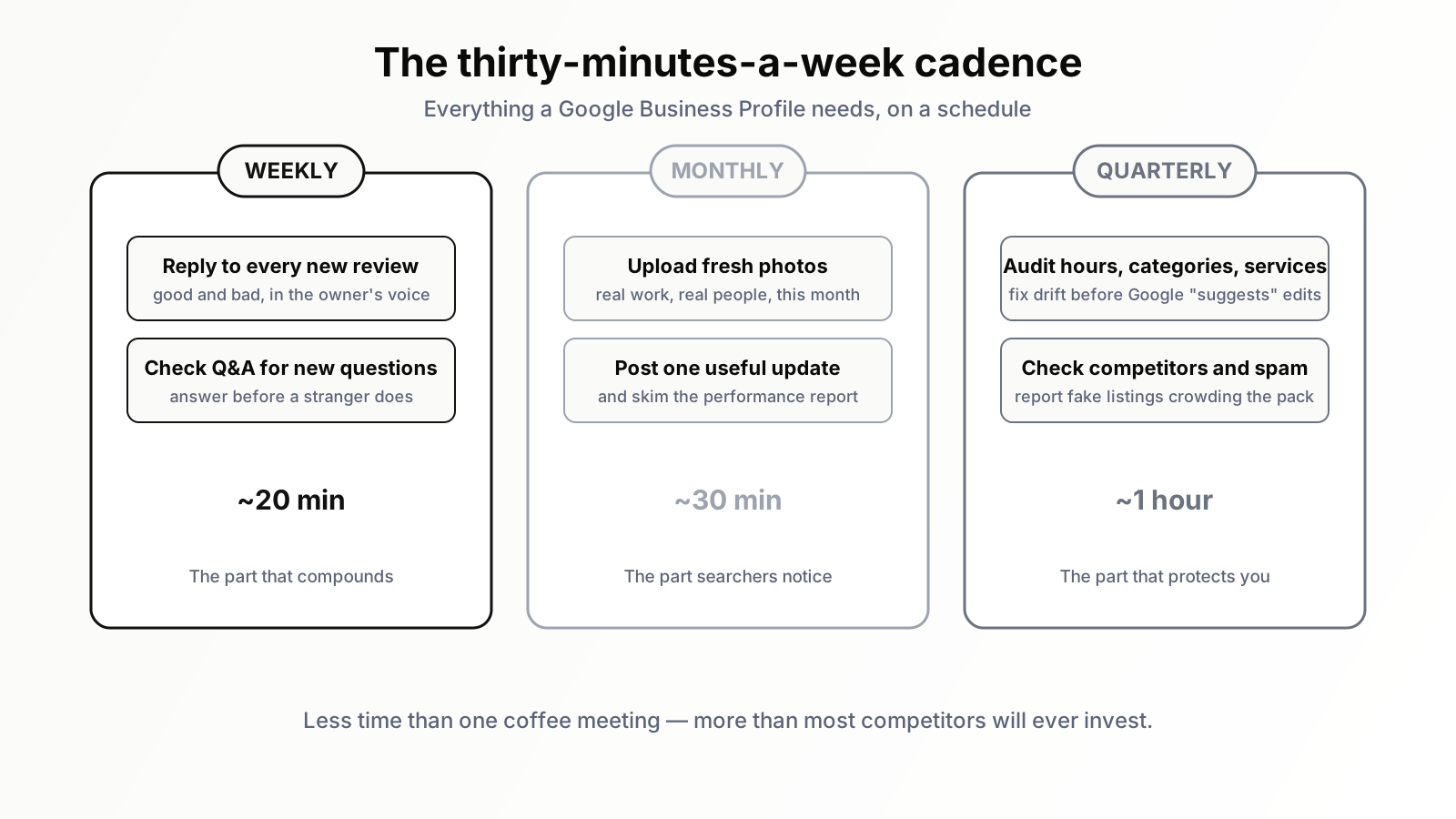
Once, this quarter: verify ownership and remove ex-employees from access. Re-choose your primary category as the most specific available match, checking what top-ranking competitors use. Complete every field — services, attributes, description, hours including holidays. Replace all photography older than the current team and office. Seed the Q&A with your ten most common pre-sales questions and answer them as the business. Set the profile's website link to your most relevant local landing page with UTM tagging so the traffic is visible in analytics — if your site lacks proper location pages, our guide to local SEO for SaaS and service businesses covers what a legitimate one contains. Confirm your name, address, and phone match your website exactly, and mark the page up with LocalBusiness schema.
Weekly, forever: reply to every new review, answer every new question, and glance at the profile data for unauthorised "suggested edit" drift. Monthly: add a genuine photo or two, post one update that a real prospect would find useful, and read the performance report — searches, calls, direction requests — so the channel has a number attached. Quarterly: re-audit categories, hours, and the competitive pack. That is the whole program. It is unglamorous, it requires no budget approval, and in most categories it clears 80 percent of competitors within two quarters, because they are all still at stage two of the claim-and-abandon lifecycle.
One more habit separates teams that sustain this from teams that relapse: put the profile's numbers in the same monthly report as the website's. The moment "calls from profile: 47, up from 31" sits next to organic sessions in a deck that leadership reads, the asset stops being invisible and the half-hour stops being negotiable. Channels survive in companies when they have a number and an owner; the profile has spent a decade having neither, and that — more than any algorithm — is why it rotted.
And if you operate in Vietnam or any market where messaging apps dominate, note that the profile's chat and call affordances are often the first contact channel a mobile searcher uses. The buyer does not bookmark your site for later; they tap the call button in the pack while standing in the problem. Every field that decides whether that tap happens — rating, reply tone, photos, "open now" — is a field someone either maintained this month or did not.
The cheapest ranking asset will stay cheap until everyone reads this
Every era of search has a moment where an asset is mispriced — where the effort required is wildly below the value returned, because attention has pooled somewhere more fashionable. Schema markup had that moment. Topical authority had it. Google Business Profile is having a long one right now, sustained by the collective decision of entire industries that a free, high-intent, machine-readable storefront is beneath their attention. The mispricing will not last forever; the AI-answer era is already forcing companies to care about structured entity data, and the profile is the front door of that data.
Until then, the playbook is embarrassingly simple: assign an owner, run the half-hour cadence, and let your competitors keep their photo graveyards. The honest difficulty is not knowing what to do — it is that recurring half-hour tasks are exactly what slips when the team is busy, which is where tooling earns its place. Orova keeps the recurring side of your search presence on rails — tracking how your local pages perform, surfacing the brand and geographic queries your profile should be answering, and turning "someone should check that" into a scheduled task instead of a hope. The profile is free. The discipline is the price. Pay it, because right now almost nobody else in your category is.
Run your business with AI Agents
Orova is the always-on Biz AI Agent — it plans, runs, and optimizes the work for you. Save time, unlock productivity.
Try it free