
Hreflang: How to Set It Up and the Errors That Break It
You built an English site, translated it into Vietnamese, French, or Spanish, and published everything under the same domain. Weeks later, Google is still showing your English homepage to French visitors, your Vietnamese pages are barely indexed, and search traffic from other countries hasn't moved at all. This is one of the most common headaches in localized SEO: the content exists, but search engines have no idea which version belongs to which audience.
The usual fix people try is adding more translated pages, or dropping a language switcher on the site and hoping search engines figure out the rest. That doesn't work, because Google needs explicit signals about which page serves which language and country — without those signals, it often ignores your translated content entirely or shows the wrong version to the wrong visitor. The stakes are only getting higher: SparkToro found that 68% of US Google searches in the first four months of 2026 ended without a click, up from 60% in 2024, which means the few clicks search engines do send to the right page matter more than ever. Most business owners don't realize this is a structural, technical gap, not a content or translation problem.
This article walks you through fixing that gap in plain terms: how to organize a multi-country website so search engines and visitors both find the right page, how to signal language and region correctly, and how to avoid the small mistakes that quietly break international visibility. By the end, you'll know exactly how your site should be structured and what's missing on it right now.
Hreflang: What It Does and How to Set It Up
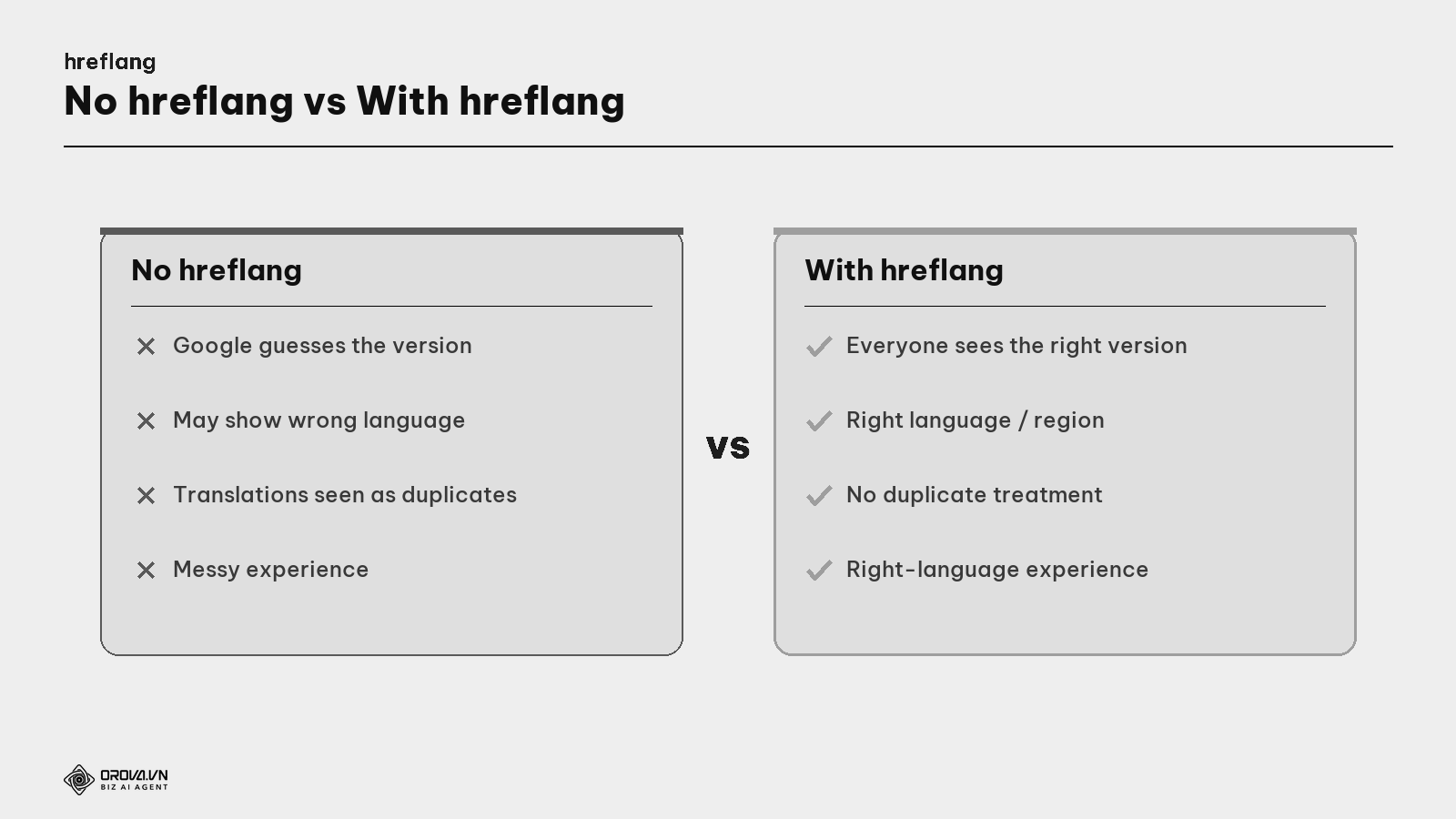
Hreflang is a tag that tells Google which language and country version of a page to show which visitor. Without it, your Vietnamese page can outrank your English one for English searchers, or Google picks one version and ignores the rest.
Where it goes: in the head of each page, in your XML sitemap, or in HTTP headers. Pick one method and use it everywhere — mixing them is a common cause of failure.
The rules that trip people up. Every page must list every version including itself. The tags must be reciprocal: if page A points to B, B must point back to A. Language codes use ISO 639-1, region codes use ISO 3166-1 Alpha 2, and the order is language-region — en-GB, never gb-en. Add an x-default for visitors matching nothing.
To verify: Search Console's International Targeting report shows errors across the whole site, and it is the only check that reflects what Google actually parsed.
The harder decision comes before any of this: whether to translate a page or rewrite it for the new market. The rest of this article covers that, with the site structures that follow from each choice.
Handing the English menu to a Vietnamese guest
Imagine a restaurant with two menus: one Vietnamese, one English. A Vietnamese guest walks in, but the waiter hands them the English one by mistake. The guest is confused, can't read it smoothly, orders the wrong thing, maybe leaves. The food is just as good — but handing the wrong version ruined the experience. Worse, if the two menus are mixed up with no labels, the waiter just hands one at random — sometimes right, sometimes wrong.
A website with multiple language versions hits exactly this. You translate articles into Vietnamese, English, Japanese... but if you don't "tell" Google which version is for whom, Google hands the wrong menu: showing the English version to someone searching in Vietnamese, or worse, treating the translations as duplicate content and picking only one. The "label saying which menu is which language" in SEO is hreflang.
This guide shows how to hand the right menu: what international SEO is, what hreflang does and how to write it (with real code), the "tags must reciprocate" rule, common hreflang errors, the three multi-country site structures, language-region codes, translation vs localization, and the rollout process.
What is international / multilingual SEO? The part of SEO that serves the right content to the right language/country. "Multilingual" = many languages (Vietnamese, English, Japanese...); "international/multiregional" = targeting many countries (e.g., English for the US vs the UK). The goal: every searcher sees the right language/region version for them.
What hreflang does, and how to write it
What is hreflang? An attribute you add to a page telling Google: "this page has different language versions; here's the list of which is for which language/region". Thanks to it, Google shows the right version to the right searcher — the Vietnamese version to Vietnamese searchers, English to English searchers.
The most common way is placing link tags in <head>, each pointing to a version. Example of a page with Vietnamese, English, and a default version:
<link rel="alternate" hreflang="vi" href="https://orova.vn/vi/seo" />
<link rel="alternate" hreflang="en" href="https://orova.vn/en/seo" />
<link rel="alternate" hreflang="x-default" href="https://orova.vn/en/seo" />
What is x-default? A special hreflang value marking the default version — the one Google shows when no language version matches the searcher. Often used for a language-picker page or the most common language version (e.g., English).
You don't need to write it by hand if your site uses a supporting platform (WordPress + a multilingual plugin, or an auto-generating system like Orova). What matters is understanding what it does and testing it's correct.
The golden rule: tags must "reciprocate"
This is the most-mistaken rule, and the number-one reason hreflang "doesn't work".
What is bidirectional (two-way reciprocity)? The rule: if page A points hreflang to page B, then page B must point back to page A. Each version must list all versions (including itself). Like two people both nodding to confirm "we are versions of each other"; missing one direction, Google ignores the whole cluster.
The practical upshot: every language version of a page must contain the same set of hreflang tags listing all versions. Missing one return direction and Google won't trust it and ignores it.
Common hreflang errors
hreflang is famously "fiddly" because it's easy to get wrong in small places. Here are the most common errors.
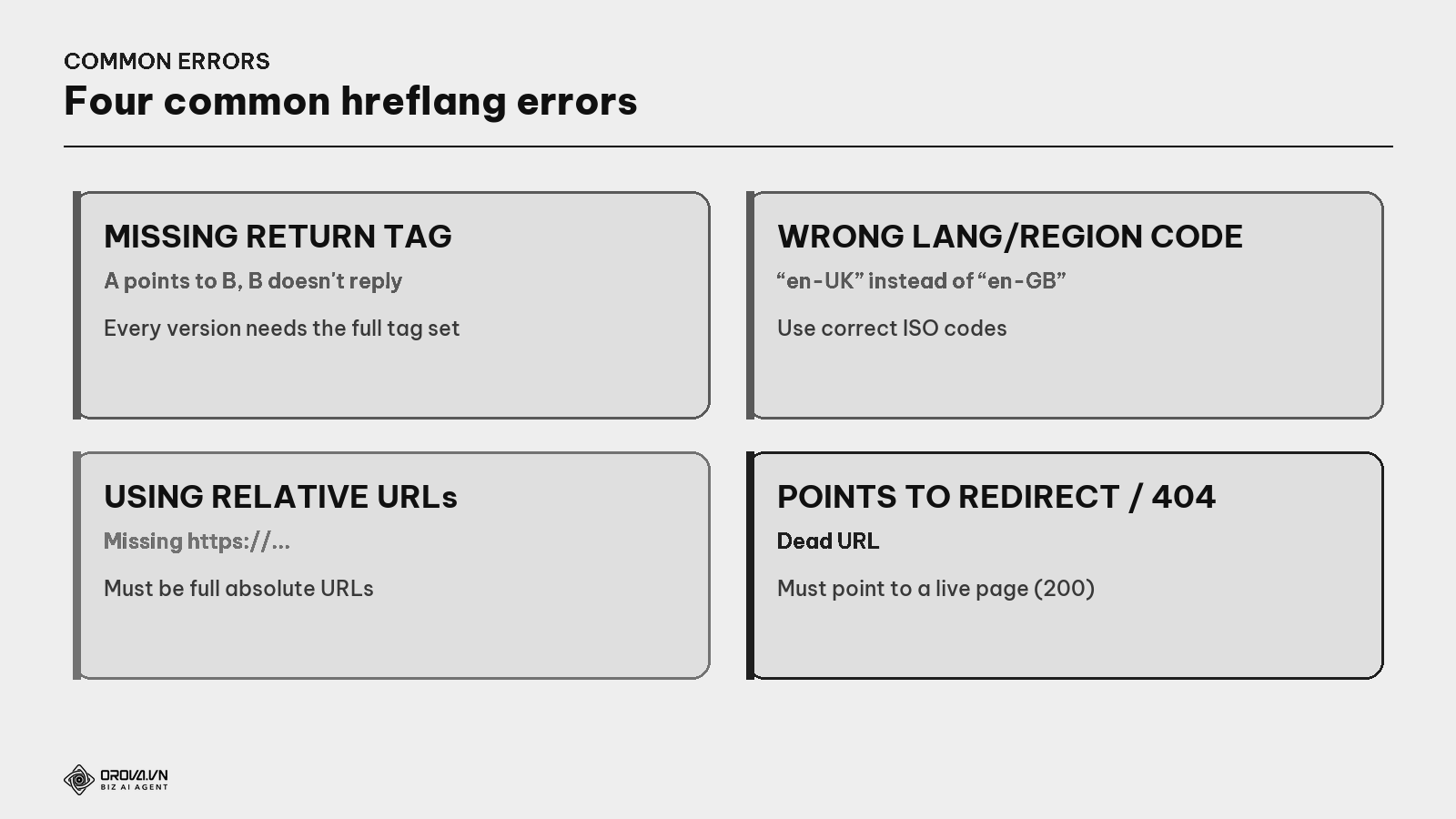
- Missing return tag — A points to B but B doesn't point back to A. The most common error; fix by having every version contain the full tag set.
- Wrong language/region code — writing
en-UK(wrong) instead ofen-GB(correct per the standard). You must use the correct standard code. - Using relative URLs — hreflang needs full absolute URLs (with
https://...), not shortened paths. - Pointing to a redirect or 404 — every URL in hreflang must be a live page returning 200, not redirected or erroring.
Organizing a multi-country website: three structures
Before hreflang, you must decide where to put the versions. There are three structures, each with trade-offs.
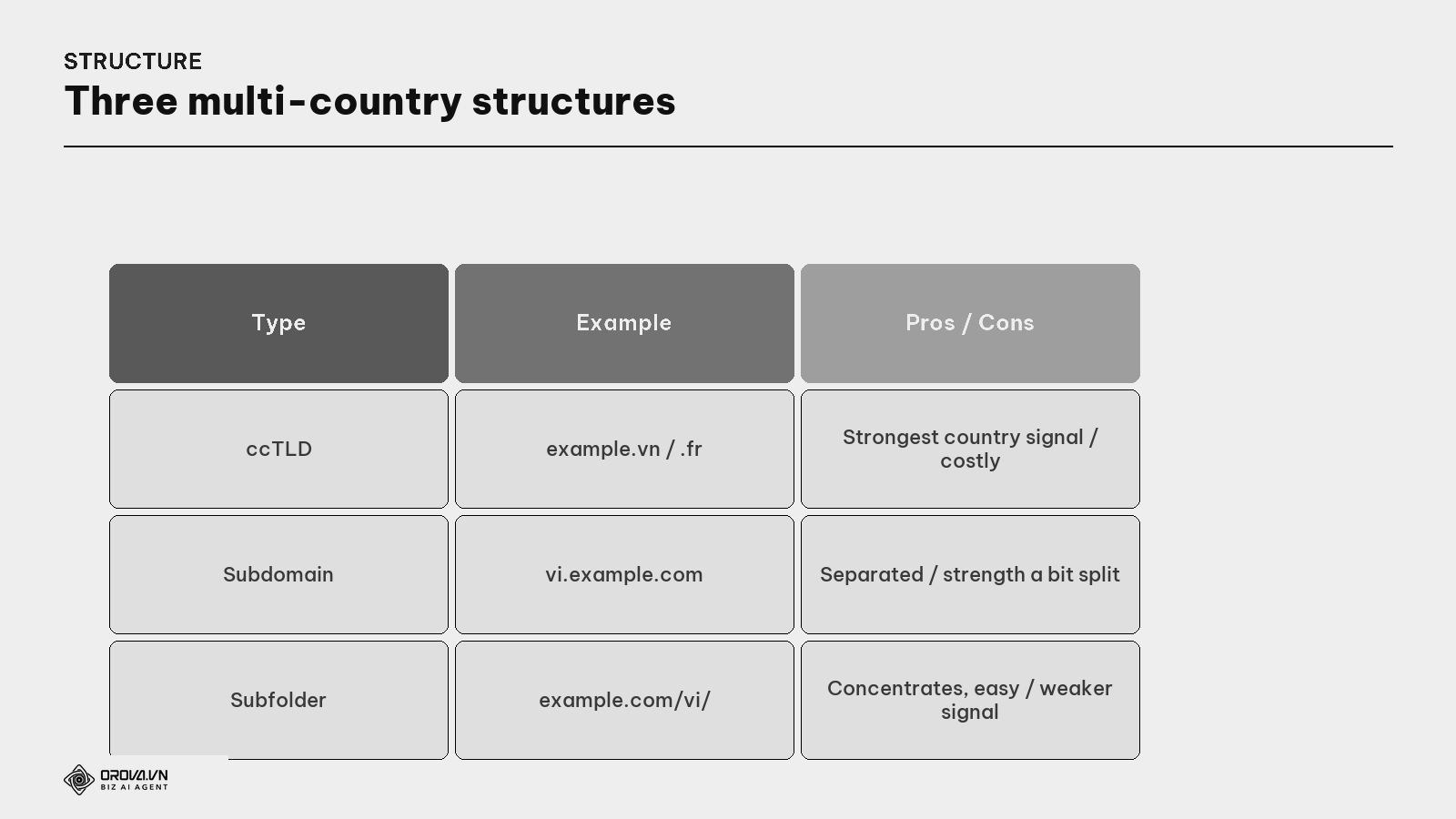
What is a ccTLD? A "country-code top-level domain" — a country-specific domain ending (
.vn,.fr,.jp). Gives the strongest geo signal but is costly and hard to manage across many sites.What are subdomain & subfolder? A subdomain is
vi.example.com; a subfolder isexample.com/vi/. Subfolder is usually recommended for most cases because it concentrates all SEO strength on one domain and is easiest to manage.
For most businesses, subfolder (example.com/vi/, /en/) is the most balanced choice — it's also what Orova uses.
Language & region codes: write them right
hreflang uses standard codes; writing them wrong breaks it. Understanding the code structure avoids errors.
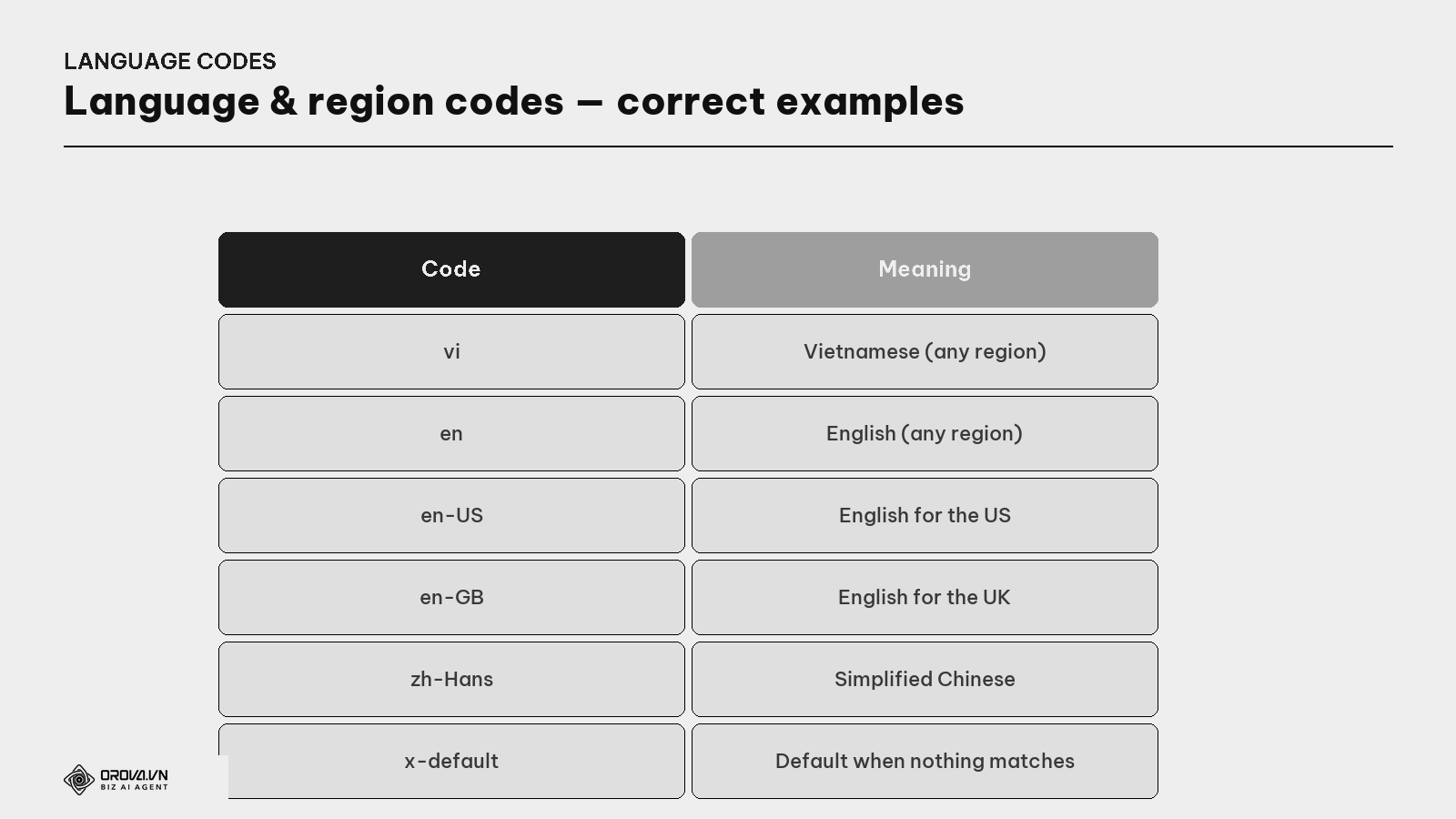
- Language only:
vi,en,ja— when not distinguishing by country. - Language + region:
en-US,en-GB,pt-BR— same language, different country. - Language code per ISO 639-1, region code per ISO 3166-1 (e.g., the UK is
GB, notUK).
Tip: if you split only by language (not country), just use the language code (
vi,en). Only add a region when you genuinely have different content per country in the same language.
Translation vs localization: more than swapping words
A good language version doesn't stop at mechanical translation.
What is localization? Adapting content to the culture/market — not just translating words, but changing currency, examples, dates, phrasing, even images. A mechanical translation reads stilted; a localized version reads like it was written for people in that market.
Translation is necessary; localization is what makes a language version truly serve native readers. Avoid crude machine translation published en masse — it's low-quality content that can be seen as spam.
The multilingual SEO rollout process
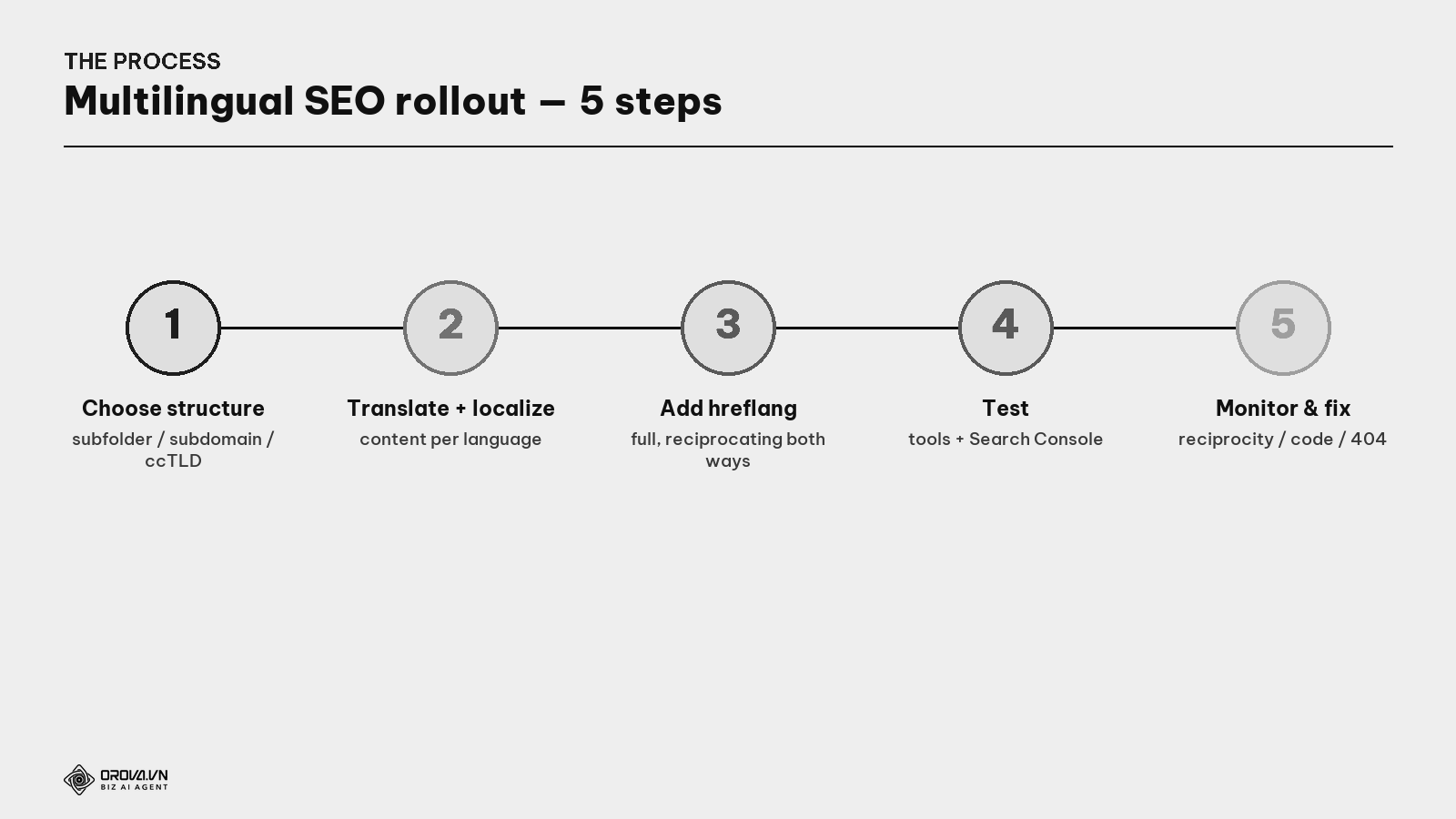
- Choose the structure (most should use subfolder).
- Create translated + localized content per language/region (no crude machine translation).
- Add full hreflang — every version contains the same tag set, reciprocating both ways, absolute URLs, with
x-default. - Test with an hreflang tool and the report in Google Search Console.
- Monitor & fix — catch missing return tags, wrong codes, 404 pointers.
"Pass" standard
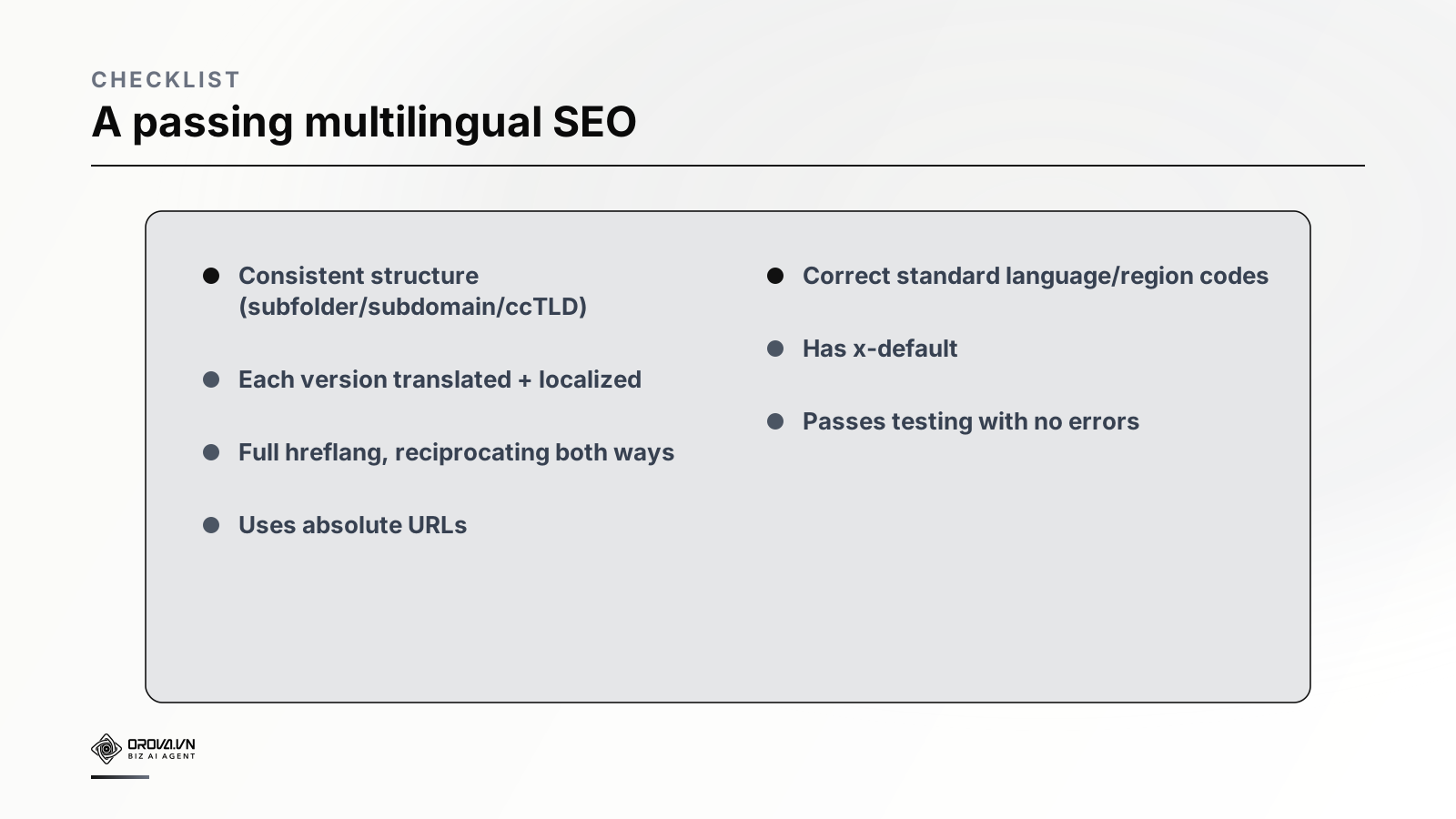
"Pass" standard: the website has a consistent multi-country structure; each language has content translated and localized (no crude machine translation); hreflang is added fully on every version, reciprocating both ways, with absolute URLs, correct standard codes, and
x-default; and it passes testing with no errors. At this level, Google always "hands the right menu" — everyone finds their language version, and translations aren't treated as duplicates.Benefit: doing multilingual SEO right lets you expand into many markets without competing against yourself. Each language version serves the right audience (better experience, lower bounce), Google doesn't confuse the versions, and each version's SEO strength counts correctly for its market. It's the foundation for good content to reach the whole world instead of being stuck in one language.
FAQ
What if I don't add hreflang? Google may still guess the language, but it easily guesses wrong (showing English to a Vietnamese searcher) and risks treating translations as duplicate content. hreflang is the sure way for everyone to see their right version.
Does hreflang help rankings? Not directly. It doesn't raise rankings, but ensures the right version shows to the right person — improving experience and avoiding versions competing/being seen as duplicates. The benefit is indirect but important for multilingual sites.
What's the most common hreflang error? A missing "return" tag — A points to B but B doesn't point back. Then Google ignores the whole cluster. Ensure every version contains the same tag set listing all versions.
Which structure: ccTLD, subdomain, or subfolder?
For most businesses, subfolder (example.com/vi/) is most balanced: concentrates SEO strength on one domain, easy to manage. ccTLD (.vn, .fr) gives the strongest country signal but is costly — only worth it if you truly run separate large markets.
Can I use machine translation? For drafting, yes, but a human must verify and localize it. Publishing crude machine translations en masse is low-quality content that Google may demote (see the AI Content guide).
Is the code en-UK correct?
No. The UK region code per standard is en-GB (ISO 3166-1), not en-UK. Using the wrong code makes hreflang ineffective for that region.
When do I need x-default? When you want to specify a default version for searchers who don't match any language/region in the list (e.g., someone in a third country). Usually points to a language-picker page or the most common language version. Highly recommended for multilingual sites.
Back to the wrongly handed menu
Remember the restaurant handing the English menu to a Vietnamese guest? The food was still good, but handing the wrong version ruined the experience — the guest confused, ordering wrong, maybe leaving. The problem wasn't the food, but not knowing which menu to hand to whom.
hreflang is the label that helps Google "hand the right menu" to each guest. You can translate content into ten languages, but if you don't say clearly which version is for whom, Google hands one at random — ruining the experience and making versions compete. Label it right: choose a clean structure, translate and localize properly, add full hreflang reciprocating both ways, with correct codes. Do that, and every guest entering your "restaurant" gets the right menu in their language — and that's how good content can serve the whole world.
This article is part of Orova's complete SEO guide series. It's a deep-dive within the cluster — see "Technical SEO", "Site Architecture & URL", and "Using AI to Write Content" for the full picture. Get started with Orova at orova.vn/en/seo.
Sources
Google Search Central (hreflang, language/regional versions, x-default, multi-country URL structures) · Google Search Console (International Targeting report) · Ahrefs & Semrush (common hreflang errors & implementation).
Getting Your International Pages Seen — Without the Manual Guesswork
Setting this up properly means auditing every page, matching language versions to each other correctly, writing the technical tags by hand, and checking them repeatedly as your site grows. Even for a modest multi-country site, this becomes a recurring task — one missed or mismatched tag can quietly undo all the work you put into translation.
Orova SEO is built to handle this kind of ongoing technical upkeep automatically, so you don't have to manually track and fix these signals every time you add or update a page. If you're managing content in more than one language, it's worth taking a look at how it works.
Let Orova SEO handle the repetitive part
Keyword research, drafting, refreshing old posts and rank tracking — running automatically on your own site.
Explore Orova SEO