
AI Marketing Platform: What They Do and How to Compare
You ask your marketing team what the new AI marketing platform is actually doing, and you get the same fuzzy answer every time: "it's automating things." Automating what, exactly? Deciding what, based on what, and asking your permission when? Nobody on the team can walk you through an actual day, and that makes it very hard to trust the thing with your ad budget.
This is not your team's fault. Most explanations of AI marketing tools stop at the sales-pitch level — "smart," "autonomous," "24/7" — without ever showing what the software actually reads, decides, or types out on a normal Tuesday. When you cannot picture the daily work, you cannot judge whether it is doing something useful or just quietly spending money in the background, and that fog is exactly why so many business owners stay nervous about handing over control. The stakes are only getting higher: 68% of US Google searches in the first four months of 2026 ended without a click at all, up from 60% in 2024, according to SparkToro, which means the platform's daily decisions now matter far more than the traffic they used to reliably generate.
This article removes that fog. We walk through one full working day of a marketing platform, step by step, in plain language — what it checks first thing, how it decides what matters, what it drafts on its own, what it is allowed to launch without asking, and where it stops and waits for a human to say yes. By the end, you will be able to look at any AI marketing platform and ask the right questions, instead of nodding along to "it automates things."
AI Marketing Platforms: The Categories and How They Differ
The label covers several very different products. Sorting them makes comparison possible.
Content platforms generate and optimise copy, articles and ad creative. You review and publish. Analytics platforms pull data from your channels and surface patterns a person would take days to find. Automation platforms trigger actions from rules you set — a follow-up email, a paused campaign. Agent platforms are the newest: they decide what to do and do it, within limits you define.
What to check before buying, in order of how often it gets overlooked: does it connect to the channels you actually use; does it act or only advise; can you see and reverse what it did; and where does your data go.
The one that matters most is the third. A platform that acts without a visible log and an undo is a platform you cannot safely leave running.
The rest of this article follows one through an ordinary working day — what it checks, what it changes, and what it hands back to a person.
Before sunrise: the data sync
An agent's day begins where every good marketing decision begins — with data, and with the unglamorous work of collecting it. Overnight, while the team sleeps, the agent pulls fresh data from every system it is connected to: Search Console queries and impressions, analytics sessions and conversions, ad platform spend and results across each connected account, rankings, crawl status, and whatever else its integrations cover.
This sounds trivial. It is not. Anyone who has assembled a weekly report by hand knows that the data-gathering step quietly eats hours: logging into five platforms, exporting five CSVs, reconciling five different definitions of "conversion," and fixing the date ranges that never quite line up. The agent does this every single day, without drift, and — more importantly — it normalises the data into one model. Spend from the ad platform, sessions from analytics, and queries from Search Console end up describing the same campaigns and the same pages, joined together, so the next steps can reason across them instead of across disconnected exports.
There is a second thing happening during the sync that humans rarely do at all: the agent checks the data itself for problems. A tracking tag that silently stopped firing, a connected account whose token expired, a feed that returned half the usual rows — these are the failures that corrupt weeks of human decisions because nobody notices them. An agent that validates its inputs every morning notices them in one day. In our experience this single behaviour — boring, invisible, entirely unintelligent — pays for a lot of the more glamorous work downstream, because every later decision is only as good as the data underneath it.
Early morning: the anomaly scan
With fresh data in hand, the agent does its first genuinely analytical pass of the day: it looks for things that changed. Not everything that changed — everything changes daily, that is what noise means — but things that changed beyond their normal range.
This is a statistical job, not a magical one. For every metric the agent tracks — clicks to a page, spend on a campaign, conversion rate of an ad set, impressions for a query cluster — it knows the recent distribution: the average, the variance, the weekly seasonality (Mondays are not Sundays). An anomaly is a value that falls far enough outside that distribution to be worth attention. A page whose clicks dropped forty per cent against its own Tuesday baseline. A campaign whose cost per result doubled overnight. A query cluster whose impressions are suddenly climbing — which is an opportunity-shaped anomaly, not a problem-shaped one, and a good agent flags both.
Compare this with how human teams catch the same events. Mostly they don't, until the weekly meeting, or the monthly report, or a stakeholder asks an awkward question. The dashboard has displayed the drop since the day it happened — dashboards are honest — but display is not detection. Somebody has to look, at the right chart, with the right comparison window, on the right day. An agent looks at every chart, with every comparison window, every day. The difference is not intelligence; it is coverage and constancy. We wrote more about why this gap exists in our piece on impressions rising while clicks stay flat — a pattern that sits invisibly in Search Console for months precisely because no human is paid to stare at that ratio daily.
Mid-morning: prioritisation, or deciding what deserves attention
The anomaly scan typically surfaces more items than anyone should act on. A naive system forwards all of them and becomes an alert cannon that the team learns to ignore within two weeks. A useful agent does what a competent senior marketer does with a long list of problems: it triages.
Triage means scoring each finding on two axes. First, impact: how much money or traffic is at stake? A conversion-rate dip on a page that gets thirty visits a month is a footnote; the same dip on your top commercial landing page is an incident. Second, confidence: how sure is the agent that the signal is real and the cause is identifiable? A clean, well-attributed drop with an obvious cause ranks higher than a fuzzy wobble that might be seasonality.
The output of this step is the difference between an agent and an alarm. An alarm says "metric X crossed threshold Y" and leaves the thinking to you. An agent says: here are the three things that matter today, in order, here is why each one matters in expected traffic or spend, and here is what I propose to do about each. Everything else from the scan is logged but not escalated. Protecting the team's attention is part of the job — arguably the part that determines whether the team keeps using the agent at all.
Late morning: drafting actions, not just observations
Here is where agents earn the name. Analytics tools, even very good ones, stop at observation: this dropped, that rose, here is a chart. An agent continues into the next sentence — the one humans had to write themselves until now: therefore, do this.
Concretely, "drafting an action" means producing a fully specified, executable change, not a vague suggestion. The difference matters enormously in practice. "Consider improving the meta description" is a suggestion; a drafted action is the new meta description itself, written, character-counted, attached to the exact page, ready to apply. "The budget on this campaign is underdelivering" is an observation; a drafted action is "raise the daily budget on campaign A from X to Y, because its cost per result is 30 per cent below the account average and it has been limited by budget for six consecutive days — expected effect: roughly Z more conversions per week at similar efficiency."
Notice the three components of a well-drafted action, because they are the quality bar you should hold any agent to. One: the specific change, machine-precise, no ambiguity about what will happen. Two: the reasoning, in plain language, citing the data that motivated it. Three: the expected effect, stated in advance — which is what makes the action checkable later. An action without reasoning cannot be trusted; an action without a predicted effect cannot be verified. Agents that skip either component are not really agents; they are random buttons.
The range of actions varies by domain. On the SEO side of the house, a day's drafts might include title and meta rewrites for pages losing click-through, internal links from strong pages to a newly published cluster article, a fix for a crawl issue, or a content brief for a query cluster where impressions are growing but the site has no dedicated page — the kind of work we described in our explainer on SEO AI agents. On the ads side, drafts skew toward budget reallocations, pausing exhausted creatives, search-term exclusions, and bid adjustments — the daily grind covered in what an AI ads agent is. Same loop, different verbs.
Midday: the approval queue — where autonomy meets governance
Now the most important architectural fact about a well-designed marketing agent: it does not silently do everything it drafts. Between the drafting step and the execution step sits an approval queue, and the queue is not a limitation grudgingly accepted — it is the feature that makes the whole system deployable in a real company.
The reason is asymmetry of consequences. Marketing actions differ wildly in blast radius. Rewriting a meta description on a mid-tail blog post is low-stakes and trivially reversible. Tripling the budget on the account's largest campaign is neither. A sane deployment maps this asymmetry onto permission tiers: some action types may run automatically within guardrails, some always require a human click, and the team — not the vendor, not the model — decides which is which. Early in a deployment, almost everything goes through the queue; as the agent's proposals prove themselves, the team consciously widens the autonomous tier. Trust is granted incrementally, with evidence, exactly as it would be for a junior hire.
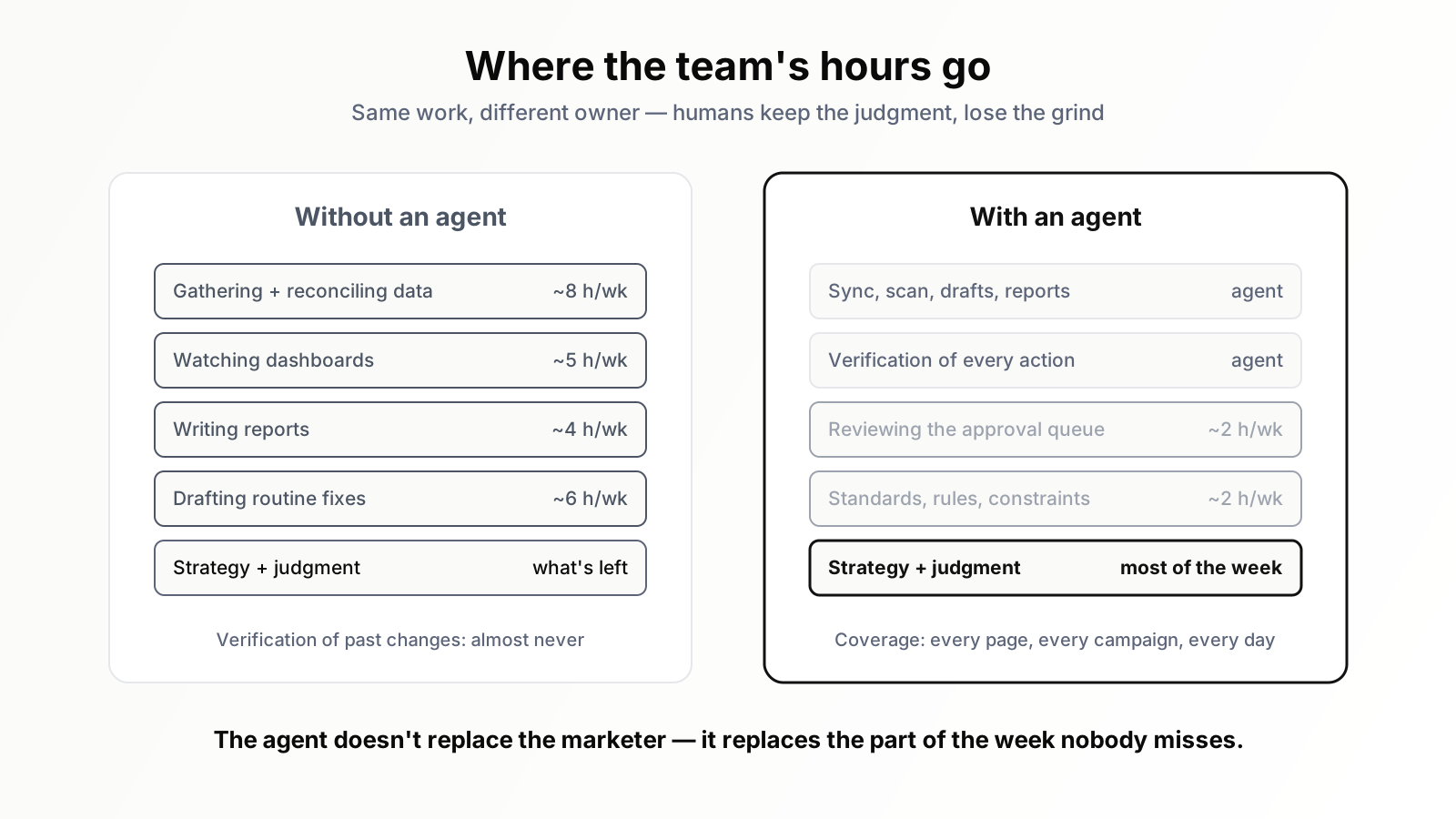
What does the human actually see at the queue? If the agent drafted its actions properly, each item reads like a one-paragraph memo: the change, the reasoning, the expected effect, and the option to approve, reject, or edit. A competent reviewer clears a typical day's queue over a coffee — minutes, not hours — because the agent already did the analysis and the writing. This is the honest division of labour: the machine does the reading and the drafting at a scale no human can match; the human contributes the judgment, the context the data cannot see ("legal asked us not to touch that page this week"), and the accountability. This is also where Orova planted its flag: both its SEO agent and its Ads agent for Google, Meta and TikTok run on a review-then-act model by default, precisely because an agent a team can supervise is an agent a team will actually use.
Rejections, by the way, are not waste. They are training signal. Every rejected proposal, especially one rejected with a reason, teaches the operator something about the boundary between what the agent sees and what the business knows. Teams that write one short sentence when they reject — "we never bid on competitor terms," "this page is mid-redesign" — end up with markedly better queues within weeks.
Early afternoon: execution
Approved actions get executed, and the execution itself is the least dramatic part of the day — which is exactly the point. The agent applies changes through the official APIs of each platform: ad budgets and statuses through the ad platforms' interfaces, content and metadata changes through the site's CMS connection. No browser puppeteering, no fragile screen-clicking, no shared passwords in a spreadsheet.
Three properties separate professional execution from a script someone wrote on a Friday. First, atomic logging: every change is recorded with what changed, from what value, to what value, when, on whose approval, and under which reasoning. The log is the institutional memory and the audit trail; six months later, when someone asks why a campaign's budget moved in April, the answer exists. Second, reversibility: because the previous value is logged, any change can be rolled back, and a serious agent treats rollback as a first-class action, not an apology. Third, rate discipline: real platforms have learning phases and review delays, and an agent that respects them — batching changes sensibly rather than thrashing a campaign with hourly edits — outperforms one that technically can act every minute and therefore does.
Mid-afternoon: verification, the step everyone forgets
Here is the question that separates a closed loop from an open one: after the change, did the predicted thing happen?
Human teams are structurally bad at this question, through no moral failing. The person who made a change in week one is buried in new work by week three, and revisiting old decisions is nobody's job description. So changes accumulate, their effects blur together, and the team's beliefs about "what works" drift away from evidence. An agent has no such excuse and no such drift. Every executed action carries its predicted effect, and the agent checks back — after a sensible interval that matches the action type, since rankings move in weeks while ad metrics move in days — and compares prediction with outcome.
Three results are possible, and all three are valuable. The prediction held: confidence in that action type rises, and the case for letting it run autonomously strengthens. The prediction failed: the action gets flagged, possibly rolled back, and — critically — the failure feeds back into how the agent scores similar proposals in future. Or the result is ambiguous, contaminated by some external event, in which case the honest answer is "cannot attribute," which is itself worth recording. Over months, this verification habit compounds into something rare: an empirical, written record of which marketing interventions actually work on your site and your accounts, rather than in someone's conference talk. We argued in our analysis of closing the loop between dashboards and decisions that this feedback step, more than the automation itself, is the real economic payload of agents.
Late afternoon: reporting that writes itself
Towards the end of the working day — the human one — the agent assembles the artefact that managers actually want: a brief, written account of the day. What changed in the numbers, what the agent proposed, what was approved and executed, what got verified and how it turned out, and what is waiting in the queue for tomorrow.
This sounds like a small convenience until you price the alternative. Reporting is one of the most quietly expensive activities in marketing — hours per week of screenshotting charts and narrating them, repeated across every account and every client. An agent generates the narrative from the same data model it works from all day, so the report is not a separate chore; it is a by-product. And it has a property human reports often lack: it is complete. It includes the rejected proposals and the failed predictions, because the log does not have an ego.
All day, underneath everything: learning the account
One more thread runs through the entire day without occupying any single hour: the agent is accumulating context. Which pages are the site's commercial core. Which campaigns are sacred and which are experiments. What the team rejects and why. What seasonality looks like in this niche. Which action types have a strong verified track record on this specific account and which keep failing.
This is what makes the difference between month one and month six of an agent deployment. In month one, the agent's proposals are generic best practice — correct, but the kind of correct any competent consultant produces on day one. By month six, a well-run agent proposes things that are correct for this business: it has rejection feedback, verification history, and a year's worth of the account's own rhythms behind every suggestion. Teams that treat the agent as a disposable tool never get there; teams that treat it as a junior colleague — reviewing its work, correcting it in writing, gradually extending its responsibilities — do.
What the agent does not do all day
An honest job description includes the gaps, and they are not small.
The agent does not set strategy. It optimises toward objectives someone gave it; deciding that the objective itself is wrong — that the company should chase a different segment, kill a product line, or reposition against a new competitor — requires context that lives outside any data feed. It does not know what your CEO promised the board, what your legal team is nervous about, or what your brand should never sound like, unless humans encode that. It does not invent positioning, taste, or creative direction; it can draft endlessly within a direction, but choosing the direction remains stubbornly human. And it does not carry accountability. When a budget decision goes wrong, "the agent did it" is not an answer any organisation accepts — which is, again, why the approval layer is not bureaucracy but the very thing that keeps a human's name attached to every consequential change.
It is also worth saying plainly: an agent with bad inputs has a bad day, at scale. If your conversion tracking lies, the agent optimises toward the lie faster than any human would. Deploying an agent raises, not lowers, the value of clean measurement — a theme we keep returning to in our guide to what SEOs should actually track in GA4.
The day, summarised — and what to do with this picture
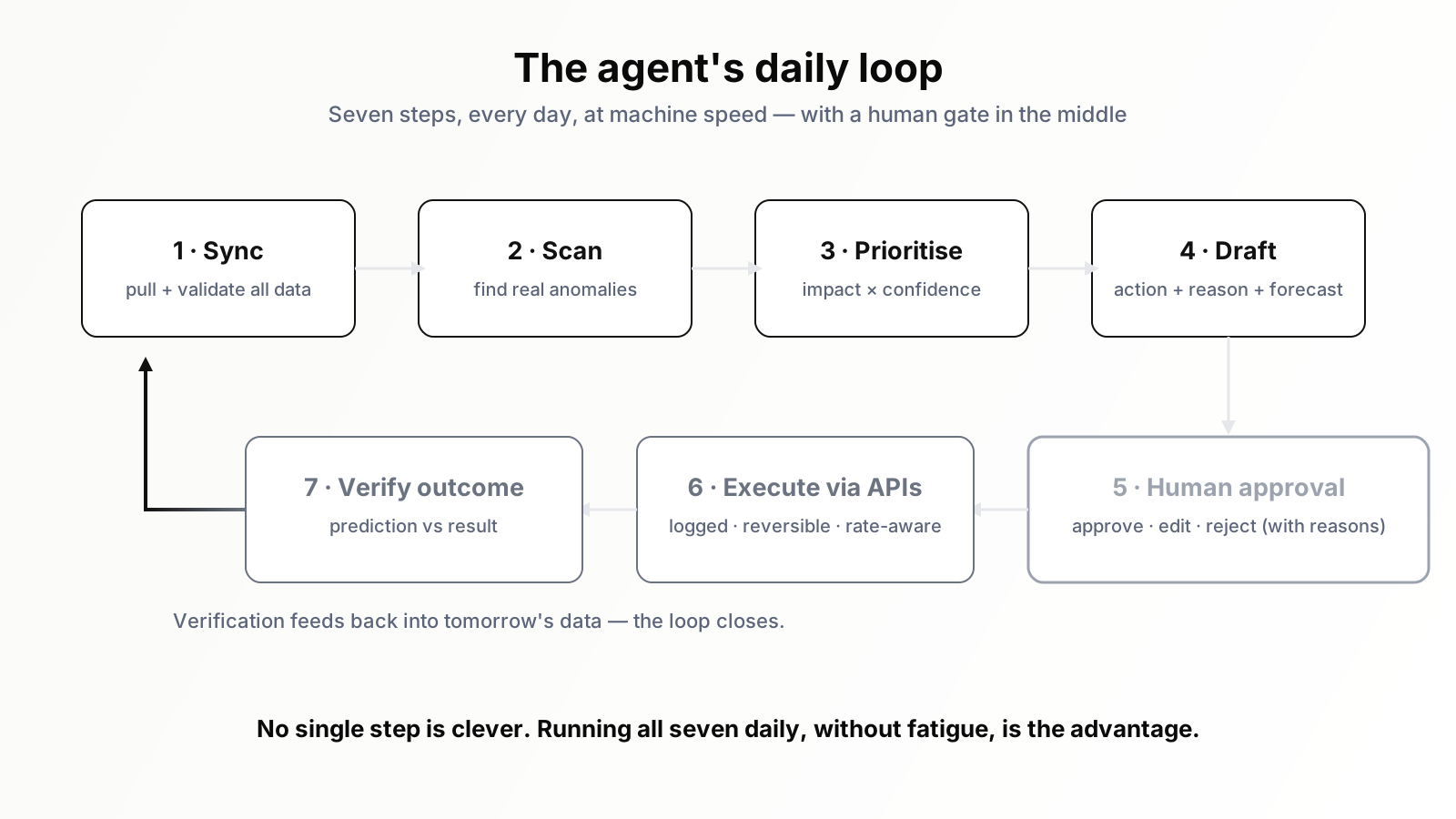
So: sync and validate the data; scan everything for real changes; triage to the few items that matter; draft fully specified actions with reasoning and predicted effects; queue them for human approval according to their blast radius; execute the approved ones through official APIs with full logging; verify predictions against outcomes; report it all in writing; and learn the account a little better than yesterday. That is the working day. No single step is miraculous. The compound of all of them, every day, without fatigue, is what no human team can replicate by trying harder.
If you are evaluating agents — or being evaluated against one — this hour-by-hour picture is your checklist. Ask any vendor, or any internal build proposal, to show you each step: where is the data validation, where is the triage logic, what does a drafted action contain, who approves what, where is the log, and who checks the predictions. Systems that can answer all of that are agents. Systems that cannot are dashboards with a chat box. Orova's agents were built to answer every one of those questions in the open — drafts, reasoning, approvals and verification all visible — because we think the only agent worth hiring is one whose working day you can audit.
Watching one day is useful — running it every day is the real work
Reading through a full day of this work makes one thing obvious: none of these steps are hard on their own, but doing them all, every single day, across every campaign, is where a human team quietly loses hours — checking numbers, spotting what changed, drafting the next move, then writing up what happened for the boss. Nobody has time to do that well and still run the business.
This is the part Orova SEO takes off your plate. It runs that same daily loop in the background — watching your numbers, flagging what needs attention, and preparing the next action for you to approve — so your team spends its time on decisions, not on checking dashboards. If that sounds useful, it's worth taking a look and seeing it work on your own data.
Let Orova SEO handle the repetitive part
Keyword research, drafting, refreshing old posts and rank tracking — running automatically on your own site.
Explore Orova SEO