
hreflang Without the Headache
There are two kinds of SEO professionals in the world: those who have implemented hreflang, and those who still sleep well at night. hreflang is the markup that tells search engines which language and regional version of a page to show to which searcher, and it has earned a reputation as the single most aggravating piece of technical SEO that does not involve a server log. People who calmly debug crawl budgets and shrug at canonical tags will quietly close their laptop and go for a walk when hreflang comes up.
This is unfair. Not because hreflang is easy — it is genuinely fiddly — but because the headache is almost entirely self-inflicted. hreflang punishes carelessness with a precision that feels personal, and once you understand the handful of ways it punishes you, the markup becomes merely tedious rather than maddening. Tedious is survivable. This is a guide to making your peace with hreflang, mostly by understanding why it keeps biting you.
What hreflang actually does, in one breath
Strip away the dread and hreflang does something simple. When you have the same page in several language and regional versions — English for the US, English for the UK, Spanish for Mexico, Spanish for Spain — hreflang is a set of annotations that says, on each version, "here are all my sibling versions, and here is which audience each one is for."
It does two useful things. It helps a searcher land on the version meant for them, so a Mexican reader gets the Mexican-Spanish page rather than the one written for Spain. And it tells search engines that these near-identical pages are deliberate regional variants, not duplicate content fighting each other for the same spot. That second job is why hreflang exists at all: without it, your carefully localised pages look, to a search engine, like the same content copied across folders, and they compete instead of cooperate.
That is the entire concept. It is not complicated. The complication is in the details, and the details are where the headache lives.
Headache one: the codes look easy and are not
An hreflang value is a language code, optionally followed by a region code. "Spanish" is one code. "Spanish as used in Mexico" is the language code plus the region code. Easy, you think, and then you discover the rules.
The language code and the region code come from two different standards, and they do not always look alike — sometimes the region code is not the obvious abbreviation you would guess. The language code comes first, the region second, never the reverse. The region part is optional; the language part is not. And there is the famous trap: the region code for the United Kingdom is not the one most people instinctively type, because the obvious two letters belong to a different country entirely. People get this wrong constantly, the entry silently fails, and they spend an afternoon wondering why the UK page will not behave.
The fix is unglamorous: do not type these from memory. Look every code up against the official lists, every time, and treat a code you "are pretty sure about" as a code you have not checked. hreflang gives you no error message for a wrong code. It just ignores the entry, and an ignored entry is an invisible failure — the worst kind.
Headache two: the relationship must be mutual, or it does not count
This is the rule that causes the most pain, and it is genuinely the heart of the hreflang headache.
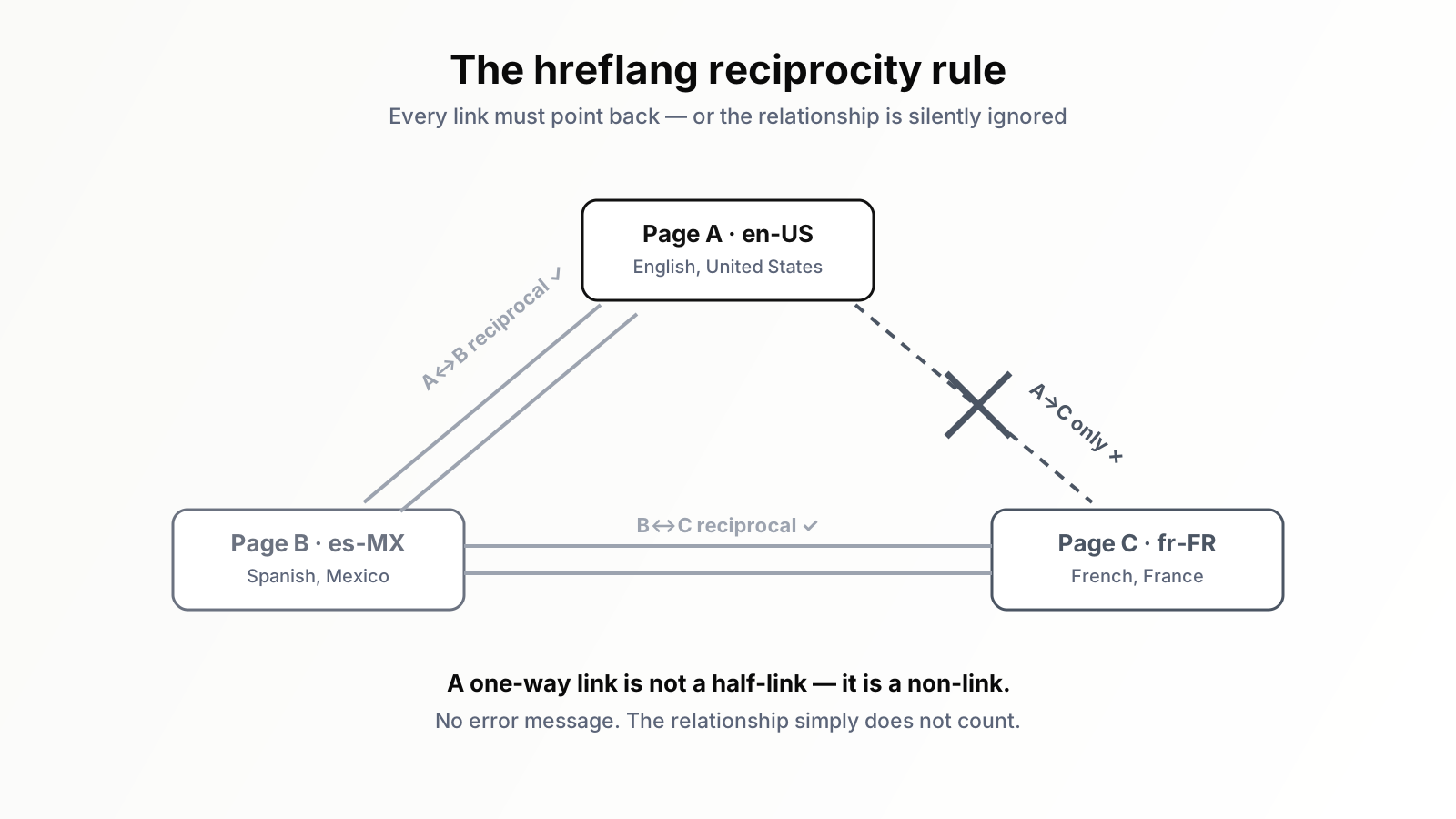
hreflang links must be reciprocal. If your English page declares the Spanish page as its Spanish sibling, the Spanish page must declare the English page as its English sibling in return. A one-way declaration — page A points at page B, but page B does not point back — is not a half-working link. It is a non-link. Search engines see the missing return reference and discard the whole relationship as untrustworthy.
This is why hreflang feels so brittle. With three language versions of a page, every version must reference all the others and itself, and every one of those references must be mirrored. Add a fourth language and every existing page must be updated to include it. Forget to update one, and you have a non-reciprocal link, and the relationship quietly breaks. The markup is not just detailed; it is interconnected, so a small omission in one corner degrades the whole set. Reciprocity is not a guideline you can mostly follow. It is a binary the markup either passes or fails.
Headache three: forgetting to point at yourself
A subtle one. Each page's hreflang set must include a reference to the page itself, not only to its siblings. The English page lists the Spanish page, the French page — and the English page. It feels redundant, like signing a letter you are mailing to yourself, and so people leave it out. Leaving it out breaks the set. Include the self-reference on every page. It is not optional, it is not redundant, and the markup will not forgive you for deciding otherwise.
Headache four: forgetting the searchers who match nobody
You have built versions for the US, the UK, Mexico, and Spain. A searcher in Germany, searching in German, matches none of them. What should they see?
hreflang has an answer: a default fallback version, declared with a special catch-all value, designated as the page to show anyone who matches none of your specific targets. People skip it, because it covers the audience they were not thinking about — and skipping it means a large slice of the world's searchers gets handed an undefined choice. Pick a sensible default, usually your primary or most universal version, and declare it. It is one extra annotation that closes a gap you would otherwise never notice was open.
Headache five: hreflang and canonical tags having an argument
Here is the contradiction that breaks more international setups than any code typo. A canonical tag says "this other page is the real version of this content; index that one instead." hreflang says "all these pages are legitimate regional versions; index each of them for its own audience."
Point the Spanish page's canonical tag at the English page and you have just instructed search engines to do two opposite things at once: index the Spanish page (hreflang) and do not index the Spanish page, prefer the English one (canonical). Faced with a contradiction, search engines tend to obey the canonical — and your Spanish page vanishes from results, and you cannot work out why because the hreflang looks perfect.
The rule is simple once stated: each market version should declare itself as its own canonical. The Spanish page is canonical to the Spanish page. hreflang handles the relationships between versions; canonical only ever points a page at itself. Cross those wires and you will spend a week debugging the wrong file.
Headache six: putting it in the wrong place
There is a quieter trap that does not involve a single annotation being wrong — it involves all of them being in a place that does not work. hreflang can be declared in three places: in the page's head section, in a sitemap file, or in the server's response headers. They are equivalent in effect, but they are not equivalent in practicality.
The head-section method puts the annotations directly in each page's markup. It is the most familiar approach, but for a large multilingual site it is also the most fragile, because every page carries the full set of references and every set must be kept consistent with every other. The sitemap method moves all of it into one central file, which is far easier to maintain at scale, because the entire matrix lives in one place that can be regenerated as a whole. The header method exists mainly for non-HTML files such as PDFs, which have no head section to put markup in.
The mistake people make is mixing methods inconsistently — some pages annotated in the head, others in the sitemap, the two disagreeing with each other. When the signals conflict, search engines are left guessing, and a guess is not what you wanted hreflang to produce. Pick one method, the sitemap usually being the sane choice for a site of any size, and use it consistently. Do not scatter your annotations across two systems and hope they agree. They will not.
How to check whether it is actually working
One of the cruelest things about hreflang is how long a broken setup can stay invisible. Because it fails silently, you can ship an entire international site with non-reciprocal links and wrong region codes and never see an error — you just see, weeks later, that the wrong version of a page is ranking in a market, or that no version is. By then the damage has had time to settle.
So build verification into the process rather than waiting for symptoms. After publishing, three checks catch almost everything. First, run the affected pages through a dedicated hreflang validator — there are tools whose entire job is to crawl your annotations and report missing return links, malformed codes, and absent self-references. Second, watch your search performance data segmented by country: if a market's version is suddenly being served to the wrong audience, the country-level numbers will look strange before anything else tells you. Third, spot-check by searching from the target region, or simulating it, and confirming the intended version appears.
The principle is the same as everywhere else in this article: hreflang gives you no feedback on its own, so you have to manufacture the feedback. A setup you have not validated is a setup you do not actually know the state of, and "it looked right when I shipped it" is not knowledge. Treat verification as part of publishing, not as something you do only once a market has visibly broken.
The actual cure: stop doing it by hand
Notice the pattern in all five headaches. None of them is conceptually hard. Every one is a failure of consistency at scale — a wrong code, a missing return link, an absent self-reference, a forgotten fallback, a contradicting tag. They are clerical errors, and clerical errors are what humans produce reliably when asked to maintain an interconnected matrix of annotations by hand across dozens of pages and a growing list of languages.
So the real cure for the hreflang headache is not heroic attention to detail. It is to stop relying on heroic attention to detail. Generate hreflang annotations from a single source of truth — a system that knows your full list of page versions and produces the complete, reciprocal, self-referencing set for every page automatically, and regenerates all of it whenever you add a language. Then validate the result with a dedicated hreflang checker that flags missing return links, bad codes, and absent self-references before they go live. Humans are bad at maintaining matrices. Machines are good at it. Let the machines do the matrix.
And do treat hreflang as worth the trouble. For a single-market site it is irrelevant, but the moment you operate in multiple markets — see our guide to international SEO for the bigger picture — hreflang is what stops your localised pages from cannibalising one another. Skipped or broken, it does not merely fail to help; it lets your market versions actively compete, which is worse than having one version. The headache is real, but the alternative is a quieter, more expensive pain.
Where an AI agent fits
hreflang is the perfect example of work that is too detailed for humans to do reliably and too important to skip — an interconnected, ever-growing matrix of annotations where one missed return link silently breaks a relationship. Maintaining it by hand across many pages and languages is not a test of skill; it is a test of patience that everyone eventually fails.
An SEO AI agent treats hreflang as the structured, mechanical problem it actually is. Orova works natively across multiple languages and can help keep hreflang relationships consistent as you add market versions — generating complete, reciprocal sets from one source of truth, including self-references and a fallback, and flagging the contradictions, like a canonical pointing at the wrong page, that quietly remove a version from search results. You still decide which markets to enter and how to localise. The agent simply removes the clerical fragility that turns a simple concept into a recurring headache. Get the structure right once, and let the agent keep the matrix honest as it grows.
Run your business with AI Agents
Orova is the always-on Biz AI Agent — it plans, runs, and optimizes the work for you. Save time, unlock productivity.
Try it free